Last week, Gossip dropped a new video.
National hero Gabourey Sidibe is going to host Saturday Night Live.
Newsweek argues that nations with progressive attitudes about homosexuality are happier and healthier. Also better dressed, I’d wager.
Surprise: the Obesity Task Force doesn’t actually have any obese people on it. They should probably change the name.
Some musings on tights as pants, from Definatalie. Also featuring a sketch of Fat Gaga which I want to be the first in a very long series of such drawings.
A long-delayed missive on “childhood obesityâ€, from a onetime obese child.
By Lesley | March 24, 2010
Hello.
My name is Lesley, and I was an obese child.*
I was first made aware of my size during a routine checkup by my pediatrician. I estimate I was around eight years old at the time. The doctor showed me a chart; the chart was arranged by height on one axis and weight on the other. For my height, which we could not change, I was supposed to fit into a certain box for weight, which, ostensibly, we could.
A year later I began a new diary (I was very much into diaries, even as a youngster) in which I introduced myself in the following fashion:

For those who cannot read my messy scrawl**, the important part reads: “My name is Lesley. I am 9 (almost ten) and overweight. 105 pounds!â€
I didn’t write, “I am 9 (almost ten) and I love unicorns,†although that was equally true. Nor did I write, “I am 9 (almost ten) and I live in Florida with my dad and my dog Priscilla who is all black and a poodle/chow mix with a big poofy tail,†although that was likewise accurate. Instead, when faced with an opportunity to introduce myself, I wrote my age, which determined the normal parameters for my size, and my weight, of which I was keenly aware.
I look at this diary today and feel the rage I once felt for all sorts of perceived injustice, a rage that that I’ve long since shed in virtually every other aspect of my life as too much work, an energy drain, a waste of resources. Nevertheless, seeing those words scrawled in pencil in the diary kept by my nine-year-old self sends my lingering anger into the stratosphere. Because it is so very unfair that before I’d lived to see my age inscribed in double-digits I had already come to understand that my weight defined me; everything else about me was secondary, less important, than my being fat.
I’ve discussed before the change I experienced not long after that diary entry was written. I’d spent my life as an active and athletic child, my apparent fatness no obstacle in keeping up with my peers (and frequently besting them). As I got older — slowly, as time moves glacially in youth — I came to understand what being fat meant; what was expected of fat people. Fat kids were lousy at sports, and those who tried to play anyway were to be mocked for it. Fat kids were always picked last, and though I was never picked last, I suddenly came to fear that it would inevitably happen, and when it did, I would always be picked last, forever more. So I stopped playing. As a self-preservation maneuver, a means of avoiding the teasing and bullying that few fat kids can ever fully deflect. I dreaded the very public Presidential Physical Fitness Tests my school administered annually; though I could still land myself somewhere in the average for flexibility and strength, the skin fold unmasked me. Every year I was inevitably far above the normal body fat range for my age. The secret was out. I was an obese child. I was a fat kid.
I never had any weight-related health issues back then, nor do I now. But I began to diet. I did! In elementary school, I dieted, I became gravely conscious of the food I ate, and with a child’s simplicity of mind I developed lists in my mind of foods that were “good†and foods that were “bad†and the standards by which any as-yet-unlisted food could be determined to fit in one category or another. My pediatrician sent me to a dietician, who prescribed daily menus in strict portions. Good for list-making! As the years passed and I ventured into the numbers-obsessed indoctrination of Weight Watchers and Jenny Craig, my standards become tighter and the “good†food list grew ever shorter while the “bad†food list looked more like an amazing party to which I hadn’t been invited. Both of these programs had lists of “free†items, things that you could eat unlimited quantities of and still be true to your diet. Unsurprisingly, I pored over these lists with glee. Finally, someone had written the “good†foods down for me! I devised combinations that I could eat without worry. One example was romaine lettuce with red wine vinegar and Mrs. Dash. I ate this — I hesitate to call it a salad — multiple times a day. Pickles were also free. I ate many, many pickles. Rye Crisps. Crystal Lite.
I was extremely hungry, you understand. All of the time. The hunger was a constant nagging in the back of my brain, a perpetual tremor in my gut. When I’d managed to eat so little as to feel tingling in my extremities and a racing feeling in my chest, I knew I was Doing Well On My Diet.
Some weight came off, in small bursts, but then it would stop. There would come a point at which, no matter what, my weight would stubbornly remain, usually after about twenty pounds of loss. I’d cut out the romaine lettuce. No change.
I was an obese child. A fat kid. And it seemed that no matter how powerfully my mind longed to be anything else, my body would resist. Eventually I would surrender, devastated, heartbroken, and eat normal food again, and then the lost weight would return, plus more. And then, after that, I would marshal my forces and make a fresh attack on my fatness, one which would be doomed to failure like all the rest. I would return to exercise; but not the exercise of my younger days, playing games with friends, having fun. Exercise became a chore. I walked, long, pointless walks around my neighborhood, wearing headphones, satisfied only if I could maintain the speed at which my legs were throbbing painfully but manageably enough to keep moving. Still, I could not shed the fat kid stigma. It didn’t matter if I tried. Trying gets you no credit. You have to succeed. If you don’t succeed, your discipline isn’t great enough. You aren’t working hard enough.
It’s fair to say I worked as hard as I could, then, and still I couldn’t make my dream of thinness — the only dream I had, and let’s not dwell on the tragedy of a teenage girl dreaming not of becoming an astronaut or the President, but only of becoming thinner, as I was neither the first nor the last to spend my formative years in this state — come true.
Oh well.
Eventually, once I’d graduated high school, I gave up on dieting, because I’d personally been party to so much evidence that it simply didn’t work. When I was eighteen, I repeatedly asked my doctor about Fen-phen, but she said no. In retrospect, I may have dodged a bullet, as it was a year later that the startling numbers of young women dying of heart problems after taking this medication first started receiving media attention. Pills were out. Bariatric surgery — praise be to whatever vague forces guide the universe! — was still recognized as a life-altering potentially-dangerous last-ditch effort only to be deployed on those mythical fats whose weight was keeping them prisoner in their homes. What else could I do? I was out of options. I was an obese child, now assured of a life as an obese adult.
The path I ultimately chose was self-acceptance, and cultivating an appreciation of my body no matter how my appearance may (or may not) change. I chose to care for myself and dig myself. It was a long time coming; it didn’t happen in a week or even a year. But with time I came to realize that it wasn’t my fatness that made me hate exercise; it was the social expectations associated with being fat that did so. It wasn’t my fatness that made me feel inferior to and isolated from most people I met; it was the cultural ideology which dictated that fat people are lonely, miserable, and broadly unpleasant.
Nothing that happened to me as a kid, none of the changes I went through, none of the self-loathing I absorbed, none of the teasing I tolerated, none of it would have taken place if I were fat in a vacuum. None of it happened exclusively as a result of my fatness. It happened because of the culture in which I was living, a culture we all share to one degree or another. It happened because I received, processed, assimilated and internalized the negative messages about what fat people can and cannot do, and what fat people are and cannot be. It happened because my peers did the same and acted out those cultural expectations upon me; because my pediatrician believed that putting a nine-year-old child only slightly bigger than average on a diet was a smart and responsible choice; because my parents, trying only to raise me as a happy and healthy kid, thought that I needed help in order to be normal. My fat was never the problem; the problem was living in a world that targeted fat people as defective, unintelligent, ill, repulsive. If I hadn’t felt singled out, if I hadn’t been utterly convinced that no one in the world aside from my parents would like me, let alone love me, until I stopped being fat… my childhood and teenage years probably would have been very different. Indeed, if I hadn’t beaten my metabolism to a pulp through compulsive dieting during my formative years, I may even not be as fat as I am today. I’ll never know.
This is why when I hear or see anything on the subject of Michelle Obama’s new campaign against “childhood obesityâ€, I feel a terrible knot in my stomach, because I know this sort of approach will always, inevitably, turn into a campaign against obese children. And fat kids have enough to worry about, frankly. They have to fight hard already to resist this culture that tells them their size will always hold them back; they do not need to be further singled out by a crusade mounted by this nation’s (in all other respects, rightfully so) beloved First Lady. I was damaged as a result of being a fat kid, certainly; however, what damaged me was not my fat, but the messages I received about fatness. I was damaged by both perceiving myself and being treated by others as inferior, an object, something in need of repair, and not a person worthy of basic respect. I was seriously damaged by the endless dieting, such that I grew into adulthood with absolutely no idea of how to eat in a healthful and self-aware way. I was damaged by the idea that so long as I was fat, my life would be forever on hold, as only thin people get to be smart or successful in life.
Call it a campaign against childhood couch-sitting. Call it a drive to get kids to go outside and play, in the grand tradition of the many hours I spent doing the same as a (fat) kid. Call it a movement to educate children on basic nutrition and how their amazing growing bodies work for them. But don’t single out the fat kids. Their burden is already heavy enough. And if I am any indication, doing this will only ensure that this generation will be fatter than ever, dragging behind them huge heaps of food issues and low self-esteem as a bonus. Not all of them will be as strong-willed, independently-thinking, and plain old determined as I have been, and as many of you have been, who were able to shed the fat-based self-loathing and begin that crazy adventure towards self-acceptance. Many of them will struggle with body hatred for the rest of their lives.
How does that help? How does specifically targeting fat kids help anyone, when children are already committing suicide as a result of bullying in which they’re called “fatâ€, even when the kid in question isn’t actually fat? What this says is that fatness is already so reviled amongst children that even the suggestion of it can drive a kid to despair. Imagine, then, what life is like for the kids who are legitimately fat. Imagine the effects that underscoring the existing stigmatization of fatness will have on all children, and how they relate to anyone who looks differently than what they have been taught to consider “normalâ€.
Imagine.
—
* The reality of whether I technically fell under the “obese†category at eight years old is uncertain. I was large for my age in general, and I doubt I was all that fat even though my weight was an omnipresent concern in my mind — and I mean this without hyperbole, as I can vividly recall being convinced I was enormous compared to my peers even in elementary school. I may not have been more than “overweight†by a few pounds, though those pounds were enough for my pediatrician to obsess over my weight on every visit. Certainly, by the time I reached seventh grade, I had accomplished the task of becoming obese.
** I have blanked out the last name of the object of my nine-year-old affections. I don’t know why. The thought of posting it as-is left me feeling strangely exposed. I guess none of us ever fully shed our childhood insecurities.
This post originally appeared on Fatshionista.com. A shorter version was published in Newsweek.
I live in the great Commonwealth of Massachusetts, where we have had laws mandating that all residents must have health insurance on the books since 2006. Indeed, the Massachusetts healthcare reform law was supported and largely guided by then-governor and once and future Republican presidential hopeful Mitt Romney, who may be a secret baby-eating liberal at the state level, but is most assuredly not one at the federal level. Opponents (and people who like to coin dumb new words) called it “Romneycare”, so when you hear “Obamacare” today, you’ll have a sense of the background of the term. As a result, the healthcare reform bill that this weekend squeezed quietly though Congress, like an elephant trying to silently cross a floor made of eggshells during a funeral, won’t change my life as much as it will some folks’; I am used to my semi-outrageous state income taxes paying for social programs, and frankly I am happy to contribute. Unlike my federal taxes, for example, I needn’t worry that my state taxes are funding wars I do not support, as to the best of my knowledge Massachusetts has yet to declare war on anyone (aside from the Yankees… rimshot!).
So I’ve watched the reform debate with great interest, albeit without a clear idea of how it will or won’t affect me in my own damn life. And one aspect of the debate in particular has drawn my attention, for a variety of reasons which I will cheerily elucidate below: the abortion issue.
For those just tuning in, and for my readers who live in countries with established and civilized healthcare regulations, anti-abortion Democrats have been creating a huge drag on the passage of this bill. In the interest of getting shit done, back in November Democratic representative Bart Stupak proposed an amendment to the bill specifying that federal funds would not be used “to pay for any abortion or to cover any part of the costs of any health plan that includes coverage of abortion”. Ostensibly, this would prevent taxpayer money from going to pay for abortions, a distinction about which anti-abortion advocates are really quite stodgy. (No word on how the same folks feel about taxpayer money going to pay for, say, the execution of state and federal prisoners, or the deaths of tens of thousands of civilians in Iraq as a result of the US-led war there. Not all life is precious, kids!) On the surface, this might even seem like a reasonable concession, if you’re not deeply committed to women’s privacy and right to make decisions about her own body. But there are a few aspects of this amendment that betray a larger cultural movement with which I have major problems as it relates to bodies in general — not just female ones, and not just ones that are knocked up.
First, in the interest of full disclosure, I should note that I do not get the whole fetus obsession many anti-abortion folks have. I work extremely hard to keep an open mind on these issues, and to find common ground even with people with whom I have major philosophical differences. If I cannot agree with them, I try to at least gain some level of understanding of the alternative positions. And I’ve spent literal years reading debates and looking for an answer to the question of why an anti-abortion advocate would be in favor of forcing a woman to carry and deliver a child she does not want. Don’t we have plenty of evidence as to what happens to kids with mothers who ignore or resent them? Or who cannot afford them? On that note, I had an essentialist feminist professor many years ago who, stunningly, was fond of arguing that “pro-choice” as a term was misleading, because, according to her beliefs, many women have abortions simply because they cannot afford to have the child. The implication being that OF COURSE all women want to carry and deliver babies, if only we lived in a communist system that would support them; she would even, on occasion, go so far as to argue that under such a system, abortion would magically disappear. I found this horrifying, partly because of the suggestion that women intrinsically want to be mothers (and those who say they don’t are fooling themselves), and partly because it was an insane derailment of the actual point, that being that the choices women make about their bodies should be free of government intervention. Thus I continue to be baffled by those who would support government initiatives to restrict abortion, particularly since many of these same people are uniformly opposed to the impositions of a large and powerful federal government in all circumstances that do NOT involve fetuses.
Ultimately, the Stupak amendment was scuttled in favor of an executive order issued by the President specifying that no federal money would pay for abortions, a compromise which enabled the remaining anti-abortion Democratic stragglers to vote in favor and pass the damn thing. But the problem, amendment or executive order, remains the same: this restriction may not simply limit government funding for abortion, but may in fact lead private healthcare providers to drop abortion coverage altogether. The alternative would be to offer it as a separate rider on a policy, but this is hardly worthwhile as very few women go about life ever expecting to need to abortion such that they would pay for additional coverage. Ultimately, what we have here is a situation in which the personal beliefs of a few is dictating the medical realities of the multitudes, even extending to impose said beliefs on those who may not share them.
So, what’s my damage? Certainly abortion is a long-standing cultural hotpoint, so the fact that it’s appeared as a sticking point here is not surprising. But this isn’t simply about abortion. Indeed, this points to a more troubling overall trend of the past decade, in which people’s choices about their health are open to public debate and judgment. This idea is rooted in the American tradition of personal responsibility; note that all but the most radical abortion opponents allow for exceptions in cases of the Holy Abortion Trinity of rape, incest, or in which the life of the mother is endangered by the pregnancy. The distinction being that, from this perspective, abortion should only be an option when the pregnancy results from assault and is not a result of a “mistake” on the part of the knocked-up. This approach might work for a lot of abortion opponents in theory, but when you extend this thinking, which will inevitably happen as those who take such positions gain footing as they have above, it becomes startlingly limiting. This is where my criticism comes in. Let’s indulge in a little thought experiment in which we evolve this perspective into a broader ideology that seeks to limit funding to pay for the health care of those who make other “bad choices” in their lives. If you are injured in a car accident in which you were driving under the influence, maybe your insurance would refuse to cover your medical bills. Smokers diagnosed with lung cancer may be likewise denied (with an exception, perhaps, for those who have quit, along the lines of rape/incest/mother’s life above). Did you fail to get a mammogram promptly in your 40s that would have caught breast cancer at stage early enough that your treatment would have been less expensive? Wow, you fucked up. No coverage for you. Or hey, what about fat people who develop diabetes, or arthritis, or heart disease? Given the conventional wisdom (true or not) that these conditions are inextricably correlated with fatness, we might be looking at a moral opposition to paying for their treatment. Personal responsibility! Health insurance only for the healthy!
The truth is, simply living is dangerous to one’s health, and not every decision we make in our daily lives is reached after a thorough consultation with the possible health consequences. And yet, we’re turning into a nation of judgers, happy to hold others to a ridiculously high standard that we ourselves cannot hope to reach. Buying health insurance is not a promise that we won’t do anything to endanger our health; it’s a protection that when we DO get sick or injured, as is inevitable, we’ll be able to get the care we need. Health insurance coverage does not drop out in case of negligence, and arguably that’s a good thing, because we’re only human, and we make mistakes, and whether those mistakes result in an unwanted pregnancy or a broken ankle, we shouldn’t also have to prove ourselves faultless in order to justify our care.
The examples above are far from reality, and we can be thankful for that, but as long as our culture (not to mention our government) is moving in a direction that positions our bodies and our health as public property, open to conjecture and debate, the movement to demand private information and hold people individually responsible is a danger to everyone. Lest you think me overly alarmist, remember that we’ve already seen the argument against fatness framed as an issue in which the non-fat rail against having their insurance premiums paying for the treatment of those disgusting and soulless fat people, so it’s hardly a stretch to imagine that the growing public discourse against “obesity” might eventually evolve into a movement that seeks to actively (as well as passively) punish the fat for… being so fat. But when this sort of thinking prevails, nobody wins, as none of us are entirely pure.
I don’t do scales, spoken cheerfully, brightly. With a smile.
This is my automatic, comfortable response, these days, when I visit a doctor’s office. There are really only four reasons I typically find myself at the doctor’s office, and they are, in order of frequency: because I need a new copy of the prescription for my allergy meds; because it’s that time of year when I’m having basic preventative maintenance; because I have a question; or because I have the flu. I haven’t had the flu since 2007 — touch wood — so the primary reasons are scrip refills, annual physicals, or random questions. Nevertheless, I get asked to step on the scale almost every time I come in. You’d think a cursory perusal of my chart would indicate, hey, there are NO WEIGHTS written down here! Going back years and years! But no. They still ask. I assume it’s just kneejerk, like taking your pulse and temperature. It’s what they do.
Fortunately, I’m okay with being asked, now. It took me awhile to be okay, and the process began when somebody told me, many years ago, that you can refuse to be weighed. It’s true. You can say no. For someone like me, who’d spent her life with a mortal terror of doctors and scales, and who’d nonetheless been intimately acquainted with their use — often weighing myself multiple times a day during my dieting childhood — this was a revelation. What? I don’t have to do something the physician’s assistant asks of me? I have a choice? Incredible. Particularly considering that my scale-phobia had historically kept me from going to the doctor for many issues I really should have seen to much earlier. I could force myself there for an annual physical; I was good about that. But once a year was my limit, and even then I was prone to withholding symptoms out of fear that the doctor would blame my weight. For example: I only discovered I had undiagnosed asthma when an attack landed me in the emergency room in my mid twenties. I thought the occasional wheezing and gasping for breath was… normal? It was mild enough, and seemed to go away eventually. Certainly nothing worth facing a scale over. Until the morning came when I couldn’t breathe at all.
Even in the ambulance on the way to the hospital, oxygen mask strapped to my face, feeling disoriented and frightened, looking out the back windows at the parted traffic left in my wake, I vividly remember thinking, Well, at least they probably won’t try to weigh me first in the ER.
True story.
Hence, discovering I was allowed to refuse the scale was a big deal. It meant I could go to the doctor with only moderate anxiety, instead of the debilitating, paralyzing anxiety I had done battle with for as long as I could remember. It gave me some small degree of control over my engagement with the medical world, even if it was primarily symbolic. It made me recognize that I had rights, as a patient, and those rights deserved to be respected. Oh, I had my failures. My first year of scale-refusal attempts (almost all of which took place at Planned Parenthood, as that was my cheapest option for getting checked out and purchasing birth control pills in a time when cheapness was important) were a string of dismal defeats. They went like this.
Nurse: “Okay, please hop up on the scale.”
Me: (twitching & terrified, as though I’m watching a speeding bus bearing down on me, and speaking in a voice audible only to dogs) “Um, no.”
Nurse: (confused) “Excuse me?”
Me: “Okay.” (gets on scale)
This happened again and again, for two years. It was so very disheartening.
Right about now, some of you are starting to wonder: hey Lesley, why don’t you want to be weighed? It’s true that not all fatties have problems with the scale; indeed, it’d be inaccurate even to suggest that all size-acceptance activists have problems with the scale, as I personally know many who don’t.
But I ain’t one of them.
The fact is I have scale-related trauma going back to some of my earliest memories. Not just at the doctor’s office, but at Weight Watchers, Jenny Craig, and every other diet plan I’d ever participated in. To start with, my experience has always been that in receiving medical care, every appointment can be divided up into the time before the scale and the time after. Before the scale, medical professionals tend to respond positively to my cheery doctor’s-office demeanor. We chat and joke. After the scale, their response invariably changes. They get quiet, less responsive, even somber. I won’t argue that this is true of every fat person, or every doctor’s office, but it has happened repeatedly throughout my doctor-visiting life. As if once they see how very fat I actually am, expressed in triple digits, something changes. And it’s really, really distressing to be on the other end of that. Not being weighed means I am typically treated like a three-dimensional human the entire visit, and not like some pathologically ill chunk of meat.
I have also many more personal reasons for refusing to be weighed. I’m not going to get explicit about my personal reasons here, because, to be frank, I don’t fucking have to explain myself unless I choose to do so. Neither do you. That’s the beauty of privacy. It will have to suffice to say that the inevitable and persistent mental and emotional damage, often lasting for weeks or months after the fact, that is done to me by getting on a scale — and yes, it happens even if I am facing away from the numbers — far outpaces any possible benefit a medical professional can gain by knowing the exact number of pounds I weigh on any random doctor’s office visit. I am weighed when there is a clear and measurable need for it: to prescribe the proper doseage of a certain medicine, for example. But I am not weighed as a matter of course, because, simply put, that does far more harm than good.
Finally, it was on my very first visit to my current doctor — this would have been circa 2000 — that I decided I was going to stand my ground. I went in for my first appointment and was met by a friendly young man who led me down the labrynthine halls toward the assigned examination room. I clenched my fists, breathed deeply; I could do this. He stopped suddenly outside a small room with a scale near the door. “The room we’re going to be in doesn’t have a scale,” he explained, “so if you could just–”
“No.”
He paused, cocked his head at me, perplexed.
“No.” I said it louder. I knew it sounded desperate. I was shaking. My heart pounded like a earthquake through my whole body. I felt nauseous from the fear. And I suddenly realized the patently obvious fact that he could not force me to get on the scale. For one thing, he was a lot smaller than me. And even if he wasn’t, I suspected that the employment of bodily force to weigh someone was frowned upon in most doctor’s offices. In that moment I experienced one of the more radical epiphanies of my life, when I discovered that all I really had to do was simply stand still. I’d spent years trying to devise explanations and excuses that would convince medical folks to somehow understand or withdraw their scale-related requests, but I didn’t actually need them to do either. All I had to do was resist the (admittedly nigh-overwhelming) urge to follow instructions. All I had to do was not move.
He began to say something, “I don’t–”
“I’m not getting on the scale.” I planted my feet and willed gravity’s prodigious effects to keep me fast. We both just stood there for an instant, considering the situation. I’d like to say we faced off like two well-matched gladiators on the bloodstreaked floor of the Roman coliseum but in reality he just looked bewildered and uncertain and I was near-hyperventilating and visibly trembling from head to foot.
After a moment’s thought, he made a gesture that was half shrug, half nod, said, “Okay,” and then he led me to my exam room without another word on the subject. My immediate reaction was to shout “I HAVE TRIUMPHED!” and skip gaily out of the office right then and there, but I still had an appointment to keep. After finally managing to say no and keep my word, that first conversation about fat with my current doctor (a conversation I’d had with many other doctors in the past, with varying degrees of success) was a piece of cake. I explained that I was fine with being weighed for specific situations in which it was necessary, but that I did not want to be weighed every time I came in. I explained why. I explained that as a person who did a lot of sewing (and, uh, shopping) I am constantly aware of my body measurements — the act of being measured doesn’t affect me in the way that being weighed does — and asked him to trust that if I noticed any sudden and unexplained changes in my size, I would report them. And finally, I said, you know, it’s not like you need a scale to tell you that I’m fat. My doctor was understandably reluctant to agree to my conditions, but I can be quite persuasive, and in the end we reached an accommodation under the terms I’d suggested. I was lucky; not all doctors would accept a patient’s need to manage the weighing process. And I know it; this is why I have stuck with that doctor for nearly ten years, in all that time never once having been weighed in his office. Ten years of saying to various nurses and physician’s assistants — cheerfully, brightly, standing firm, “I don’t do scales.” Smile.
I am quite aware that this post will make people angry. Oh, it will make them so very angry. It’s about control. Just get on the scale, fatty! No. You don’t get to police my healthcare practices any more than you get to police the size and shape of my body or the things I choose to do with it or the food I feed myself. You don’t get to draw lines; I do. I made a decision based on knowing myself, and knowing what the experience of being weighed recalls, and what happens inside my head as a result. No one else can make that decision for me. If scales don’t bother you, then be weighed! Be weighed! Numbers are okay. Numbers shouldn’t be secrets. Numbers shouldn’t be shameful. And indeed, I have no problem with numbers — pounds or inches — themselves, in isolation of the weighing process. But we should all have the opportunity to create boundaries. And we should all have our boundaries respected. Even if they seem irrational to others. Even if they seem foolish.
No, I don’t do scales. Cheerfully, brightly. Smile.
I’m an “out” blogger, as they say — I blog under my real name, and I have a certain awareness that there are a lot of folks out there in the world who “know” me, or at least know some fairly personal things about me, as a result of reading this blog. Some of these are also folks who, for example, work at the same place I do. I only bring this up because in the course of conceiving this entry, in which I discuss my ladyparts, it occurred to me that when said folks see me in the hall they may be likely to think, “Ladyparts!”
But! The subject of ladyparts-medicine is too often associated with shame, in my opinion, and surviving a doctor’s appointment with sanity intact is too critical to the lives of many fat folks for me to ignore, and so I am putting this out there regardless.
I have a very thorough doctor, whom I generally appreciate and dig mightily. And as a person given to mild episodes of hypochondria, I am a very compliant patient. So when my doctor says “I’m going to recommend you get X” I am not the sort to ignore this suggestion. I tend to go and get X at my next convenience. Most recently, following some minor menstrual eccentricity, he suggested I have an ultrasound — the combination platter of abdominal and transvaginal — given that both fibroids and endometriosis have tended to run in my family. I made the appointment, and was generally calm about it until the day arrived, when, like any rational-thinking adult, I began to hear voices screaming in my head: “OMG TUMORS CANCER IMMINENT DEATH”.
See above regarding mild episodes of hypochondria.
I realized a few hours in advance of my appointment that my anxiety was not exclusively connected to the morbid fear of looking within and discovering something ominous. Certainly that was a factor, but if that were all I had to worry about, I could have managed it. I did a fair amount of pre-ultrasound research as a coping strategy, which usually helps. I’ll break it all down for those of you who haven’t had the pleasure: the two-part ultrasound begins with a bladder full of pee and a traditional on-the-belly survey. Though indeed it may be more accurate to call it an on-the-bladder survey, since a goodly portion of the procedure involves the radiologist-tech person smashing the ultrasound boom mic against your urine-engorged bladder. Pleasant. After that, you will be instructed to toddle off and pee, and then return for round two, in which a different wand gets stuck up in your lady business. The vag-wand at my place du ultrasound was longish, narrow, white, and made of smooth plastic, as if Apple designed it. Most folks seem to recommend taking on the insertion of this bit of equipment oneself, and much of what I’d read indicated that the typical instruction was to “insert it like a tampon”. Not a tampon-user myself, I found this specificity amusing, given that you only “insert it like a tampon” inasmuch as you insert it into your damn vagina, which would be a clearer instruction, but WHATEVER, MEDICAL COMMUNITY. I presume the “tampon” business is an effort at making this seem normal, though I think using code contributes to the weird cultural shame around much of women’s health.
Maybe now you understand why I was feeling a little skeevy about the whole process. Some folks described the ultrasound as harrowing; some said it was preferable to a standard pelvic exam. Let’s spin the wheel and see what she’s won.
But the worry over the weirdness of a new procedure and the possibility of it being wickedly uncomfortable wasn’t all that was on my mind. My ultrasound-anxiety was being compounded by the standard anxiety I feel when I have to meet with a new medical practitioner. Performance anxiety.
There are two things in this world about which I am religious: oil changes for my car, and annual checkups for me. I have always been meticulous about preventative maintenance and I credit this habit for both my good health and my ability to keep an old car running for a very long time. Having such a committed background in regular checkups, I’ve learned the art of making a good first impression on a new doctor or specialist, which is pretty key for me as a fat person looking to get quality care.
My secret to getting a positive response (or at least a less-negative one) from even the most fat-squicked doctor is this: being terrifically cheerful.
Numerous studies going back decades have repeatedly demonstrated that a stunning number of doctors automatically harbor negative assumptions about fat patients, based exclusively on their weight. One more recent example is discussed in an article in the Huffington Post here; another on CNN.com here. What can I do, knowing that I have roughly a 50/50 chance of seeing a doctor who will judge my health and capacity to follow instructions based on my appearance alone, before even looking at my chart? My response, historically, has been to adopt a near-insufferable level of joviality. In cases where the doctor responds positively, I’ve made my interaction with them markedly easier. In cases where the doctor responds negatively (which does happen on rare occasions), I at least get to feel satisfied that I’ve probably annoyed the shit out of them for the duration of our appointment.
This works; being cheerful and upbeat simply works to get a better quality of care in almost every instance. But it’s also enormously taxing, because it is, after all, a performance. Going in for my ultrasound appointment, I was nervous as hell, but I also knew that as soon as I met with the wand-wielder I’d have to push all that worry away and take on a lighthearted, friendly, cheerful persona if I wanted to be certain I’d be treated like a whole person. I’m not really complaining here: I have the good fortune of having excellent health insurance and also living in a city that’s home to many of the best hospitals in the world. But this pressure to perform under what are at best extremely uncomfortable circumstances does add an additional layer of stress, a layer that a thinner woman who felt entirely justified in being nervous when she was actually, you know, nervous, would not have to face. I resent it. I resent having to put this happy-fat-lady caricature on. But it’s the most reliable method I know for securing good customer service when I’m meeting a specialist or any new-to-me medical professional for the first time.
Edited to add: Just in case anyone’s reading this entry after googling “does having a transvaginal ultrasound suck?” I will state that my own personal experience was that it was indeed more comfortable than a standard pelvic exam and pap smear, but it also lasted like five times as long. So, in summation: less straight-up discomfort, but taking a length of time (around fifteen minutes, probably) that rapidly became very annoying.
Coming up, in part two: No, I Will Not Hop Up on the Scale, Thank You.
Visit msnbc.com for breaking news, world news, and news about the economy
Yes, that right there is a twelve-minute Today show clip of Meredith Viera interviewing Kirstie Alley about her new reality show, how she hates reality shows, her new diet company, whether her new diet company is a Scientology front, and Kirstie’s long and exciting history of being fat and less-fat and fat again (if you can’t watch the video, the attending article sums it up pretty succinctly). Sure, I want to smack Meredith Viera in the back of the head for a few of her comments, such as the fun “food = cocaine” trope I keep hearing lately. But generally, this interview is a good example of why, even against my will, I so enjoy Kirstie Alley’s crazy ass.
I have little patience for whining, in general, in life. And this was part of why the Carnie Wilson recapping attempt was so difficult for me (if not doomed to failure from the start): because all Carnie does is whine. She whines about being fat, about working out, about eating, about not eating, about her schedule, about pretty much every damn thing in her life. And that might be okay — some people are just whiny — if she didn’t also continuously whine about the fact that the people she employs to tell her what to do are actually daring to tell her what to do. If her jackass personal trainer is getting on her nerves, she should fire the sleeveless prick. If her husband is being a jerk, she should stand up for herself and tell him to treat her with respect or GTFO. Carnie’s whole modus operandi is rooted in being passive-aggressive and not taking responsibility for herself. And truly, I’ve known a lot of real people like that in my life, and you reach a point where you just can’t prop them up anymore. I broke up with Unstapled mostly because of Dr. Oz’s heinous miscarriage of medical “care”, but it was also because there are only so many ways I can scream at the television for Carnie to just fucking assert herself. With snark’s help, I could deal with the dieting, the body-loathing, the dysfunctional married life, the extreme narcissism; but in the end, I could not deal with Carnie’s inability (or unwillingness) to make her own decisions, to figure out what’s best for her, and to carry that out with the expectation that those who care about her will support her no matter what. And to know that if they don’t, well, she’s better off without them.
Kirstie Alley, to her credit, needs no encouragement from me in the arena of assertiveness. Nor does Kirstie strike me as putting on a show or a persona for the camera, as she comes across as disarmingly authentic, which is no doubt a big part of why the people who are fans of Kirstie Alley tend to be positively crazy about her. There’s something extremely appealing about her personality that I find difficult to resist. Maybe it’s her dry sense of humor. Maybe it’s that she comes tantalizingly close to saying “bullshit” on live TV in the above clip. Does she also often annoy me to the point that I hate that I like her so much? Sure. Am I disgusted that this whole show is going to be about her losing weight and promoting her crazypants diet company? Absolutely. But do I also think that there’s a good likelihood of also seeing some interesting analysis-worthy material on fatness, culture, and celebrity? Hell yes. The clip shown on the Today show segment above, in which Kirstie talks about when the tabloids first began focusing on her weight following a miscarriage, is already evidence of that. Say what you want about her, Scientology and Twitter feed included — but Kirstie’s not stupid. Where Carnie seems to believe that she deserves to be treated like garbage for being fat, I am inclined to think that Kirstie doesn’t fully buy that. But we shall see.
Kirstie Alley’s Bigass Life premieres on A&E on Sunday, March 21. My first recap will premiere here shortly thereafter.
In the opening scenes of Lady Gaga’s latest video, for “Telephone” — which is as much a short film featuring the song as it is a song the video is meant to promote — we follow Gaga into a “Prison for Bitches”. As the story goes, Gaga is doing time for having murdered her boyfriend in a prior video for “Paparazzi”. She’s escorted down the cellblock by two heavily-muscled guards, who are themselves challenges to standard notions of femininity. She’s wearing sunglasses, which she removes in order to look directly and purposefully into the camera as it tracks backwards in front of the trio as they walk. Having paraded her past the other inmates, the guards shove Gaga forcibly into her cell, where they unzip and remove her dress and thrust her onto the narrow bed, where they leave her to struggle momentarily while they exit the cell, closing and locking it behind them.
Gaga, in response, jumps up and angrily grabs at the bars, climbing to hang from them with her head out of the frame and her legs spread, while the guards walk away saying to each other, “I told you she didn’t have a dick.” “Too bad.” This, of course, is an in-joke, a reference to the much-ballyhooed rumors that Lady Gaga is intersexed, rumors she often seems entirely too amused by to fully discredit. If Gaga had any real anxiety about her penis rumors, she’s had multiple opportunites to address them before now. Instead she seems to have chosen to both dismiss and fan the flames at the same time.
And so it comes to pass that in the first minute of this epic video, Gaga is literally shoving her blurred-out, fishnet-clad (and don’t think for a moment that’s not intentional) snatch in our faces, in what functions as a comment on our communal sense of entitlement to the most private aspects of the lives of those we elevate to the heights of fame. As a culture, we fancy that even the genitalia of our stars is our business, and we’re most interested in that (as in anything) when we think they’ve got something to hide. But the most sublime aspect of this presentation is the digital blurring. The image is a huge tease that ultimately tells us nothing. There could be a vag there, sure, or there could be the fabled “little bit of a penis”, or she could be smooth and slit-free as a Barbie doll. Gaga’s crotch shot says: is this what you want, a look around a woman’s body that is literally incarcerated, the freedom to explore her like she’s nothing more than a doll? Well, fuck you. Some information is still not public property. Some privates, it seems, are still private. Too bad.
Like most artists, Gaga is a product and a consumer of popular culture as much as she is a creator of it, but unlike most artists, she appears to be self-aware about that, and even employs it as part of her persona. Where other pop stars try for originality and fancy themselves unique and groundbreaking, Gaga goes for pastiche and presents herself as a fan of pop culture as much as she is herself a pop idol. This video is a buffet of product placement, a practice in which sponsors pay to have their products featured in media. Now, product placement is everywhere. It’s just that normally, it’s done in such a way as to be subtle, a nearly-invisible assault on the audience’s subconscious, so that we can have things sold to us with our defenses down, even while we think we’re being entertained. The placement in this video, on the other hand, is overt to the point of being borderline obscene, and from here it neatly ascends into the absurd. Whilst she is groping a fellow inmate in the exercise yard, we get prolonged looks at Gaga’s Virgin Mobile phone. Later, once Gaga’s been bailed out by Beyoncé, they share a Honey Bun, and Gaga takes Polaroids of Beyoncé driving and singing. These initial, blatant placements are startling and jarring, for sure, given that we’re unaccustomed to them being so over-the-top. But by the time we get to the cafe where Gaga is making poison sandwiches with Wonder Bread and Miracle Whip, we’re expected to be in on the joke. The brands become as preposterous as the rest of the video, the labels as ubiquitous as Lady Gaga’s pantless form. Simply put, it’s funny. The context of the placement — lesbian groping; a ride in the pussy wagon; poison sandwiches — is so outside the norm for typical commercial associations it’s practically making fun of the sponsors who financed this video. Wonder bread, y’all — is there anything more astutely, not to mention literally, white-bread America? Would Miracle Whip independently have chosen to associate its product with the poisoning deaths of a café full of customers? The video is having a self-conscious laugh at consumerism’s expense. We will sell anything, anywhere, to anyone. The context and association isn’t even of concern, anymore.
The story here is almost an afterthought, window-dressing for the bland consumerism, and “Telephone” itself is the afterthought to the afterthought, like a song that comes on in the car when you’re driving to the grocery store and, for three and a half minutes at least, you can pretend you’re tearing up an imaginary dance floor. The song is just the sugary frosting on a difficult cake; it’s designed to be instantly liked by as many people as possible, a task which itself requires talent. After all, it’s pop music. The challenge comes later, in the surroundings Gaga creates for her music.
After Beyoncé bails Gaga out of jail, the two take off to meet Beyoncé’s asshole boyfriend (played by Tyrese Gibson) so Beyoncé can poison him in the same way Gaga dispatched her own lover in “Paparazzi”. Gaga also proceeds to kill everyone in the diner, which is followed by an Americana-clad dance number amongst the corpses. Finally our duo takes off into the sunset, pursued by the police, with a promise of “To be continued…” The references to other films and bits of pop culture are plentiful and probably not-always-intentional. Beyoncé turns in a bit of acting so perfectly stilted and affected that I expect John Waters is attempting to reach her agent to give her a movie role even as we speak. The pair takes their road trip in the Pussy Wagon from Quentin Tarantino’s Kill Bill (in a cameo suggested to Gaga by Tarantino himself while they were having lunch together). Were you expecting Citizen Kane? You’re in the wrong theater. This video plays out more like a reboot of Thelma & Louise, with a script (typical awkward pauses and strange profanity-laden bits of Life Wisdom included) by Tarantino, as directed by the late Russ Meyer (or, possibly, Ed Wood with a massive budget). This video is a pop culture love letter, a fever dream of satire, pastiche, and homage, and one that underscores the aggressively self-determining approach to fame that is the hallmark of Lady Gaga’s success, and Beyoncé’s as well.
Gaga’s relationship with feminism is uneasy and uncertain, not unlike my own, and even as she has more recently copped to being “a little bit of a feminist” after a long period of rejecting the term, her work seems more inclined toward interrogating and challenging culture, sexism, and exploitation without necessarily overtly condemning it. This video is no exception, dabbling as it does in lesbian undertones combined with a monstrous revenge fantasy and mass murder literally draped in American flags, and concluding with the infamous Thelma & Louise hand-clasp which serves as a forceful barring-of-the-door against the meddling of trifiling men who’d seek to break our terrifying yet compelling heroines apart. The visuals are riddled with sex from beginning to end, but it’s complicated sex, a queer romp dressed up in straight drag. The lingering shot on Beyoncé’s cleavage is so unabashed as to be uncomfortable, which is insane considering the amount of women’s cleavage media serves up on a daily basis, but like the product placement, we are accustomed to it being more subtle. The overtness here renders our standard voyeurism into something downright embarrassing. The prison-yard makeout-sequence is likewise skewed and queerified, as it shows a lesbian hookup that would be of great appeal to straight men if only it involved two women with larger breasts and more traditionally-feminine presentations; instead we see Gaga paired with a decidedly butch partner, whilst surrounded by fellow inmates representing a diversity of genders, shapes, sizes, and ethnicities.
This is a video about lots of things, and clearly, different people are going to parse it in different ways. Some folk will take it utterly seriously, and these people are probably doomed to hate it. Some folk will find it a terrifically fun bit of camp hilarity. As the conventional wisdom goes, a work can only successfully achieve camp status if it’s not trying to do so; camp requires an absolute sincerity and belief in the result. And Gaga sincerely believes in what she’s doing, even as she frightens or alienates or enrages or disappoints or impresses. You don’t have to like it, of course. But it’s hard to argue that Gaga doesn’t have something to say beyond the standard trope of “Buy my records and give me money.” Fact is, without the videos and the interviews and the crazy ensembles, Gaga would be a bog-standard pop star, unremarkable and forgettable — it’s her personality and her out-there-ness that distinguishes her, and that draws loyalty from her fans, many of whom likewise consider themselves outsiders. Gaga is balancing on a wire, connecting with the marginalized with a wink and nod, while still being musically-accessible enough to infiltrate the brains of even those most opposed to deep thinking about culture and what it means to belong. Whatever your opinion of her aesthetic or her music, Lady Gaga is a rare individual in popular culture: a woman who controls her own representation, says what she pleases, and manages to be successful in spite of it. For that alone, I’d admire her — digging what she does with this power is just a bonus.
I caught the last fifteen minutes of the last episode (hopefully forEVER) of Unstapled last night, and felt totally justified in abandoning my recaps. The moral to the story is: nobody learns anything, nothing changes, but at least it’s over. Bust out the champers! On the up side, Chynna Phillips (late of Wilson Phillips) turned out, and was kind of a snarky bitch in the best possible way. On the down side, the reunited W-P sang “Hold On” (oh shit, THAT VIDEO, LOLs-a-million) in Carnie’s living room with Rob on guitar, which means I have that damn song stuck in my head even now, try as I might to scrub it clean with the scouring power of Lady Gaga (oh shit, THAT VIDEO, for totally different and awesome reasons — check out the hot fat chicks enjoying prison life with our heroine). There is also a startling lack of Unstapled reruns on the GSN schedule, which would seem to indicate that the show’s not been doing so well, considering they had been replaying it seven to eight times in a single weekend.
But now, Carnie is out of my life forever, so on to the fatshions.
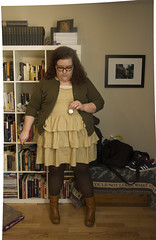
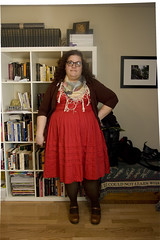
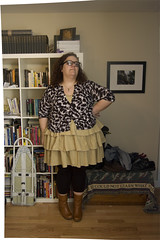
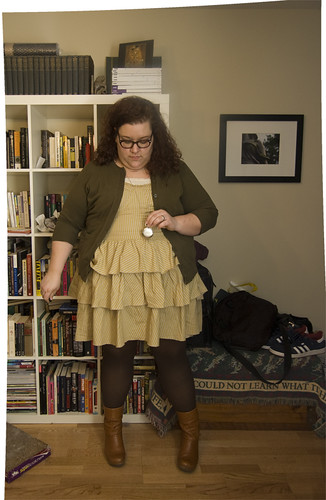
dark green cardi by Jones New York;
brown tights from Avenue (I think);
(long discontinued) boots by Dansko.
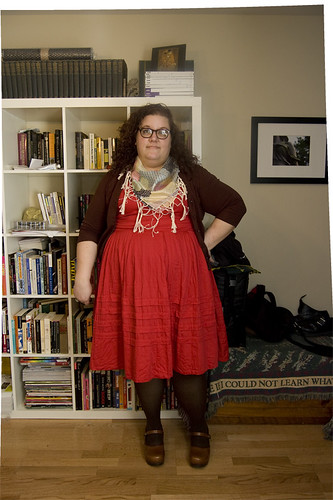
brown cardi is Carole Little, by way of Marshalls;
silk scarf from Target (seriously!);
brown tights from Avenue, I think:
maryjane clogs by Dansko.

black/purple/white leopard-spot cardigan from Marshalls;
leggings are old;
boots are Dansko (and sadly discontinued, since somebody always asks!).
WR47E4ZBMKP2
 Here we have two new Q&As originally from Formspring. The first I answered on the Formspring site earlier this week. The second I’m answering here because I thought it deserved a wordier answer than I like to type into the tiny text-entry box the Formspring site affords me. So:
Q. You exercise and and are a veggie lover – What do you eat that keeps you plump?
Kittens, by the handful. And the souls of Jenny Craig “consultants”, since they don’t need them anymore after taking that job.
No. I’m joking, of course. See, nothing “keeps” me fat. Fat is just what I am.
This morning the local news covered a new study that found that moderate drinking helps women to “maintain” their weight. I noticed, as usual, that the concept of maintaining one’s weight, being slim, and avoiding weight gain were all used interchangeably, but these are not interchangeable concepts. This language implies that fat people must necessarily constantly gaining weight, that it is impossible for a fat person to reach a certain weight or size and just settle there. It creates a perception that all fat people must be recently fat, or getting fatter by the minute. The idea is that fat bodies are utterly out of control and wildly accumulating weight at all times.
This is, to put it scientifically, total bullshit. I’ve “maintained” my current weight for a decade. I get no fatter, I get no thinner. I go to the gym, I eat foods that folks who place moral values on such things would think of as positively virtuous. If I didn’t do these things — and there have been periods in my life when I didn’t — my weight still stays the same. It simply doesn’t change.
There is no thin version of me. There never has been. At my slimmest in my adult life (reached as a result of a period of depression and a total lack of self-care during my twentieth year), I still wore a size 20. This is it, yo. I am a fat person. I cannot conceive of a reality in which I am not a fat person. For me, staying fat does not demand effort or commitment or the eating of some special fat-making food at regular intervals. It just… is.
Q. In all other species, there is a range of normal sizes and body fat %, and if an animal is very much outside this range for its species it is an indication that something is wrong. Why do you think humans are the exception?
This is one of those questions that, for me, falls under the logical fallacy known as the appeal to nature. Broken down, the idea is that if something is deemed “unnatural” then it must be bad. I have a few criticisms of this approach. For one, “nature” itself is a culturally-constructed concept. Once you get past the obvious examples of trees and bunnies, what counts as nature? Who decides? Often “nature” is employed to distinguish things that are untainted by human efforts, but that sets up humans as somehow anti-nature, which seems counterintuitive. Are we not ourselves every bit as natural as the trees? Or is it only the objects and circumstances we create that are deemed unnatural?
More than that, “nature” is frequently deployed as a code word for “normal”, and used in this way, it places a value judgment on things that are unnatural/abnormal. For example, opponents of gay marriage (or gayness in general) will often argue that gay sex is “unnatural”, meaning abnormal, meaning something that ought not to be allowed to take place in the established order of things. You’ll note that this carries a very different weight than simply saying “gay sex is icky” or even “gay sex offends me” — calling it “unnatural” makes a global proclamation against the behavior based on some invented “natural order” that is defied by the existence of said behavior. Instead of merely being about personal opinion, this places it in a framework of perceived universal norms of existence.
This question also reminds me of an aspect of the “but isn’t it hard for fat people to run?” question from earlier that I neglected to identify, in my efforts at answering it thoughtfully. Specifically, my question is: how easy is it for anyone, of any size, to run, comparatively speaking? And when was the last time you really had to run, not simply to catch a bus or to beat the rain to your front porch, but in a life and death situation? I’d argue that for most of us living in technologically-advanced nations in the 21st century, running has become a bit of a luxury. Today, as a species, we no longer have to worry about outpacing a wooly mammoth, and I think that’s probably not a state of affairs any of us are eager to return to. It’s something we pay money for the privilege of doing in a gym during the winter; something we perform on a machine meant to simulate the ground we’d cover. Running is something we make time to do, not out of necessity nor as a matter of survival. I can infer from the question an unspoken suggestion that running is somehow of greater intrinsic or evolutionary value than… not running? Reading a book? Some other sedentary activity?
Speaking more directly to the question posed above: humans would be the exception in this scenario for the plain and simple reason that our lives are more complicated than those of non-human animals. Let’s say some random antelope, one in a herd of a hundred hanging out somewhere in Africa, gets very fat. How would an antelope accomplish this task? He gets his nutrition from the grass he eats. He gets his exercise by running like hell to escape lions, which is as good a motivation for exercise as I think anyone can get. His life is pretty straightforward, and is probably very nearly identical to the rest of the antelopes in his herd. If this one antelope gets fat, while the rest of his herd remains normal-sized, you’d have to assume it was likely the result of some biological problem unique to the individual antelope.
Now, let’s look at humans. Humans don’t travel in herds like the antelope, nor do we run everywhere; some of us walk to work, some take the bus. Some drive. Some take a train. Some do a combination of these. We interact with lots and lots of different other humans throughout the day, as opposed to the antelope, who mostly just sees the same other antelopes in his herd. Like the antelope, some of us work outdoors, and regularly use large muscle groups; but some work indoors, and spend hours and hours sitting almost immobile at a desk. Some of us bring our lunch from home; some go out. Some have steaks and martinis, some eat vegan, some Thai. Some go to McDonald’s. So far as I know, not many go out and graze on the grass for every meal. Some of us go to a gym for exercise, which antelopes do not; some of us go home and watch American Idol, which antelopes do not; and some of us watch American Idol while at the gym, which may well happen with cartoon antelopes in The New Yorker, but not in real life. We travel long distances, even across continents, frequently. We survive diseases and injuries that would have turned an antelope into lunch for the next lion that happened along.
We are very different from antelopes. Our lives are far more complex and diverse. The idea that fatness is a biological or evolutionary disadvantage is based on an assumption that the skills and strengths that enabled our ancestors to collaboratively stalk and kill wooly mammoths are equally as important to modern-day success in life, and this, frankly, just isn’t the case. Truth is, any collection of modern-day people would find reproducing an impressive mammoth-takedown hard going, as we (those of us living in places where blogs and reliable electricity are normal ways of life, anyway) simply don’t develop and value the same skills today as we did in the time when mammoths kept us alive.
The above is a bit of a tangent, but my broader point is that you can’t compare modern-day technologically-advanced humans with animals, because our environments and activities are so very different. The last time I attempted to answer the question of whether fat is “natural”, it came down to me asserting that fat people aren’t jaguars, which continues to be true. If you will forgive me for being so narcissistic as to quote myself:
The nature argument is sort of a pointless one to me; essentially it’s just using a very old ideology of Western culture, one that equates nature with pureness and virtue and truth, to try to validate or invalidate fatness. I remember years back, when Kirstie Alley was doing Fat Actress, she made a comment in some magazine arguing that you don’t see fat animals in the natural world. The quote went something like: You never see a fat jaguar in the wild. […] There are lots of animals – elephants and hippos spring to mind, both of which will mightily kick your ass and/or kill you really, really dead if so inclined – that “naturally†incline toward shapes that visually evoke fatness, at least when compared with a jaguar. Was Alley’s point that humans should be more like jaguars than elephants? I don’t even know where to begin with how random and nonsensical the whole idea is. Humans are humans. Elephants are elephants. Jaguars are jaguars. Never the twain shall meet.
…[A]t the end of the day, I don’t really care if this is my natural state, or the state I was destined to have at birth, or the state I’ve created through childhood decisions and past disordered eating… or not. There may be folks out there who worry about whether they’re existing as nature intended; I am not one of them. This is my body, right now, and after years of battling with self-hatred and self-doubt, I am truly, wholeheartedly, happy and satisfied with it. For those who feel differently, I don’t dismiss or belittle your discomfort or worries – in fact I sincerely hope you can work that out in some manner that enables you to feel similarly happy and satisfied with yourself.
My feelings on this haven’t changed one jot. Because I don’t have to justify myself, or my right to live in my body how I see fit, to anyone. Neither do you. Is your body “natural” or “unnatural”? Who the hell cares? You’ll never know; not everyone will agree. And you still have to navigate this world. Why not focus on living your life today, without worrying about the semantics? As we are instructed by that great example of American filmmaking and font of boundless wisdom which I cited in my prior post on this subject: Whatever will be, will be.
I walked into a commonly-loathed fatshion store and tried on the 2 bras offered to me. They came in black and beige with polyester all over. Struggling to squish my tits into one, then the other cup was like playing chicken with the fat kid on top. It just so happened that of the two options available to me, only one option fit somewhat acceptable and so I walked out with a beige monstrosity big enough to fit on a toddler’s head.
I have been fighting with the bra industry for acceptable support since I started developing torpedo tits in the fourth grade. Back then it was ‘fuck it I’ll wear a t-shirt” and the occasional check-in from a classmate. Ever had an older kid try to snap a bra strap you didn’t have? It’s actually more embarrassing than later when I got snapped by an actual bra strap on my back. Granted this is steeped in misogyny and gender expectations that are screwed up and worthless as-is, I still felt the pressure to holster up and get my tits further up my body than gravity allowed.
By high school I was what I thought to be a DDD cup. This lasted through several bouts of anorexia and bulimia causing my front end to topple over my wasting bottom end more than once. I had an aching back, an aching butt, an aching body. Then I gained weight and everything balanced out. I went to college, went to my professional life, bought some femme attire and started hunting for a good bra fitting that told me how to properly hoist the flab in front to make me look like Wonder Woman. That’s when I found out I was a 42 F/G/H depending on the brand.
Cool.
Damn.
I’m fucking huge, no? Then I found out lots of boob-toting folk have some crazy alphabet number on their body. Except the bra industry says SUCK IT and gives us A-DDD. Except Lane Bryant who says here, have 2 options in F-H. Not sufficient I say, not sufficient. So I had a low point. I hit bottom. I wanted pretty.
I talked to a boob surgeon.
I called my insurance company and found out I could reduce my tits for almost no monies. Cool! Smaller tits equal better fitting garments! Equal cuter bras! Equal cheaper bras? Equal cuter bras! Oh yeah also maybe less pain, that’s why insurance would cough up cold hard cash. I mean they don’t really care how my wrap dress fits or whether or not this bra has flowers vs the beige terror. So I scheduled an appointment with a plastic (?) surgeon for the start of 2010 and began doing some research.
OH MY GOD YOU GUYS SO MANY PEOPLE CHOP THEIR BOOBS UP. After posting on Facebook about whether I should chop or not, 22 people responded with “DO IT” and 1 person said “bad idea.” TWENTY TWO PEOPLE – I never get that many comments to my inane FB ramblings and queries. Most said cuter bras/less pain for the win! and some said better fitting garments. Most all said it was the best idea ever.
I never made it to my boob doc appointment. Not only did I not want to cough up $25 to talk about my tits, I started thinking about fat acceptance. Granted most of my personal thoughts could be harvested for a whole new exciting post, I still thought I’d share a few here. Maybe increase discussion. Maybe talk more about boobs. I mean I love boobs.
Wikipedia tells me that in 2005 over 113,000 women had breast reduction surgery. It also tells me that the most common candidate has gigantomastia – super huge boobs. That name alone makes me giggle – of COURSE they’re gigantic! Who came up with that name, baby cousin #2? It also links me to websites on candidate before/after pictures. I scrolled those pictures. I squinted at the bodies and boob sizes. I ooh’d and aaaah’d at the amazing! post-op! results!
But in the end I noticed that not a fat body was found among the post-op pictures. I didn’t know what the boob re-scale would do to my currently proportionate shape. I didn’t get a clear answer in the phone consult or via my primary care doctor on whether reducing the fat in my boobs would reduce the pain in my body, or if that was similar to saying I should reduce the fat on my body to reduce the pain in my body. And I’m not a fan of dieting to reduce pain, hasn’t worked for me yet and too often gets used as an excuse for treating fat bodies by fair health standards.
I also didn’t like the way my brain was moving. Is it really ok for me as a fat acceptance and health at every size fatshionista to cut my body up for better bras? Why not cut my stomach up for better shirts, or my thighs up for better pants? It’s all body modification outside of health and doesn’t do a helluva lot to increase my fledgling body acceptance and love. If I’m demanding that the problem isn’t with my body but rather the clothing industry when a dress fails to fit, the same should be true for bras. I just have to dig deeper for cute undergarments and learn to love my tits for what they are – giggle – gigantomastias.
And indeed, I found a polka-dotted bra and I LOVE IT.
 Two Whole Cakes is a blog written by