Yesterday I remarked to my husband: I just realized that this month marks the tenth anniversary of my de-galling, that is, the day I had my gallbladder removed.
I mention this experience here frequently. I hesitate to call it traumatic but it was, in a way, insofar as being an experience I went into with a wide-eyed obliviousness to reality and was subsequently shocked by the truth of things after the fact. It definitely left a mark on me, one with farther-reaching effects than the nearly-invisible laparoscopy scars — a few soft dashes I can feel, still, with my fingertips on my abdomen, but which I can no longer see unless I look very, very closely.
It was a surgery I went into with absolutely no idea of what abdominal surgery — even the laparoscopic kind — involved, aside from the tiny camera on its flexible tube. During an unexpected delay, I lay in the pre-surgery ward for two hours, terrified, wearing only a hospital gown, my resolve melting, my future husband trying to keep me engaged, a nurse having drugged me with something — valium? — that she said would make me feel as though I’d “had a glass of wine”. It did make me drowsy, but my anxiety skyrocketed, adrenaline surging, realizing if I had to fight my way out of the hospital (I might!) then it would be all the more difficult to do with this slow muck in my veins. (When she came around a second time, I declined.) Eventually I had to go to the bathroom, and there I was, a freeze-frame from a million sitcoms, wobbling unsteadily down a corridor, carrying my IV bag in one hand and with my bare-ass behind, nonplussed by the open-backed robe, swinging in the sterile air.
My future husband helped me, but stopped at the bathroom door to give me some privacy (ironic, that). I did my business, and when I rose to flush I realized I’d been holding the IV bag too low, and my blood had backed up into the long and narrow connecting tube, turning it from clear and antiseptic to red-black and ominous. I nearly lost my bearings then, seeing my blood backing up into that IV bag. I opened the door and told D, “I messed it up,” or something, and showed him the tube and the blood creeping slowly upward, threatening to contaminate the saline solution in the bag at its end. He hefted it high enough, and my blood came back in (recess is over, blood!), and he walked me back to the hospital bed where I would wait some more.
There was a point, minutes before they brought me in for the surgery, that I could not manage my fear and rage anymore, and I cried. I said, “Why can’t they just get on with it?”
The anesthesiologist, whom I’d met a few days before and whom I’d made a little uncomfortable with my probing questions about the state of my brain during the anesthesia (”Like, how close to dead will I be?”), had told me at our meeting that once I was put under, there’d be no time, no awareness. I’d had tubes in my ears twice as a kid, and I remembered the vivid dreams I had during those minor procedures. But no, with this sort of anesthesia there’d be none of that. He said, “It will feel as though you’ve just closed your eyes, and then opened them again.”
They wheeled me down the hall to the operating room, which was high-ceilinged, very white, brightly lit, and monumentally terrifying. The anesthesiologist I’d met with before was not the anesthesiologist who was here now; evidently the delay had resulted in some changes. The man’s face is a literal blank, in my memory, as are the faces of everyone in the operating room, though he was friendly and kind-voiced. Things seemed to go very fast, and I felt very slow. The mask came down; it wasn’t secure and I tried to tell him, “It’s not…”
I closed my eyes.
I opened my eyes.
Well, except I didn’t. I wanted to open them but couldn’t; they were taped shut. My eyes rolled fruitlessly against my lids, and I could hear the room, and had an odd sensory awareness of the space, but I could not move anything else. I spiked into a terrible panic and immediately heard multiple voices telling me to calm down. It’s just the anesthesia. I couldn’t listen; clearly they didn’t understand that I couldn’t fucking move and if anything was worth panicking over, that was. But then, all at once, I could feel my muscles again. Okay.
It was only after they’d wheeled me out of the operating room that I realized the surgery must be over.
In recovery, they brought me ice, and a giant white elastic band, at least ten inches wide, to wrap around and compress my midsection. It was too small, but the nurse heaved and pulled — me apologizing groggily as she did so, for my girth? my inability to assist? — and managed to secure it. Velcro. Another nurse came by and noted that it seemed to be too small. I murmured, “I doubt I am the fattest person ever to have my gallbladder removed.” They said they’d find me a larger one, but they never came back.
My throat hurt; someone mentioned that was because of the tube. Why did they put a tube in my throat, I wondered. I was beginning to grasp that my body had gone on some strange adventure without me. My brain choked off. My voice eclipsed by a tube. A heap of meat on an operating table, one in an assembly-line of common surgeries.
I’d begun to look at fat acceptance four years prior to this. It’s a long process, and if it’s not a long process then you may be doing it wrong, or else you just may not realize when it began. I had stopped trying to lose weight; I had come to love myself, uneasily, and to live in a truce with my body, if not in contentment or pleasure.
These things had happened to my body and I wasn’t there. It was as though the whole of my history of body-hatred and self-punishment rose up on me like a towering black monolith, all at once, and I practically saw through time to realize the immensity of the damage I’d done, the disdain I’d held for myself, my body, my health, during my years of self-induced deprivation.
I thought, Fuck: what did I do all that for? Why did I work so hard to beat up the awesome vessel that brings me to the world?
My surgery was straightforward and complication-free. I had expected, hilariously in retrospect, that this was a true outpatient situation. That I’d have the surgery and a few hours later would go home. I don’t know why I believed this. I don’t know why no one corrected me beforehand. I was never told anything, in advance or after, about what to expect.
I was lucky; they found me a room relatively quickly, and I was out of recovery and into a room with some other woman whose face I never saw. A bathroom separated our little alcoves. Once settled, I was overwhelmed with a desire to put on some underpants. I could think of nothing else. A nurse came in; I asked her if I was allowed to use the bathroom, as a ruse to achieve my true purpose. She said oh, I’ll bring you a pan for that. WHAT. I said. Of course immediately I really did have to go to the bathroom. The nurse forgot to bring me the pee-pot anyway.
Shortly thereafter the shift changed, and another nurse came by and introduced herself. In spite of my efforts to seem casual about it, I burst out in a hail of barely-restrained tears, “Can I use the bathroom?” Of course, she said. I nearly wept with gratitude. “Can I also put on some underwear?” Yes, she said. I momentarily imagined her an underpants-bearing angel. I wobbled into the bathroom, peed, put on my underwear. I felt slightly more human, slightly less meat-like. Overnight I would face gruesome pain as the anesthesia wore off, but my pain tolerance is legendary and I knew that all I must do is hang on til morning. I watched television. When it got so late that nothing was on, I read I Know Why the Caged Bird Sings for the first time, straight through, and when I finally nodded into light sleep I dreamed of my gallbladder sprouting wings and taking flight from the cage of my body.
In the morning, my surgeon came round to check on me and his expression upon seeing me standing beside the bed was one of astonishment. “You’re up,” he said. I was perplexed and annoyed. “Am I not supposed to be up?” I asked. I felt insulted. Of course I was up. I had made a full pass of the corridor outside my room in the hours before he showed up. I thought, why the hell wouldn’t I be up? This is an outpatient procedure. I should leave now. Around 10:30 that morning, 24 hours after I’d arrived, I was sent home to convalesce for a full week, which I did with all the patience and care that you might expect — that is, none at all.
Even at the time I was confused by my apparent need to exorcise my gallbladder. The only correlating risk factor I had was my fat. I was young, and gallbladder problems requiring surgery are quite rare in those under 60. I was a strict vegetarian and had been for several years, and vegetarians virtually never get gallstones (fiber is an enemy of gallstones, and the typical vegetarian diet is fiber-heavy; also, diets high in animal fat and cholesterol are gallstone-friendly, and vegetarians don’t consume animal-based foods, period). The only risk factor I had was a history of dramatic weight cycling, in which I would lose and regain weight repeatedly.
Again: I thought, Fuck: what did I do all that for? Why did I work so hard to beat up the awesome vessel that brings me to the world?
I still feel sad for my gallbladder, a Lost Boy forever wandering the bodily-organ version of Neverland, maybe hand-in-hand (duct-in-duct?) with the other innocent gallbladders parted from their abdominal homes too soon. I never meant to hurt myself so badly; at the time I thought of my compulsive crash diets as open-handed slaps to my hated fatness, not the kind of deep trauma that could ever result in long-term damage. I made mistakes. I suffered the consequences.
More than that, however, I emerged from this experience more ferociously in favor of body acceptance and self-love than ever before. I felt, vividly, the importance of owning one’s body and living in it fully, and realized that all the abuse we heap upon ourselves does take a toll, be it emotional or physical. I came to understand for the first time ever the importance of being healthy, and I don’t mean the universalizing and troubling concept of “healthy” our culture currently prefers, but the kind of healthy that encourages and cultivates a knowledge and awareness of your unique body, and what it can be reasonably asked to do, and to never feel shame if your body does not operate by the same parameters of someone else’s body. I’m talking about a “healthy” that is rooted in self-determination and individual autonomy, and is thus equally applicable along a spectrum of bodies, including professional athletes, cancer survivors, gym rats, the doctor-phobic, the poor, you joggers, and folks with a limited supply of spoons in equal measures — a healthy that excludes no one and that is specific and relative to the individual.
All of this is why I reflect so often on my gallbladder: because it changed me, and made me a fiercer and louder proponent of fat acceptance, indeed, it made me the activist I am today. And because sometimes we need to lose something in order to appreciate what we have.
It’s been a light week around here, I know. I have this cold-that-is-not-quite-a-cold and much of my normal internets-reading time has been spent researching information on podcasting stuff. So instead of my own words, here are some words from a couple of other, funnier people than I.
CNN interviewed Sarah Silverman, and among other things, asked the famously-offensive comedian if there are any jokes she herself finds offensive.
“I don’t really care for like fat jokes about women, specifically,” [Silverman] said.
“Because I feel that we live in a society where fat men deserve love, and fat women do not deserve love — at least in white America. And so I feel like that’s an ugly thing, and it doesn’t make me laugh.”
How about that? I have often said that I don’t have a problem with fat jokes, so long as they are actually funny — it’s just that so few of them are. Head over to CNN to watch the whole interview.
Secondly, the following comes from Joan Rivers, of all people:
I admire so many people. I guess the children who work in my basement making jewelry. I admire them tremendously! [Laughs] Aretha Franklin – because she’s fat and she doesn’t care. I think it’s great. I spend my life dieting, and I love to see a heavy woman saying, “This is who I am†… and is proud to buy two seats on an airplane. I hate to get on airplanes: You gotta put a seatbelt on, and obviously Victoria Beckham was sitting there right before you and you have to let it out.
Sure, this is partly her acerbic humor, but given Rivers’ deprecation of her looks elsewhere in the interview, I’m inclined to think there may be an element of truth to it — or else I am simply too optimistic and lacking in cynicism, but I’ll take that too. Hat tip to Jezebel for pointing this out, as I never would have read an interview with Joan Rivers otherwise.
Finally, there will be a new Fatcast this weekend. Huge thanks to everyone who’s been listening and subscribing, we’re having great fun with it and we’re glad it shows.
Miscellany: A new podcast (already); weight loss not a game-changer; and I cannot stop watching this video.
By Lesley | April 28, 2010
Marianne and I made another mini podcast last night on the idea of the “Fatosphere”. (Also, “scare quotes”.) You can either listen or download via the web; or if you haven’t already, you can subscribe via iTunes.
In it, we failed to say thank you for the tremendous offering of kudos and support from y’all, so: thank you. We’re both overwhelmed by the response. Already. We are digging this new media like whoa, so it’s wonderful to get such positive feedback (though we are open to constructive criticism as well).
Elsewhere, MSNBC has run an article on post-weight-loss “disappointment”, essentially noting that often folks lose a great deal of weight only to discover that all the things they disliked about themselves and their lives are still the same. I know I’ve said it a thousand times at least: if you don’t like yourself as a fat person, you won’t like yourself as a thin person either. Says the article:
“People expect a lot from weight loss, things that weight loss alone can’t deliver,†says [Lee Kern, clinical director for Structure House, a residential weight loss facility in Durham, N.C.] “People think it just isn’t worth it and relapse all the way back.†And then they learn “the hard way†that success and happiness aren’t linked to a number on a scale, he says.
Hmm. I do wonder where folks might pick up these unrealistic expectations. Could it be from listening to the kind of doctors who use the word “relapse”, a word generally applied to drug abuse or illnesses like cancer, to describe weight gain? Or could it be from a culture that promotes life in a fat body as a horror not worth living, and life in a thin body as a constant superlative pleasure? Shit, culture LIES? I don’t know anything anymore.
Two of the names in the article are familiar to me, though I’ve only pinned down one: Jeannette Fulda wrote a book that I read a review of and which led me to write the sentence, Weight loss don’t put gallbladders back in the abdomen, y’all, right here in this blog two years ago.
Says Fulda:
…Although she believed she was realistic about what weight loss could and couldn’t do for her, Fulda thought a “leaner bod†meant no more health woes, which “just goes to show that being thin doesn’t guarantee perfect health,†she says.
And she is surprised that despite her monumental weight loss she still has what she calls a “skewed†relationship with food.
“I eat when I’m bored, when I’m sad, and that’s not something that went away with being less heavy,†she says. “I guess we all really think that losing weight gets rid of our issues. But in so many ways we’re still the very same person, not that skinny woman we dreamed about.â€
I know, right? Thin people are not smarter, happier, more successful, more confident, more secure in their bodies than you are. It’s unfortunate that many of us have to put ourselves through hell in order to learn this, but that just underscores the ubiquity of the message. The standard “but of course being fat will cause you to DIE DIE DIE!” rhetoric aside, the article is an interesting read, so check it out if you haven’t already.
Finally, to end on a high note: there is this video. I’ve been watching daily it for weeks. I think the artist has the potential to reach Gagaesque levels of amazingness, and coming from me that is high praise indeed. I can’t get it out of my head. And so I infect you all with it, on the off chance that some of you may not have seen it yet.
Right on.
It’s Alive: We join our intrepid heroes as they venture cautiously into the world of podcasting.
By Lesley | April 26, 2010
 So Marianne, who likes to be fat over at The Rotund, and I have many conversations that result in many ideas, more ideas than we have time to follow through on, unfortunately. Among them is Marianne’s suggestion awhile back that she and I do some kind of video-based fat-conversatin’ adventure. We both did research on how to make this happen, and came up with a bunch of complicated limitations. So last week I suggested, hey, why don’t we just do this as an audio-only podcast? I’ve always wanted a podcast!
And Marianne said, Yeah! I’ve always wanted a podcast too!
Somehow the stars aligned and on the past Saturday morning, we managed to make it happen. We’re tenatively calling it The Two Whole Cakes Fatcast and our first episode, Exposure!, which deals with the perils of public fattery, is live now. It’s still pending in the iTunes store but until it gets approved you can download (or listen to it) here. If you’d rather grab an RSS feed, you can find that here. EDIT: And now Fatcast is up in the iTunes store, so you can subscribe there as well, if you’re up for that level of commitment.
I expect that the sound quality will improve as I learn to use Soundbooth more fully. The podcast above represents my first time ever doing anything in Soundbooth, and thus I’m allowing myself to feel rather proud of it, even though there’s plenty of room for improvement.
We have many subjects we want to discuss in upcoming episodes, and your support and feedback is definitely appreciated. Thank you, dear fats, for listening.
 Last week, Roger Ebert, who is possibly the smartest guy in America, made a blog post extrapolating on a statement he once made that video games “can never be art”. He was moved to do so because a reader had pointed him at an unfortunate TED Talk on the subject. If, unlike me, you do not harbor starry-eyed dreams of actually being Roger Ebert when you grow up such that you scour his blog regularly for tips on making this happen, you can find the original post here. Also: you should read his blog regularly, okay?
[Speaking of blogs you should read regularly, my husband has also weighed in on this on Bitmob. His new-ish blog deals exclusively with video games, so if you dig critical writing about gaming, do check it out.]
Also last week, while Ebert was tangling with the gaming public, I had the rare good fortune to be in the right place at the right time to check out the Cory Arcangel exhibition at the North Miami Museum of Contemporary Art, and this has kept the subject on my mind. Cory Arcangel is an artist who uses video games in his work, but their use is as dependent on their corruption as it is on their original forms; the art is interesting because the components are familiar, while Arcangel’s use of them is unexpected. (For example, the stranded Mario pictured above is a still from his mind-bending Super Mario Movie.) Arguably, this could make his work a teense inaccessible to people without the proper context, but as someone who gets the backstory, I enjoyed it.
Now, you and I can pick over the various established definitions of “art” all day long, and Ebert spends a good portion of his post doing exactly that. For the purposes of this post, all I require is your agreement that, however else it may be designated, art inspires an emotional response from the people who view or otherwise consume it. Sure, this is as true of bad art as it is of good art. And the emotional response may be positive, negative, or ambivalent. But even if this isn’t part of a formal definition of art, it’s certainly a part of how art operates in human lives. What kind of response we expect, or enjoy, is unique to the individual, however I think we can agree that whatever interest we have in art stems from a desire to be moved.
My favorite art tends to affect my perception of reality, and to enable me to lose myself, however briefly, in the work. With film, this is somewhat of a given; films are supposed to draw us into their worlds. Indeed, the source of most of my disgust with Avatar was its failure to capture my full attention and prevent me from checking my watch every fifteen minutes. (I am quite aware I’m in the minority there.) Confronted with more static visual art, the challenge is greater, but works ranging from John White Alexander’s Isabella and the Pot of Basil to, unexpectedly, Damien Hirst’s Away from the Flock have in equal measures managed to elicit this response from me. The art I enjoy tends to be diverse; my requirements are that it shakes me up, makes me think, and/or engages my imagination.
Back in 2008 I saw an installation by Luisa Rabbia, who at the time was serving a residency at the Isabella Stewart Gardner Museum here in Boston. The installation, Travels with Isabella, Travel Scrapbooks 1883/2008, consisted of a collage of altered vintage photographs from the Gardner collection, embellished with animations by the artist, added music, and displayed as a film of these interconnected images scrolling continuously from right to left. I found the experience rapturously hypnotic and I completely lost myself in it. So much that I went back twice to see it again.
It was only after the exhibition had closed that I figured out why.
This two-dimensional, side-scrolling work was eerily reminiscent of the 8-bit video games of my (misspent?) youth, and though this may have been far from the intention of the artist, my response was rooted in my distant memories of feeling similarly hypnotized by controlling the actions of a frantically leaping plumber on a small TV screen. The unflagging progression of new visual worlds appearing from the right side of the screen, more spaces and environments to see and understand and navigate was similarly intoxicating. Even though I am aware of the brain’s in-built response to this sort of camera movement, regardless of medium, all I could associate it with was Super Mario Brothers. Whether I like it or not, my perception of media as an adult is inextricably infused with my early experiences of playing video games.
In my lifetime, the ubiquitous image of the blank-faced youth staring open-mouthed at a screen with game controller in hand has taken on significance as the inevitable downfall of civilization… or at least the corruption and stupifying of our future. Funnily enough, take away the controller and this is probably how my face looks when I am absorbed in a piece of art. When we experience good art — be it a painting, a song, a film, a dance, a book — we can lose ourselves in it. There is nothing else, in that moment, except the art, and our experience of it. Now, Vermeer’s Girl with a Pearl Earring or Fellini’s 8 1/2 may be considered art partly because they have reliably demonstrated their ability to elicit an emotional response in many people, and there is some cultural agreement that yes, these things count. But art is not the brushstrokes on a canvas, nor the flickering of light through celluloid. Art is more than the sum of these parts; something happens between the work’s production and its consumption that makes it wonderful. Arguably, that thing doesn’t happen via some magical intervention from without. Rather, it happens in the mind of the viewer.
Says Ebert:
I repeat: “No one in or out of the field has ever been able to cite a game worthy of comparison with the great poets, filmmakers, novelists and poets.”
He’s not wrong. It’s difficult to make a case that an individual game, by itself, can legitimately be called art even by the most forgiving definition, partly because we lack the established critical language and conversation about gaming that we have for things like film and music. But the gamers defending their media have a point as well, because a video game played by an engaged and invested individual can certainly evoke similarly-powerful emotional responses as experiencing art can. Ebert’s post set off a flurry of defensive posturing in the robust gameblogging community (even eliciting a response from Kellee Santiago, the TED-talker who inspired his post), and though I freely admit I have read very little besides Ebert’s original post and one or two other responses, it seems much of it condemns of Ebert’s qualifications to determine the art-worthiness of a medium he has admitted he does not consume. Gamers rebel against Ebert’s declaration because being told video games cannot be art would seem to invalidate the mammoth emotional import of their unique experiences of gaming. Those who assert that Ebert’s inability to understand the “art” in video gaming stems from his lack of game experience are right, though it’s not simply a matter of showing Ebert the “right” game to change his mind. A game has to be experienced; it can’t be demonstrated at a distance. Compare seeing Bob Ross painting happy trees on PBS and seeing the otherworldly reproduction of light in a Rembrandt in person.
Truth is, a great many contemporary video games borrow heavily from the conventions of filmmaking. The critical difference is that film is a passive experience: the audience simply sits and consumes whatever the filmmakers are communicating. Video games, on the other hand, are necessarily interactive. Without this interaction, games have no impact at all. Thus Ebert sees Kellee Santiago displaying random static screenshots from various games, and he continues to be unmoved. As well he should. Being shown a picture and told what a game is about is no substitute for actually playing it; the thrust of the media is entirely lost. Is listening to someone recap the plot of Citizen Kane a fair approximation of actually watching the film? Hell no. Ebert isn’t just being obstinate here; Santiago has utterly failed to make her case in way that is accessible at all to people who aren’t already singing in her choir.
That said, the euphoria, heartbreak, terror, and sadness that can imparted by gaming are not limited to games that mimic film. Last month, as anyone who follows me on Twitter is probably aware, I spent a weekend with over 50,000 other geeks at the inaugural PAX East, a unique gaming convention that focuses not on the business and industry and profitability of producing games — something Kellee Santiago spends far too much time on — but on the gamers themselves, and the social community of gaming. One of the attractions was a “lounge” in which people could form groups to play Rock Band, a game involving the use of controllers shaped like musical instruments, in a nightclub-like environment. I spent quite a bit of time hanging out in this lounge; frankly, the extreme postmodern implications of being in a fake nightclub where fake musicians played fake instruments as part of a video game was damned irresistible. At one point, a cluster of young men took the stage, nerdy and socially-awkward even by the loose standards one finds at such a convention. They shuffled to their places, all four primarily concerned with staring at their shoes. When the song began, however, they were changed; no sooner did the first notes hit the air than these kids became jumping, preening, shouting rock stars. I was gobsmacked. The joy, the passion, the energy of those kids — somehow, it only came to the surface as a result of the game.
Ebert asks:
Why are gamers so intensely concerned, anyway, that games be defined as art?… Why aren’t gamers content to play their games and simply enjoy themselves?
Art also has the power to be transformative. When gamers argue that games they play are art, they are really arguing that games are intense, legitimate, emotional pieces of media; they are stories and experiences that have affected them, and that their lives are improved for having played. Legitimacy, for better or worse, is part of our mainstream cultural understanding of what constitutes art, and denying the art in a media can sound as though one is denouncing its value. Those who would defend the art of video games could argue these media are, as in the painted canvas or printed page, more than the sum of their parts, and it is an individual’s interaction with those parts that makes a game like an experience of art. They have a personal stake; the “art” they’re protecting belongs to them, as much as it does to the game, even as the game is privileged over their own contribution. They are not passively consuming this media; they are creating it, every moment they play. The games themselves are a factor, but do not need to be “art” in order to have substance. In debating whether video games are themselves art, we’re overlooking the possibility that video games may have the potential turn their players into artists, and I suspect that is where their greatest value lies.

Hello loves! I am extraordinarily pleased to announce that I have an article up on Newsweek.com today. For serious! It’s a heavily-edited version of the childhood obesity post of a few weeks ago, which elicited such a powerful response from so many of you. I owe a huge debt of gratitude to Kate Dailey, articles editor at Newsweek.com, who was willing to take this issue on and give it some crazy nationwide exposure.
Earlier this morning, I skimmed through the comments over there, and many of them seem to be repeating the same predictable choruses. I’ve no plans to read them in greater detail because, frankly, reading harsh and vicious things total strangers have said about me is kind of a bummer, and I dislike being bummed. I would much rather people criticize my arguments in a civil and thoughtful way, as I thoroughly dig those conversations, but some folks have to ruin it for everybody by Making It Personal, as though I, individually, am the Official Representative of all fat people everywhere.
My being an unapologetic fatty makes some people angry, y’all. It’s an unseemly kind of anger, not unlike folks who get all enraged about gay people getting married, or about electoral politics. It’s the anger of people who really can’t even articulate why they’re angry, because they are so very angry. And I believe in giving people their anger-space. I’m not keen on people exorcising their anger upon me personally, as I think in this case it’s misguided and unproductive, but anger is a valid emotion and one that’s better expressed than suppressed. I’ve got anger too! And I have far less of it today than I once did, so I understand the angry people, to some extent. I can even sympathize.
Thus, in the interest of clarifying some things, here’s a little round-up of typical angry reactions to my suggestion that being fat is possibly not the end of the world, and my own thoughts on each.
1. You’re using up all the healthcare! Ironically, the only time in my life I’ve been hospitalized was when I had my gallbladder out at 23, and my need to have my gallbladder removed was a result of repeated episodes of dramatic diet-induced weight loss. This is a known cause of gallbladder problems in people under 40. Seriously, google it. Aside from that, I go to the doctor for an annual physical and pelvic exam, and have the occasional office visit. I do this because that’s what healthcare is for. I’ve talked more in-depth about the broader implications of the OH GOD WON’T SOMEBODY THINK OF THE HEALTHCARE issue awhile back and that’ll have to serve.
2. You’re a liar! This actually came up when the Newsweek piece was being edited: it was suggested that, in an effort to head off accusations of my pants being on fire, I include some hard examples of Things About My Health That Are Healthy. I nixed it for a few reasons, and the editors at Newsweek have my gratitude for not fighting me on that. First: health is private, kids. It’s all well and good for those of us with immaculate numbers to rattle them off as “evidence”, but I’d rather folks assume I’m right at this moment experiencing Death By Fat than reinforce the popular notion that anyone is entitled to private information about a stranger’s health. Second: whether or not I personally meet your arbitrary standards has nothing to do with my argument that regardless of their health, fat people (of all ages!) should be treated with basic human dignity and respect. You don’t get to be mean to fat people, be they adults or kids, be they sick or well. Third: the folks who call me a liar will not believe anything I say anyway. Why waste time and energy better spent grooming my pet unicorn, Glitterbum?
3. You just eat too much/don’t exercise enough! This is really a corollary to the “liar” comment, but it comes up often enough that it’s worth mentioning. I eat when I am hungry and stop when I’m full, and I probably exercise more than the average person. My weight has been stable for ten years now. When I say “stable” I mean I have neither gained nor lost an appreciable amount of weight at any point in that time. This is the case whether I exercise or don’t; whether I’m eating home-cooked meals of whole foods or eating dinners out. This is the case whether I’m a strict vegetarian or a casual omnivore. This is the case whether I’m spending forty-five minutes on the elliptical five days a week or whether I’m using that time to sit idly on the beach and read a book instead. Now, it’s absolutely true that I feel better overall when I’m home-cooking and exercising, so this is my standard mode of living. But my weight doesn’t change either way. I’m not stating that every single fat person on the planet is just like me. I don’t know every single fat person, and nor do you, so neither of us can say. But it’s certainly been true in my case.
4. It’s impossible to be fat and happy with oneself at the same time! In fact, it’s totally possible. It may not be your experience, but your experience is just one of the millions upon millions of unique experiences spread amongst all the wonderful people in this beautiful world, many of which are utterly foreign to you. And that’s okay! As for me, I’m not looking for your validation; I don’t require it.
5. This is not okay! You don’t get to decide this for anyone but yourself. You do not get to police other people’s bodies. You get to make decisions about your own body. This is called body autonomy. It means you get to rule your individual body, and everybody else gets to rule theirs, and we all get as much privacy on these matters as we want. Privacy is why we have doors on the stalls in public restrooms, folks. It’s a good thing. Trust me, if there’s never yet been a time in your life that you wanted privacy around the internal goings-on of your body, that day will eventually come and you’ll be glad to have it.
6. You’re irresponsible/reprehensible/evil for suggesting that this is ever okay! On the irresponsible/reprehensible tip, we have a difference of opinion. Surely we can agree that we are both tremendously lucky to be living in societies that allow us to have our own opinions about things. So far as being “evil” is concerned, shall I link to my infamous piece on Fat Satan at this point? I believe I shall.
7. You are physically disgusting! Here we venture into the realm of personal aesthetics. I don’t mind if you find me disgusting. I harbor no expectations that I am a universally majestic thing of beauty to all who set eyes upon me. As it turns out, I don’t owe you beauty. Indeed, no one does. And this is a good thing! It’s good because it means you don’t owe anybody beauty either. So many people spend their whole lives in pursuit of an idealized form that they cannot possibly achieve, and this information frees you from that obligation. Now you have unimaginable reserves of energy to put into something that makes you feel good about yourself, instead of the opposite. Take a photography class! Hike the Appalachian Trail! Develop a pitch-perfect karaoke performance of “More Than A Feeling”! Build a scale-model replica of the Sydney Opera House using toothpicks! Whatever tugs at your bobber, friends!
8. Why are you so fat? It was gnomes.
Have I overlooked any?
On the up side — lest I give the impression that it is all bad — I have been positively inundated with wonderful and kind and congratulatory and thankful emails all day long. I’m honestly blown away by the number of folks who’ve taken the time to say thank you, some using few words, some using many. So finally, because I don’t say it enough: my gratitude to every last one of you, all of you who read and comment, and who read and don’t comment, and who link, and all of you who send me emails, the heartbreaking ones and the funny ones and the uplifting ones and even the hateful ones. Thank you all, for giving me props when I do good and for calling me out when I do bad.
Onward!
 I am ever so thrilled to host this outstanding guestblog by Poliana, the ultrarad scooterist pictured on the left (amazing photo by Damon Landry), about a new option in the search for fat-friendly riding gear. It’s nearly enough to make me want a scooter myself, but I live in Metro Boston and would fear for my life. To those of you braver than I! -L
The question of where to find motorcycle and scooter riding gear for plus-sized women has come up more than a few times in the Fatshionista LiveJournal community (click here and here for two examples). Each time, the best solution has been to spring for custom-made gear, which can be prohibitively expensive and time-consuming for the average rider. Very few companies will create custom riding gear — those that do, command a high price. And unless the rider can visit their store, this means e-mailing some measurements and hoping for the best. This process goes something like this: place an order, wait a few weeks, try on the gear (assuming it’s not lost in the mail), send it back for some adjustments, wait a few more weeks for the alterations to be done, and then riding season is over.
Riding gear is sometimes available off the rack in larger sizes for men, but it can be hard to find, especially in extended sizes. As a woman who has been fat all of my life, I of course have purchased clothes in the mens department. I can take ill-fitting street clothes and “make it work” by not zipping a coat over my bust, cuffing up too-long sleeves, or wearing a mens’ shirt as a tunic dress. That’s not the case with riding gear. Because of the position of potentially life-saving armor and panels of abrasion-resistant fabric, good fit is of utmost importance. That being said, women riders of all sizes often make do with mens gear as a last resort. It beats riding with no gear, or even worse, not riding at all.
The few companies that do offer plus-size options for women are notorious for their wonky fit. These jackets are typically based on a mens design, with very little ease given for a woman’s hips and bust. One recent style takes a mens’ jacket and adds corset lacing in order to cinch the waist, with the resulting flare at the top and bottom of the jacket creating room for bust and hip. Another company took their best-selling mens’ jacket and placed stretchy panels in the sides to give the womens’ version some curvature. Believe me when I say these riding jackets are as unattractive as their descriptions.
For too many years, women have paid far too much money for ill-fitting and ugly safety gear. That was then, and this is now. Enter GoGo Gear, the groundbreaking line of stylish safety apparel designed by and specifically for women. GoGo Gear is the first fashionable protective riding apparel for today’s woman on the go. The line comprises cutting-edge, feminine outerwear with robust interior engineering that includes abrasion-resistant fabric, quality CE-approved armor in the back, shoulders and elbows, and highly reflective details.
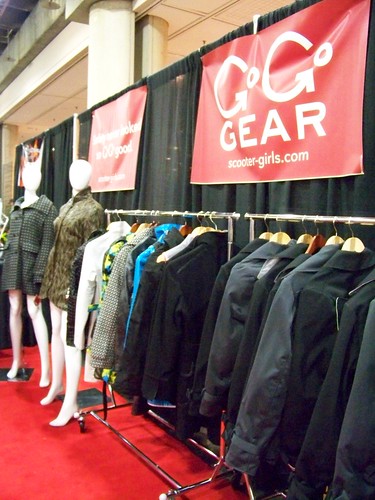
President and CEO Arlene Battishill created the Los Angeles-based company to provide women with chic alternatives to traditional riding gear. She combined her educational and corporate experience to undertake an exhaustive R&D effort, utilizing social media such as Twitter and Facebook soliciting ideas, opinions, and measurements from women riders. I first heard about GoGo Gear via Twitter, and I was very skeptical. I may have only been riding scooters for four years, but I’ve certainly tried on enough poorly-made and even-worse-fitting “plus-size” riding jackets to fill a lifetime. My first Tweet to @LAScooterGirls was something like, “Your jackets sure look cute, but how do they FIT?”
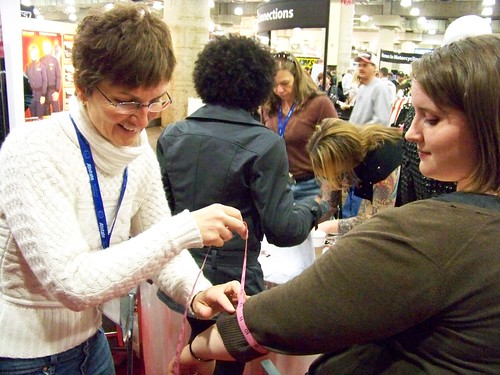
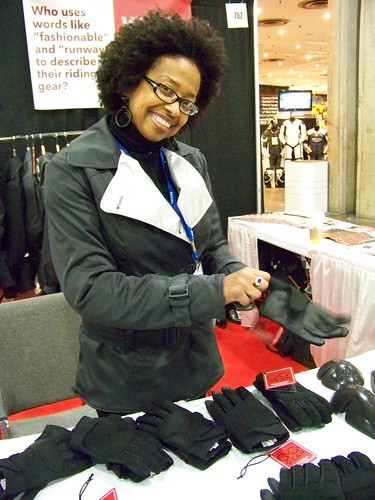
I had the opportunity to check out the goods at the 2010 Cycle World International Motorcycle Show in New York City. Seeing first-hand the attention to detail going into these jackets and coats was a thrill. The fabrics have beautiful hand and feel luxurious and durable. The construction is exacting, and the customizable belts, snaps, and buttons make each garment look tailor-made when worn. I observed women of all sizes trying on the prototypes and was amazed at how the riding armor stayed invisible as they walked around the booth. I honestly think this company is doing something completely revolutionary. Never before have we seen womens’ riding gear designed from the ground up. Thoroughly inspired, I asked Arlene for an interview:
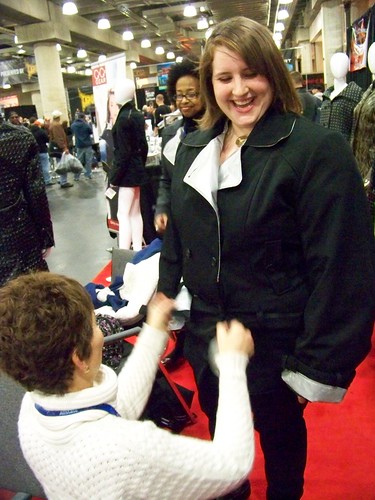
Your standard sizes include petite & plus ranges. Why did you, as a brand-new scooter gear line just starting out, decide to include sizes other than S-M-L?
We started out, day one, with sizing that was petite to plus because that’s how women are made. It is always easier and more cost effective for manufacturers to make garments in S-M-L, but that’s for the convenience and profit of the manufacturer, NOT for the benefit of the consumer. We pride ourselves on the “fit” of our jackets, and we could never offer the S-M-L sizing in our jackets because they wouldn’t look right. Our jackets have a very sleek, refined look to them and you can’t retain that look if you do the generic sizing.
We want to be able to account for the small differences in sizing that are specific to women. Even within the styles and fabrics, there are minor differences in sizing, because we want to be able to have at least one GoGo Gear jacket that will fit a woman perfectly…because if it does, she’s going to feel like a million bucks! I think that a lot of companies happen upon plus sizes as one of those “aha!” moments where they suddenly think that there’s a market to exploit and then they go after that market, a market they’ve ignored for years. For us, we want our customers to know that we’re thinking about them from day one, in ALL sizes and working to come up with designs that we think are most flattering to women in the many sizes we come in.
I always refer to the “little black dress” as the inspiration for our GoGo Gear. Every woman has to have a little black dress in her closet. When she puts on that little black dress, something really special happens to her; she’s transformed, she becomes everything she feels she is! That’s what I want women to feel in our GoGo Gear, to feel like they own the world because the jacket fits perfectly and as a result, they look and feel great!
So many riding gear lines have tried to capture the female market, but have failed because their jackets are cut to fit male riders. What was your process for determining the correct sizes for women riders?
That is the 64 million dollar question! How do you EVER know what the correct size is for any woman! We come in all shapes and sizes. There’s no hard and fast rule for determining the correct sizes for women. In fact, big retail companies have spent millions of dollars on “fit” with respect to their garments and even they don’t know what the correct sizes are. As you can see with most any brand or garment, everyone is a different fit and the important thing for any woman is to just try things on and see how they feel in the garment. The whole thing is a very big process of trial and error.
Many riders equate scooters with the UK Mods of the 1960s, but let’s go one step beyond. Which era of fashion do you look at the most, and why?
I look a lot at the designs from the 1940s through 1960s from the classic couture houses of London and Paris. I think there is something SO elegant about the simplicity of the designs and that’s what’s most appealing to me. The designs from that era, particularly the 40s make me want to cry sometimes because for me, they are just perfect.
Since you’re in Los Angeles, I wonder what you think of today’s Hollywood.
To be honest, I don’t spend a lot of time looking at Hollywood and how women are dressed. I think all too often the celebrities have stylists that go out hunting for obscure designers who make things that will never see the light of day in the stores where we all shop and so the designs are really inaccessible to women who are not part of the Hollywood celebrity club. I also find that having designs that are so expensive so as to make them exclusive (read: unobtainable) is a big turnoff for me. I love designs that make a woman feel like she could see herself in it, that she would feel and look amazing in it AND doesn’t have to break the bank to get herself in that design.
What’s on the horizon for GoGo Gear?
We are currently partnering with an Australian company to produce premium Kevlar jeans which we will be calling the “ultimate date night” jeans! We all know how much we like those sexy stretch denim jeans and to have them be protective as well…it goes without saying, we’ll be ready for that date!
We have several more jacket styles delivering over the next few months. In particular, the ventilated Café jacket will arrive in early May. This is the jacket for women who routinely don’t wear protective gear during the hot weather riding months. It’s abrasion resistant with armor and has side panels that are ventilated from the armpit area to the bottom of the jacket. It has a “mandarin” collar, is very sleek looking and comes in black, red and linen white. The other feature we’re really excited about with this jacket is the French cuffs we put on as a way to provide adjustable sleeves. Many tall women contacted us telling us that their sleeves were never long enough and given that jackets are all pretty much made with the same length sleeve, we used the French cuff as the method to make the sleeve adjustable.
The Racer jacket will follow in late May, early June. It’s our sportiest jacket and is also very sleek. It has curvy reflective stripes on the front and back, gorgeous silver zippers and ventilation in the armpit area. The “Café” and “Racer” jackets are our homage to the “Café Racer” bike!
Once we get to the Fall, we’ll see the much coveted Vintage coat with wool outer layer, a water repellent treatment to the fabric, a zipout liner for windproofing and warmth. The coat provides extra wind protection for the thigh area and has a large collar to create a snug fit around the neck. The reflective details are strategically located so they don’t detract from the look of the coat. This coat will deliver with a classic vintage black and white pattern well as a brown and blue more Mod pattern.
GoGo Gear is out now and available in shops & online: http://scooter-girls.com/

Everything in this story is true.
Well, except for the end. There I had to embellish, as it was written before the story was truly over. The real end was very different from the one I imagined, but then life has a way of surprising you.
And except for the fate of the girl I called Kathy. Kathy is the only character who was not a real person in my life, and I think I wrote her story as a way of imagining how my own path might have taken a morbid turn. Everyone else was real, with names that I changed in sufficiently uncreative ways such that even now, twenty years later and having long since forgotten these events, I can reconnect the characters with their real-life counterparts.
Last week, I visited my mother in South Florida. When we arrived at her condo, I had barely sat down on the couch when she pulled a sheaf of papers from a box. They were from an old dot-matrix printer, the pages still interconnected, the eyelets runnning down both sides still attached. I recognized them immediately, even as I couldn’t recall what they said.
My mom said, “Do you remember this?†and I spent the next two hours rereading this snapshot of my thirteen-year-old self, the memories coming back, terribly unwelcome. I wrote this toward the end of my eighth-grade year, only after I was secure in the knowledge that I was going to a high school where I would never see any of these people again.
I know these experiences shaped me, in spite of having scrubbed them from my memory. This is how I remember it, which is no doubt different from how every other girl in the story remembers it. Some will read it and be horrified; some will read it and know that they had it worse. Nevertheless, this isn’t just my story, the story of an isolated, socially-troubled fat girl. This is the story of every whipping-girl.
Some of the writing is stilted and brazenly influenced by the YA novels I devoured, but I’ll be presenting the full manuscript here, unedited, over the next several weeks. This is a story of the bullying I suffered and the bullying I perpetrated. It begins in 1990. I was thirteen.
—
Seventh Grade
1: Tremors
I didn’t hear the story until a few hours later. Danelle was being pushed out. There was some conflict at lunch, one of those seventh-grade things, and apparently she said something about “going where she was appreciated†and meaning me, in the library. Of course I wasn’t in the library. I just let them think that on days when I’d had as much as I could take of their little clique. I guess, at the time, it was my clique too, at least more than it was Danelle’s. Anyway, letting them think I was being a geek in the library was better than letting them know I was crying in the bathroom again. So Danelle never found me, and I had to guess at what happened from their conversation.
“Do you believe her? She is so stupid!†Beth said. Her best friend Cindy nodded absently, a prisoner of the jewels of popularity.
Christina stood up and mimicked what Danelle had supposedly done. “I HATE YOU GUYS!†she screeched melodramatically. “YOU’RE ALL JERKS!†Her voice cracked as she pretended to be on the verge of tears. “I’m going where I’m APPRECIATED!†She grabbed Beth’s books with an exaggerated gesture and flounced comically away. They all laughed. I laughed with them, even though Danelle was supposed to be my best friend. I was willing to sacrifice her for my own popularity. The way I saw it, Danelle was on her way out. I’d be damned before I’d let myself be dragged down with her.
I had seen this happen before. It was truly a fantastic phenomenon. Life in the clique would get boring. Usually two or three members would start to stir things up. Soon the whole clique would be centered on ridiculing and mocking one other member. There are always two kinds of people in a clique: those who ridicule, and those who get ridiculed. I was always the latter. One would think that those who get ridiculed would band together and stick up for each other. But it doesn’t work that way. It’s every girl for herself.
I said before that Danelle was my best friend. I use that term as loosely as possible. I met her in the fourth grade, and with the exception of a short friendship between the both of us and a girl named Sandy, she succeeded in preventing me from becoming friends with anyone else until the seventh grade, which was an eternity at our age. We were the type of best friends who lived at each others’ houses, and knew where the glasses and drinks were and saw about as much of each others’ parents as we did our own. I can remember one time I had a friend, Lara (in my clique now) sleep over at my house. The next morning I spoke to Danelle, who had an absolute fit and insisted that we come over to the house where she was babysitting that afternoon. So we walked over, and when we arrived Danelle was so rude and obnoxious to Lara that she left. Danelle said to me, “Oh my god, I didn’t even do anything to her. I don’t see why she’s being such a bitch.â€
At any rate, Danelle had always kept me at arm’s length for when she got rejected from a clique. I had never been part of these first few cliques. I was completely bound by Danelle. She used to tell me stuff like, “I think I’m in!†and would repeat all the witty little things the popular people said during the meager moments she was around them at school. Popularity was the biggest thing in middle school. It was where you sat during lunch and who you sat with that made all the difference in the world. I’m not really sure how I got into this clique when Danelle did, around the middle of the school year. It just sort of happened. Probably by mistake.
Later in the day we stood in our tight little circle outside, waiting for our buses. Danelle sat on the wall pretending to be deep in conversation with somebody, smiling too much and laughing too loud. She was trying to tell us, “Hah! You think you matter to me? I have tons of friends who like me.†We laughed and made faces and comments and laughed some more. I was standing slightly to the side, trying to edge my way into the circle. In every clique, I’m always the person there isn’t quite room for in the cluster, the one who is always asking, “Who?†or “What?†in the middle of the conversation, and the one who can be furious and nobody notice or care.
So there we stood, and Brittany was standing up for the underdog, as usual. “What did Danelle ever do to you guys?â€
Christina gave the rest of us a knowing glance. “Well…†and we all burst out laughing again.
Christina was not a regular member of our clique. She was fighting with the members of her own clique and I had invited her to sit with us, which she did once or twice a week. Little did I know that when I did this I was sealing my own fate.
The regular members were Danelle, Beth, Beth’s best friend Cindy, Brittany, and me, Annie. Beth could be sweet as sugar one minute, sharp as a dagger the next. She and I had our moments. There were times when I think she actually liked me. Cindy, I was convinced at the time, had no identity of her own. Brittany was a bigmouthed prankster dedicated to the underdog. And Lara was a true comedian, but she only sat with us maybe twice a month.
Finally the bus Christina and I rode home arrived. Cindy gave me her phone number, to my surprise, and told me to call her that night. We climbed the steps and rushed to get seats in the back. Danelle was on this bus, also, and when she got on she sat in the first seat next to this geek named Lance. Christina and I laughed and made jokes about “Danelle’s new boyfriend†with another girl named Michelle. The three of us were pretty good friends, although Christina and Michelle had a tendency to argue.
We got off the bus and went to Jack’s, the frozen-yogurt place. We sat down with our wafflecones and ate with long-handled spoons. As we ate and talked, Michelle made a swoop in the air with her spoon, “This is how Christina eats hers.†She held the spoon by the every end of its long handle, scooped up some yogurt, swooped it into her mouth with a flick of her wrist, and swooped it back again.
“I do not!†Christina snapped indignantly.
“Yes you do,†Michelle giggled.
“Whatever,†Christina said, disgusted.
The day was overcast. We walked home together in the usual formation, Michelle and Christina in front, me behind. The sidewalk wasn’t wide enough to hold the three of us, and only on rare occasions did I get to walk in front with Christina. Christina was always in front. She ruled even the sidewalk.
So we walked and Michelle talked about some guy that she liked and Christina made appropriate comments, but when Michelle said, “Don’t you think he’s just so hot?†Christina giggled and responded, “Not really.†That shut Michelle up until we reached the corner where Christina and I turned and Michelle went straight on to her house.
“Can you come over?†I asked Christina when Michelle was across the street.
“Yeah, but let me go into my house first so Michelle doesn’t find out,†she whispered as she turned up her walk. I went past the next house to my own.
Christina had a puzzling nature. She would probably tell whoever was home at her house to say she was in the bathroom if Michelle called. Sometimes I would call Michelle and know Christina was over there just from the way Michelle would say she wasn’t. Christina liked intrigue, and deviousness, and lies. And now I look back and wonder why in the world I bothered with her. I still don’t know. I wasn’t the only one. She had us all in the palm of her hand.
—
I’m endlessly amused by my ruminations on these events as a sage fourteen-year-old (“an eternity at our ageâ€; “I look back and wonderâ€), when I was writing this a long year after things unfolded.
To give some further background: “Danelle†and “Christina†both treated me in much the same way, back then – as a friend outside of school, but as a pariah inside. Danelle, in fairness, was a very good friend to me prior to the ravages of sixth grade, and I really do have many fond memories of spending time with her at her grandmother’s house, which was only a couple blocks from where I grew up, as well as at each of her divorced parents’ houses. Danelle was, however, prone to dramatics, which did her no favors trying to fit in, and every minor slight was reason for major alarm. Today I’d probably say she had some kind of social anxiety disorder, though to be honest, who didn’t, at thirteen?
Christina could also be a good friend but in general her behavior toward me was appalling; our friendship, as will become apparent, was a secret she wanted to keep from everyone else she knew. Throughout the events above and the ones to come, she and I still spent most evenings a week together, outside of school, though I wonder even now why I continued to trust her. I remember even then wondering why she had to be such a horrid bitch in the presence of company when I knew she was capable of being a true friend when she and I were alone.
And it turns out there is one name that I didn’t change: that of the “geek†on the bus, Lance. Sorry Lance; you probably suffered as much as any of us did. I’m sure you’re a great guy today.

Yesterday, on my way home from work, I stopped by Target to look at this dress and this dress, both of which I’d seen on the website, but honestly, trying to gauge the potential ugliness factor of floral prints using web images is a total drag. So off I went. D was with me, but as we reached the cobwebbed and neglected back corner of the store where the plus sizes are kept, lit only by gaslight and populated by roving bands of highwaymen, he went on to the video games department while I began my search.
As started picking through the racks, I was dimly aware of two girls chatting with a third, an employee on fitting-room duty, a few yards away. Within moments their whispers, giggles, and confidential glances at me — though not at my face — made plain that I, or possibly the combination of me and one of those crazy ruffled dresses from eShakti, was the subject of their shared humor.
Y’all, few things disarm me as completely as teenage girls. The harassment of teenage boys does not even faze me, but girls are another matter. Boys are down for a confrontation: they yell, I yell back, or laugh, or crack a joke, and we both go on about our lives with very little lingering anger. Girls tend to be less about confrontation and more about quiet humiliation, whispers behind cupped hands, comments delivered with a deceptive smile. There are exceptions, of course, but in general, these are the ways of the vicious world of teenagers.
The possibilities ran though my mind. I could say, “Hey girls, what’s so funny?” or “A word of advice: if you’re going to make fun of someone nearby, you may want to be more subtle, otherwise you look like assholes,” or “Excuse me ladies, can I ask your opinion? Which of these two dresses do you think is more likely to get me whispered about and laughed at?” I have learned, however, that in these situations my best approach is to keep my mouth closed, because no matter what clever rejoinder I may have in mind, once I open my mouth, all that will issue forth from it is a string of enraged profanities and abuse. Despite my best efforts. This is a personal limitation I acknowledge and moderate by keeping my fool mouth shut.
Instead I circled around the rack between us and stood in full view of them, feigning interest in a hideous hippie-caftan thing. I looked up at them and smiled, meeting all of their gazes. I had intended it to be as sincere a smile as I could manage, but it came out wrong and rapidly resolved itself into a sneer. I realized I was angry; sometimes it takes me a minute. I stood and gamely stared black-bladed daggers at the three girls, all of whom had been facing my direction. One, after a moment of looking very uncomfortable, turned her back to me. Another kept glancing up to see if I was still glaring. I was. And then she’d look away. Repeat. They were silent, their body language stiff and uncomfortable. Is this weird for you? I thought. Is being openly stared at and judged by a total stranger weird for you? Do you fail to enjoy it?
Though I was still angry — and I allow myself anger, in these situations, as anger is healthier than internalizing shame — I also felt a kind of sympathy. Girls at that age are utterly ruthless, often heartless, and rarely kind. They don’t know. They don’t know that fifteen years into the future they could be on the other end of this exchange. They see things from one perspective and in one direction only. When I was asked for advice to give a room full of sixteen-year-olds, among my thoughts was this:
Do not hate yourself. Have regrets, engage in second-guessing, be insecure, scared, desperate, lonely. But do not hate yourself. Do not hate your body, because whatever about it bothers you today will seem patently ridiculous years from now. Do not punish yourself, mentally or physically, for failing to look a certain way; for not striving to be an athlete or a model; for being socially awkward; for never quite living up to the expectations others set for you. Do not punish anyone else. Even the most confident and popular among you struggle with insecurities and pressures, no matter what you say. Be kind.
…Everything is changing, all of the time, but years from now it will seem nothing is changing, ever, and change will only come through a whole lot of effort, or with resistance, or with crisis. In the meantime, eat ice cream, listen to music that speaks to your soul, go on long pointless late-night drives to nowhere with your friends, windows down. Walk in the rain. Wear whatever you want, even if people stare. Have fun. Be safe. Most importantly: have fun.
I might well had added: don’t be a bully. I might well have added: don’t be a dick. For someday the dicked-upon may be thou. But these are instructions lost upon so many young people trying to learn the ways of the world and how they can fit into it. Seeing me, so willfully and pointedly sticking out in that world, is a disaster. Were the points and giggles because they assume I only stand out because I don’t know better? Probably. The concept of standing out on purpose is not a familiar trope. Why would anyone do that? Why would I enter a department store like that and make myself… a target?
I do it because others do, and because I want to support their efforts, and I also want to show others still that they can do it too. Standing out is okay. Standing up is okay. Doing both at once, well, that’s activism. Those Target girls can laugh at me for having the gall to look out of the ordinary, and I can know it comes from a place of insecurity and immaturity and, probably, a sense of not-fitting-in-ness of their own. Curiously, that knowledge makes me want to stand out more. I’m educating you kids; you don’t even know why.
Back in 1994, I was a senior in high school. And this was my jam.
And this little dalliance took me right back there. Some folks won’t ever fit in. Let’s keep it up and imagine that the day comes when nobody has to, when there won’t be any “in” to fit. When there are no more targets, and girls in department stores will laugh only at ugly hippie caftan-tops, instead of at other people. And I don’t have to vacillate between wanting to scream at those girls and wanting to take their hands and say, okay, girls, this fear doesn’t have to last forever. And pigs will fly! That’ll be the day.
A few of you have inquired about the long-promised Kirstie Alley recaps. The episodes are sitting on my DVR, a-waiting my attentions. Truth is I’ve been a mite distracted with writing other stuff for other purposes for the past couple weeks. I do intend, still, to visit Kirstie Alley’s planet, but be warned I will be abandoning my usual once-weekly discipline and put them up as I am able.
Speaking of things long-neglected, I have not abandoned my Formspring page, though the backlog of questions has become hopeless, and as such I’m mostly using it for blog fodder (see the Let’s Go To The Doctor! series, which I hope to wrap up this week, or a forthcoming piece in a future week on Oprah’s “ending” her war with food because of some book she read). I’m happy to still use the Formspring site to answer any more pointed inquiries that don’t require 1200 words to explain, though. Thus, consider it an anonymous means of whispering in my ear. (The alternative is the site’s contact form.) If there’s something on which you’d like me to pontificate here on the blog, or if you have an off-topic or rapid-fire question, do still submit them over there, as I check it a few times a week.
What else? While I’m at it I’ll promote the Fatshionista Facebook fanpage, which I’d love to see folks other than myself posting on. As of now it’s mostly just me going “HEY GUISE I MADED YOU A NEW POST LET ME SHOW YOU IT”. There is also a Fatshionista twitter feed which is basically just an echo of the Facebook page. Finally, there is my personal Twitter feed which is way more constantly updated, except for today, apparently, because I had a busy morning.
 Two Whole Cakes is a blog written by