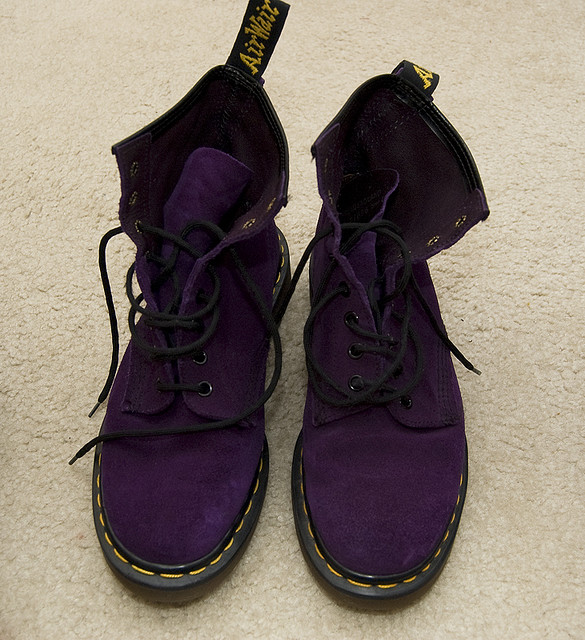
I don't wear these so much as I sit and admire them. Like art.
I bought my first pair of boots when I was fourteen, at a shop called The Wild Pair in the Palm Beach Mall. I’d been reading Sassy magazine for a couple years at this point, and their fondness for a particular English boot manufacturer had always intrigued me. The style was cutting edge, at the time. Pairing heavy black boots with floral dresses looked utterly bizarre to the untrained eye, but I liked the result. It was tough and unexpected; it was discomfiting. It may come as a total non-surprise to some, but even then I was interested in the idea of dressing oneself to challenge convention, rather than to fit in.
Of course, being fourteen, the fabled Dr. Martens were far out of my financial reach. I did not have a hundred dollars of my own to spend on them, and I couldn’t even fathom asking a parent to do so. Who spends that kind of money on shoes? I wondered. And unfortunately, Docs were not yet popular enough to find cheap knockoff versions at Payless. I’ve always had a thing for shoes, though, and The Wild Pair was a favorite shop because they carried the slightly out-there styles I was most interested in. And they had a clearance wall.
It was there that I found them: black 10-eyelet steel-toed Dr. Martens in fine haircell leather. There was only one pair, and it was in my size. The price tag stickered to the sole of the left boot, Sharpied all over with deductions and sale prices, settled on twenty dollars as the boots’ current cost. I need to impress upon you, here, that Dr. Martens boots simply did not go on sale at the time — they were nearly impossible to find at all in the shoe stores of South Florida to which I had access. So while I would have preferred the classic smooth leather to the haircell texture, I leapt upon the opportunity that fate had so kindly laid in my path. This would mark only the first in a series of future experiences in which I would find a single pair of Docs in my size and on sale, but I could not have known that then. I had them. Finally. I had them.
I did not wear the floral dresses at fourteen, so I pulled on my docs with jeans and t-shirts and wore them every minute I could. I went to Catholic high school, which meant uniforms, which meant I did not wear them to school. While I wasn’t aware of any specific prohibition in the dress code, I knew wearing them would mean drawing a dangerous amount of attention — it would mean becoming a target. Nobody was wearing these boots, you understand. They were big black monsters that looked totally unlike the trends of the day. I was scared. So I wore them in my own time but never, ever to school.
Well, once, to school.
There were certain circumstances under which we were allowed to wear our own clothes to school. One of these circumstances was the day on which I was due to be photographed with the rest of the National Merit Semi-Finalists for the yearbook. Sure, we had to dress up, but still, a day in school uniform-free was a welcome change. I’d worn a floral dress in a mottled print of pinks and purples and blacks, and — brazenly — my Dr. Martens boots, which by this time were several years old and beat to hell, the steel toes covered in scuffs and scratches. Somehow, in my head, I thought this would be okay, because I was out of uniform. I might have suspected trouble brewing when my much-beloved Latin teacher laughed good-naturedly at my footwear and announced, “When I was a girl, one of our favorite insults was to say ‘Your mother wears combat boots!’†But she seemed unfazed once the initial surprise wore off, and I didn’t worry.
Around mid-morning, we gathered outside for our photograph. Mr. Heller — and that is his real name, which I am using because he was a rank asshole — was the assistant principal. He was present to oversee the photograph, which was evidently important business. Mr. Heller took one look at my boots and exclaimed with unrestrained horror and rage: “What is that?â€
“…. Those are my boots.â€
He was apoplectic. His face got redder and redder as he stared at my feet. Given his intense reaction, you would think my boots were unholy abominations made from the flesh of aborted fetuses, the soles stitched into place by Satan himself. Mr Heller hemmed and hawed for ages over whether I should be allowed to even be in the photograph — which, for the record, I wasn’t all that jazzed about anyway. It held up the whole process for far longer than a simple group picture should have required. Finally, after another faculty member suggested my National Merit status was not compromised by my choice of footwear, he bellowed for me to stand in the back. All the way in the back. He instructed the photographer: “Make sure you can’t see her shoes.†In the resulting yearbook photo, I am a levitating head behind my National Merit comrades.
Once the picture was done, Mr. Heller barked at me: “You need to go home and change.â€
I was a good kid, and an outstanding student. I really never got into serious trouble, not at school and not elsewhere. So I was startled and a little scared by this instruction, even though Mr. Heller’s reaction seemed out of proportion. But as I walked through the parking lot to my car in the middle of the school day, I began to feel more anger than fear. The drive home took 30 to 40 minutes each way. This boot-fearing fuckwit was demanding I miss classes to change my damn shoes.
When I got home, my father was there, and was quite surprised to see me. “What are you doing home so early?†he inquired.
“Mr. Heller sent me home to change my shoes.â€
My father was astonished. “He made you come home because of your shoes?â€
“Yes.â€
“That’s ridiculous!â€
Yes, it was. But it was a valuable first lesson in the power of style. I suddenly saw that there was a lot of potential force in my sartorial choices for fucking shit up.
I bought my second pair of Docs in Boston, immediately before beginning my freshman year at Boston University. They were a little different, even for Docs, and featured a soft weathered black leather and closely-set eyelets running nearly to the toes. I never owned a pair of the punk-uniform 1460 8-eyelet boots in black or cherry red; the boots I chose always had something unique about them. I did learn quickly from scene-knowledgeable friends that there was a proper way to lace one’s boots. My habit of leaving the top eyelet of my old steel-toes unlaced was anathema. Boots were to be laced horizontally, all the way to the top, the edges pulled completely closed over the tongue. This was a clear subcultural signifier — to the untrained eye they looked like little more than tightly-laced boots, but to a knowing observer they announced one’s allegiances and social/musical/political interests loud and clear. Lace color was an important factor for further communication, though colors and meanings have regional — and I’m sure international — variations. I learned that red laces signaled Nazi skinheads, so I avoided red-laces-wearers. White could mean “white powerâ€, but may also be worn by SHARPs so one could not assume racism on this fact alone. Blue signaled straight edge. Yellow might label an anarchist, but then again, so might red. Wearing the black included laces was the safest course if you did not want to get too embroiled in politics. It wasn’t so much that there was ever a strict code of colors as there were vague correlations. An underground language of boots, with multitudes of divergent dialects. Though the precise meaning may be unclear, the overall expression of boot-wearing was an effort to fuck with the status quo.
In college I explored other Statement Boots beyond Docs. I had Undergounds, and Gripfasts, and Fluevogs, and New Rocks, and Swears. I had a lot of boots. In retrospect, I’m actually a little shocked at how many boots I had. In part, I invested so much in my boots because my shoe size gave me access to an incredible array of outrageous styles, while my clothing size led to a lot of closed doors when it came to outrageous clothing.
But there was more to it than that.
In my sophomore year of college I visited an old friend and assisted as she bought her first pair of Docs. At the store, she laced them up and stood, taking a few stiff, tenative steps. Then she said, with some degree of surprise, “I feel… powerful!†I’ve had this same conversation with uncountable fellow boot-aficionadi over my life, and the first time you put them on, the sensation is overwhelming. Heavy statement-making boots, like the famous Dr. Martens, very often do make us feel powerful; they make us feel strong, even a little invincible. While I enjoy a good totter in high heels on occasion, there is also something to be said for wearing shoes that announce you are not one to be fucked with, oh no. I am not someone you want to fuck with.
As the years passed, I eventually sold nearly all of my boots on eBay. I kept some for nostalgic reasons — a pair of bright green 10-eye steel-toed Docs, which I bought in Little Five Points whilst visiting an old friend in Atlanta when I was nineteen. The same pair in purple, for which I scoured eBay for years and finally procured in lightly-used condition. Another pair of purple Docs, pictured at the top of this post: 8-eyelets in rich suede, made by Na Na in the early nineties, back when Na Na was collaborating with Dr. Martens. I don’t much wear these old boots anymore — I keep them as portals to my past. In every scuff and crease there are stories, experiences, places, people. They were present at all of the important events of a certain stretch of my life. They are scrapbooks in shoe form.
I’ve recently bought a couple new pairs of Docs on sale; I miss the look, and they’re good for bad weather. One of my purchases was a pair of the classic 1460s in smooth black leather, once so unthinkably bizarre, even frightening, and now a style tradition worn by all sorts of people. Wearing them again over the past few weeks has reminded me of all the above — and of how I rarely feel so capable and so comfortable as when I am wearing my boots, and not just because of their physical characteristics, but because of what they represent to me, in my life. They represent my commitment to being ferociously and unapologetically myself.
So this is my nondenominational holiday gift to you, my beloved readers: I’m giving you boots.
Yes, the boots are a metaphor. But do hear me out.
I’m giving you these boots, and I want you to put them on and feel secure and strong and tough. I want you to wear them for the purposes of stomping the shit out of the pressure and anxiety you may feel for failing to look however people think you should look, or for failing to behave in whatever way people think you should behave. These boots are specially designed to destroy the sad feelings and self loathing brought on by a rude comment, and they resist the internalization of cultural messages about what is normal. These are boots that immunize you against taking shit from anyone; these are boots that turn you into someone who is not to be fucked with. These are your Boots of Total Fucking Badassery, and they give you +50 against body fascism and arbitrary beauty standards.
There will be a break-in period. It will take time, longer than you expect. You’re certainly going to blister. You may even bleed. And you’ll have to keep putting them back on, every day, over the blisters and raw skin, and soldier forward. But your sacrifice will have its reward, because eventually you’ll be wearing boots that fit you perfectly; they will never fit anyone else quite the same, because you will have shaped them to your unique needs. And you’ll wear them and you’ll be — ferociously, unapologetically — yourself, without worrying about what other people think of you, and without letting your fears or insecurities hold you back.
Happy holidays, my loves.
Joy Nash’s name is pretty much synonymous with “funny and gorgeous” in the very particular dictionary inside my head. And it’s not just the camera adding this extra weight: she’s like that in person too. If, like me, you missed seeing new videos from her, I have an important question for you. Do you want to weigh 120 lbs or not?
See also: The Terrarium Diet.
Still hungry for more awesome fattery? Margitte of Riots Not Diets has created a necessary/beautiful/smart/thoughtful/vivid documentary featuring Jessica of Tangled Up in Lace and Keena of Buttah Love. Watch it below, or on Vimeo. Be warned, this video may be NFSW owing to the use of some Adipositivity photos. Also because it might make you cry. As it did me.
fat body (in)visible from Margitte Kristjansson on Vimeo.
Any other new fat videos I’ve missed? Please do share them in comments.
Dear Ryan Murphy,
Last night, at the behest of numerous readers who have asked for my take on the new “fat girl†on your show Glee, I braved the endless trailers for Tron: Legacy and ventured forth onto Hulu.com to pick up a couple of recent episodes.
It turns out my limit for Glee episodes these days is 1.35 — it was just over a third of the way through the second one that I became utterly convinced that some small furry animal, maybe a hamster high on meth, had worked its way inside my skull and was running around screaming like a man on fire. I closed the Hulu window and the sensation stopped. I think we can both agree that your show is not good for my head, though I already came to that conclusion awhile back, which is why I stopped watching it in the first place.
I don’t know, Ryan Murphy; by all rights I should love your show. It has singing and dancing and it is quirky as fuck and it features an ensemble cast. These are all things I like. Part of the problem is that at some point, Glee became self-aware, and, like Skynet, turned upon all of us, we who had given it life. The Glee of today no longer serves its audience, a cheery distraction on a Tuesday night, but has morphed into an unstoppable train of high-kicking solo-belting sermon-preaching cultural ubiquity. It is everywhere now; it cannot be killed. It is made of liquid metal. There came a moment when all of the characters suddenly turned loathsome and sanctimonious, and still I watched, fearful that the show would find me in the night and murder me as I slept if I should dare to ignore it.
But I did eventually manage to survive a separation, and our time apart has done little to rekindle the spark these characters once had for me. There are exceptions, of course. Though most of the cast leaves me feeling dead inside, Chris Colfer as Kurt is practically perfect in every way. I had no opinion of Dianna Agron, who plays Quinn, until she responded so memorably to the GQ photoshoot controversy on Tumblr, which made my wrinkled little chickpea of a heart go pitter-pat. My heart, she is easily wooed by anyone who can offer a few smart and rational words in the face of hand-waving controversy, and sadly she is not wooed so often these days.
But I am delaying the inevitable: there is also the marvelous Ashley Fink.
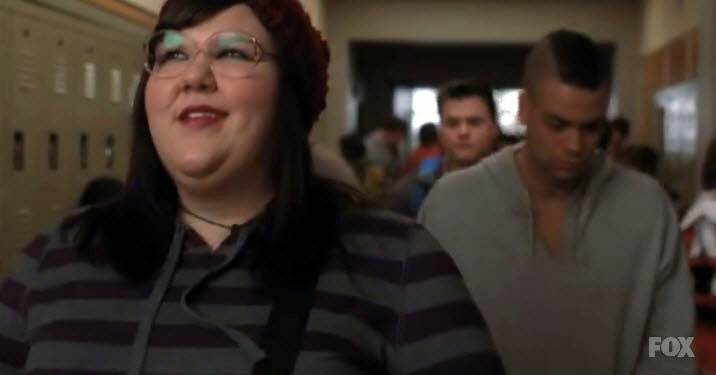
You cast Ashley Fink as Lauren Zizes, a once-in-awhile supporting character who has recently joined the glee club on a more permanent basis. I also know Ashley Fink as Carter from the late lamented fuck-you-ABC-Family series Huge. My first exposure to Ms. Fink happened a year or so ago, when someone posted a question to my Formspring page informing me that the Glee wardrobe folks were totally cribbing my style for her character in her first appearance, evidently because there was a cardigan, mixed prints, and glasses involved. What I remember of the scene was Fink’s character demanding a box of Mallomars and yes, I thought about how I do enjoy a Mallomar now and then. To be blunt, I think Ashley Fink is awesome. I will brook no argument on this point. What I want to discuss, Ryan Murphy, is your portrayal of Lauren Zizes.
Lauren has mad style. She knows her fatshion, bitches, and wears short skirts and horizontal stripes with equal aplomb. She is snarky and clever and untroubled by the shrieking dramas of the glee club. She does push-ups to amp herself up prior to a performance, and is on the wrestling team. She likes Puck and lets him know it; after bribing him to hook up with her, Puck admits, in spite of himself, “I have to say, she kinda rocked my world.†She seems confident, bemused, sharp-edged, funny. If she were real, I’d want to hang out with her.
But you, Ryan Murphy, you have to go and ruin it by making Lauren’s defining characteristic an obsessive love of candy. The fat girl. Loves the candy.
Now, I make a good many jokes here about the so-called “bad†foods on which fat people are said to exclusively subsist. Bacon. Cheese. Handfuls of lard. Pie. The name of this blog even has “cakes†in it. I crack wise about this stuff in an effort to both be funny and to point out how ridiculous these assumptions are. Of course most fat people don’t demand buckets of candy in order to accomplish a task. There are even fat people who don’t much care for candy at all. I’d rather have a cup of tea, myself. The stereotype of the “badâ€-eating fatty is offensive, sure, but it can also be funny. Sometimes, it has to be funny, or else we’d all be crying (or kicking people’s heads in) twenty-four hours a day. When we can bring laughter to a subject, that tends to help folks relax, and to open up the conversation to question these ideas. Yes, of course it’s silly to assume that all fat people eat Crisco with a spoon, a laughing person might muse, having not really thought about these stereotypes before.
In order for this to work, once the laughing dies down, you have to make a point of the joke; we laugh, while part of us may believe the stereotype is true. Let’s talk about that. But you, Ryan Murphy! Instead of dragging the absurdity of the fat girl’s candy demands into the light of day and deconstructing that idea, you are banking on it. The fat-girl-eats! jokes do not interrogate these assumptions, but rely on them to elicit laughs, even supporting the notions of those who do believe that fat people are inhuman eating machines. In the episode in which Lauren joins New Directions, her compliance is paid for with candy and sexytimes with Puck — but mostly with candy. She requires candy to join, and candy to perform. By the most recent episode, Lauren is alerting her glee-club colleagues that slush from the parking lot is edible, and she is asking Santa Claus for sweet potato fries, and she is eating the popcorn the other kids are attempting to string for hanging on the tree. Her appetite seems uncontrollable, insatiable, all-encompassing. Hmm, where have I heard that before?
Ryan Murphy, I’m inclined to think that you make these jokes not out of any real disdain for fatasses, but out of a desire to be clever, to rep for the underdog. Before Nip/Tuck, you co-created a show in the late 90s called Popular, and it was another quirky series about kids in high school. Popular had two fat characters — Carmen Ferrara was played by a pre-weight-loss Sara Rue, and Sugar Daddy was played by a pre-weight-loss Ron Lester — and their struggles with self-esteem and fitting in were treated thoughtfully and sensitively, without making their size the most important thing about them. So I know that you are capable of depicting fat folks in a more nuanced way. Unfortunately, and this is my problem with Glee in general at this point, Lauren Zizes, like many of her classmates, seems more like a caricature of a caricature, rather than a real person.
There comes a moment when the eating jokes stop being funny. You may think you’re turning a mirror on a culture that punishes women for failing to starve themselves thin; you may even think you’re standing by the right of fat girls to eat candy, and yes, fat girls are entitled to eat according to their own desires. The problem is, Ryan Murphy, sometimes you don’t get to make the in-jokes when you’re not a member of the group being mocked. It makes the jokes tricky to read, and it’s far too easy to see Lauren’s character not as a pointed attack on the stereotype of the food-obsessed, sex-craving, unlikeable fat girl but as the stereotype itself, unquestioned, uncriticized.
Is this not what you meant to do, Ryan Murphy? Did you mean this character to be funny and shocking and maybe even a winking nod to obnoxiously unapologetic fat chicks like me? Then you fucked up. Believe it or not, I don’t spend my days looking for reasons to be outraged. Those are plentiful enough that, in the interest of my own well-being, I’ve learned to ignore them. Instead, I spend my days looking for reasons to be happy, to feel good, to smile. You put a new fat girl on your show, and my fondest wish is to watch it and discover that it is awesome. I already think Ashley Fink is awesome to start with, so you are beginning on solid ground. But instead of making her a real character, I get a fat-joke punch line in human form.
You can probably understand why I’m so annoyed with you.
And I’m actually letting you off easy in this letter, understand. There is plenty about Glee that gives me pause. You’ve glossed over fat and body issues before, in that weak-ass shit where Mercedes develops and then recovers from an eating disorder in a single episode. You also have a lousy track record of dealing with disability, popular protestations to the contrary, and the most recent Christmas episode represented a horror that left me aghast and enraged, but s.e. smith has already taken that apart and I’m not going to do better here. Lauren Zizes is just the latest in a long habit of characters that fit handy slots — the disabled kid, the woman of color, the dumb blonde, the gay — but who too often exist only to service some platitude-laden Afterschool Special of a storyline. Depth seems to be optional, something we see only if it’s convenient to the plot.
Fix it, Ryan Murphy! Don’t be a part of the problem.
Sincerely,
Lesley Kinzel
Fat lady, pop-culture curmudgeon, and occasional TV viewer.
The outrageous:
Amanda Hess has a short piece up on the media’s never-ending fixation with Elizabeth Edwards’ weight, even in her obituary.
Edwards’ passing provided the Washington Post with a rare opportunity to remind readers of its obsession with her body weight, and what it all means. Four paragraphs into the Post’s Edwards obit, the paper describes her as having possessed a “real-woman figure” and “serious intellect” (in that order).
I have so many feelings about this but I continue to lack the ability to write them into the epic shrieking rant they deserve. It seems there is nothing that a woman can accomplish which will be enough to eclipse her weight.
(Hat tip to Sarah for bringing this piece to my attention!)
The confounding:
On Alternet yesterday, A lady named Greta Christina talks about being Fat 4 Lyfe:
I sometimes feel like the thinnest fat woman in the world. (Well, probably not the thinnest… but you know what I mean.) Some people say that, inside every fat person, there’s a thin person trying to get out. I feel the exact opposite. Inside this relatively lean body, there’s a fat person nobody can see. People think they can stupid, bigoted, hurtful things about fat people to me, because they don’t see me as one of them. They couldn’t be more wrong. I am fat. Not in a body-dysmorphic way — I don’t look in the mirror and think I’m still fat — but because this fat identity shaped me for years, and it will always be with me.
Christina used to be fat, and was an “ardent” member of the fat acceptance movement, she says. Christina has since lost weight and credits FA with her ongoing self-acceptance, but she also feels rejected by FA. And there is anger! Christina describes some fat-acceptance ideologies I am not familiar with. For one, she states that FA uniformly insists there is never any connection between weight and health. The prevailing FA argument I know is that weight does not necessarily cause health problems all the time, and its impact is dependent on the individual. In other words, some fat folks have health issues caused or aggravated by their size; some do not.
Christina also asserts that FA advocates believe all weight loss is always damaging and bad. I think most of us agree that the industry that sells weight loss is always damaging and bad, and I think most of us agree that weight loss can be damaging and bad for many individuals, depending on circumstances. But all the time? No. When it comes to the complexity of human bodies, pretty much nothing is true all the time for everyone. Christina goes on to state that she was dismissed and abused for noting that her weight was contributing to a mobility issue. Frankly, this makes me wonder if she wasn’t actually hanging out with FA folks, but with run-of-the-mill assholes.
Simply put: fat acceptance/activism/whatevs is a movement of criticism and questions, not authority and groupthink. Its purpose ought to be noisy inquiry into what our culture tells us about bodies, ours and other people’s. Its purpose is not to replace one set of monolithic rules with another.
Christina finally argues that FA should be “supportive” of people who diet. Sillypants! As many folks have observed in many places over many years: the whole world is supportive of people who diet. FA should not overtly condemn or attack people who diet, but dieters should be cool with just not bringing that up in FA circles, which, again, are meant to question the culture that supports dieting.
(Hat tip to Regina for the email alert!)
The unsurprising:
Michael Gard writes about Australia’s increasing life expectancy and declining incidence of heart disease and stroke. Way to go, Australia! Good news, right?
Actually, this is good news for everyone except for a group of health experts who have spent the last decade telling Australians what a fat and unhealthy lot we are.
The obesity lobby has good reason to be worried. The avalanche of chronic disease and sharp decline in life expectancy that they predicted have not materialised.
[…]
People who study body weight know that, in reality, the concept of ‘ideal weight’ is at best purely theoretical. Nobody actually knows what a person’s real ideal weight is and being a little above your theoretical ideal is not actually very significant for your health.
In fact, being technically overweight is no better a predictor of life expectancy than your height or hair colour and a steady stream of recent research articles shows that overweight people have the same health prospects as so-called ‘normal weight’ people.
So this is part of the explanation why we are getting heavier and healthier; most of the hundreds of thousands of Australians who technically fall into the overweight category are perfectly healthy.
Because I have nothing to add that isn’t already covered by the above, I’ll admit that when I read articles from Australian sources, I give them accents in my head. I do this with UK ones too.
The really, really unsurprising:
The Daily Fail is fail-y!
…I fail to buy into the myth that girls today feel pressured into being thin.
Monica Grenfell’s thin friends feel “marginalised” by an alleged pressure to be fat. We should send them flowers.
(Hat tip to BuffPuff for the giggle.)
The semi-coherent:
There is a new Fatcast. We were supposed to have a tight conversation about closet organization. I’m not sure what went wrong.

Oh, I've been on this ride before.
Back in September, the US Food & Drug Administration pulled diet drug Meridia off the market because of fears that it increased the risk of heart problems and strokes. Remember? Since a heart and a brain are both required for humans to live, the FDA concluded that maybe endangering these organs in the process of taking off a few pounds — a very few pounds; specifically, five pounds, on average — was unwise. I took this opportunity to write about what I called the defiant absurdity of the diet-drug business, focusing mainly on the fact that these companies continue to produce drugs that don’t actually work, and possibly do harm, and yet the FDA continues to approve them anyway. I also did a little run-down of the currently-approved diet drugs on the market, in case you want a refresher (NB: that post remains the first and only time I have used the word “shart” on this blog).
Yesterday, an expert panel finished their evaluation of new diet drug Contrave (I expect they will revisit the name once it goes to market, as Contrave sounds… weird) and recommended that the FDA approve it. Unsurprisingly, there are lingering concerns that Contrave may also cause cardiovascular problems, and the panel suggested that the FDA ask Orexigen Therapeutics really, really nicely to check that out a little more thoroughly.
But that’s not the thing that makes this news worth posting. The thing that makes this worth posting is here:
The advisers were not overly impressed with the modest weight loss seen in patients taking Contrave, but some said rejection could quash development of such drugs at a time when two out of three Americans are overweight or obese.
“My concern is … we will potentially kill development of these medications, and it is the most serious disease that the United States is facing,” said panel chairman Abraham Thomas, head of endocrinology at Henry Ford Hospital in Detroit.
Yes, it is just what it sounds like: this drug was not approved because it actually works, but to encourage the research and development of other weight-loss drugs. It’s especially preposterous that these experts can’t even be arsed to pretend that they think Contrave is a fantastic drug that will provide a safe and reliable solution for people trying to lose weight. Nope, their primary concern is that the FDA’s continued rejection of weight loss drugs — it happened twice just in October — will suffocate weight-loss drug research. If the FDA continues to reject weight-loss drugs, then companies will cease spending money to research them, because drug companies are in business to make money, and there’s no money to be made from a drug that won’t be approved by the FDA.
In the quote above, the panel chairman calls overweight/obesity “the most serious disease the United States is facing”, though I am bound to also note that cardiovascular problems are a pretty significant threat, and one often correlated — rightly or wrongly — with fatness. If he believes that fat is associated with cardiovascular problems, isn’t it wildly irresponsible to approve drugs that may cause cardiovascular problems on their own? Especially considering that one previously-approved drug, Meridia, was just recently pulled from the market for this very reason? Or are fat people disposable — their quality of life so unbearable that a premature death would be a mercy, and not a tragedy?
It all might make sense, in a twisted way, if these drugs were legitimately effective. The FDA requirements for effectiveness in diet drug trials is that at least 35% of participants lose at least 5% of their body weight. For a 300-pound person, that’s fifteen pounds. To break it down further, the drug needs to produce a minimum loss of fifteen pounds in roughly one out of every three 300-pound people who take it. Obviously, the loss would need to be even less for someone who weighs less to start with. That’s it. Given that the panel was not “overly impressed” with the “modest weight loss” results of Contrave, it’s probably safe to assume their numbers were not much above these minimum requirements.
It hardly seems worth the risk. But there’s money in it, and so the diet-drug charade ambles along, gamely pretending that obesity is not a complicated affair, produced by a number of intersecting factors, the order and composition of which differ for pretty much everyone.
Nope, all you need is a pill. It’s simple, guys. Maybe it is working, and we just aren’t believing hard enough in it! To bring back one of my favorite quotes ever, from an FDA panelist assessing former diet drug Meridia:
“I think that just because we didn’t measure the benefits scientifically doesn’t mean they don’t exist,†said Dr. Jessica Henderson of Western Oregon University.â€
Clap your hands, children! Clap your hands.
Image by Daryl Mitchell, via Wikimedia Commons.

Have you seen this woman? She is probably plotting to destroy your security AT THIS VERY MOMENT.
Today’s edition of Obesity Epidemic Hand-Wringing comes from David Frum, a CNN columnist whose posts appear alongside a picture of him beaming a cheery smile. Frum, near as I can figure, is a rare creature these days: a rational conservative. I’d all but forgotten such individuals existed, so I will give him credit for momentarily reviving my belief in political discourse.
Okay, that’s over.
Frum’s piece on CNN.com, “Why obesity is a national security threat,” addresses the recently-released report that, in 2008, far more people were discharged from the military for being too fat than for being, uh, tellingly gay. Most of the coverage of this report, which I believe surfaced last week, has trended toward the “see how ridiculous DADT is?” line of thinking, with a generous seasoning of “OH SHIT WE ARE SO FUCKING FAT, IT IS THE ENDTIMES!” Frum, however, sticks to the idea that a flabby army makes for a weak nation, and this is a problem.
I admit I have a hard time getting stressed out about the widening of the military. I am inclined to think that if the fatter soldiers are continuing to run around with 80 pounds of gear strapped to their backs, this isn’t really an issue. Of course, there’s more going on culturally with the fear of a tubby military, as our concept of American masculinity often associates strongly with men in uniform, and so an apparent loss of physical power amongst our troops might seem to indicate a loss of… physical power amongst American men in general. And that IS a problem, boy howdy, from the perspective of said men.
I’m ignoring women here on purpose, as the military weight standards Frum describes are specific to male recruits, and female soliders are not even mentioned. Like I said: this fear is as much about American masculinity as it is about national security, and Frum is hardly alone in (probably unwittingly) illustrating that.
Frum’s column notes the alleged leaps and bounds that obesity rates have taken in recent as evidence of this as a growing problem:
By the military’s own numbers, some 61% of active-duty personnel were above ideal weight in 2007, up from 50% in 1995.
This reminded me of something I wanted to revisit on this blog, as it has been a long time since I brought it up. Step into my TARDIS, kids. We’re taking a trip to 1998. Woooooweeeeooooooo…..!
Hey look, there’s Bill Clinton, denying sexual relations with Monica Lewinsky! NASA actually has funding and is doing all kinds of cool shit, including finding the first signs of the existence of water on the moon (which was confirmed only this year — y’all, can we please give NASA more money?). Titanic has won a million Oscars and James Cameron proclaims himself “King of the Worldâ€, marking the first time — though far from the last — that I feel an urge to punch him in the junk as hard as I can. Viagra’s been approved by the FDA, giving both Bill Clinton and James Cameron another reason to be cheerful. Microsoft is facing anti-trust charges from the federal government! Iraq is kicking out UN weapons inspectors, in a move that will not work out so well for them in the long run! A massive tsunami wipes 10 villiages in Papua New Guinea off the face of the planet, giving us all a new natural disaster to be terrified of, while a familiar one, Hurricane Mitch, kills 18,000 people in Central America. Frank Sinatra is soon to shuffle off this mortal coil. I am an undergraduate film student working really hard to get my faux-arty proto-feminist “experimental†final project for my production class edited and done, before they lock me out of the COM building at the end of the spring semester. Oh shit, and I still have to master the soundtrack, I’m never going to finish.
And then, on a Wednesday in June, 25 million Americans who went to bed with their bodies at a “healthy†weight suddenly woke up fat.
This is literally old news. Bless CNN for keeping its archives online.
Millions of Americans became “fat” Wednesday — even if they didn’t gain a pound — as the federal government adopted a controversial method for determining who is considered overweight.
Controversial! Controversial, y’all!
The guidelines are based on Body Mass Index (BMI), a height-to-weight formula that ignores whether the weight is from fat or muscle. It also ignores whether someone has a large or small frame. The weights are the same for men and women.
[…]
Some health experts reject the new guidelines, claiming people who aren’t fat are now considered overweight. For example, under the new definitions, many professional athletes would be considered too heavy.
Critics also worry that these lower weights will persuade doctors to start prescribing diet drugs for people who don’t need them. Some diet drugs carry health risks, such as an increase in blood pressure.
Note the dubious tone — note the open criticism! This formula ignores the ratio of fat to muscle! There is no distinction made for frame size, nor for biological sex! The 1998 BMI rules make the case, in all seriousness, that every single human being on the face of the planet — and these were adopted from guidelines created by the World Health Organization, so we needn’t restrict ourselves to the US — that every single human being on planet fucking Earth should fit within one narrow weight range regardless of any mitigating physical differences between them. These guidelines did not stop being controversial because they’ve since been proven to improve the health and prolong the lives of Americans; they stopped being controversial because they were absorbed into our conventional wisdom simply by the passage of time. This is how we do things now. You 25 million new fatties, get in line for your new body-shaming. Oh, and be sure to bring your checkbook; this will be expensive.
Many of you reading this are already familiar with The Great BMI Shakedown of ‘98; many of you are not. But this is one reason of many to question the notion that obesity rates are skyrocketing out of control. In 1998, these rates went up literally overnight, without the need for anyone to actually, y’know, gain weight. What do “overweight” and “obesity” even mean, when they are applied so cavalierly and with so little regard for a given individual’s highly subjective health?
But wait, let’s rewind! What was that statistic in Frum’s column again?
By the military’s own numbers, some 61% of active-duty personnel were above ideal weight in 2007, up from 50% in 1995.
Right, right, now I remember. Lacking a specific reference to BMI, we can’t know for sure whether this uptick is due in part to the 1998 change, but I think it’s a safe argument that when the National Institutes of Health changed their parameters, the military did too.
The point here isn’t that the guidelines are wrong. The point is that the guidelines are irrelevant, too strict to reasonably apply, and yet apparently too malleable to really mean anything, if all that it takes for a person to slip from “normal” to “fat” is the adjustment of a line on a chart. Does a paper-based shift from one category to another suddenly make it impossible for a soldier to do his job? What has really changed?
Returning to David Frum’s column, he acknowledges:
Serving personnel who exceed military limits are offered counseling, nutritional programs and other weight-control assistance. Discharge is very much a last and unwelcome resort.
Very few people who are in the military want to be discharged. The people who serve do so by choice, not by coercion, so losing their job — and more than that, as in many cases, military service is a big part of a person’s identity — this is a terrible tragedy. Thus, I would venture to say that the discharged soldiers’ failure to lose enough weight to continue to serve is not because they simply weren’t trying hard enough, but rather because significant and permanent weight loss is nearly impossible for a substantial number of people.
The problem with anti-obesity public health campaigns is that while they may have long-term effects on statistics across broad populations, they often do so at the expense of people who are already fat, and who — for whatever reason — cannot succeed in making themselves acceptably thin. Frum lauds Michelle Obama’s childhood-obesity campaign, but as I wrote on that topic for Newsweek back in April, it would be far more meaningful to focus on improving the overall health of all kids, no matter their size, rather than zeroing in on a conversation that only underscores the existing cultural loathing of fat people, adults and children included. After all, thin kids eat at McDonald’s too. And isn’t it in our best interest to make certain all our soldiers, both current and future, are offered the same opportunity to be healthy, even if their standards of health may differ from individual to individual?
Frum’s piece never does deliver on the promise of its title, “Why obesity is a national security threat”. Is the threat the notion that all Americans are on an unavoidable slide to uniform fatness, leaving us without a functional military — hardly a likely scenario — or are individual fat people posing a danger? Ostensibly Homeland Security officers have yet to pound on my door and drag me to the Fat Detention Center because they are so busy arresting all the other fatties. (Possibly I will be tortured, in which I am promised cake and then it will turn out that there is no cake?) The real problem with obesity is that it continues to be used as a smokescreen and a scapegoat that distracts us from worthier issues, like making sure that all Americans have access to affordable, high quality healthcare. Or making sure that the wars we send our fatted soldiers off to fight are just and that their sacrifice is for a greater good.
But what do I know? I am apparently a threat to national security.
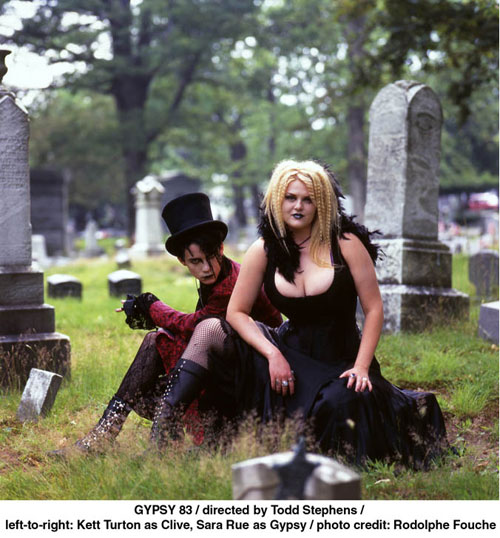
I prefer hiking boots for graveyard-based activities, myself.
Gypsy 83 tells the story of Gypsy Vale, a 25-year-old Stevie-Nicks-obssesed goth girl working for her sister’s Fotomat and living with her musician father, well played by X’s John Doe, in the unremarkable nowhere of Sandusky, Ohio. Gypsy’s best friend is 18-year-old nascent queer Clive, a straight-A student who is apparently the only other goth in town. Clive’s parents are deceased, and he lives with his straight-laced but very supportive older sister. How Gypsy and Clive met is never revealed — obviously it wasn’t in school, given their age difference — but they share that deep platonic love that downtrodden outsiders who find one another and cling for dear life know so well. Both of them suffer daily harrassment at the hands of Sandusky’s residents, many of whom enjoy wearing pastel sweaters draped over their shoulders. Although both Gypsy and Clive have loving family, they are the only ones who truly understand each other.
One night, hanging out in Clive’s basement lair of draped velvet and posters of Morrissey and The Cure, Clive and Gypsy discover an annual Stevie Nicks tribute night in New York — the “Night of a Thousand Stevies†— and Clive announces they must go, so Gypsy can finally begin her long-delayed career as a rock star. Gypsy is stunned to see a picture of her similarly Stevie-Nicks-obsessed mother, who abandoned her and her father eighteen years ago, on the site advertising the event. Thus it follows that after some minor uncertainty, our two heroes set out on a road trip from Ohio to New York so Gypsy can perform, and potentially reconnect with her long-absent mom.
The film follows a fairly standard road-movie format, in which Gypsy and Clive stop off at various places to be harassed by the locals and to occasionally cry, dance, or learn a difficult lesson. Sometimes all of the above. Karen Black turns up in a brilliant performance as a tragic lounge singer named Bambi LeBleau; a pack of frat pledges being hazed appears twice. There is also a strange turn when the duo briefly adds a hitchhiking Amish runaway to their merry caravan, in a weird subplot that starts off trying hard to be quirky and then comes to an abrupt and loathsome end.
Gypsy is of a middling fatness, and her size is mentioned often in casual insults, to which Gypsy responds indignantly with such platitudes as “Big is beautiful, haven’t you heard?†That said, Gypsy is not above exhorting one jerk to “suck my fucking cock†in front of a packed bar in the very center of White America, all feathered hair and acid-washed-denim and Autograph’s “Turn Up the Radio†playing to a shuffling dance floor. Her exterior of self-assurance may not be undercut when she plods on a treadmill at home while watching herself in a mirror — there’s nothing wrong with keeping active — but her appearance of confidence suffers when she drinks a Slim-Fast for lunch, instead of, you know, actual food. Indeed, I’m not sure that we ever see Gypsy eat, though we do see her drink. In Gypsy’s one sex scene, she first asks if she can keep her dress on, but after being told how beautiful she is, decides to hell with modesty and gamely takes it off. Though she stands up for herself as a rule, at no point in the film do we ever get the sense that Gypsy has grown more self-accepting, and that’s a shame, as her bombastic assertions to strangers that she is fine the way she is would be more compelling if she herself believed in them. These criticisms aside, Gypsy’s size is not a huge part of the plot except in the few cases where she faces down haters, and there is no weight-loss redemption at the end.
I found the goth angle in this story a bit more authentic and believable, and though it may not be a pitch-perfect image of how goth is done in more metropolitan areas, it does capture the mingling of dark glee and extreme awkwardness embodied by so many members of that scene. These are not kids just playing with 99-cent Wet n’ Wild eyeliner from the drugstore and tearing up black Hanes t-shirts to reassemble them with safety pins. The Sandusky Joann Fabrics has nary a single bolt of crushed velvet nor stretch lace that has not felt the gentle touch of Clive, who capably sews his own clothes, as well as many of Gypsy’s. Her outfits vary between romanti-goth and more Nicksian ensembles of cream-colored lace, while Clive is dressed in the classic goth sense, with a nice attention to detail, such as the ubiquitious bondage belt of o-rings and chains. (This, he must have bought online.)
Clive and Gypsy do attend to many stereotypes — they hang out in cemeteries, taking pictures of themselves and shooting spooky movies on super-8, they drink absinthe, and they goth-dance at every opportunity, be it in a public park or at a redneck bar (“pick the rose, smell the rose, throw the rose awayâ€). There are cheery montages to two of the most upbeat Cure songs ever recorded (“Just Like Heaven†and “Doing the Unstuckâ€). Everywhere they stop, they apparently first drape in velvet and fringe and surround with lit candles. This is eye-rollingly funny when it happens early on in a cemetery, but becomes ridiculous when it later takes place in a highway rest stop. If only it were done with the teeniest bit of self-awareness, or if we ever saw them gothifying a space before settling in to use it, I’d find this charming. Instead, it’s often distracting.
The film also explores Clive’s burgeoning queerness on their interstate journey. Prior to leaving Ohio, we learn that Clive is pretty sure he’s gay, though he’s not much interested in sex, and remains a virgin. Gypsy’s break with long-term celibacy in a rest-stop bathroom is twinned with Clive’s inevitable loss of virginity in the cruiser-friendly men’s room next door, and the two scenes are intercut almost so as to seem like one. His relationship with the slightly-older Gypsy is romantic in a platonic sense, and when he earlier asks her for an experimental fuck, just to be sure he’s gay, she kindly turns him down, saying she’s “been there†already. Later, when Gypsy halfheartedly apologizes for treating him appallingly after his bathroom encounter, he explains, “I thought I was in love with you, but I’m not. I worship you.â€
When Clive and Gypsy finally get to NYC, they go directly to the nightclub hosting the anticipated event, entering to the opening strains of Apoptygma Berzerk’s “Suffer in Silence.†It’s a great song, but it’s very much not goth, and it comes from an album that sharply divided old-school goths with those more accepting of synthpop and the burgeoning electronica scene. (And let’s just pretend that Apop ceased to exist after releasing Harmonizer, okay?) If Gypsy and Clive’s entrance were serenaded by Peter Murphy — or Andrew Eldritch, for that matter — then Clive’s wide-eyed and breathy acknowledgment that “We’re home,†would have had more impact, but Apop is what we get. Of course, once inside it’s not all darkness and dead roses, as Clive is hit on by a boy named Hazelton, and fails to know that “Poppy Z†refers to “Poppy Z. Brite†and that Lost Souls is a book and not an album, a misstep that gets him condemned as a poseur in a scene that feels more damaging than any of the other harassment this poor kid has received. Meanwhile, Gypsy discovers what’s become of her mother, and while we do get an answer of sorts, there is almost no explanation or resolution around her mother’s (and father’s) actions.
In the end, I’m not actually sure what this film means to be about. Is it about being a glittering freak in a dull mainstream world? Is it about Gypsy and Clive’s intense friendship? Is it about Gypsy’s search for her mom, and ultimately, herself? Is is about coming out and coming of age? Gypsy 83 attempts to touch on all these themes but never really satisfies on any of them. Clive and Gypsy reach their destination, but they don’t seem all that different for it. The final scene is, sadly, downright weak, and a plot point mentioned several times — Clive’s inability to drive — is totally forgotten so that he can vanish into the sunset in a predictable conclusion.
What saves this film for me is Sara Rue and Kett Turton, who play Gypsy and Clive. Today, Sara Rue is a Jenny Craig spokeslady and weight-loss advocate, but for this film I can forget all that and imagine that the Sara Rue playing Gypsy — sharp, hot-tempered, yet fragile — is someone else. Kett Turton is a standout as the exuberant and innocent Clive, so much so that he won the Best Actor award at OUTfest the year Gypsy 83 was screened. The chemistry and rapport between the two characters is magical, and feels as immediate as any of the intense friendships I had at that age. It is enough to even make up for the curious lack of actual Stevie Nicks music on the soundtrack — save a karaoke-esque cover version of “Talk to Me†— which was the result of the refusal by Nicks’ people to give over any of the rights. That said, this film is clearly a labor of love, and though it may lack a strongly-voiced message, the actors make it a story worth watching.
On Netflix and DVD.
Real Quick: Kathy Najimy offers confidence through spandex, sizes S-XL only.
By Lesley | November 30, 2010
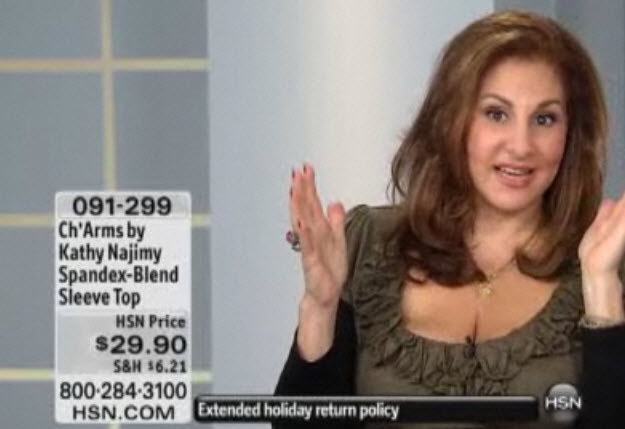
Don't you just hate it when people can see your arms?
Kathy Najimy is an “award-winning” actress who spent over a decade as the voice of a character on one of my most hated television shows of all time, King of the Hill. I don’t know what character she was, because as I’ve already noted, I really loathed that show. She’s also been in a bunch of other television shows and movies, though I mostly remember her as the fat nun in Sister Act.
Evidently Kathy’s had some free time even with all that acting, and has invented something that already existed, which she is now peddling on HSN under a name so precious and clever I would want to stab it if it had a body to stab. They’re arm-Spanx, and Kathy’s calling them “Ch’Arms”. The apostrophe makes it look French, right? That makes them fashiony!
But what are they for? Kathy, explain yourself!
“Ch’Arms is a garment problem–solver. For those of us who love the look of short sleeve or sleeveless garments but sometimes choose to have our arms covered, Ch’Arms gives us the best of both worlds.  No more bulky layers either under or over your cute shirt or dress.  Ch’Arms is lightweight and seamless and allows its wearer to feel comfortable and confident, covering your arms without covering your garment or body!”
I’ve mentioned that these things already existed, and they did — as dancewear, or as another product with another cutesy name that I have blocked from my memory, which was offered to me whilst shopping at Lee Lee’s Valise a couple years ago. And even before that! In my goth-clubbing days in the 1990s, we used to achieve the same effect by taking a pair of tights, cutting a neckhole in the crotch, chopping off the feet, and yanking the result on like a shirt, repurposing the legs as sleeves (custom thumbholes optional). It’s true that this was most popularly done with fishnets, but pretty much anything from Leg Avenue‘s line of “costume” hosiery would work. And this DIY sheer top was equally effective for plus sizes too, as I can reluctantly attest.
But I digress.
Kathy says above that this product is for people — oh let’s be honest here, we’re talking about women — who love the “look” of short sleeves, but would prefer them without all that pesky shortness in the sleeve area. Which begs the question of whether these people love the look of short sleeves at all, or whether what they don’t love is the look of their arms. Describing arm-coverage as a “choice” is also interesting; this language strives to avoid judgment. It’s true there are numerous reasons, many of them unrelated to a lack of arm-esteem, why a person might want to keep her arms covered: some women may do so to repurpose warm-weather clothing for winter wear, for example, while others may do so for religious reasons. However, this product is pretty obviously aimed at women who are simply insecure about the appearance of their upper appendages. This is about the freedom to hide your arms, ladies! You don’t hate freedom, do you?
Watching the videos on the HSN site is a must here, as Kathy refers to the Ch’Arms-clad mannequin by name, and at one point says, “You can see here that Margaret has changed her outfit, and now she’s wearing the beige [Ch’Arms],” when Margaret is quite clearly a mannequin and therefore incapable of changing her own outfit. I wonder if Kathy thought they were going to photoshop in a live model in post-production, especially since a flesh-free mannequin is hardly a great spokesmodel, given that Margaret’s arms look the same whether they’re Ch’Armed or not. And in a final ironic twist, this garment is not even available in plus sizes. Evidently slender women are entitled to a means of hiding their arm-shame, but fat women are not, and must do penance for their fatness in all those bulky layers until they can lose enough weight to merit a sleek arm-covering option. Thanks, Kathy Najimy! (Correction: Apparently they do go up to a combined “2X/3X” but they seem to be mostly sold out.)
This product is gimmicky, and at $30 a pop, grotesquely overpriced, not to mention a clear effort at exploiting women’s body-insecurities for financial gain. Oh sure, I hear Kathy say she’s trying to help all those ladies who choose to exercise their god-given right to cover their arms for vague and subjective reasons, but I’d argue that what would really help is assuring all women that their arms are fine just as they are, and certainly nothing to be ashamed of. So long as women are made to feel that their various body parts are unacceptable or ugly, this is not a choice. Arm-coverage can only be a choice when women are no longer pressured into hiding, obscuring, or altering their physical attributes that fail to be “perfect”, and Kathy Najimy is working to reinforce that influence, rather than to free anyone from it.
Meanwhile, somewhere in Southern California, Carnie Wilson is kicking herself for not thinking of this first.
H/T to Jezebel.
Bears still shit in the woods, your experience is still not universal, and other obvious truths.
By Lesley | November 22, 2010

Pictorial representation of life under the towering monolith of Fatscism.
Via the power of the Twitternets, Lauren of Pocket Rocket has pointed out a… well, a really very strange interview on Real Bodies Unite, a UK site advocating for body diversity in fashion. The subject is Vanessa Reece, a coach/consultant in the field of internet promotion and marketing. Evidently Reece also used to be fatter, and was a fatshion blogger at one time, though I have to plead ignorance of her credentials there, as I’ve only ever had glimpses of her in these circles on Twitter.
Over the course of the two-part interview, Reece expresses some strong opinions about fatness, fat fashion, and fat acceptance. Now, none of this would be distressing if Reece had restrained herself to speaking about her own life and choices, on which she is the undisputed expert. I am in favor of people finding happiness and fulfillment by whatever path they choose, so long as they support the rights of others to make their own decisions and don’t prescribe behaviors. But in an unexpected, apropos-of-nothing turn, Reece chooses to take vague aim at fat activism:
What advice can you offer to other men and women who want to make a change to their lifestyle but are struggling?
Look at the facts before you look at the plus-size community. I was very well known in that community for a long time and very few people within it offer advice on how to make changes should you wish to. I support the people that are brave enough to.
Be under no illusion! Some of the most well known people in that community either struggle with depression, inner self doubt and or health issues. If they tell you otherwise I’d wager they are in the grip of denial as I was or they’re just happy to stay in the gang. Hard facts hurt but addressing them may just extend your life span and comfort. It’s not about acceptance it’s about education. I’m sick of hearing the word acceptance being used as an excuse not to educate people on the facts.
I would say be brave. It’s easy to be ‘one of the gang’ but far harder to be the leader of your own destiny.
I’ll admit my hackles were raised mostly at the passive-aggressiveness of these statements, which seem intended as a warning against falling in with a dangerous “gang” of self-accepting fatasses. But what’s really troubling is Reece’s assertion that everyone’s experience insofar as dealing with depression, “inner self doubt” and/or “health issues” matches her own. This is essentially the opposite of good body activism, which should emphasize subjectivity and body autonomy over universal expectations and norms.
In part two, Reece adds:
Teens and twenty somethings are particularly easy to target if you sell them the right ‘dream’ which in this case is plus-size fashion and that ‘fat’ = strong, happy, comfortable etc.’ Until recently I drank that kool-aid up and I believed it. I woke up with new eyes and strong consideration of the facts and I can speak for myself without the need for a garment to do the talking for me.
To all those teens and 20 somethings who currently are overweight I would say, enjoy the fashion because it’s beautiful but don’t use it as justification to stay overweight forever. When the time is right for you, you’ll see that the majority of obese people really are not truly comfortable physically or mentally and those that are either in denial (and will hate you for pointing that out as I used to be when someone questioned my health and weight) or luckily have not yet suffered any health effects from their weight.
What we have here is a straw-man soiree. Who is “targeting” young people, and for what purpose? Whence are these messages that “‘fat’ = strong, happy, comfortable etc.’” being issued, and where are they receiving such wide exposure? None of that matters. What matters is THEY’RE DOING IT! AND WON’T ANYONE THINK OF THE CHILDREN? Reece’s comments here seem to paint a picture of a culture that is secretly run by dogma-enforcing fat acceptance operatives, in which obesity panic goes ignored — a world gone maaaaad! It certainly isn’t a world I am familiar with. Enjoy the beautiful fashion? I’d love to! Where the fuck is it?
When people make accusations of groupthink or a monolithic “gang” mentality amongst social justice activists, they are serving one purpose: to discredit the opinions and experiences of marginalized groups. When people call me out on something I’ve said that is problematic, it’s way easier for me to put them down as pushing some self-interested agenda, knee-jerk and zombie-like, than it is for me to actually stop, think, and consider that my experience may not be universal, and my opinions may be poorly informed. It’s difficult to admit that I don’t know everything in the world — it’s very difficult for me personally, as I am by nature an insufferable know-it-all — but it helps to realize that not knowing everything means I get to keep learning, and that makes my life far more interesting.
The intro paragraph to the first part of the interview makes brief mention of Reece’s movement from self-acceptance toward emphatically advocating weight loss and calls this shift “controversial” — but there’s nothing controversial about it. The idea that body acceptance is dangerous and wrong, and that weight loss is necessary and rewarding, is the prevailing ideology in the UK, as well as in the United States and pretty much all of Europe and lots and lots of other parts of the world too. That ain’t controversy — that’s right on trend. What makes this scenario strange is that this is an interview appearing on a site that purports to be campaigning for a diversity of bodies in fashion — an idea which IS controversial — and so many of Reece’s comments are extremely shaming, presumptuous, and just plain old offensive.
BE UNDER NO ILLUSION, folks: There is no universal bodily experience, no matter your size, no matter your circumstances, no matter what. We do not come off an assembly line, identical in composition and purpose. I believe Reece when she says she was a miserable huffin’-n-puffin’ fatty with eating habits that didn’t work for her, and so she felt compelled to change things. I totally believe her, and why wouldn’t I? I can’t know how she feels; I trust her with her body as I would have others trust me with mine. But her assertions that all fat people must be as miserable as she was (or is) strike a sour note. (They also, frankly, make me doubt her exposure to fat acceptance at all, because the FA blogosphere is filled with the stories of fatties who, for example, go to the gym regularly and cook nutritious meals at home, things Reece seems to believe no fat person does.)
It is okay to make choices for yourself, on your own terms. You have a right, always, to draw your own boundaries, and to have those boundaries respected. However, making sweeping generalizations about the allegedly-uniform experiences of ALL fat people reads like a sad effort at validating one’s own choices. A weight-loss advocate arguing that ALL fat people are depressed and ill (and those who claim otherwise are in “denial”) is actually no different than a fat-accepting person arguing that ALL fat people are perfectly healthy and happy, and any fat person who expresses a different experience is a liar. And you know what? You don’t need that validation — you don’t need to convince the whole world that everyone is just like you in order to justify yourself. If it is good for you, then that is enough.
There is power in making our choices and standing by them. Where Reece chooses to shame all bodies over a certain unnamed size, we must pair our personal convictions with a willingness to respect the bodily autonomy of people with different identities, perspectives, and circumstances if we are to have any hope of building a culture that truly reflects the breadth of human body diversity. In one of the quotes above, Reece counsels us to “be brave” and face the universal truth she proposes, as though losing weight were a radical departure from norms and expectations. The deeper implication being that body acceptance is a form of cowardice.
This, ultimately, was the point that offended me most. Whatever ill may be spoken of all of you, those who believe and doubt, those who ask questions and debate facts, those who strive to understand the feelings and positions of people who differ from you, those who still fight with disordered eating and eating disorders, those who struggle with accepting the person you are and with discovering the person you want to be, those who battle with daily visibility and grotesque harassment and well-meaning concern and the wish, understandable, forgivable, to just be “normal” — none of you want for bravery. Indeed, you are the bravest people I know.

That's one pissed-off turkey.
Did you know the brilliant Rachel of Cupcake & Cuddlebunny debuted an original Winter collection at the Re/Dress Indie+ event earlier this month? Shop it here.
You can also see video of the Re/Dress runway show, which includes many other independent plus-size designers, here.
This weekend, Marianne and I recorded a new Fatcast, on the popular topic of Holidays With Your Family. I’d hoped to have it edited and posted last night, but a seven-hour housecleaning seizure intervened. Look for it tomorrow morning.
Over on Livejournal, Elusis has some smart thoughts about the TSA screening controversy:
It is no accident that women have been complaining about being pulled out of line because of their big breasts, having their bodies commented on by TSA officials, and getting inappropriate touching when selected for pat-downs for nearly 10 years now, but just this week it went viral. It is no accident that CAIR identified Islamic head scarves (hijab) as an automatic trigger for extra screenings in January, but just this week it went viral. What was different?
Suddenly an able-bodied cisgender white man is the one who was complaining.
Read the whole thing here.
Elsewhere, on The Hairpin — rapidly becoming one of my more beloved blogs — Emily Gould has some smart and necessary words about the upcoming Tavi/Jane Pratt magazine project:
What I’m trying to say is that it creeps me out that everyone I know is sending you their resume because I want experience to count for something, and right now it seems like it has never counted for less. It seems like the most talented people I know have spent their working lives honing their skill at something that, for the most part, has ceased to exist. And as much as part of me wants desperately to be considered cool and smart enough to work with you guys, there is another part of me that just can’t get past being annoyed that a generation of talented twenty- and thirty-somethings with years of working at dead magazines and newspapers under their belts are unemployed, quasi-employed, and spinning their wheels on Tumblr because the future belongs to people who have never not had an email address.
Read it the full post here. (As an aside, I often feel like the only person on Earth whose love of Sassy — an influence on my adolescence that cannot be overstated — was matched only by my hatred for Jane.)
Finally: you know what would immeasurably improve your 2011? An Adipositivity wall calendar. Preview the goods and get your own here (link NSFW).
 Two Whole Cakes is a blog written by