I’m tickled to be posting this here on behalf of a reader who is assembling an anthology of writings by fat queers, a project that I think is fabulous and extremely necessary and couldn’t be happier about (and I’m not just saying this because it was such a struggle to find good sources when I was writing my MA thesis on fatness & queer theory a hundred years ago).
Check it out:
Call for Submissions
Working Title: Spilling Over: A Fat, Queer Anthology
Editor: Jessica Giusti, Feminist Studies Ph.D. Student, University of Minnesota
Contact: spillingover@gmail.com
Submission Deadline: December 1, 2008Despite the attention given by queer studies to the materiality of bodies and the cultural and social inscriptions that designate them, still a dearth of both scholarship and literature exists around intersections of gender, sexuality, and fatness. As fat studies begins to emerge as a viable academic location of inquiry, questions surface as to how fat bodies, deemed “excessive” in their trespasses of size and space, create even more complex subject positions when compounded by queer desires. This proposed anthology seeks contributions addressing junctions of “fat” and “queer” in pieces that consider the representations and resistances of non-normative corporeality and also writings considering the theoretical conceptions of these intricate subjectivities. Spilling Over will reflect the notions of excess, boundaries, and containment implied by the labels “fat” and “queer” both singularly and collectively. In the form of scholarly writing and creative non-fiction pieces, essay submissions might consider (but are not limited to):
• theorizing the concept of “excess” as it pertains to fatness and queerness
• fat and queer identities; personal narratives; reclaiming “fat” and “queer”
• notions of (in)visibility, hypervisibility, and passing and/or privilege
• intersections of race, class, gender, sexuality, ethnicity, (dis)ability, age, and religion
• the economics of the obesity “epidemic” and the diet industry
• fat, queer art and performance; performativity
• pleasure, sex-positivity, eroticizing non-normative bodies
• acceptance movements, political activism, resistance
• the engagement of feminism with fatness
• global, transnational, transcultural constructions of fat, queer bodies and lives
• critical reflections of fatness and queerness in media, literature, film, music, and visual arts
• the rhetoric of fat oppression, fatphobia, homophobia, transphobia, bigotry, responding to and/or addressing hate speechBy December 1, 2008, please send your 2,000 – 6,000 word submission, along with your complete contact information and a 50-100 word biography, to spillingover@gmail.com with the subject line of “Spilling Over – Submission.” Submissions must be received in 12 point Times New Roman font and sent in via Word documents (PDFs will not be accepted). Pieces will be reviewed and decisions made by April 2009. Please note that accepted submissions will be approved on a tentative basis, pending editorial board approval once the anthology has secured a publisher.
Questions can be directed to me at spillingover@gmail.com or visit the MySpace page at www.myspace.com/spillingoveranthology
Please distribute widely.
I love Igigi. Well, I should qualify that: I love Igigi when they’re making stuff that fits my style, which they don’t always do. I love them when they match me because the quality and fit of their garments is absolutely outstanding.
Some seasons, yeah, I’ll look and the site and howl “NO IGIGI NO! WHAT ARE YOU THINKING? I WOULD NEVER WEAR THAT.” (Yes, I treat them as though their sole purpose is to satisfy my demands. Full disclosure: I do this with plus-size retailers a lot.) Some seasons I am incapable of coherent speech because their offerings are so appealing, so all that comes out is “AAAARRGGGDHSAGHD” as I strain with the effort of figuring out how I’m going to pay for this stuff.
As many of y’all probably already know, Igigi has recently added video to their site, which is, in my ever so humble opinion, a stroke of fucking genius. (NB: Old Navy Plus is following in their footsteps on the video bandwagon; let’s hope this starts a trend amongst plus-size online-only retailers.) The videos are brilliant because they really do help to give a sense of how a garment moves, as well as the weight and hand of the fabric used (something that tends to be important to me).
This morning I was looking over the Igigi site (truthfully, I was weighing Igigi’s Brigitte Mod Dress against this more affordable option from the Silhouettes catalog), when I ran across the Jackie dress.
This is the kind of dress that renders me speechless as described above. Oh, it’s lovely. It’s the kind of thing Igigi does incredibly well: a sophisticated, slightly retro-flavored, well-fitted dress, equally excellent for a day at work or for more formal occasions. It’s why I love them, when they’re not doing the more monotonous and predictable matte-jersey stuff (in my opinion only, of course).
But there’s more: click through to the Jackie dress, if you will, and then click on the option to watch the video.
Now, the first couple of videos Igigi put up featured a full-length model wearing the dress, walking toward the camera, doing that goofy model-turn, posing, the end.
This particular video has added something more.
This video is dress porn. This is not meant as a criticism, but an acknowledgment that in my world, dress porn totally exists. Note the closeups, the tender stroking of the fabric. Should I be watching this at work? This is not merely informative, or educational. It’s seductive! Igigi, you tawdry tramp, you brazen hussy, you JEZEBEL OF THE FATSHION UNIVERSE. Give me the dress. GIVE ME THE DRESS. I NEED THE DRESS. THE DRESS AND I ARE MEANT TO BE TOGETHER.
It’s good that my fatshion obsessions aren’t, like, creepy or anything.
This is not fat-related, but it is race-related, which is obviously another important subject frequently touched on ’round these parts. What you’ll see, if you watch it, is some common-sense advice on how to address those inevitable racist statements or actions you may come upon in your travels through life (and the internets) in a way that is constructive and forward-thinking.
I didn’t make this video, I’ve just seen it linked via YouTube a million times lately, and this evening it occurred to me that it might have a useful place here.
Pay attention: there is an excellent and thought-provoking post over at Shapely Prose by guest blogger Occhiblu, who takes issue with an article uncritically linked on Junkfood Science on Friday.
Sandy calling this article “profound†and explicitly linking it to weight-based discrimination in the U.S. is problematic, to say the least. Saying that this is where “we’re being led in the name of perfect health and bodies, and in the war on obesity†endorses this view that somehow the Chinese are more oppressively perfectionist than the West and uses the racism of the original column to erase the reality of Chinese culture in order to make a point about fat discrimination. She tosses Chinese culture and values under the bus in her effort to talk about why fat discrimination is bad.
Occhiblu makes some great points, and the post serves as a hard reminder that when folks observe that fat acceptance has done an imperfect job of addressing its racism, they’re not necessarily accusing people of being candidly Racist-With-A-Capital-R-And-A-Pointy-Hat. The failure we’re most often guilty of is not being overtly offensive but simply not thinking critically about race when we’re going about the daily business of FA. This, I would hazard, was a case of someone simply failing to consider the racist implications of the article; for white folks in particular, this is an easy thing to overlook.
It’s a continuing process, and one we all have to recommit to every day, even when we fuck it up. Like riding a bicycle; when I fall off, I don’t throw the bike away – I get back on and give it another go even at risk of skinned knees.
Last week(ish), deciding, apparently, that I hadn’t been quite had my fill of being defeated and demoralized at my 9-5, I set out to try and find a pair of jeans. My less-than-stellar fitting lb & torrid pairs (acquired on my last trip to Minneapolis) were (and still are) rapidly disintegrating and I was getting really sick of my other work bottom half coverings (plaid bermudas that bag out like two sizes over the course of the day, it SUCKS). Addition-Elle has been papering the town with their New! Better! Denim! adverts, so I figured I’d check out what all the textual yelling was about. The store was pretty dead and the salesperson was double triple keen on helping me find something that would work, which, apparently, involved me lifting up my shirt so she could better look at how my current pants fit, and my body shape. Well, I thought it was a little excessive, but then so am I, so I obliged and she gave me a scrutinizing look up and down and then pronounced “well, you don’t really have any curves, so that’s your problem.” Now, I have children grabbing my stomach and yelling “hello baby!” into it all day long*, so it’s not as if i’m especially sensitive or shocked by people making comments about my fat/body but it really irked me to have my body described this way. I mean, having someone tell you your body (as opposed to limited fit options) is a “problem” is pretty obviously objectionable, but curiously, that’s not really the part that bothered me. I was disturbed that someone would look at my body and see “no curves.” For the past week or so, I’ve been thinking about the why and what of that.
This isn’t the first time someone has told me that my body “isn’t curvy” in a pejorative sort of way. The first person to take note of my awol curves was a salesperson at a Lane Bryant in Minneapolis. She insisted on measuring me so that I could find my perfect pair in the Right Fit denim and told me that my “lack of hips” meant I should try the yellow fit. I told her that i found this odd, because even though I don’t have very pronounced hips in comparison to my waist, I have a really round and jutty behind (which me & the dictionnary people would seem to think constitutes a curve, but maybe we’re wrong on that) which usually means I need a rounder cut to accomodate it. Anyway, Right Fit Pusher Expert was adamant that my measurements added up to yellow, and I figured she must have fit a lot of people, so I gave her the benefit of a doubt and tried pair after pair of the yellow fit even after the fit of the first pair (cutting into the front of me, too tight in the thigh) made it clear it was the WRONG cut for me and not suited to my body. Let’s take a minute to review the claims and implications of the Right Fit Campaign, shall we?
Claim: LB “scanned more than 14,000 women’s bodies in the Intellifit machine, a fitting-room sized instrument that electronically detects measurements and records over 200,000 data points… just to fit you better.” (Does anyone else find it highly unlikely and extremely dubious that 14,000 womens bodies can be easily/productively sorted into THREE groups?)
Implication: If none of the three WHOLE fits are right for you, then you defy the futuristic science of Intellifit (which is totally a legitimate scientific instrument/process, btw) then your body must be deviant/”wrong.”
When I started university as a recovering dangerous dieter, I was an inbetweenie and on my body 14/16 means a fat distribution that somehow reads to people as more “hourglass” even though my hip/ass shape doesn’t change and I have never not had a lower adomen overhang tummy. As I put on weight through university, my mom regularly made comments about how tragic it was that I “was losing my voluptuous hourglass figure.” She always delivered these remarks with wistful head shaking, as if I was purposely ruining my most valuable posession. (I guess she thought I was). At the time I found this devastating. Now, when I see photos of me from the early noughties, I’m confused since I am basically a smaller version of the 8 shape i am now. It seems that what my mom was really expressing was that being a size 14 with DDs is closer to the ideal (or “hourglass”) than being a size 20 with a G cup. I’m not the first person to write about shape privilege, and I definitely won’t be the last, but I guess my recent increase (pretty firmly into a size 20) has got me thinking more about whether or not it’s a concept or really just a dressed-up offset of the thinner=better imperative.
Now, let’s be clear, that i’m not against being shaped like something other than how i’m shaped now, (honestly if my bottom half was actually smooth and curveless, like say, that of a lego person, I’m fairly certain I could effortlessly & inexpensively create fabulous pants and skirts with a few cuts in a square of fabric) or that I buy into the idea that to be a woman, I should have full hips that do nothing but “undulate” (Harlequin romance style), it just sucks that I, like 99% of other women am being actively reminded that there really is only one acceptable body type (for both thin and fat women alike) and little understanding/acknowledgment of bodies that fall outside that description. (Even in the case of LB’s THREE fits, the curvy/hourglass ideal is upheld and goes unchecked. The way in which the fits are named and visually and textually arranged on the website suggests a sort of hierarchy in which curvy is at the top; e.g. “straight” and “moderately curvy” are meant to be defined in relation to “curvy”, they are steps up to the ideal of the hourglassy “curvy”). I am not an hourglass, and therefore according to society/clothing I am missing something. My body is wrong, and not quite there in terms of the expected and revered feminine ideal. I fall short of being a real woman (and only real women deserve a pair of jeans that look good). I don’t have prounouced hips, but I am visibly fat therefore my body (from the breasts down) is understood (from the front, at least) as excessive at the same time that it is lacking (an important marker of femininity). I think it’s both sad and noteworthy that both salepeople described my body in negative terms/space suggesting flaws or failings on my part (the things I lack) versus identifying the body that I do have, the one that actually exists, and is/was present (too present, as it’s a fat body)right there in front of them.
*not random children, i work at a daycare. it’s probably funnier to imagine small, random children, yelling into my stomach though.
Juxtaposing Thoughts
Day 1
What’s the difference between overweight and obese? I was on a website recently that had one of those goofy quizzes you’re supposed to fill out in order to determine who your best romantic match would be and this was asked of me. Am I fat or obese? Am I kind of healthy or just downright beggin’ for death by explosion?
I finished the lil quiz like a good little cubicle whore and waited for my results. In the mean time I ate a piece of chocolate. I think I should have clicked “obese†since eating is obviously a cruise for a bruise.
When my results came in I discovered that I was fat enough to feed 52 cannibals. This would be due in part to the massive amount of massive on my bones. Glad to know I can be helpful in times of famine. I continued eating my chocolate.
I wanted to re-take the quiz and click “obese†to see if anything changed. It didn’t. So what’s up with that?! Does the quizmaster really make a differentiation between fat and obese or is it just another little pinch at fatties……
Would you click “obese†instead of fat? Does it need to be a separate (but equal?!) category in order to get a point across? Is “obese†going to become one of those reclaimed-for-empowerment words or was this merely a microcosm of ignorant interwebs socialization and communication? Or should we continue this thread?
I vote for “female†or “bitch.â€
It’s in the media, therefore it must be true!
My personal feelings on weight-loss surgery are hardly a secret and have been oft-repeated, both here and elsewhere. They are, in summation, that I do not begrudge anyone their individual rights to discrete and private decisions regarding their own bodies, but that on a political and personal level I am strongly, fiercely, vehemently opposed to weight-loss surgery. In practice this means I don’t generally end the relationship if a friend chooses to have WLS, but said friend must acknowledge that it’s just not a subject we can discuss. I try to think of it as the kind of basic philosophical disagreements I can have with a given person and yet overlook, because I like that person and their friendship is more important to me than agreeing on everything, which is unreasonable anyway (as an alternative example, evidently I also have friends who disagree with me that pistachio ice cream is a grotesque concoction of Satan, and yet we manage to push past that as well).
On a personal note, WLS freaks me out. The concrete facts of it freak me out, whether it’s sealing off a teeny tiny stomach-pouch and reconnecting it on an express route some distance down one’s small intestine, or even sticking an inflatable donut around the stomach to choke part of it off. It freaks me out. My digestive system WORKS! It works! Why would I take something that works and mindfully fuck it up? I have an almost panic-response to it, which makes it extremely difficult, if not impossible, for me to understand why anyone in full possession of the facts (as everyone I’ve known who’s gone the WLS route has been) could do that to their body.
So it goes without saying that this article’s opening horror-story of WLS gone wrong gave me the shivers: The miracle weight loss that isn’t: Risks of gastric-bypass surgery are often underplayed, some experts say
The article is from Self magazine, on the web by way of msnbc.com, and is unusually critical of WLS considering the obesity panic that typically permeates the news media.
[D]espite the growing popularity of obesity surgery — and the general perception that it’s a shortcut to thinness and good health — it’s no easy path. The American Society for Metabolic & Bariatric Surgery (ASMBS) in Gainesville, Florida, puts gastric-bypass surgery’s death rate at between 1 in 1,000 and 1 in 200. In one AHRQ study, 4 in 10 patients developed complications within the first six months, including vomiting, diarrhea, infections, hernias and respiratory failure. Up to 40 percent of gastric-bypass patients can suffer nutritional deficiency, potentially resulting in anemia and osteoporosis; seizures and paralysis have been reported in extreme cases. Some of these malnourished patients experience bizarre neurological problems, as Wells did. [Emphasis added]
Whoa whoa whoa, hold up there a minute, article! Between 1 in 1,000 and 1 in 200? Does that strike anyone else as being kind of a broad freaking range of potentialities? Is that not a pretty horrifying reminder, in fact, that the exact number of casualties from WLS is totally fucking unknown? And is it not likewise horrifying to realize that doctors nationwide are proffering WLS willy-nilly as a cure-all solution for their fat patients who suffer from basically any health condition, weight-related or not?
Does this make anyone else want to roar like a big fat intestinally-intact lion?
All this for a surgery that the experts admit is poorly understood. Few randomized, controlled studies (the gold standard of research) have been performed comparing gastric bypass with nonsurgical weight loss therapy. Although initial weight loss can be dramatic — gastric-bypass patients typically shed around 70 percent of excess weight — patients gradually regain 20 to 25 percent of what they lose. For people with extreme obesity, defined as having a body-mass index of 40 or greater, gastric bypass often merely shifts them into the obese category. […] Altogether, weight loss surgery remains an uncertain proposition, and although potential patients must meet certain criteria (as the women interviewed for this article did), experts caution that the surgery is definitely not meant for the mainstream. “Because it’s risky, it’s only appropriate for a tiny fraction of people with obesity — the sickest 1 to 2 percent,†Dr. Kaplan says. “The idea that all obese people should get surgery is insane.†Yet that’s the way weight loss surgery is being peddled to the public.
I even had it “peddled” to me, totally uninvited, apropos of nothing. For the record, fatness notwithstanding, I am an impressively healthy individual, with only one chronic condition – very mild asthma – and that is unrelated to my fat. The fact that a well-meaning medical professional suggested WLS to me, a healthy body, essentially for cosmetic reasons, illustrates in a particularly stark way how irresponsibly WLS is both portrayed and understood by the medical community. Furthermore, peddling WLS to healthy individuals on the basis that their fat MIGHT, SOMEDAY, affect their health is on a level with recommending women with the most minimal risk factors for breast cancer get their breasts removed as a precautionary measure. It takes the position: “We don’t actually fully understand how fat works or how it influences health in a direct way, and instead of trying to further that understanding, we’re going to recommend you just get the fat removed, via a gruesome procedure that will in the best of circumstances affect your ability to eat and digest food for the rest of your life and the long-term health consequences of which are largely unknown.”
I understand that, for some percentage of people who choose WLS, the choice is made out of desperation after trying to confront weight-related health issues in non-surgical ways without success. I completely understand that diets don’t work and that for some people WLS seems the last chance they’ve got. But I also feel as though trading one set of health problems for another is hardly progress.
And there’s also the fact that WLS does not result in the fabled “permanent weight loss” fairy tale so many are eager to believe.
The greatest period of weight loss is the 12 to 18 months after bariatric surgery, after which you start to see weight regain, according to Meena Shah, Ph.D., an obesity researcher at the University of Texas Southwestern Medical Center at Dallas. Her 2006 review of the controlled studies done on the issue revealed that the disease-fighting properties of both bypass and banding surgery go down as patients’ weight goes back up.
[…]
But a new theory might provide some answers about post-op weight gain, and prove that willpower has little to do with it. Researchers are now theorizing that the reason patients lose a certain amount of weight in the first place is because gastric bypass, in part by toying with hormones, somehow lowers the body’s natural set point, the weight your system is most comfortable maintaining. A patient’s hunger returns, because the body has achieved that lower set point. “The surgery changes our physiology, the way the body responds to food. It makes heavy people more like people who are naturally thin,†enthuses Dr. Kaplan, who is conducting cutting-edge research on the topic. “Understanding this as a set-point issue allows us to stop blaming the patient who doesn’t do as well, because they were just built that way. What they lose is what they lose, and they can’t expect to lose any more.â€
We’ll set Dr. Kaplan’s weird circular logic aside (”WLS makes fat people like thin people, except without actually making them thin!” I’m sure that sits well with his patients). Basically, WLS is surgically-induced starvation, and as such illustrates a perfectly paradoxial problem of surviving in an advanced consumer civilization – the “problem” of too much (for more on this, see Susan Bordo’s exceptional Unbearable Weight). Conventional wisdom would erroneously blame too much food for fatness, so the solution, it would seem, is to forcibly restrict intake. Except it doesn’t work – because fat people don’t get fat exclusively from eating too much food, simply restricting food isn’t going to make fat people thin.
Unfortunately, the article glosses past the fact that more and more people are choosing to pay for WLS out of pocket, owing to insurance companies and their mysterious and unfathomable rules about who qualifies for surgery and who does not. The unspoken side effect here is that WLS often remains a viable option only for the middle and upper class fatties; those without a few grand to spend (or the ability and inclination to put the procedure on credit) are out of luck.
Overall, the entire article is pretty impressive, considering it’s coming from Self magazine, which, unless it’s recently changed, is hardly a great bastion of size acceptance. I would not have expected such a critical assessment from that source, but I’m glad to be wrong, and I wholeheartedly recommend anyone who’s even thought about WLS give it a read.
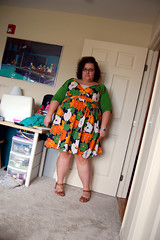
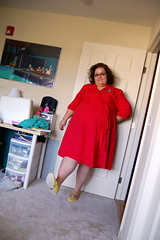
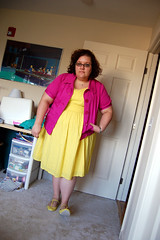
For years upon years I wore nothing but black. By this I don’t mean that I wore “a lot” of black, or that the majority of my wardrobe was black – I mean bloody everything was black. The most color you’d see on me was, maybe, if something had red stitching on it. The black was omnipresent enough that it became a sort of trademark; I was always that girl who wears black all the time. People remembered me that way. People would refer to me that way.
Black was easy. Everything matched. I could spill shit on myself (a common occurrance even today) and not worry about a stain ruining the garment forever. In a more visceral way, it was also deliciously dramatic and cosmopolitan. I will argue til I’m dead that everyone is saying something, intentional or not, with the clothes they wear – even clothes that offer camouflage or cover.
To invoke our own ever-brilliant stitchtowhere, who was quoting someone else that said:
“As a visible expression of the social order, grooming practices mark a society’s members by rank, gender, occupation, and age, and also communicate identity, affinity, or aspiration. Failure or refusal to groom communicates resistance, carelessness , or incapacity. Thus, it is never possible simply to “opt out” of the discourse of dress. No one can dress in a way that signifies nothing.” (Scott 12)
Black says that you’re Serious. Black says that you’re Not To Be Trifled With. Black simultaneously stands you out and renders you invisible.
At some point in the past few years I befriended color for the first time, really, since my childhood. To the extent that now it’s difficult for me to wear black at all, unless we’re talking about a job interview or a formal event or something requiring some other variation of a uniform. I like color – particularly bright, retina-searing color – for some of the same reasons I liked black. It’s memorable. It’s dramatic. It’s something people remember.
It’s also attention-getting. Culturally-speaking, fat bodies are earmarked as either invisible (insofar as getting no attention at all) or temporary (insofar as only getting attention as the “before” in a before-and-after, or as the warning against alleged bodily/moral iniquity lest THIS COULD BE YOU). Wearing color means making myself – and my body – visible in a forceful way. I’m almost impossible to ignore. I may be othered; but you’re going to see me no matter what, whether you like it or not. And truthfully, personally, I don’t particularly care if you do – visibility for me is only marginally connected to attractiveness, or about being seen as “pretty”. No matter my body size, no matter what my face looks like, the eye of the beholder rules the day, so in the end there will always be folk who find me unattractive or even repulsive. I can’t be arsed to worry about that, or to allow myself think it says something about me, since I can’t change it. And as is often repeated but less often heard in fat acceptance circles: you don’t have to be “pretty”. You don’t owe attractiveness to anyone.
No, for me visibility is – literally, simply – about being seen. Seen, as the great big fatass I am, contented and proud in my own skin; this is a miserably uncommon representation of fat people, and yet I know these folk exist, because here I am. And here are my fat friends who feel similarly. Where are we represented, where are our experiences reproduced? If I can’t see them in culture, I will represent them myself.
I wouldn’t argue that all fat people should demand attention. I wouldn’t prescribe behavior to anyone unless they were comfortable with it. I am mostly asking you to consider what you’re saying with the clothes you wear, with your style, or lack thereof. Is it you? Or is it what the cultural discourse says you should be?
Note: This post was written partly as a result of my thoughts while catching up on discussions elsewhere about Julia’s excellent post here last week. Just so there’s context.
Here’s the newsflash: Race affects me.
I’m white. I’m white as white gets. My background is an even mixture of Anglo-Saxon and German. You’d probably be hard pressed to find whiter. So white, in fact, that I could tell tales of overt, organized participation in racism amongst certain of my great-grandparents. As a child I heard elderly family members toss the N-word around at the dinner table. That’s my ancestry, that’s where I come from, in part. I’m fortunate enough to also come from other relatives who lived their lives in decidedly, demonstrably anti-racist ways, though not everyone has that balance. I think for all the indignance that a lot of white people engage when allegations of plain-spoken racism against people of color comes up, it’s probably a little closer to home than we like to admit. Generationally, we can’t be as far removed as we’d like to imagine, because culture didn’t change that long ago, and hasn’t really changed as dramatically as we like to think besides.
This affects me; race affects me. If you’re white, race affects you too. And I don’t mean other folks’ races, which is often the mistaken assumption a lot of white folks seem to make whenever the subject comes up. Being white affects you. It is a function of our privilege as white folks that allows us the option of living our lives without knowing the how or the why – an option, I might add, that is not afforded to the majority of people of color. Race ain’t something that happens to other people. Race is not external to you. Your race influences, to one degree or another, how very nearly everyone anywhere interacts with you, what they assume about you, how you’re treated in public and private spaces, the kind of attention you get, the expectations placed upon you.
Because most of these interactions and assumptions associated with whiteness are positive, we get to walk around feeling like nothing’s wrong, everything’s cool, race ain’t our problem.
That’s white privilege.
White privilege is being able to live our lives being positively affected by race in a million ways and never being compelled to notice or question or think about all that. Even though these privileges are usually gained at the expense of others. Even though these privileges are, underneath their shiny veneer, grotesque and unfair and plain old wrong.
Being both fat and white is, thus, an intersectional identity. My whiteness affects my fatness, and vice versa, and both in concert affect my social engagement with the outside world, in every culture, in every place.
White folks may be harder on me for being fat. They may be harder on me for being fat, and louder about it, than people of color are. They may be ruder; they may be more unabashedly disgusted and unforgiving. This isn’t because people of color aren’t also subject to fatphobia (participating in it or suffering from it); this is because institutionalized systems of oppression are such that white folks as a group have more cultural and authoritative oomph than people of color do. A person of color who openly disparages a white person for any reason in space that is dominated and controlled by white folks (that is, almost everywhere, and certainly everywhere that white people tend to go) is playing a very dangerous game. I shouldn’t have to extrapolate further on the potential outcomes of such behavior. Use your imagination.
White folks may also be harder on me, a fat white woman, for being fat than they would be on a fat person of color. This is not because it’s somehow more acceptable for people of color to be fatter, but because people of color are often invisible to white folks – othered, distant, ugly, inferior – and as a result when white folks see a fat person of color, I would argue that it’s somehow less a cultural affront. It’s less personally-identifiable. White folks see a fat person of color and know, conclusively – “That’ll never be me; no matter what happens, how I let myself go, that’ll never be me.†White folks see a fat white person and think, “Shit, if I’m not careful, if I don’t watch myself, that could be me. That could totally happen to me.†White folks see me and my body and it works for them like a cautionary tale; culturally, I represent the result of a lack of self control; I represent a horror of their own body.
The fact that white folks might be more candidly and vocally hard on me for being fat only speaks to white fatphobia – it says NOTHING about how POC deal with and understand fatness, no matter how common this extrapolation may be. No matter how many times we argue that this says something about the acceptability of fatness within different racial and ethnic groups, it will never be true. Making that argument presumes that white folk exist outside of race, that only POC have race, and that white is the default or the norm, and that race intersects with fatness only when the two happen, at the same time, to people of color.
People of color aren’t responsible for telling white folks how being white intersects with being fat, and it’s plain ridiculous to expect them to perform this service for us. People of color are often in the unenviable position of seeing white privilege – seeing us using it and accepting it and (un)knowingly reveling in it – more clearly than white folks do, and when we’re lucky these people of color will take a moment out of their day to inform us of what they see. But at that point it becomes the exclusive purview of white folks to understand their whiteness and how their race affects and amplifies and downplays their other identities and positions in culture and society (including but not limited to sexuality, body size, gender identity, dis/ability, and economic class). People of color have their own shit to work out. It’s offensive to expect them to help us with our issues as well.
You have race. No matter what your background is, or what your skin looks like, you have race, and it affects you, and it affects how your fatness (if you are fat) is received and understood as well, and just because different races perceive and process fat differently doesn’t mean one is better or worse than the other. Nobody lives outside fatphobia, and nobody lives outside racism. It’s everyone’s problem, and everyone’s responsibility to understand.
If you glean nothing else from this post, I hope you remember that.
I am helping facilitate the POC Caucus at this year’s NOLOSE, and I wanted to make the announcement to any folks who might be attending or thinking about attending!
Here’s our workshop description:
A supportive space for people of color at NOLOSE to mobilize, strategize, debrief, and discuss the intersections of race, fat, and other oppressions. During this session, we will examine such topics as:
* Identifying both successes and failures/challenges within the larger Fat Acceptance/Activist (FA) movement around its relevance and attention to POC experiences and needs.
* Identifying the strategic directions where we would like to see NOLOSE head and concrete suggestions or plans for how to get there.
* Identifying the strategic directions where we would like to see the FA movement head and concrete suggestions or plans for how to get there.
This session is closed to self-identified People of Color only.
Tara Shuai is a twenty-something biracial high femme New Yorker by way of DC and Richmond, VA. She is a lover of fatshion, social justice, blogging, and figuring out ways to live fabulously on a dime. Tara blogs regularly for fatshionista.com and her personal blog, contributes to Racialicious, and is the fatshion and beauty correspondent for FemmeCast.
Miasia Johnson has been black and fat all her life. She, however, didn’t know it until she was 10. She has had 32 years (this weekend! Woohoo!) of experience being a fat person of color, but only 22 being a conscious fat person of color. She’s excited to explore that consciousness at NOLOSE.
I am also going to try and push my own agenda for us as a group to publicize some sort of position paper or fact sheet as a result of our discussions and recommendations at the caucus. Kind of like a “We, the fat and POC people of NOLOSE 2008, want XYZ and PQR from the FA Community and from NOLOSE and this is how we think we can get there…”
 Two Whole Cakes is a blog written by