If you have issues with knee-high boots not zipping up over your calves (like I always have, even when I was thin — former dancer), here’s an idea that I came up with, that works great.
Lace them up with elastic.
Using elastic, you can lace them much more tightly, and still have the stretch to allow you to zip them. Once they’re on, you can adjust the elastic to be tighter at the ankle. I usually put them on to lace them, making sure that the elastic is not too stretched but also not completely relaxed, to get the best fit. I also usually make a knot at the ankle, because the elastic will move around over time, making the foot part too loose and the calf part too tight. Once you have the fit right, tie a tight knot at the top, et voila!
I prefer to use elastic cord from REI (which is still cheaper than most shoelaces). It takes about 10 yards per boot for a knee-high boot, depending on the number of eyelets. Just take the laces out and measure them, and get the same amount. Tie small knots in the ends to keep the laces from fraying. After a few months, the elastic may need to be shortened, and of course, you will have to replace it if you, like me, wear your boots for years.
If you can’t find the cord, flat 1/2″ elastic for sewing will also work, but not as well.

pictured: customized Fluevogs laced with flat elastic
Madelyn Boudreaux is a DJ, photographer, writer, artist, roller derby announcer living in Salt Lake City, UT. She is also a member of the fatshionista! livejournal community. This post first appeared there on October 17, 2008.
The Rotund recently reminded me: I got catcalled again a weekend ago, at the mall. Crossing the parking lot, in front of a car that was stopped in traffic, I heard someone yell something about the rate at which I was moving my fat ass. I’m assuming the context wasn’t in my being slow, since I’m a pretty rapid walker and had just passed a cluster of slender teenage girls meandering slowly toward the mall entrance. Maybe it was the rapidity that got their attention.
I didn’t even turn around when this happened, didn’t feel even a twinge of the old panic such events used to evoke. Without turning my head I burst into a big grin and gave said fat ass – which was facing the harassers at this point – a big theatrical smack with my left hand, without making even the slightest adjustment to my pace. It was a weirdly positive experience, like my brain had somehow reprocessed the negative intentions of the harasser and converted them to a positive reminder that yes, indeed, I have a fat ass, and I’m all good with that, and it’s pretty damn excellent, being all good with that.
This makes two such incidents in a relatively short period of time, which is unusual since I’ve gone literal years without being catcalled in this way. While I certainly suffer from the common affliction a lot of fat folks have – that of not having a real clear notion of how big we really are from the outside – if I weren’t so certain of my immutable dimensions I might be concerned that I was growing.
I have been the same size now for a long time. I keep control garments to verify this – two non-stretch dresses I’ve owned for a solid eight years that fit exactly the same as they did when I bought them. Truthfully, I am as baffled by the degree to which my weight and size remain steady as anyone else might be. I eat good food. I’m relatively active (and even when I’ve gone through phases of being extremely active over the years, my size does not change). This has gone a long way in cementing in my own mind that this is just the weight I’m supposed to be.
This has also gone a long way insofar as enabling me to assemble a wardrobe of clothes that I love.
As a fat, diet-obsessed adolescent and teenager, my clothes were usually temporary and utilitarian. I hated shopping because I hated the limited selection available to me (doubly awful in the pre-Torrid world of the early nineties), and because I was always dieting, always on the cusp of being the True Thin Me anyway, what was the point in giving much thought to what I wore now? This body wasn’t mine, it was transient. Soon it’d be gone. Why give love and attention to something you hate? That’s dangerous! If you let fat folks wear stylish, well-made clothing, they might stop hating their fat bodies so much! And then what would happen? They may stop dieting! Some of them, anyway.
The above was actually a common argument when Torrid first began garnering national attention – for many people, the idea of giving fat teens access to trendy clothing meant giving tacit approval to teenage fatness. Obviously, this suggestion is both ludicrous and insulting, because it implies that fat teens aren’t punished enough for their fatness without also denying them cool clothes, and by extension implies that fat teens need to be punished in the first place.
What’s funny about this is that it’s partly true: today, I am significantly less likely to hate my body and thus attempt to diet because I do have a wardrobe I love, and changing the size or shape of my body would mean having to leave those beloved garments behind. To make a potentially-ugly confession, I honestly shudder at the idea of my body size changing – be it fatter or thinner. My effortless size-stability is sort of a gift, I acknowledge, and renders my fatshion experiences very different from those of people whose bodies are constantly in transition, by accident or design. Today, my avoidance of changes in my size is not rooted in fear over my body becoming socially unacceptable – it already is. My concern over any possible bodily shifts – in either direction – is instead related to the worry that my current wardrobe would become unwearable.
I feel like I’ve worked too hard to carve out my own style to handle that happening with any sort of grace or aplomb.
Seriusly…..I received a dress (2 actually) from Alight (alight.com) about 3 1/2 weeks after I ordered it. They claim this is because they were moving warehouses and thus things were taking longer to ship. Fine. I receive both dresses on a Friday and return one promptly on Monday – it was a Mlle Gabriele brand and they always run small. This was September 30 or so.
Flash forward to today. They claim they haven’t received my return shipment. Their website says they are not responsible for lost packages. I just want the correct size of that very cute grey pinstripe shirt-dress. It’s been two months since I placed the original order.
Suffice to say the size variations and the Customer Service (track your package or we won’t deal? wtf!) are definitely hurting my wallet’s desire to return to them for fun fatshion. Yes they provide access to a variety of designers and fun options, but the risk of losing money and the irritation and annoyance of sizes being 2-3 times smaller than standard is just not worth it.
I’m sad that I lost out on $20 and a cute dress. I’m sad that Alight.com doesn’t value its’ customers enough to provide quality follow-up and believe us when we say something got lost in the mail. Asking a customer to insure all packages being mailed back is rather crude – as if the shipping costs to return aren’t large enough – as if waiting a week to hear from Customer Service weren’t rude enough!
Alight.com – thanks but no thanks.
Call it the magic of the interwebs – but the same day this was published I got an email from one very big boss man saying that my return (cough) was found (cough) and they’d ship out my exchange, sorry for my inconvenience, yadayadayada. I was dubious – what if I just stirred some pots and they were sending me a mumu to shut me up? I didn’t order a mumu, dammit!
I held my breath (sort of) and today came my proper exchange. My cute cute pinstripe dress (pictures to follow, y’know, when I wear it!) and in perfect condition. So hats off to you, Alight.com folks, for responding to the pissed-off-ness of the internet fattie and her quest for a hot dress. Thanks for (a)lighting up my life a lil bit on a Thursday morning.
Good thing this fattie has Patience.
Am I the only one who keeps finding myself in these situations?
I have a pretty diverse selection of friends, as a result of which I tend to end up at parties or general hangouts where I only know one person. These hangouts usually consist almost exclusively of women around my age (I’m 30), and there are almost always snacks involved. The conversation seems inexorably to turn to food, calories, dieting, etc etc etc—at which point the statements coming out of the mouths of these reasonably intelligent, educated women become increasingly preposterous. Playful debates over which calories “count†and which ones don’t; agonies over whether one should eat one more slice of pizza or “save some calories†for dessert; and of course, the martyr’s rallying cry of “I can’t—I’m trying to lose weight.†It’s like being in a Special K commercial. Except that I am not really in the commercial—there are never any fat girls in those ads. I am forced into horrified spectatorship, watching these nice, attractive, healthy women pillory themselves in the stocks of self-denial.
Having been raised by a relatively strict English mum, I have a certain amount of ingrained politeness that prevents me from clawing at my hair and screaming obscenities when I get trapped in one of these conversations. But they always end up reaching a point where I just can’t keep quiet anymore.
And then it happens.
Now, I’m probably dating myself here (I’m certainly not dating anyone else, HA HA), but when I was a child I used to be a devotee of the Marvel Comics character the Incredible Hulk. For those of you not familiar with the basics of Hulk mythology, Bruce Banner, a mild-mannered nerdly scientist type, receives a dose of radiation that causes him to transform into a gigantic walking tank—rage personified. This happens, predictably, whenever he gets angry, because rather than expressing his anger healthily, he represses it until it literally starts to bulge out all over him.
As a quiet, nerdy kid, I was totally fascinated by this character. I found myself wishing I could be even just slightly irradiated, in order to be able to ward off bullies in the schoolyard.
Now, as an adult, something very similar happens to me when I get trapped in these diet-talk scenarios: I become the Incredible Bulk. I bust out my ‘secret’ alter-ego of self-defined, unrepentant fat girl. Up until that point, everyone has (obviously) been aware of the fact that I am fat, but they are (to a degree) prepared to overlook that as long as I seem to worship at the altar of diet. However, once I start rampaging, the fat simply can’t be ignored.
Not that I start tearing off my clothes or throwing furniture, mind you (at least not until I hit the gin); it’s more that I go on the offensive before I even realize I’m doing it. I get into arguments and refuse to back down. And I tell total strangers that the essential ‘truths’ they’ve been told their whole lives, by everyone, are complete B.S. I’m not sure whether it’s damaging my cause more than it’s helping.
In one particular situation, a friend-of-a-friend had mentioned the well-known ‘fact’ that children were increasingly fatter with every generation, and I blew my top and started naming article after article from Junkfood Science that she needed to read before I was even going to listen to that crap again.
More recently, I was at a party where one woman was rationalizing aloud why she chose not to have a second slice of cake, and I burst out with, “Oh, for crying out loud, would you please just eat it?!†before launching into a long diatribe of the reasons diets don’t work.
I also gave a guy shit on a dating website (which shall remain nameless) for listing “being overweight†as a “habit†that he felt was a deal-breaker. (He contacted me, having clearly not read my profile, where I talked about my fat activism.)
I can’t deny that my alter-ego has been effective on occasion. People do listen to you when you’re being ranty, more so than when you are being polite, and the fact that you are so impassioned about something makes them curious enough to go and check it out.
A part of me hates that I am this person. I don’t want to become known as that rude fat girl who is always yelling at people to eat. I don’t want my anti-diet-talk to become as offensive to others as their diet-talk is to me. Because I try to respect people’s right to do things I wouldn’t do, like aspire to lose weight, in the hope that they, in turn, will respect my right to be unapologetically fat.
But it is just so exhausting to see beautiful, smart people agonizing over whether a cupcake is going to prevent them from reaching their ‘goal’ weight. Every time I hear talk like that, it’s like a slap in the back of the head, reminding me that some of these women would probably rather die than look like me.
So I’m not sure what the answer is yet, what form and voice my fat activism needs to take to be both striking and effective for others and comfortable for me. Perhaps there isn’t an answer.
Maybe the next time I rage out on someone, I will give them the link to this post.
The song is old (almost ten years old, which is making ME feel old), but I only recently saw the video. While it’s not directly fat-related, the video definitely has something interesting to say about the politics of willfully and unapologetically looking different in a culture that pressures folks to conform.
The lyrics consist almost entirely of the sampled phrase, “If everybody looked the same, we’d get tired of looking at each other.”
 Before I tell this story, I must first explain: one of my hobbies is cemetery photography. If you live in a place less steeped in history than I do, or if you’ve never visited a Victorian garden cemetery, this probably sounds a little strange. And, well, it is a little strange. But less strange than you might think, as I maintain that many old cemeteries are naturally photogenic places.
My favorite local haunt (see what I did there?) is Forest Hills Cemetery in Jamaica Plain, MA. I’ve been taking pictures there for many years, and have some favorite spots. This weekend I made the first in my annual series of trips to take pictures of the changing fall foliage. While I was there I had an unusual encounter.
I was spending some quality camera time with the monument I refer to in my head (and in photo captions) as Our Lady of the Strong Shoulders, who marks the Hammer family plot (the patriarch of which is called Thorvald, no kidding). Forest Hills – with its sprawling, hilly grounds, paved pathways, and beautiful landscaping – is a fairly popular spot for walkers in the neighborhood, and often while I’m there taking pictures I’ll see people strolling around. Usually I’ll exchange hellos, or maybe a comment on the weather. On this day, two middle-aged women came by as I was fidgeting with my tripod. When they saw me, one of the women walked over to me, smiling; her friend stayed on the path, waiting.
“May I ask what you’re photographing?” she said.
I explained that I particularly like the Hammer lady, that she may be, in fact, my favorite monument in the place.
“Oh!” said the cheerful walking-woman, who was tall and slender with a pageboy haircut. “We were just discussing our favorite monument!” Pause. Then, confidentially: “Would you like to know what it is?”
“I certainly would.” This woman seemed delightfully wacky and I wanted to hear anything she had to say.
“It’s a bronze bas-relief of a woman standing… I’m sorry, I’m reading your pendants.”
I was wearing the two word pendants I got on Etsy several months ago. I don’t wear them very often anymore, because people always ask what they mean, to the extent that I’ve developed a knee-jerk two-sentence explanation that I can hand out like a brochure.
The wacky/friendly woman read aloud, “One says prolix…”
And I went into my little spiel, “‘Prolix’ means wordy, and I chose it because for most of my life I’ve been somewhat notorious for taking a hundred words to say what others could express in ten,” the wacky woman nodded happily at this, “and ‘undulant’ means wave-like…”
“Which represents your body, your size! I see! That’s wonderful!” Smiling, nodding.
I sort of blinked and nodded. It was a pleasant shock. Usually my explanation of ‘undulant’ gets sort of a blank stare and a pause and then a rapid change of subject. There wasn’t a single false note in this woman’s voice; she made the connection with a unexpected lack of judgement or surprise. In other circumstances, her intuitive leap between “undulant” and my actual undulating body was so direct that to a different person she might have seemed rude. But I loved it, and it was a fantastic little moment of feeling understood.
For me, being an activist means not letting things slide; it means speaking up even when it would be easier to be silent. It means pointing out when people say things that are hurtful or offensive even when I know their intentions are good. It means occasionally being annoying with the politics and having to deal with the consequences of calling folks out who don’t want to be called out and who don’t know how to take it well. It means being unpopular some of the time, and accepting that. Thus, having moments like the one above, in which I don’t have to explain, or make my stand, in which I can just chill the fuck out for a minute and feel like someone gets me, without my having to explain, without that weird tension as whomever I’m trying to communicate with tries to negotiate the idea that maybe, not everyone automatically thinks of fatness as a bad thing. Maybe, some fat people don’t hate their bodies or want to change them. It’s a heavy concept, if you’ve never heard it before.
I only had a moment to let this sink in before the woman went on to describe the monument in question, and her friend joined in to describe its location (in a large Victorian-plus cemetery, even the most remarkable monuments can be difficult to find unless you know exactly where to look). Finally they left me to my picture-taking. As they walked off, I heard the quieter, more reserved of the two say to her gregarious friend jokingly, “You really ought to learn to be more outgoing.”
As a general rule I am a pretty reserved person. I keep to myself and prefer when others do the same. But I am, for once, pleased with someone else’s proclivity to extrovertedness. Because it provided me with such a great little moment of acceptance.
I have 10 fingers and 10 toes. I have two hands and two feet. Everything spaced equally, I can only count so far in one day. Thus I cannot quantify how many times a day or week “HELP MY HAIR” posts show up on the interwebs. I can’t tell you how often I feel for someone’s locks of lurve. But I can tell you how often I’m going to lament mine.
Ready?
Really?
…………………….> MOAR WAITING

I walked into a hip, posh salon and asked for assistance killing my ego. Well really I said “help, my hair is odd!” and asked for face-shape recommendations.
“How about some roundness?” the polite hipster asked. SURE!
I walked out with a round face and a round head of round hair sans the curls I heart so hard. I walked out wondering why round worked with round, why she didn’t say “how bouts we square it up for you?” and why I felt so nekkid.
Hair grows. Mine grows quickly so dreading haircuts isn’t necessarily important. But how often we rely on that ever-important first-impression-maker and beg assistance from people who give us those old stand-bys about chins and fleshy bits round our middles. Why we aren’t more adventurous.
Does this giant mass of hair covering my face make me look FAT?
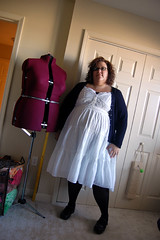
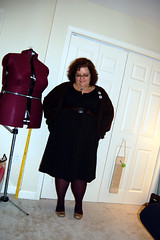
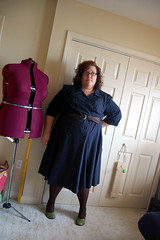
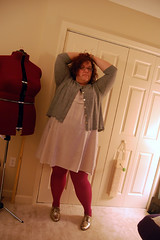
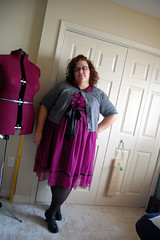

About thirty minutes ago, friend and fellow Fatshionista blogger etana was seated on the floor in my office with her dreamy guide pup D. We were talking about the eternally-limited resources for plus size clothing, and the need to Be Resourceful. Which got me thinking.
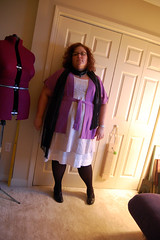
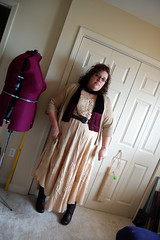
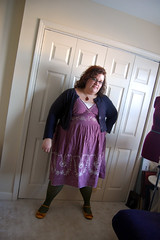
Often when I’ve posted outfit pictures – be it here, on Flickr, on the Fatshionista livejournal community – I will see comments from folks envying the apparently-awesome local resources I must have available to me for plus-sized clothing. It’s always with a bit of chagrin that I tell people how little of what I wear was actually procured locally. Sure, I live in a good-sized city, and I could hit up a Lane Bryant or three if I wanted, but I don’t much care for Lane Bryant’s goods, so I rarely do. In fact, everything you see in the above images – everything, right down to the accessories and shoes – was purchased online. Some of it was scoured from catalogs, some from online-only shops, some from the websites of big-name fatty chain stores, but every single piece was ordered online and shipped to me.
This is the norm for my shopping habits. Yes, I pay for shipping, but I typically more than make up for it in coupon codes (cough Retail Me Not cough). Yes, sometimes the stuff I order crashes and burns on me in the most horrific way and I have to send it back. Yes, it requires a lot of patience, and persistence, and shopping online is occasionally a big gamble that fails to pay off. But it’s also the only way I’ve been able to build the wardrobe I really want.
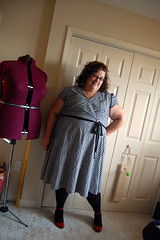
The one exception in this particular grouping is the dress pictured above. It’s a black & white gingham faux-wrap dress by Donna Ricco, and that dress I bought in person at Lee Lee’s Valise, in NYC, back in May of this year. Even at the time I was struck by the novelty of buying something in a store because I truly, breathlessly loved it, not because I was settling due to needing something right away, or because it was the least awful option available in a sea of awful options, or because it was on sale. The simple act of trying something on, and having it fit, and loving how it looked, and being able to buy it and take it home right then – I know this is the standard operating procedure for a lot of women, especially a lot of women thinner than me, but it was a big freaking deal for me. To the extent that I have a hard time imagining what it’d be like to do that all the time.
There’s a health food take out place a couple doors down from my job. Their tagline is something like, “No fried foods, no mayonnaise, no soda, no butter, no bacon, no white bread.”
Sad for them, but I usually just walk on by. Yesterday morning, several of their employees were handing out menus. We actually already have their menu at the office, so I politely declined.
“SE NECESSITA!” called out one of the guys. You need it.
I turned around, smirked, and threw my middle finger in the air. I turned away, walked another 10 feet, and stepped into my building.
Thought #1: I knew this was bound to happen eventually. In New York, as in many other cities, people get paid by their companies to hand out flyers, menus, and coupons. I once had a man look me up and down, see his face light up, cross the street, and make a beeline to me. He handed me a “lose 35 pounds in 30 days!” flyer. I always cringe when I see someone flyering outside of a gym, because I know they will always give me something. I always refuse, and I always expect them to say something when I do.
Thought #2: Oh god, I’m going to have to see this guy all the time. And sure enough, at lunchtime, he rode by me on a bike, on his way to deliver someone’s lunch.
I bitched about being harassed to my co-worker, who commiserated about how inappropriate it was of him to say that. Today, on my way to grab a sandwich, I passed by the restaurant again and decided I was going to say something. I thought about the best way to do it, and started thinking about the guy who told me I needed it. I thought about those flyering jobs, how most people are probably rude to him, or simply deny his humanity by ignoring his presence when he’s just trying to do his job and give away a menu. Most people probably don’t even say no; I see them keep their eyes forward and studiously ignore the person they just don’t have time to say no to. I thought about how people paid to flyer are almost always men (and sometimes women) of color, and how they’re probably paid very little.
I didn’t want him fired.
After getting my sandwich from the deli a block away, I walked back to the restaurant, took a deep breath, and walked in. Nervous about the fact that there were other customers around, I pushed past my anxiety and politely asked to speak to a manager. She was a youngish woman of color, and probably gets paid cents more per hour than her co-worker who I was there to complain about.
I told her what happened, and told her that I thought what he said to me was inappropriate. I said it calmly and politely, careful not to be rude or demanding. In this situation, tone was important to me. As an upwardly mobile woman of color, I clearly have class privilege over folks in the service economy, and I didn’t want to assert my authority as someone with (more) money by being demanding and reinforcing those hierarchies. Too often, I see folks with relative degrees of privilege react to situations like these by displaying what I consider to be abusive treatment to employees of large corporations who often have little or no control about the policies they seek to change. I’ve also been on the receiving end of this, having had many jobs in the service industry before I started my salaried career, and I wasn’t interested in recreating those experiences for someone else.
The manager immediately apologized and agreed that what he said was not ok. “Can you describe him to me?” she asked. “No, I don’t want to get him fired,” I replied. “Please just tell all your guys not to say things like that to the people they’re trying to give menus to.”
I asked her if they had menu quotas and she told me they did not. She asked me again if I wanted to tell her who he was and I declined again. I thanked her for listening to me, and I left, my mouth dry and my heart beating loudly against my chest.
This year, my goal has been to challenge myself to speak up. Speaking out against oppressive comments is easy on the internet because writing is the easiest form of communication for me. In person, I get tongue-tied, nervous, sweaty, inarticulate.
I still worry that the guy might get fired. If everyone gets lectured, it’s possible that his co-workers will tell on him. I really struggled between my need to speak up and my acknowledgment of the many sociopolitical factors that probably brought this man to say what he did.
All of this is to say that this shit is complicated, and I don’t know that there was one right answer. I hope I did the right thing by myself, by him, by my communities.
This was too good to pass up. Regarding the recent NOLOSE conference, blogger Adrienne had a few questions and a call for discussion to put up on the interwebs. We thought the folks at Fatshionista.com would enjoy a chance to chomp the bit…..
I am in favor of a conference about queer fat politics that attempts to take into account “the intersection of all our identities,” providing a forum for much-needed conversations. As I reflect on the conference, however, I continue to feel uneasy about some of the ways in which intersectional politics were framed. Conversations conference attendees seem to reveal that one of the principal criticisms of the conference was that, while workshops and other events focused on foregrounding identities other than queerness and fatness, specific conversations about queerness and fatness and their intersection were all but absent. Indeed, I agree that there was an extent to which the connections between queerness and fatness were assumed, within the context of the conference, to be a “done deal,” apparent and obvious to all attendees. Which is, of course, not the case, and we have to be careful not to make that assumption.
More specifically, though, my principal concern with the framing of intersectional politics at NOLOSE– in the keynote speech, and in some of the workshops I attended– was the assumption that these discussions about intersectional politics are taking place in the context of a movement that already exists. In other words, one of the conference’s founding assumptions seemed to be that all attendees have equal access to an in-person movement where discussions about queerness and fat oppression are already taking place, and that our principal concern with intersectional politics is to inject a broader analysis into a conversation that is already taking place, everywhere.
As a queer fat woman in a small town, I do not live in a place where the intersection between queerness and fatness is a “done deal.” In fact, I don’t live in a place where queer and fat issues are separately taken into account. Again, as a graduate student, I have access to resources that not all small town residents enjoy, but I still wouldn’t say that I belong to a queer “community” here so much as a group of queer friends– and, because of queer alienation and invisibility in small towns, even that has taken months to cobble together. Here, I’m just beginning to hear the barest whisper of discussion about fat politics– and again, that only because I have access to a campus.
In workshops, I heard quite a few people from urban settings note that NOLOSE was a safe space for them, because most of the time they felt surrounded by thinner people, and thus marginalized as fat people. I suppose it’s true that fat bodies are more visible in my Midwestern small town. But I’d like to remind people that, just as being surrounded by women does not necessarily mean that one is in feminist space, living in an area with more fat bodies does not necessarily mean that one lives in a fat-positive environment. I have many fat friends, but quite a few of them are enrolled in Weight Watchers, and many others struggle in less formal ways with accepting their size. Consequently, the conversations I have with people face-to-face are still quite elementary: debunking the obesity epidemic, explaining Health At Every Size, attempting to demonstrate that fat acceptance is a valid social movement. I cannot afford to assume that queerness or fatness, let alone the intersection between the two, is something that does not need explanation.
This is not to say that I have no use for intersectional politics. In general, I think that the trajectory of most social justice movements is problematic and needs to change: you know, begin with a single-issue movement, universalize the experiences of the most privileged members of that movement, piss off a bunch of marginalized groups, and then attempt (or don’t) to build a more intersectional approach once the already-biased base has already been formed. It would, I think, be really nice if, in my current environment, I could help to build queer and fat communities and movements that are intersectional from the get-go. But in order to do that, intersectional politics needs to be reframed as the founding basis for a movement, not something you work to achieve once certain structures are already in place. And that reframing, I assume, is something that would benefit all queer fat folk, not just the ones who don’t have urban privilege.
Different Stakes, Different Strokes
I’d like to thank GM for help on this next point: it was his offhand comment in the “More Than Just Fashion” workshop about rural settings that helped me solidify what was, until that point, a series of inarticulate misgivings into a full-fledged analysis. In that particular workshop, we discussed what C has called the “NOLOSE Fashion Olympics”: the perceived pressure on the part of several conference attendees to dress in certain fashionable ways, possible issues of exclusion that issue from the pressure to dress up, and the meanings of fashion and exclusivity in a conference where a) sexuality and sexual desirability are foregrounded, and b) issues of race, class, gender, size, shape, age, and so on are always already present.
All but absent in this conversation, I think, is the particular effect the Fashion Olympics may have on rural conference attendees in particular. Foremost, of course, is the question of material access for fatties in small towns. Internet access may work to some extent to level out the playing field in terms of clothes shopping, but shipping costs, the logistics of having to return clothing that doesn’t fit, technological savvy, and other factors may work to limit equal access in a small-town setting.
Throughout the course of the conference, both Gini and I heard some urban conference attendees display contempt for some of the major brick-and-mortar plus size clothing stores, such as Lane Bryant, Fashion Bug, and so on. I’m very much in favor of supporting independent vendors whenever possible, but the fact is that because I live in a small town, I’m basically thrilled whenever there’s a store with clothes in my size that I can walk into. I’m lucky enough to live in a place with a Lane Bryant, Fashion Bug, and Torrid in relatively close proximity– but even then, all three stores are in towns half an hour away, and because I don’t own a car, I’m at the mercy of friends whose shopping moods and financial windfalls coincide with my own. Let’s not forget that being able to shun the principal paths to plus-size fashion is, in and of itself, a privilege.
More important for me, I think conversations on the Fashion Olympics and NOLOSE sexual economies failed to take into account that, due to our differing geographical locations, attendees have differing emotional stakes in the conference. In particular, I am thinking about a comment during the “More Than Just Fashion” workshop asserting that conferences are perhaps more fun, and less stressful, if one does not attend with the expectation to participate in some sort of sexual economy, and/or if one does not attend with the expectation that NOLOSE will be the place where one is accepted. I think that kind of nonchalance is much easier when one lives in an urban setting, with a vibrant queer community and a significant fat-positive voice, where access to social acceptance and sexual currency is much easier to come by. But while, for some attendees, NOLOSE is a place where they can focus their energies and bring their experiences back to already-vibrant communities, for many rural attendees, NOLOSE is the only place where we can hope to depend on social and sexual acceptance. Many of us come to NOLOSE– I certainly did– with the knowledge that what community and connection we don’t find at the conference, we will almost certainly not find at home. That automatically raises the stakes for us.
As such, when we talk about fashion and exclusion in a setting like NOLOSE, we need to take into account not just differences of material access for conference attendees, but also emotional access. We must also realize that small-town queers may not have access to the social connections enjoyed by urban queers, and as such, gaining entry to the social life of the conference may be more difficult– a problem compounded by these increased emotional stakes.
 Two Whole Cakes is a blog written by