I’m now the proud owner of these high-waisted lamé shorts (in silver dots/back) and I intend on wearing them… IN PUBLIC.
My birthday theme this year is “the future” which i’m choosing to interpret as amped-up-hipster-meets-ziggy-stardust with a bit of superhero twist. (the beauty of this theme is that it is very, VERY, LOOSE).
Lamé-curious fatties on will want to know that even though most AA lamés only run up to an L and look, to the naked eye, like bathing suit bottoms for the size 18 MONTHS crowd, my profound derriere–which is a 20, 22, or 24 depending–actually fit into them without harm or foul. I didn’t have to have to jump into them from a second story window, nor did a team of dedicated professionals trained in the precise art of lamé extraction have to be deployed to remove me from their shiny mettallic grasp. once they were on i did not even “ACK!” in the change room.
Lamé hotpants are like the ne plus ultra of FATTIES SHOULDN’T WEAR THAT, which, it should come as no surprise to many of you, makes me like them that much more. It amuses me to think that narrow-minded concern troll type people hate fat acceptance precisely because they are worried about this sort of thing happening. They are fearful, that fat acceptance will challenge and collapse exclusionary/meritocratic ideas of fashion and OMG MAKE FATTIES THINK THEY CAN WEAR SPEEDOS ALL THE TIME !!!11onety!! when they should obviously “earn that right like everyone else*”. It’s absurd. It’s my experience that the more you have the unwavering the presumption to be who you are the less you stand feel violated by another person’s refusal to conform to dominant–and usually limiting–ideals. There are always going to be things that don’t appeal to your individual aesthetic, but there is a world of difference between not wanting to wear something because it doesn’t move you, versus feeling that someone else doesn’t have the right/deserve to dress how zie wants simply because you don’t like it or don’t feel confident enough to wear it yourself. More than that, there is a stark difference between thinking an item of clothing is fug, versus directing palpable hatred at the person choosing to wear it. I mean, really, how repressed/frustrated/bored/boring is a person if someone else’s going about their business in a neon unitard makes their baby jesus cry. What must their priorities be?
In the spirit of that stellar post of Fillyjonk’s I just linked to, it occurs to me that a large (har) population of lamé hotpants-clad fatties taking, unapologetically, to the streets is probably many peoples idea of what a horrific apocalypse of cultural and moral values would look like. To these people, I–all 5′3, 250 comma-splicing pounds of me–have the potential to be very terrifying. And not just, peeking-through-your-fingers-at-a-horror movie terrifying but actual HARBINGER OF DOOM, capital T-my-world-will-never-be-the-same Terrifying. And you know, not to give myself too much credit, but I WISH it were that easy. If my wearing hotpants 8 days a week could actually bring about a swift and dramatic shift in the way many people view fat, fashion, feminism, and humanity–a literal cultural and moral apocalypse–I’d strap those suckers on, saddle up my tiny pony, and usher that mother the fuck in, already.
*aka hateful people who were born thin. or hateful people who weren’t but discipline and punish their body to stay/get that way, and would like you to suffer too, goddamnit. because if you don’t buy in, what the hell are they so hungry for?
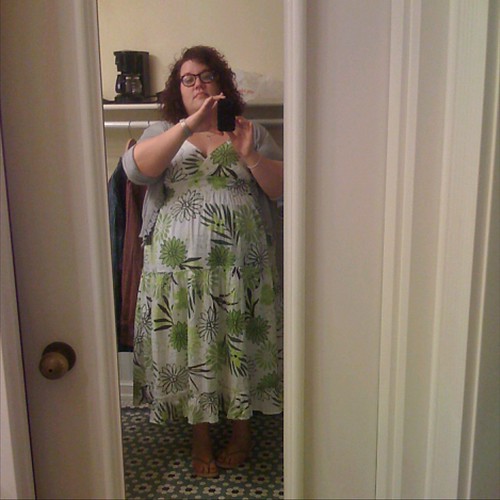
My long silence is explained! I’ve been off on holiday in Florida, hence the mirror photo above. My vacation was fabulous in spite of the fact that Disney-licensed Crocs were, hilariously enough, involved (I wonder how many people will never trust anything I say about style again, owing to that little confession?), because I also got to go to Ross, AKA Ross Dress for Less, aptly named for reliably having a huge selection of dresses, even in plus sizes (up to 3X or a 24W, generally-speaking). We don’t have Rosses this far north, alas, though I grew up with them as a kid in Florida. I have unsurprisingly returned to Boston with a truly ridiculous number of cheery printed sundresses (mostly Speed Control/Mlle Gabrielle/other-Blue-Plate-clone brands) for a maximum of $15 each, when I’d pay easily two or three times that from Alight.com.
I know some folk don’t think much of Ross, and it’s true the stores can be disorganized and unkempt, but maaaan, it’s all worth it to so fully satisfy my passionate dress desires. If you can deal with the occasional smudge of shopdirt and having to stand in line for twenty minutes to make your purchases (UNIVERSALLY TRUE!) and you are out for dresses, then I’d suggest giving Ross a chance. Sadly, everything not on the dress racks was sort of crappy, but considering the alternative is Marshalls or TJ Maxx, which rarely carry any plus-size dresses at all, then I can live with that.
In other news, via the Fatshionista LJ community, it turns out Forever 21 is launching a plus size line on May 1, to be called Faith 21. (An aside to any F21 marketing/branding folks who might be reading: why “Faith”? I am dying to know.)
More than that, it’s evidently fatty-fashion week at the LA times, which has two (YES TWO OMG) other interesting pieces on plus-size “designer” fashion (or the lack thereof) up right now. Read them here and here.
Finally, Lane Bryant has taken up twittering. Weird? Useful? This strikes me as more odd, personally, as Lane Bryant’s current dumpy-or-dull offerings are hardly speaking to the mostly-youthful Twitter audience. Or maybe it’s a positive sign of things to come.
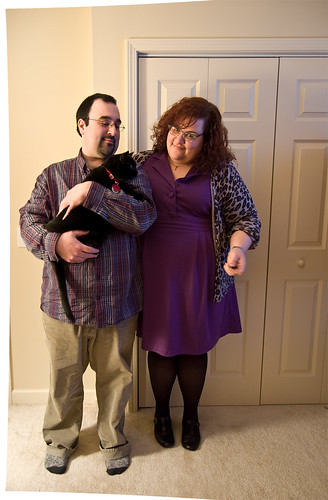
I met my husband on the first day of classes in January of 1998; I was a junior, he was a grad student. A compulsive flirt, I (inadvertently) tipped my hand early on in our interactions such that it was plain that I dug him right away. He asked for my phone number; I gave it.
Then he didn’t call. Weeks passed, and nothing.
I don’t actually remember thinking too deeply about it at the time; we saw each other in class twice weekly and we were still friendly, so I figured he’d changed his mind, or forgot, or whatever.
Years later, he would confess that part of his long indecision in calling me for a date was rooted in the fact that I was fat, and he’d never dated a fat girl – or at least, a girl as fat as me – before. Leaving aside this common double-standard of a fat guy being reluctant to hook up with someone equally fat or fatter, I’ll note we were were both less fat back then – I was working too much (in a convenience store), partying too much (rest in peace, ManRay), and stressed out all the time (both of the above plus full-time studenthood), and was descending to the smallest I’ve been in my adult life, which was around a size 18/20. But I was still fat, for sure. Hearing this honesty from him so many years after the fact was weirdly gratifying, as in those days I was often wondering if potential paramours who weren’t calling were put off by my fatness, or whether it was something else. It was a pure moment of “I KNEW it!” out of the obscuring fog of my friends at the time repeatedly telling me, “No, you’re not fat, I’m sure that’s not why so-and-so isn’t interested!” Maybe not, friends. Denying it doesn’t make it go away.
Most of my romantic endeavors prior to this were a balancing act of knowing, realistically, that I was less likely to get macked on as a fatty, versus working (really hard) to believe that I nevertheless deserved romancing by someone who sincerely dug me back, regardless of my size.
Clearly, the guy who would become Mr. Lesley eventually got over his worries and called me. And we dated, yadda yadda yadda, we’ll be married six years in August. That’s not the happy ending to the story, however – marriage isn’t for everyone, and merely landing a significant other doesn’t necessarily erase the worries that one is undeserving of romantic attention.
The happy ending to the story is the fact that I was ultimately successful in my efforts to learn that I was valuable and worth romantically pursuing even as a fatty. That I was – and am – intelligent and interesting and occasionally hot, no matter what my body looks like. As much as I love my husband and I love being married, coming to realize that, independently of any would-be beau’s interest in me, was the best part of all.
You don’t need someone to be actively loving you in order to believe that you deserve love. Ideally, when it happens, it should be a confirmation of what you knew all along: that you’re awesome, and worth being pursued, and worth loving.
Via AdFreak, the creepily-named “Active Life Movement” organization is warning parents and kids of the dangers of fatness by… imagining what fat toys would look like. Click any of the images below for the giant screen-filling versions.


The tagline for this campaign is “Keep obesity away from your child,” but I am failing to understand the connection. Is it that you should not allow your offspring to play with nonexistent fat toys? That you should keep fat people away from your kid?
If the concept is that the non-fat versions of the above toys often operate as role models for kids, then that’s even more bizarre. Are we really okay with our kids wanting to be pirates when they grow up – so long as they’re thin? The use of a Barbie-like doll is particularly baffling, considering that the “normal” Barbie body, with its gigantic rack and tiny waist, is WAY the fuck out of proportion with what a healthy child’s body should look like.
On the upside, taken out of context, these are some spectacularly fabulous images. (And cropped versions will inevitably be turning up as icons on LiveJournal in 3…2….1…..!)
Today I was on amazon.com – this is not unusual – and upon adding one of my purchases to my shopping cart, a bunch of weight-loss memoirs popped up as “recommended items”.
Arguably the weight loss memoir is a very new genre, one that can probably be traced from the beginnings of large-scale (will these puns NEVER get old?) obesity epidemic hysteria. And I’ve talked about them before, in one of my favorite-ever rage-fueled rants. However, I had not realized there were so very many weight-loss memoirs now. I’ve noticed that most of them seem to be culled from weight loss blogs. I’ve also noticed that most of them seem to come from women who were my size or marginally bigger at the time they had their HOLY SHIT I’M FAT Wake Up CallTM. The language used in these books’ blurbs – language describing life in a body my size – is fascinating. These people were “outcasts”, they were lonely and unhappy, they hurt all over, they couldn’t do anything, they hated their lives.
It’s always: “I was miserable and alone, I hated myself, but then I lost weight and everything was better!”
Though my control over this sort of thing is pretty much nil, it’s distressing to see life in a body that weighs as much as mine (I will stop short of calling these bodies “like mine”, since clearly they’re not) so overwhelmingly represented in such unfamiliar and negative ways. I’m not calling the weight-loss memoirists liars – they are, I presume, just telling it like they see/saw it – but where’s my experience, or something at least similar to my experience, represented in print? Nowhere, man.
Probably because my story wouldn’t be nearly so compelling. My memoir – in elevator-pitch (in a very tall building) form – would go as follows:
I can document my awareness of being fat going back to when I was nine, though I’m quite sure it was present sooner – I just have it written down for the first time (in a diary) at that time. The overarching theme of my entire childhood and adolescence was my desire to be thin; I can’t remember a point at which this wasn’t a constant thrumming in my mind, when it didn’t influence every decision I made or how I saw myself. I dieted continuously – my weight going rhythmically up and down – from sixth through eleventh grade. At 18 I left Florida, moved to Boston to go to college, and due to the regional cultural differences, for the first time in my life I started to feel like I wasn’t a complete pariah just because I was fat. People liked me. People wanted to DATE me. And I was STILL FAT. I still thought they were kind of crazy but I was coming around. Eventually I started reading things (Fat Girl Dances with Rocks, Shadow on a Tightrope, eventually Fat!So?) that reinforced the idea that there were fat people out there in the world who didn’t hate themselves and who didn’t hold themselves back from achieving their dreams just because they were fat. They weren’t waiting until they were thin to perform onstage, to dress ostentatiously, to express themselves, to fall in love. They were just doing it. I started just doing it. That was twelve years ago.
Obviously, a whole lot of stuff happened in between these events, but this is supposed to be an elevator pitch, after all.
Ultimately, my fat memoir would come down to: “I was miserable and alone, I hated myself, but then I stopped and everything was better!” I’m not sure this is the kind of thing people want to read – it’s got the whole Triumph In The Face Of Adversity Angle, for sure, but there’s no neat and tidy happy ending, no measureable physical transformation, and perhaps most importantly, no tales of enduring brutal sacrifice and shame to reach an arbitrary goal. Maybe people don’t want to read about being happy with what you’ve got. Or maybe they do, but nobody’s writing it in memoir form.
Have any of you read any of these memoirs? I’d love to hear others’ thoughts on the subject.
There is no shortage of slut bashing in this world.
I remember one of the first times my mother told me that what I wanted to wear was inappropriate. I was about 8, and loved wearing bright colors and crazy patterns (clearly, not much has changed!). I had this gorgeous white ruffled tank top that I inherited from an older friend, and that I thought looked fantastic on me. My mom saw me in it and told me that I couldn’t wear sleeveless shirts because my arms were too fat.
When I was 12, I had bought my first black miniskirt, and remember walking home from the bus while the mean boys in my neighborhood shouted insults at me, taunting me. “Do you have a boyfriend? Tell us his name!” they sneered. Later that year, the popular girls in school talked loudly and pointedly behind me about how some girls had legs that were too fat to wear knee socks like the ones I happened to be wearing.
A few years after that, a rumor circulated around my high school that I would sleep with any boy who would date me. Yet, I had never even kissed anyone at my school, let alone slept with them. It had everything to do with the fact that I was a punky girl who wore tight pleather pants, red patent stilettos, and had pink hair and her eyebrow pierced.
After college, I had a job at a health food store where my standard work outfit was a pair of pants and a form-fitting shirt. One day, I was crouched down to rearrange some cans when the owner of the store walked behind me. She bent down and without asking, tugged down the bottom hem of my shirt. “Too much skin was showing,” she explained, referring to the 2 inch span of lower back that you could see when I was bent over.
I also remember my first femme idol. I remember how I saw her out at a queer event, and how long and how hard I stared at her. She had had the audacity to wear a corset that prominently displayed her extremely generous cleavage. And a short skirt. And heels. And she was fat. I remember the simultaneous feeling of discomfort and envy. I wanted to be that, to look like her. I wanted to be a larger than life sexpot who everyone in the room turned their heads to. But I also couldn’t imagine willingly showing off my body like that. I didn’t wear my clothes baggy, but I also didn’t dare put it on display like she did.
Pretty soon after that, she became my friend. And I started exploring what it meant to be femme. My friend wore delicious curve-hugging clothes that highlighted the shape of her body. I was fat too, and had only ever learned that fat was meant to be tucked in and molded. My friend paid no attention to any of the old rules I had come to live by, and I found myself constantly challenged and in awe of her bravery. Even though we were friends, I still remember that simultaneous feeling of discomfort and envy when I watched her take fashion risks that I couldn’t even imagine daring to try. I had been taught to be my own body police.
Over the years, as I’ve built up an incredible community of queer fat femmes in my life, I’ve also seen the slow and steady evolution of the comfort I have with my own body. In these years, I’ve had many firsts. Wearing my first mini-dress in public. The first time I wore a dress so tight I couldn’t sit down very well in it. My first bikini. My first bikini on a public beach.
In the queer fat femme context from which I operate, blatant displays of the body can be sources of power and strength. We wear our sexualities like rhinestone-covered girl scout badges, showing off for ourselves and each other as much as we do for others. No, you don’t have to wear something short or tight or sparkly or see through to be seen as sexy in my community, but those things also aren’t judged as “too much.” In my world, “too much” is not just accepted, but welcomed. I see my gender as a simulacrum of womanhood; a copy of a copy of a copy that I’ve remixed, revamped, re-imagined, and reclaimed.
And this is also why, when someone tells me that my clothes are “too tight” and that “you don’t have to wear tight clothes to be sexy,” I feel rage. I wonder if they know how hard I had to work just to feel like I was even allowed to wear those clothes, much less feel confident and beautiful in them. I wonder if they’ve ever been slut bashed, and wonder if they’re policing my fashion because they’ve been slut bashed. But I especially don’t understand it when those criticisms come from other supposedly fat-positive people, because in my world, letting the outline of your belly show in a dress, or wearing something sleeveless that doesn’t hide your arm fat isn’t just ok, it’s appreciated. Tight clothes on fat bodies are inherently political, and I would even say moreso when those tight clothes look damn good and are worn with pride.
I don’t need everyone to like the clothes that I wear, but I am also attuned to the undercurrent of slut shaming that is so often levied against people who wear revealing clothes. I would ask those people who feel discomfort and/or disgust to think about what it is that’s behind those feelings. It took me years to unlearn all that crap that I had been fed about the appropriate way to wear my fat, and I still have days where I cringe at the sight of my belly poking out in a dress. But then I also remember that embracing my fat and being body positive isn’t just about loving the “acceptably fat” parts of me (i.e. tits and ass and hips). My belly deserves to be honored too. And, like a wise friend of mine once said, “Back fat is the new cleavage.”
Lesley’s Late-Season and Therefore Possibly-Not-That-Useful Guide to Tights
By Lesley | February 10, 2009
There are three things I hear really, really often:
1. “Whoa, how many dresses do you own?”
2. “Do you EVER wear pants?”
3. “Where do you get your tights?”
The answers are:
1. A whole lot. I haven’t counted, but I would guess it’s more than a couple dozen.
2. Yes, but generally only on weekends, and always only under dresses.
3. How serendipitous – that’s what this post is about!
I am compelled to reassert this, as it doesn’t always come through adequately in pictures: I am quite fat. I wear, generally, between a 24 and a 28 from most major manufacturers. When I’m shopping for clothes, sometimes the biggest size available at Lane Bryant or Torrid is not big enough. This does indeed give me more options than folks who reliably outsize these stores, but it means I have markedly fewer options than smaller folks. As a point of reference, I am about 5′9″ tall, my calves are about 21″ around at their widest point, and my thighs about 30″. In case the pictures of me already plastered on this blog are not enough, you can see more of my actual legs in action doing the important job of holding up my body on my Flickr stream.
I get my tights from a few places, and have strong opinions on all of them. Please keep in mind, however, that your mileage may vary dramatically from mine. Everyone’s shaped differently and tights that work for me may not work for you even if we’re the same overall size or weight.
Avenue: In a curious twist, Avenue’s house brand tights seem to have vanished from their website. All they’re showing right now for tights are the Sara Blakely Assets things you can also buy at Target (and which I will not be reviewing here because I Don’t Do Control Top, Ever). It’s possible that this is because they’re gearing up for spring, but I’ll talk about them anyway. Avenue’s tights can be extremely hit or miss – occasionally I’ll get a pair and find them pre-punctured for my convenience with a big random hole. This has happened more than once. The pairs that come into my possession hole-free are wildly comfortable (I get them in size E) and long-lived; I have Avenue tights from last year that look like new. But they can apparently be a bit of a gamble. Avenue does offer some muted colors outside of the standard black and brown (their grey and burgundy tights are my favorites) and some great textured and patterned versions that are impossible to find anywhere else in larger sizes – this year they had argyle and chevron-patterned versions that were really striking.
Jessica London: Do you have insanely long legs? Have I got tights for you. I’ve not ordered tights from Jessica London since last year, but holy crap do they ever run long (in the larger sizes, at least – the tights may very well get longer as well as wider when they’re sized up). They also come in colors! Yay Jessica London! They’re only available in packs of two (this has always bewildered me, but okay) and the quality is good but not outstanding. Also, the sizing can be completely random; if I’m buying clothing from Jessica London, I generally need a 28 or a 30. If I’m buying tights, I actually need to size down, which goes against all my hard-won tights-buying wisdom.
Lane Bryant: Evidently Sara Blakely is plotting dominion over all our fat asses, since the tights currently on the Lane Bryant website are all Spanx, all the time. Nevertheless, Lane Bryant also has house-brand tights, usually in the fall, and they’re just okay. Part of my “meh” reaction to them is that their largest size is just a little bit uncomfortable for me. I have a cute pair of lace tights from LB which I sadly never wear because they have the aforementioned hated control top. Basically everything here, even the patterned stuff, only comes in black and brown, which is boring as hell. That said, their tights are true to size and hold up well.
Torrid: I have had three pairs of Torrid tights in my life, and I am not hugely fond of them, mostly because they’re usually both a bit too short (yay, falling crotch! my favorite!) and a bit too snug in the thighs (yay, lack of circulation! my favorite!). To their credit, though, if you can fit them, they’re of reasonably good quality and offer some truly crazy-ass tights options, as well as some crazy-ass tights-like but not-really-tights options (purple lamé leggings, anyone?). The fucking accursed Spanx are present here as well. GO THE FUCK AWAY, SARA BLAKELY. I DO NOT WANT MY ASS COMPRESSED.
We Love Colors: Up until they revamped their plus size tights section and added a version with lycra in it, I hated this place. Their old tights (don’t buy those!) were 100% nylon and I’ve yet to meet a single solitary soul who had a good experience with them. The crotch slid down, they bunched at the ankles, they didn’t fit right in the thighs; everyone complained. Their new lycra-blend tights (that’s the good, buying-friendly link) are more expensive but worth it, since they’re actually wearable (after all, what’s the good in saving $6 a pair when the cheaper ones don’t get worn?).
This is where I get basically all of my colored tights at this time (BUT ONLY THE LYCRA ONES, in a size E). I have worn them all season long, almost every day since late September or so. I wash them in the washing machine on the delicate cycle and then hang them to dry. Despite all this abuse, only one pair has a teeny hole developing in the crotch area – and since it’s in the crotch area, it’s not going to run down the leg, so I’m not stressing about it.
In conclusion: old, non-lycra tights bad; new, lycra-having tights good.
That pretty much sums up my sources for the tights I wear daily in the fall and winter (and part of the spring). I hope it’s helpful. Is there someplace I’m missing? Have you had great luck elsewhere? Let us know in comments.
A few days ago I got an email on a subject I’ve actually gotten several emails and comments about recently, and which (for my own stupid reasons which are delineated at the end of this post) I have avoided discussing:
As a wheelchair user the biggest insult people seem to throw my way is that I am fat. I am beautiful. I hadn’t let myself be photographed for a long time and a friend snapped a candid photo of me and for the first time in my life, 100 pounds heavier than I used to think was fat (I am only 260 at 5′6′’) I finally saw how beautiful I am. That was my reaction to the picture.
I want to know why I have to justify my weight. A blind person and I started to discuss things recently and she actually told me I should find a way to excercise, when my doctors insisted I stop due to the sheer danger of it and my fragility. Why is it the world’s business if I am heavy? Can you address this for me, and others?
When did my body become public property? When did it become alright to tell a person in a wheelchair to get up off of their fat ass and walk? Why is this socially acceptable and if I call someone on their wretched behavior I am the villain?
Let’s be clear, for any new folks in the room: your body is not public property. Your body is not public property if you’re disabled; if you’re a sex worker; if you’re female or female-identified or of indeterminate gender; if you’re ill; if you’re scantily dressed; if you’re homeless; if you like boys or girls or both or neither; if you’re pregnant; if you’re a person of color; if you’re intoxicated. There is nothing you can do that makes your body public property – no action you can take, no decision you can make. No one’s body is public property. Everyone’s body deserves individual respect and recognition; there are no circumstances in which this isn’t true.
Furthermore: everyone’s body is different. Everyone’s. Body. Is. Different. Just because my body, at 5′9″ and 300-something pounds, can engage in some particular activity doesn’t mean that everyone who is my height and weight can or should be able to do so. In the same way, just because someone is fat and uses a wheelchair does not mean they experience the same challenges and joys as every other fat wheelchair-using person, or that they are somehow lazier or more voracious eaters than a thin person who also uses a wheelchair.
This is the ideal – that these differences be universally recognized both individually and culturally. The reality is different, and is rooted in the strong connection between fatness and disability in broader cultural discourse. Setting aside for the moment a more politicized definition of disability, of our primal fears, illness and disability rank near the very top.* Depending on the person you’re asking, even death may be preferable to a life without sight, or the ability to walk or speak.
When other people make our bodies public property, they are taking away our power. They are impinging on our agency, our sovereignty over ourselves. This doesn’t always come from shadowy outsiders, either. Our families do it. Our friends and coworkers do it. Our lovers and our partners and our wives and our husbands do it. Our children can do it (just as we can do it to them). It doesn’t have to be rude; the intentions behind it can be good. But anyone who’s ever offered uninvited commentary on your body and your abilities has, to some degree, made your body a common object.
Further: when we interact with a disabled person (and the “we” in question can be able-bodied or not, since disabled folks are not immune to internalized ableism either), we are reacting to an unfamiliar strangeness that is clearly written on the body.** As I said above, I can pretty easily imagine that everyone my size has an experience similar to my own, even though it may not be true. I can imagine this because there’s nothing overt about a body that looks like mine on a superficial level to make me think that body would be different in practice. When I see someone in a wheelchair, or using a cane, or with a body that is clearly functioning in and experiencing the world in very different ways than mine, my reaction may be one of confusion or embarrassment or frustration or fear. In trying to mitigate these feelings, I may inadvertently try to take possession of that person’s physicality, and tell them “oh, you should/need to do x, y, and z!” instead of asking questions and listening and trying to understand something of their experience from their perspective. When I do the former, it is because I am making the situation about me, and my confusion or embarrassment or frustration or fear. This is both counterproductive and disrespectful of the person I’m trying to connect with.
(That’s looking at things from a personal, emotional perspective. But that’s not really was ableism is all about. Ableism is not just the words and actions of individual people any more than racism is. Wordily defined, ableism is about a culture and a society that is specifically designed to support able-bodied people (see: privilege) and which fails to accomodate the needs of disabled people such that they are fully empowered to participate in culture and society as full-fledged citizens.)
A lot of otherwise size-positive folks will bristle at any possibility of associating fatness with disability, because many of us are so invested in being good fatties – you know the ones, the fatties that eat vegetables, have gym memberships, and get clean bills of health from the doctor at their annual physical every year. In other words, the fat folks who live their lives as daily confrontations of every negative stereotype about fat people. But for better or worse, fatphobia and ableism are connected if only because culturally, many not-fat folks react to fatness in the same way as they do disability: with fear or barely-disguised revulsion. Many people are just as afraid of becoming fat (particularly DEATH FAT; i.e. so impossibly large as to become unable to buy clothes in regular stores, or to fit easily into a single coach-class seat on an airplane) as they are of becoming disabled. Because many people believe that suffering changes in one’s body and ability (inevitable anyway, given the aging process) automatically equate to a loss of enjoyment of life. When you have a person who is both fat and disabled, culturally-speaking, said person may as well be wearing a t-shirt that says “I clearly don’t know how to take care of myself.” Conventional wisdom tells us we are supposed to help the infirm, the elderly, the disabled, but sometimes they neither want nor need our help but simply want to be treated with the same respect you’d give anyone else.
As a final note: being able-bodied myself it’s challenging to write about the cultural links between disability and fatness, and the inherent ableism that’s often rampant and unexamined in many corners of fat activism. I can take small steps of awareness, like not assuming based on a person’s appearance that it’s cool if we take the stairs instead of the elevator, or that five blocks isn’t too far to walk, or that because we wear the same size you must be as active (or inactive) as I am. When writing entries like this, I spend a lot of time thinking, “Shit, am I saying this wrong? Is my language here offensive? Am I doing it right?” Thus it’s difficult to put posts like this out there, because I am always running the risk of looking like an asshole. However, speaking for myself, I’ve come to understand that I really don’t learn anything without being willing to look like an asshole, without being willing to confront the unfamiliar, the stuff that makes me confused or embarrassed or frustrated or scared.
Looking like an asshole is no big thing so long as I can do it in the service of educating myself and others.
——
* Because this is a blog and not an academic paper I’m not messing with footnotes here, but there’s been beaucoup psychological studies that have looked at this over the years, if you’re inclined toward the research.
** Even when the writing on the bodily wall is done in invisible ink.
Are you heavy or healthy? Is this a message we’re still trying to answer? Haven’t we addressed this in some lecture hall, some street corner conversation, some text alert or bulletin board message? I seem to recall t-shirts or buttons, some bumper sticker I threw away. I swear we covered this already.
Find your weight. As if I lost it. That’s right – I forgot! I read the news, drank some tea, and found my keys but my weight shimmied out the door ahead of me and I just couldn’t keep up! I was pretty sure gravity had something to do with it, something about the moon and rotational motion of the earth or something but being so lost about a number on a scale I really shouldn’t try too hard to think this one through. I’ll just click this button.
Start your free diet profile. Wait – I thought I was finding my weight? I thought I was on a mission to figure out if I was healthy or heavy? Instead of figuring that out first I must start a diet profile including how much weight I want to lose. You’re so helpful even, offering an arbitrary 5-15 pounds jumping point. How thoughtful!
It’s free, it’s thoughtful, it’s confidential – because Verisign ain’t just for credit card numbers anymore.
eDiets – because lulling them with advertisements works every single time.
Two links today:
Link the first is this delicious post from Fillyjonk on the perpetual Exception:
One thing that claims of this nature have in common is, of course, a particularly navel-gazing kind of hasty generalization — “because something is true for me, it must be true for everyone.†Of all the common informal fallacies, this one might make me see the reddest, because it’s not only logically unsound but fundamentally arrogant and egotistical. But another thing they have in common, and this is what really drives me batshit bonkers, is that they actually prove our point. “So, you say you have been roughly the same weight for most of your adult life, and when extenuating circumstances made you deviate significantly from that weight, it was like you naturally settled back to your usual size? I’ll be blowed… it’s almost as if you couldn’t effect permanent changes in your body weight! Someone should write a blog about this!â€
There are many things in which we – on a cultural level – are willing to assume broad differences between bodies, while understanding that said differences are not unnatural or problematic for the body the question, no matter how unfamiliar they may be. Mothers will convene at length on the differences between their experiences of pregnancy and childbirth. Athletes can discuss their strengths and challenges given their individual instruments. These conversations are possible in a non-universalizing, non-judging way. We just don’t have them about fatness.
Link the second, on a cheerier note, is this fantastic recap from the Fatshionista LiveJournal community, of the opening party for Re/Dress, New York’s newest and most fabulous (and only) plus-size-exclusive vintage boutique. The photos are particularly spectacular and inspiring. My urge to visit NYC in the immediate future continues to rise.
 Two Whole Cakes is a blog written by