When Marie Denee, fashion blogger extraordinaire, approached fatshionista.com about being a part of the upcoming Full Figure Fashion Week, we jumped at the chance!
Co-founded by Marie and Johara Tucker of Luvin’ My Curves, the Curvy Collective is a group of plus size fashion bloggers and plus size magazines who will be attending and/or speaking at Full Figure Fashion Week in New York City in late June. FFFW is hosting a wide range of events such as a welcome event on Thursday, June 25, a panel called “The State of the Curvy Community” on Friday the 26th, a dance party, a small business owners forum, and a Saturday morning shopping soiree! You can find the full schedule here. There’s a little something for everyone with a stake in the plus size fashion community.
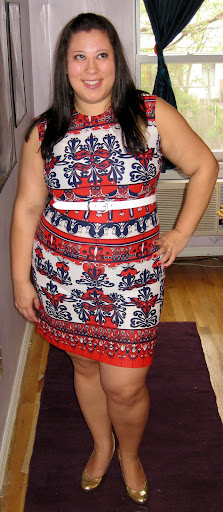
I myself will be representing fatshionista.com at the Emerging Designers Showcase & Networking Event and the State of the Curvy Community Panel. I’ll also be repping my wallet at the Shopping Soiree. Marie has promised us VIP access to these events, which isn’t a privilege I believe that I’ve ever had before, especially at a fashion event. Thrilling! So if you do stop by, please do come say hello. I’ll be the starry-eyed lady trying to stop herself from bursting with excitement! If that isn’t description enough for y’all, this is what I look like.
For me personally, one of the most exciting features of FFFW is that it’s being produced and run by fat women of color. As a fat WOC blogger, I’ve often felt alienated by the white women-centric fatosphere, so it’s great to be reminded in the flesh that fat community doesn’t just come in one color or medium.
Stay tuned for more updates and post-event roundups on Full Figure Fashion Week as it happens! And because that weekend is also concurrent with NYC Pride, expect me to be a little extra flamboyant!
Currently there’s a lot of interesting conversations happening around the Obama administration’s nominee for the Supreme Court, Sonia Sotomayor. Those who oppose her have brought up some interesting objections, such as the inevitable references to her diabetes (because culture tells us not being in perfect health makes you morally suspect). Even before the nomination was announced, Sotomayor was being derided for her weight, since being fat apparently makes one less qualified for a mostly-sedentary job.
But that’s not what I want to talk about here, at least not just now. Instead, I want to talk about context.
Context, as always, is the key to understanding. Much has been made over the past couple days of a single sentence from Sotomayor’s 2001 speech for Berkeley’s Honorable Mario G. Olmos Law & Cultural Diversity Memorial Lecture, which is, as the name would imply, specifically meant to address cultural, ethnic, and racial diversity. (Evidently this lecture was also given as part of a larger conference on diversity in law, about which I’ve yet to find more concrete information. The original lecture is here; for the conversation on whether the comment was racist, go to CNN and take your pick of the commentary.) Certainly, as the Obama administration has admitted, the offending sentence could have been phrased better – and it might have been, if it were ever intended to be yanked from its surrounding train of thought – but in the broader context of the lecture, it’s clear Sotomayor’s intended point is that simply being a white male does not inherently bestow superior judging capabilities. And really now, that oughtn’t be an offensive notion for an intelligent individual, so matter their politics.
But even the criticisms that haven’t called Sotomayor racist (because for some, it seems that “racist” = “not colorblind”; or better yet, “racism” is any continued insistence on recognizing and respecting difference and/or resisting assimilation into the dominant – and white – culture) have bristled at her comment. See Lindsey Graham’s weak suggestion that Sotomayor apologize for her much-repeated “Wise Latina” comment; this is a particularly toothless request, since apologizing for something doesn’t make it not true. At the crux of things here is a quiet, seething outrage on the part of a lot of conservative (and not so much conservative, if we’re being honest) white males, something they can’t (save the Limbaughs and the Gingrichs with nothing to lose) put words to and they know it, a rage sparked by Sotomayor’s daring to be uppity. Heaven forfend that a person of color – much less a woman of color – even suggest for a moment that she might think herself on a level with a less experienced, less intelligent white man. Damn her to hell for going so far as to intimate that in some circumstances she might even be better suited for a task.
White folks are accustomed to having to deal directly with a dominant cultural discourse that tells us we are, in fact, better and smarter and more deserving than people of color, and that the road to success is to be as culturally-white as possible. Those of us with more conservative politics may quietly support this situation. Those of us who consider ourselves enlightened liberals argue vaguely and academically against it, often only amongst ourselves. A handful of radicals may actually try to do something about it, and by so doing instantly marginalize themselves and put their movement well outside the lines of mainstream society.
The point being that while white folks are used to arguing both for and against the supremacy of white culture with each other, we are less familiar with how it feels to hear a person of color in a position of relative authority argue against it. That is kind of scary, even threatening. It is one thing to recognize and attempt to manage one’s own privilege in a white-dominated world; it is another to hear an empowered minority point it out to us. All white folks who engage with race politics in mainstream American culture do so from the position of people to whom this culture speaks, and by whom it is controlled. It is a fucked-up, unjust, imperfect system, but it is OUR fucked-up, unjust, imperfect system, and we’ll fix it when we’re good and ready to do so.
Except it can’t and won’t be fixed without a new paradigm that erases whiteness as the dominating cultural force and starts everyone on a truly even keel. Ultimately, it can’t and won’t be fixed until we, white folks, are willing to let some of our power go, and this isn’t something that can be accomplished with a single act (electing a biracial man as President of the United States, for example); it’s a process, and a journey. And as with many journeys, often it’s only when you crest a hill that you can clearly see how much road you’ve got left in front of you.
In comments to Etana’s post of last week, Dreamy, many-worded Commenter Extraordinaire, made the following statement, which I thought beautifully concise and accessible enough that it was worth my extrapolating upon into some meandering bloggery musings of my own:
Inclusivity is valuable not because it makes a pretty picture or checks a box, but because drawing on the very diverse experiences of the entire population strengthens a movement by providing a more complete solution to a deep social problem. The more a person is privileged, the more that person is closed off to the intersections of oppression. Inclusion of differing perspectives– especially those which are routinely ignored– like a rising tide, helps lift all ships.
I’m going to break this down into a few component parts here, for easy (I hope) digestibility.
Privilege does not make you a bad person. On the contrary, in many cases whether or not you have privilege is largely out of your control. Privilege isn’t about you being evil or mean or selfish or cruel or even racist. Privilege is the fact that, as a white, able-bodied, cisgendered girl, as I’ve written on here before, I have the luxury of walking around most days not having to think about race or about disability or about transphobia, for example, or when I do, my relationship to these concepts can be purely academic. I, individually, am not personally responsible for the systems under which I live; I am only responsible for how I respond to them. Thus, I can choose: I can choose to go about my life unaware of my situation and the privileges I get. I can choose to be aware of my circumstances on an intellectual level, without doing a whole hell of a lot to challenge them. I can choose to both be aware of my privilege and consciously, fiercely, committedly address my privilege and the privilege of others like me, to try to educate folks who have chosen the first path.
All of these are choices. I tend to fall in between the second and third choices most of the time, and that in itself is a position of privilege – that I have the option to pick the battles that are convenient for me. If I had any number of other marginalizing factors at play, I might not always have the alternative of just not making it a big deal. If there’s no disabled-access to an event venue, in my current state, I can simply furrow my brow, shake my head disgustedly, or even give the event’s organizers or the building’s managers a strongly-worded piece of my mind, but then I can also walk right the fuck into the building and attend the event. If I were disabled and the venue had no access for me, I could also furrow my brow, shake my head disgustedly, yell at anyone who would listen… and then I’d have to go home. It would cease to be a mild academic annoyance, and would instead become a very real obstacle.
To highlight another of Dreamy’s comments:
I believe there is a reason (as speculated at SP) that most [women of color]’s fat-related blogs don’t seem like FA blogs (but rather fashion blogs) to white women. Not because WOC are somehow more fashion-obsessed or less affected by fatphobia, but because, again… The fewer oppressions that affect you, the more likely you are to hyperfocus on the one (maybe one of two) that really stick in your craw, and– not to beat my favorite dead horse– not integrate anti-oppression into your positionality in a truly intersectional way. I know tons of bloggers OC who write about fatphobia. Just, perhaps, not in a way white folks in general would recognize as such. And not so much as a singular focus, or a unifying flag to rally around. It just doesn’t… make sense to divide things that way, for most folks.
The vast majority of my friends of color are fat, and pro-FA, in the purely anti-fatphobia sense. Well-informed and “getting it†on a visceral level and everything. They’re just not into the mainstream FA movement. [Emphasis added.]
The focus on fat by many white, able-bodied, not-poor, and/or cisgendered, etc., fat-acceptance bloggers is largely one that is manufactured and even amplified by our preexisting privilege. Those of us who are used to our privilege are, well, used to our privilege. We’re particularly aghast when somebody takes it away because we’re not accustomed to being denied what we think are inexorable rights. Thus our attention tends to get overly microscopic and centered on the one thing that affects us most directly.
As self-accepting fatasses, we all talk about wanting to see people like us represented in popular culture, as a valid, normative state of being. We want to read articles about how fat people are not moral degenerates, about how standards of health can be different for everybody; we want to see amalgams of ourselves as characters on television or film, in smart, attractive, likeable leading roles. We want to be included. We want our experiences, our realness, our voices to be recognized and acknowledged and shared.
In fat activism, we are, very often, already talking about inclusivity, even if we don’t know it. We’re asking that our unique experiences as non-self-hating fat people be included in mainstream discourse and be considered culturally legitimate, not as out-there insanity, stubborn denial, or as a curious anomaly. What we, as self-accepting fat people, are asking for from society is not that different from what self-accepting fat folks with other, intersecting identities (i.e., folks who are fat AND Black AND queer, or fat AND biracial AND disabled, or fat AND poor AND transgender AND first-generation American, etc.) are asking from US. They are asking that we challenge ourselves to embrace and include THEIR unique differences and identities in the same way we are asking mainstream culture to embrace and include OUR difference and identity.
Being inclusive is hard work – it requires we cultivate an awareness of aspects of other folks’ lives and identities with which we cannot personally immediately relate. For example, will I ever understand what it is to experience racism? Nope. Never. I have to work my tail off to even try, and I still fuck it up with impressive frequency. But how can fat activists righteously demand that the world changes to include us, different as we are, when we can’t manage to include other marginalized folks in our own damn movement?
You see that? Petty bickering aside, we actually all mostly agree. We’ve all got at least one foot standing on the same common ground. All it takes is a tiny little mental adjustment to see it, and then a bigger commitment to dealing with ALL those different perspectives, for the betterment of all of us. I love when that happens.
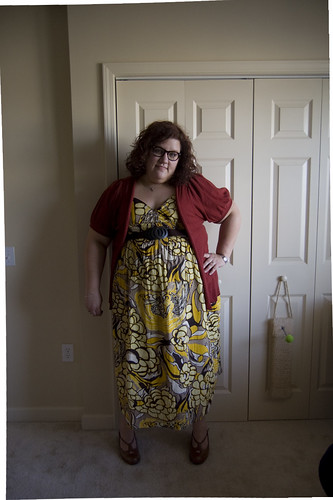
I’ve been having a mild infatuation with AJ Wright lately. I like the explodey chaos, I like the bargain-basement prices, I like that they don’t treat fat folks like lepers and have plus sizes in abundance, I like digging through piles of crap to find The One Awesome Thing In The Store… and more than all of the above, I like that I can stand in AJ Wright for an hour and hear conversations in a multitude of languages – it reminds me of where I grew up.
Metro Boston, where I have lived full-time for the past thirteen years, is a surprisingly segregated place, considering how folks up here fancy themselves such bright liberals (and, often, have such a low opinion of all states south of DC in general – oh, hell, let’s be honest, if you’re not a New Englander, you’re just plain inferior, and New Hampshire doesn’t count, though some portions of upstate NY may). When my born-and-raised-in-South-Florida father comes to visit, he’s expressed astonishment more than once at how he can spend a few days in certain areas of Boston proper and only see a couple people of color the whole time; Boston and its surround incline toward incredibly distinct neighborhoods in which people of similar racial and ethnic backgrounds all congregate, and communities that are truly ethnically, racially, and culturally diverse are very rare indeed. On the other hand, where I grew up, white folks can routinely find themselves in a bookstore or a restaurant where they’re the only non-PoC in the building – and all those PoC are wildly different from each other as well. I love Boston, don’t misunderstand, but I do wish it were a little more self-aware on this issue, as I think it’s a rare detraction from an otherwise-amazing city.
But I digress. My possibly-irrelevant point being that I like AJ Wright because it reminds me, briefly, of home.
Last weekend I was visiting an AJ Wright in East Boston, digging through the dress racks with another woman a little smaller than me. We got to chatting, pulling out dresses for each other, and comparing our fit issues. The dress racks at most AJ Wrights seem to be maintained with no attention whatsoever paid to organization by size, so if one is looking for certain sizes, one must necessarily start at one end of the first rack and just work one’s way down, checking the size tag for any dress that appeals. As a result, we were spending a lot of time pulling out cute dress possibilities only to realize they were too small, and laughing at the frustration.
At one point, my impromptu shopping partner said, with a halfhearted sigh, “Sometimes I just wish I was a size 10.”
I must have been seized by the spirit of Fat Satan at this point, because I burst out with, “I don’t. I absolutely don’t. What I wish is that I could walk into any store and reliably find something in my size, something with half a chance of fitting me as I am right now. I’d rather see the world change to fit everybody than try to change my body just so shopping was easier.”
That woman looked at me like I was half mad, but she also nodded a little. After that we didn’t talk any more. Clearly I had suffered a big old fail at feminine conversation.
Wanting to find great clothes that fit is not a radical concept, folks. Is it?
I walked into the small cosmetics shop squinting at the fluorescent lighting and hoping for the best. I had the most fabulous fatshionista I could find and was clinging to her arm for dear life. Anything would be better than my current boi look swept up into my roots as shade from the blind femme dying to get a hold of some red lip liner.
Strolling the aisles of that fluorescent dreamscape I touched every stick, tube and pot I could. I wanted to taste the lip gloss, smell the shadows and smudge every bit of color on my cheeks in one giant swoop. Damn the masses that were surely staring down at the kindly woman and her blind friend. Damn the jokes in my own head, “wear what you want, they’ll excuse you as the girl who couldn’t look in a mirror.†Clutching my small arsenal of newly minted femme supplies I headed for the door and out into my brave new world. I would try this femme thing on for size and see if my inner desire for mascara and color was worth it or setting me up for clownesque failure.
Months went by and the only femmes getting any use out of my little bag of color were the dust bunnies. I feared the mirror I could only squint at, feared the throngs of humans that would surely stare and laugh and feared thick, clumping lashes and that “not fresh†look. I feared styling and drawing attention to my crippled self. Remaining butch was safe, plain, inattentive and understood. I excused myself, blamed partners wanting an androgynous look, “lost†the wands and smudges. I hid from myself.
A year and a half later I walked into a small boutique selling cosmetics and cleansers. I agreed to let them scrub my face and sales pitch a moisturizer I already used but cringed when they said “want to try some color?†Why would I, don’t I look butch to you? Instead my lips parted and out came “yes please, please help me!†Out came the tools of the trade; a mascara wand to scare the calmest of Queens and a coral lip gloss. I was wearing mushroom eye liner and coral lip gloss. How I ever let myself get talked into coral I’ll never know…..but I learned how to put it on. I learned how to feel the mascara wand and buy smudge-tips for eyeliner, how to apply shadow so it’ll stay and smudge with my fingers. I learned that I had a choice in foundations and that glitter was not my enemy. My inner femme practically jumped out with joy. Here I was, this androgynous terrified grrrl holding mascara like ze knew what ze was doing and actually enjoying it.
It would seem so easy to be femme in a feminine world, wouldn’t it? The tools and the skills are at your disposal to invert as you see fit. Except I didn’t see fit, I didn’t see what I would look like if I replaced pale face with color. I didn’t believe that I could be viewed as a femme and blind and that I could keep up with the sassiness of femmeland in my altered reality. I choose to cling to butchness because I interpreted that to mean I could hide behind black and a shaved head. I wouldn’t have to learn an accessible way to style my self and wear colors and sassy clothing. Hiding was nice, comfortable and glitter-free.
I still fear walking out of my house in clown-style make-up, too much eyeliner and the wrong combination of shadow. But I stopped letting that fear dress me up every morning, I stopped letting my interpretation of how I was viewed and how I could be viewed dress me up every morning. Who knew a blind femme could wield mascara this fine?
I have to take a moment to ackowledge and recommend Substantia Jones’ long-running Adipositivity Project, an ever-growing collection of photographs of fat figures in various states of undress. This series has always been fascinating and illuminating, insofar as providing images of fat people in circumstances in which they’re rarely seen in mainstream culture. However – in my opinion only – lately the photographs (and their subjects) been really, really outstanding.
It’s completely not worksafe, unless you work someplace where fat bodies in lingerie won’t turn any heads, but makes a delicious little body-positive diversion on a Saturday, so check it out: Adipositivity.
There’s a show that’s long-since expired (I do believe) that had a great theme song, You’re Not The Boss of Me. The jingle is playing in my brain as I type this. As I sipped my afternoon soda and prepared for a weekend of fun and dirt, I read the most recent Shapely Prose post. Now I’m not generally a Prose follower but a friend asked me to check on the most recent post and report back on how I felt. I did just that.
In this post Kate Harding, site administrator and famous Fattie to boot posts an announcement of a new blogger joining the troupe. This blogger was admittedly more of the same white, smaller-fat/inbetweenie-fat, able-bodied cloth that the other Prose bloggers were cut from but Harding listed the reasons why that was eventually okay with her. Because she wasn’t originally looking for a new blogger, because this new person didn’t generally piss her off and the other bloggers liked her it seemed reasonable to include her while continuing to exclude other diverse fats out in the blog-o-sphere and/or wanting to join the fat-o-sphere.
Reading through the piece I found Harding to be relatively well-meaning and the other bloggers to have good intentions. They recognized their’ Wonder Bread so directly that was good enough, right? Right? RIGHT?
Nope. Step 1: admit you have a problem.
Step 2: work on fixing it.
There are so many diverse fat-o-sphere bloggers and so many more not being heard. I happen to be one of the only fat-acceptance bloggers who is and writes about disability. The Rotund and others at Fatshionista include Super-(Death)Fat. Curvy Girl Style! and The Curvy Fashionista [see also Young, Fat, & Fabulous and Nudemuse -L.] bring women of color to this mix and on and on and on. We’re here, and we have always been here. So why aren’t we being heard?
While the only change we can see happen as diverse fats is to get out there and talk, we have to be heard too, no? Privileged fats, those who are white or able-bodied or socio-economically sound or generally Western or smaller-fat, etc. etc. etc. need to listen, hear, welcome, and seek out the thoughts and opinions of their diverse community members. Not as special guests, not as one-hit wonders who make inciteful comments or cute webcomics but rather as movement members, fellow laborers who are working the land in our own way with similar goals. We may not all agree with eachother; this comes from coming from different types of cloth, but we can respect and incldue one another.
I welcome diverse fats to speak up and implore privileged fats to include us, value us and open those fattie mcfatfat arms so we can all sing you’re not the boss of me now and you’re not so big to the entire fat-phobic world, rather than to each other.
What’s it gonna take? When do we step up and include? When do we hear each other? When do we all matter?
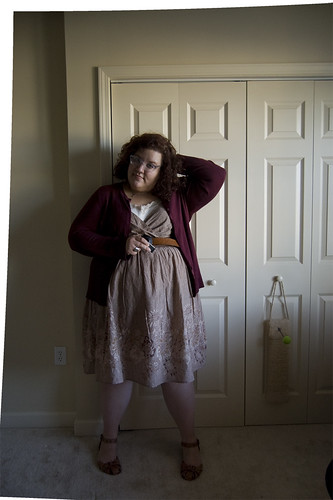
Pretty frequently I get compliments from much-slimmer people, usually women, on my clothes, or my style in general. It’s a pretty swell thing to hear, and incredibly satisfying, considering the time and effort I put into my wardrobe. But there’s also an aspect of it that’s… well, frustrating. Because when a much-slimmer person compliments my clothing, inside my head I do something like this:
Compare and contrast:
Your Shopping Experience: Woke up that morning. Showered, dressed, prepared to go out. Went to a nearby mall. Leisurely walked in and out of several stores. Tried some stuff on in a few of them. Scowled at lousy fit or dubious construction. Eventually found something nice on a sale rack for less than $20. Bought it. Went home.
My Shopping Experience: Woke up that morning. Showered, dressed, prepared to go out. Went to a nearby mall. Found two stores that had plus-size sections, but both only up to a 24, and thus too small for me even to try on. Got in car, went to another mall. No plus stores in that one at all. Went to a third mall. Found one plus-size-exclusive store with items big enough to try on. Unfortunately the apparel in question is both overpriced and not my style. Went home. Went online. Checked six websites that offer clothing in my size. Consulted six size charts for said websites. Agonized over garment style and size-chart measurement to ascertain fit, since trying-on is not possible. Debated rolling the dice on another online purchase. Placed two orders from two different websites; paid shipping for each.
[Title card: “One week later…”]
Received packages. Tried things on. Item #1 does not fit. That has to be returned. I’ll get no refund for return shipping or the original shipping cost, so ultimately it will have cost me $15 to try something on for five minutes. Item #2 fit better than item #1, but only just. Kept item #2 for a few days to debate the merits of keeping it (can it be salvaged so I don’t lose more money in nonrefundable shipping?). Ultimately, returned item #2; in this case I was able to return it to a local brick-and-mortar store, so while I lose the original shipping cost, at least I don’t have to pay any more. Went to local brick-and-mortar store, which will accept plus size returns even though it does not carry plus sizes itself. Dealt with clerk who did not recognize product, debated whether it belonged to their store, and finally had to receive instruction from another employee on how to process the return of non-store merchandise.
Went home, $20 poorer for lost shipping, and without any new clothing to show for it. On my way, did not murder anyone in a fit of fashion-deprived madness.
Please note that the above would have taken place in a major metropolitan area of the United States, which offers what are arguably the best plus-size shopping options in the world.
Whenever a not-fat person compliments my clothing, I get that they’re saying, “You have great taste!” I appreciate it. I dig it. I do. But I also occasionally feel like explaining, “You’re complimenting me based on the idea that I just walked into a store one day and bought this because it appealed to me, like you do, and that it is my taste which is the impressive and compliment-worthy thing. No. In fact, it is my persistence in the dogged pursuit of decent fucking clothing that fits me that you should be complimenting. It is my ferocious tenacity in hunting for discounts, deals, and dragging heretofore unknown plus-size options from the caves of fatshion obscurity into the sunlight as a normal part of my endless hunt for fat style. I SLAYED A FUCKING DRAGON BEFORE I COULD BUY THIS DRESS. THAT IS WHAT YOU SHOULD BE COMPLIMENTING.”
Instead, I just say, “Thank you.” And I smile.
I was away for the weekend. This was in my inbox when I got back.

Last week, we had a bit of an intervention for Torrid over on the Fatshionista LiveJournal community. Though people’s expectations and demands vary in some respects, there were a few common points, the primary ones being sizing inconsistencies, Torrid’s pricing being way out of line with the (dubious) quality of their garments, and that for a supposedly “trendy” shop they have an annoying habit of being two or three seasons behind on trends. (This is a rough summation – read the original thread for more or to add your own thoughts, but be warned, it’s very, very, very long.)
The above email image is a perfect example of everything that’s wrong with Torrid these days. These selections are practically style-free, and frankly variations on the dresses could have been had at Old Navy months ago. Though Old Navy relegates the fatties to website traffic only (all the better for us, that we don’t have to get off our copious asses to go to the store – Old Navy, you are so considerate) at least they peddle cheap crap at a reasonable price. That gal on the left? Her outfit costs a total of $137. Doesn’t look it, does it? I am not going to judge those of you who enjoy shiny purple spandex leggings (OH YES, THEY ARE SHINY) and sublimation prints. Nope, not even though I want to pat your little heads and say “Dears, dears, you can do better, and don’t let anyone tell you different.” I do hope even the shiny-legging/sublimation-loving among you will agree that paying $137 for the above 100%-synthetic-fiber ensemble is obscene. And I won’t even dwell on the fact that Torrid’s selling polyester for summer dressing; it’s just another example of how they simply don’t get it.
Thoughtful alternatives for summer dresses: I’m no fan of Old Navy, but they do reliably stock natural-fiber sundresses at bargain prices, and many people who are not me seem to like them. Anyone who follows my fatshion knows I’m hugely fond of eShakti, and the overwhelming majority of their items are 100% cotton, though the turnaround time (everything ships from India) can be long. Finally, depending on where you live, your local TJ Maxx/AJ Wright/Ross Dress for Less can be an untapped source of cute sundresses at ridiculously cheap prices, though you may have to hunt for them.
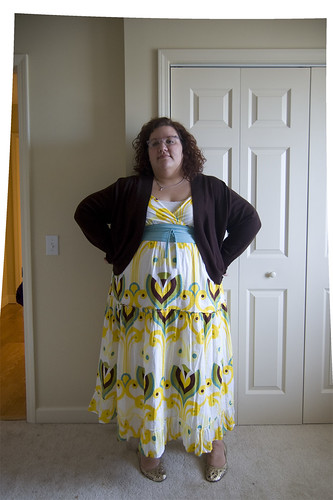
Back in February, when visiting South Florida, the land that spawned me, I picked up a few maxi dresses at Ross. I have resisted the maxi dress until now, for a couple of reasons.
1. Maxi dresses kind of make me feel like I’m wearing a nightgown.
and
2. I am secretly insecure when dressed in garments that hide or obscure my legs.
Weird, right? I don’t know why this is. I suspect it’s at least in part because my legs are what Glamour would call a “feature” of my body, insofar as they tend to be shaped according to cultural standards moreso than, say, my big fleshy nigh-waistless middle, or my squoodgy upper arms, or whatever else such magazines are likely identify as flawed bits. Obviously, I have a hard time buying into this thinking on a conscious level, but it would seem that unconsciously, at least, I’m still stuck on the must-show-yer-legs! side of things even if I’ve mostly shed the must-hide-yer-lack-of-waist! side.
This is partly why I prefer dresses to pants. Well, that and I just hate pants. So I’m trying, forcefully, to get on the maxi bandwagon and BE OKAY with going out in something that feels like a nightgown and also hiding my feature-worthy pins. The process is not helped by the unseasonable chill here in Boston, but I’m still plugging away.
Last Sunday I had the great fortune to spend the day (and then some) with the fabulous, brainy, even-awesomer-than-you-think Marianne of The Rotund. As Marianne is a big wimpy Floridian and didn’t think to bring anything warmer than a cardigan, I loaned her my jacket at one point. And it was sort of bizarre and remarkable. As Marianne says:
It seems like such a simple and small thing. It IS such a simple and small thing. But, like so many things when you’re fat, being able to do this simple and small thing is actually a really big freakin’ deal. And I didn’t even realize it until I was adjusting my shoulders and putting my hands in the jacket pockets.
There was no moment of hesitation. There was no wince as I tried to gauge just how badly this garment was going to not fit. She offered, I accepted, and bam, I was wearing someone else’s jacket.
I realize how ridiculous that sounds. But when you’ve never had that moment of utter normalcy, it is kind of a big damn deal.
And it was both ordinary and amazing, particularly considering I’ve never actually had this happen before – that is, loan somebody my jacket and have it fit, rather than note how gigantic it is on them. Read the rest of Marianne’s post here, as she says it better.
Also worth noting: evidently we’ve been added as an Editor’s Choice on Bust’s Girl Wide Web listings. Hi Bust readers! Please read about Fat Satan first and if that doesn’t scare you off, I hope you enjoy your stay. Also check out the more audience-participation-intensive segment of the show over on our Livejournal community: Fatshionista.
 Two Whole Cakes is a blog written by