Fats Acceptance or Acceptable Fats?
I think it’s safe to say there’s a fat acceptance movement going on at least in the West, at least in the United States, at least according to google. It is defined (by Wikipedia of course) as such:
thus allowing for a wide range of interpretations and tactics in how best to deal with those interpretations of discrimination against size and body politics. The convenient truth then is that fat liberation [sic] is whatever we as individuals want it to be, and whatever we as a haphazard community allow it to be.
What does that have to do with the good fats vs. bad fats debate? Consider this. Good fats are those which ascribe to a certain diet or exercise routine. Remember Marilyn Wann’s Fat!So? that hit shelves to ooh’s and aah’s the fatosphere over? She did quite a few hula-hoops in which she described her own healthcare regime, making it very clear that she herself was a good fat and followed the prescriptive behavior pattern of exercising multiple times a week and still being fat. Oh good! She can has fat. Hey you with the donut – PUT IT DOWN! You can not has fat.
I wonder then if we’ve mis-labeled our movement. Are we a fat acceptance movement, allowing space for all sizes and shapes regardless of how they got there, or are we an acceptable fats movement, making space for those who earned it? I wonder.
-
Good Fats vs. Bad Fats
I’m surrounded by fats. Fats in my food, fats in my drink, fats hanging off the bodies of the animals whose fur I’m sharing, fats on the bodies of the workers who sweat on machines to combine the clothing I’m wearing….fats rolling under the flesh on my body.
So it came as no surprise to me to walk into a room of fats and feel quite at home. What’s but a little more of that which makes my world go ‘round? Immersed, as it were, in fats I began to consume. As my lips parted and sustenance flowed in, I felt what flowed just as quickly out; the conversations around me and the feelings they inspired. I overheard discussions of what was positive to consume, what was negative to consume, and questions regarding why some things were more readily consumed by a group than others. I began to feel that I too was being consumed. I began to feel stifled, as if I had something to prove.
“I don’t eat processed sugars†one fat body proclaimed. I laid down my blueberry muffin.
“I don’t eat meat†another sighed. I held a piece of crisp bacon in the air, mid-range to my eager tongue.
“I buy clothes from independent sellers, skirting mega-conglomerates†she said into my ear. I felt the clasps on my Lane Bryant bra constrict.
“I walk wherever I go – y’know, I’m fat but I’m fit!†he spurted across the table, jumping up to prove a point. I stretched a sore leg and used the ramp to go up and down the wings of the hotel.
Where are the fat bodies intersecting in the mire of what it means to be an acceptable representative and member of fat acceptance? Can we field issues of internalized shame and guilt and fat-phobia with positivity that doesn’t continue or perpetuate further exclusion of one another? Can we have our bacon and eat it too? What’s more, can we truly embrace our bodies and each other if we can’t let go of the desire to out-fats one another?
In a space where the big 5; race, class, gender, sexuality, disability all struggle for a voice, can we make space for these lesser demons, these less visible but all the while powerful inhibitors to self-love and bodily politics? Can we embrace the divide between access to and opinions on what is health at every size, political living at every size, body consciousness at every size without judgment? I would like to think so. I believe so. But in a room of fats I heard less embracing of where we overlap and more of a desire to separate the weaks from the strongs.
I ate my bacon and put on a dress made by an independent retailer, slapped on make-up made by The Man ™ and smiled. I’m probably bad fats, but is that a bad thing?
Are you?
I’m not a big poetry person. Well, not anymore. I am reluctant to admit that my life and my daily focus have shifted sufficiently that I have a difficult time appreciating poetry in the way that I did in my late teens and early twenties. I don’t notice things like I used to back then; for example, this time of year I tend to be utterly unaware of the changing foliage until well past the color’s peak – in a few weeks I’ll be driving and I’ll suddenly realize all the leaves have changed at once, and I’ll be baffled that I didn’t see it happening before now. I am too distracted, it seems.
The point being that I am not one who is easily moved by poetry, with its high regard for small details and nuance. But back when I was a grad student, taking one of my first courses on race, we read a poem by Pat Parker entitled “For The White Person Who Wants to Know How to Be My Friend“, and the first two lines go like this:
The first thing you do is to forget that i’m Black.
Second, you must never forget that i’m Black.
Those words, for whatever reason, have stuck like a burr in my brain for many years subsequent, and have probably done me more good than the multitude of graduate-level coursework and academic readings I did on the subject both before and after hearing them. They make a seemingly impossible suggestion: that white folks must be aware of the fact that the experiences and cultures of people of color are different, but they must not fixate on those differences to the extent that the behavior becomes tokenizing, or discomforting, or – possibly worst of all – self-aggrandizing.
Those words have stuck with me also because they are so viscerally true of so many oppressed groups. I say this knowing I’m at risk of sounding like I am conflating racism with other forms of oppression – but that is not what I am proposing here. I am saying that this requirement of both remembering and forgetting is one that works in many situations, for those of us interested in showing respect and support to people whose positions or experiences we may not personally share. I am saying that when I am interacting people with identities that are not culturally normative, or culturally acceptable, and identities that I can’t claim, I can remember these lines as a guide.
If, for example, I am engaging with a friend who is disabled, when I am not myself disabled, and I feel all adrift as to how I should address situations that may be potentially problematic for a person with a disability, I will think to myself, as if my friend is speaking to me: “The first thing you do is to forget that I’m disabled. Second, you must never forget that I’m disabled.” It doesn’t provide an answer, no. But it gives me a framework, or at least a touchstone, from which I can begin; some firm ground on which I can stand while still leaving fair room for said friend to do her thing as she needs or prefers to do it. It reminds me to listen at least as much as I talk. Pat Parker’s poem really touches on the work of being friends with someone whose experience or abilities are unfamiliar, while at the same time noting that the work shouldn’t be made harder than it needs to be.
This poem also speaks indirectly to the concept of “colorblindness” – the idea common amongst many white folks that by claiming not to “see” race, they are therefore absolved from benefiting from or participating in institutionalized racism, no matter how conscious or unwitting that benefit and participation may be. Of course, the reality is that anyone who is physically capable of seeing race does see race. You can’t turn off culture inside your head just because there’s a person of color in front of you. What the idea of “colorblindness” is really meant to represent is that folks who claim “colorblindness” are claiming to be able to interact with a person of color without any preconceived notions, stereotypes, presumptions, expectations, or suspicions about said person based on their race, even the most persistent, involuntary, or unwelcome preconceived notions, etc., that those of us with aspirations toward living anti-racist lives still fight in our own heads on an almost-daily basis. Basically, “colorblindness” makes the case that it is possible for some folks to exist outside of the dominant, relentless, brain-hammering culture in which the rest of us live – the culture that both subtly and overtly reinforces racist stereotypes in everything from soft drink ads to textbooks. Colorblind folks have found a way out! They don’t cotton to that trash anymore. Somehow, the culture on which our whole damn world is built doesn’t affect them.
How in sweet fuck is that even possible? Short of being raised by wolves, or born with a brain wrapped in permanent tinfoil hat, how is it possible for anyone to escape culture? It’s not, unfortunately, something that can be done through sheer force of will. If it were, wouldn’t those of us who write and speak out as fat activists be totally free of the lingering effects of cultural fat hatred? Wouldn’t we not even need to watch our Sanity Points when entering the fray, because man, that stuff doesn’t even enter our consciousness. We’re above it; we’re outside it. We’re Teflon to fatphobic remarks; nothing gets to us, nothing sticks.
Inside my head, I’ve often changed the lines of Pat Parker’s poem yet again, to reflect one of my own positions: “The first thing you do is to forget that I’m fat. Second, you must never forget that I’m fat.” In other words: don’t assume I can’t climb the stairs; ask if you’re concerned. Think before asking for a booth or a table at a restaurant. Don’t try to protect me from your fatphobia by saying “Oh, but I wasn’t talking about you,” or “But you’re not [that] fat,” – I’m going to figure it out. Realize that my being fat is an important thing that affects my life in lots of ways, but it’s not the most important thing, nor is it the only thing I want to talk about.
And so on.
I don’t want people to be “fatblind”, because my fatness affects me and needs to be considered. I don’t want people not to see my fatness (or to pretend not to see my fatness), but I don’t want them to see only my fatness either. This expectation is paradoxical and insufferable and difficult but it’s also extraordinarily true. And when I’m trying to negotiate the tricky waters of intersectional politics, I use this feeling, this constant striving toward balance, to try to be both respectful and supportive of those with identities and experiences different from my own, even when I can’t directly relate to them. By doing so I’m both modeling the respect with which I’d like to be treated, as well as simply doing the right thing by being Not An Asshole to people who are different from me, as much as possible, even knowing that sometimes I am going to be an asshole no matter what. The real work of negotiating difference – both mine and yours – is half in an eagerness to do the right thing, and half in a willingness to look like an idiot by doing something wrong, but learning for the experience. As Parker sums it up:
In other words-if you really want to be my friend-don’t
make a labor of it. I’m lazy. Remember.

I have a subscription to Lucky magazine. I enjoy Lucky primarily because it doesn’t pretend to be anything other than what it is: a big glossy list of Things To Buy (or, more realistically, Things To Buy More Affordable Approximations Of). When I pick up a fashion magazine, I really don’t want to read articles about important and timely topics. I have books for that. Or the internet. Or the New Yorker. Et cetera. I want a fashion magazine to ply me with eye candy, and not ask me to think, or to read more than five sentences at a stretch before showing me another picture. I’m not ashamed of this.
But as much as I enjoy Lucky*, it’s also a little frustrating. Because nothing in it will ever, ever fit me. Now, truthfully, even if it did, I cannot see myself spending $700 on a single dress anyway; the bargain hunter in me shudders at the very suggestion.
I’ve thought many times over the past few years how wonderful it would be to have a fat Lucky; a shopping magazine that was all plus sizes, all the time. What’s dismaying is that I doubt there’d be enough content to fill one. Magazines like Lucky are handy because they trim down the critical mass of available fashion to certain trends, certain pieces that are most desireable, carefully selected from a veritable heap of possible options. If someone published a fat Lucky, there’d be virtually no trimming to do – one would have to feature pretty much every new plus-sized item just to fill the magazine. The range of options just isn’t that wide (pun sort of intended).
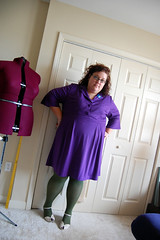
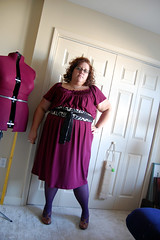
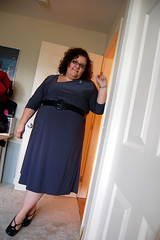
Awhile back, our own stitchtowhere, impressed with my ability to tease good pieces out of the most horrifying fat-lady catalogs, dubbed me The Catalog Whisperer, the idea being that I have developed a knack for working with a clothing resource that is, generally speaking, intractable, incomprehensible, and completely in opposition to my personal style. I liked this Catalog Whisperer concept so much that I started tagging my catalog-involved Flickr outfit posts with it. I first began scouring catalogs a few years ago because I was utterly fed up with the distressing and limited mainstream options for clothing in my size, and I stubbornly believed that even the frumptastic pages of Roamans may hold treasure for me, if only I could think creatively enough to see it. And thinking creatively is pretty key to my fatshion philosophy.
The Rotund has a post up today that poked at some things I’ve been thinking about lately in regards to being creative and resourceful with limited plus size options:
I feel extremely aggravated, of late, when people solicit instruction about whether they should keep a certain dress or even just bother to try something on. There is a fundamental difference between “how do you think this looks?†and “should I try a pencil skirt when I weigh xyz and am shaped 123?â€
I am seriously comitted to trying almost anything on. Even if it’s in a style I’ve tried before that did not work for me. Even if I’m not sure whether I even like the garment. Even though I know my preferences pretty thoroughly at this point in my life. I still give it all a fighting chance. Because I never know what a garment is going to look like until I put it on; because I don’t believe in having hard and fast fashion rules to live by; and because I would have very little to wear if I didn’t. The absolute worst that can happen is that it looks terrible, and my hard-won self esteem is not so fragile that seeing myself in a terrible dress is going to make me think that somehow, it’s not the dress that looks terrible – it’s me, that somehow the dress has unmasked my true terrible-looking-ness.
People will frequently post to the Fatshionista community saying something to the effect of “I never thought I could wear [insert garment here] until I saw other people shaped like me wearing it,” the idea being that seeing other people with bodies like theirs wearing something gives tacit permission for them to try it. This is great, but the fact remains you always had permission. You lose nothing by trying. You may gain a great deal. Successful fatshion demands a certain commitment to creativity, to being willing to wear things you’ve always been told that you weren’t allowed to wear, or that you had no right to wear, or that wasn’t your style. Yes, you may have to kiss a lot of frogs to get there, but the knowledge you’ll gain about yourself just by opening your options and seeing your body in different ways can’t be bought from any catalog.
* Full disclosure: a sizeable part of my enjoyment is derived from the fact that many Lucky staffers cut their teeth, so to speak, at the magazine that pretty much shaped by adolescence, the inimitable Sassy. Ironically, I fucking hated Jane; by its launch I had well and truly grown out of the teenaged narcissism and self-absorption so commonly found in folks of my (white, suburban, middle class) background, and Jane failed to follow me out of that unfortunate phase. Lucky, to its credit, kept all the style and dispensed with the substance.
Juxtaposing Thoughts
Day 2
Blogosphere. Fatosphere. Cryptosphere.
Why does the interweb taunt me so? This language I can’t grapple and this universe I can’t haggle. Individuals become peculiar and I’m left flouncing in a puddle of wet, hot Bluetooth devices. My jaw aches. I’m banging my fingers on a keyboard and hitting backspace. It seems as if grammar has taken a backseat to that age-old knee-jerk phonetic cousin of laziness and my 8th grade mathematics teacher would not be proud of me.
Instead, IAWTC. It doesn’t really matter what it is, it’s got to be correct if my favorite blogger has posted it. Mass consumption of mediocrity has taken an all-time swerve to the right aisle of hegemony. I’m still reading print electronically.
And you? Why are you here, drinking in more of what you may possibly fear? It’s not like I have anything substantive to remark upon, no pearly wisdom to leave at the gate of good ‘n plenty, no cyber-spacial reference. We’re all special snowflakes here.
Sometimes I loose my identity and find it on a website marketing size acceptance to me – and my wallet. I have yet to file a serious grievance. Suffice to say it is less expensive to give in if you have the right directories – retailmenot.com has become a comfort in my times of need.
I fear I haven’t made myself important enough to merit the notice of passersby. I feel I should post a giant notice to the general interconnected ‘verse regarding my existence and possible demise. Take heed: I like to be admired and agreed with. Otherwise I may leave.
This is just a briefing.
CALL FOR SUBMISSIONS:
Everyday Actions: What does an ally do?
100-400 words
Deadline: September 20, 2008
Everyday Actions is looking for anecdotes about alliances. Momentary or lasting, who has supported you? How do we show up, for ourselves and for each other? I want to hear about a time you felt supported in a way that surprised you. Or the one about how you tried to show up for someone else and you don’t know if it worked. The kid who did a report on homophobia in your high school English class. The able-bodied friend who challenges his own use of the word “lame.†The mixed-race friend who encourages you to know your own full self. How do we confront and/or use our privileges and insights as allies to each other? How do we give love and support to ourselves? How do we bridge divisions, especially those held in place with oppression? How do allies create change?
Please email submissions and inquiries to everydayactions@makeshiftmag.com
Everyday Actions is a regular section in Make/Shift, a feminist magazine committed to queer, anti-racist and international perspectives (www.makeshiftmag.com).
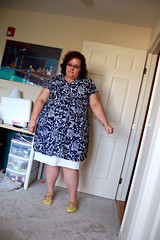

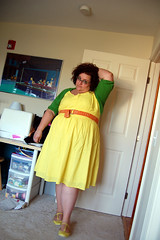
On the Fatshionista community over at Livejournal, I frequently see comments about people’s “shapes”. Most are complimentary – as in “You have a gorgeous shape!” – which I’m sure are meant with the best intentions, though they always sound a little weird to me. The obvious reason being that it sets up a duality in which some “shapes” are pleasing and some are not.
This differs, in my head, with complimenting a person’s clothing. Style and taste are profoundly individual and subjective concepts. Shape, generally speaking, is very much not. Certain shapes are always more pleasing than others; typically, specifically, the more attractive shapes are the ones that meet a cultural standard of femininity, with a defined waist and wide hips. Also, consider that nobody ever tells a dude he’s got a “hot shape”. I mean, the idea itself sounds preposterous. Women have shapes. Nobody else.
Some people have tried to frame this issue under the concept of “shape privilege”, the idea being that people with more traditionally feminine shapes have certain advantages over those with…. not so traditionally feminine shapes. I’m not fond of the idea of “shape privilege” myself; for one, I think using “privilege” to describe even mild advantages takes away some of the oomph of that word even when it’s being used to describe major differences – think of privilege as it relates to class, or gender, or race. These are issues that are far more all-encompassing and institutionalized – and also more uniformly applied – when set beside the comparatively small annoyance of not being able to find jeans that fit both one’s ass AND one’s waist, at the same time.
I don’t have a pleasing shape. I’ve got a very small bust, a big middle, wide hips, broad shoulders, and comparatively slender legs. Like an upside-down light bulb, or a butternut squash. I’ve been told that I “dress my shape well”, which – again, even assuming best intentions – I hear as a sort of code for, “Well, you do a good job with what you’ve got.” Because what I’ve got is not the shape that designers make clothes for. Everything is too big in the bust and too small in the waist (but even this isn’t hugely different than what a lot of more traditionally hourglass-shaped women go through, who deal with things that are too big in the waist and too small everywhere else).
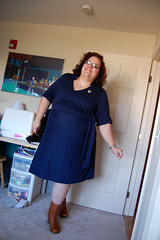
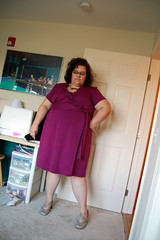
I first discovered the wrap dress via Igigi’s original, ultimately-downright-ubiquitous faux-wrap in matte jersey. It was a pretty revolutionary experience – I almost look like I have a waist! I wore many, many wrap dresses. I still do, now as much for their ability to flexibly fit my disproportionately-small bust and disproportionately-broad hips, as well as for their shape-making effects.
But these days when I look through my outfit pictures and think, “Hey, it kinda looks like I’ve got a waist there!” it looks foreign to me, odd, almost photoshopped. It hits me with a mixture of triumph and melancholy. Triumph because of the sense that ha, I beat you, horribly-limited plus-size clothing selection! I found something that I both like and that is “flattering”. Melancholy because masking my “real” shape doesn’t feel particularly fat-positive to me. This is, no doubt, connected to why I love trapeze dresses so much; these are garments that are, unbelieveably, cut to fit my actual shape. Cue the laughter when I so often see people exclaim that only the impossibly-slender – i.e. those whose shape is the categorical opposite of the trapeze dress itself – can successfully wear them. Fat people must wear things that are neither too big nor too small; they must, like magicians, dress their shape, preferably transforming it into the well-balanced “curvy” form they ought to have.
Sometimes I feel like playing this game. Sometimes I don’t. Am I fooling anyone beside myself? Does it matter?
FAREWELL, CRUEL FATOSPHERE: A Swiftian* Solution Written While Totally Sober
By Lesley | September 8, 2008
* Swiftian: Employing a satirical approach inspired by the writings of Jonathan Swift; like Swift’s writings in tone or outlook; often, specif., sardonic, caustic, pessimistic, etc. (1); see also sarcasm.
I have a problem with the Fatosphere.
Oh no, it’s not what you think! Prior posts on this blog notwithstanding, it’s not about the overwhelming whiteness of so much of Fat Acceptance. Nor is it not about the precious little FA discourse that takes place around class or gender or race or disability. I don’t really give a shit about intersectional politics, in fact. I just put that in the header for the whopping number of page hits it gets us.
No, my problem is far more widespread, and far more insidious. You see, the Fatosphere bothers me – I’m not sure how to say this – because… well… they’re really into fat acceptance.
Damn, it is SUCH a huge relief to finally acknowledge that out loud. Whew!
It’s like these people see fat prejudice everywhere! It’s crazy! They won’t shut the fuck up about it! Some newspaper prints an article about how being fat will inevitably kill you and it’s as if they take it all personal and shit! If someone they work with, or even a family member, is making hilarious jokes about how disgusting fat people are, they just can’t leave it alone! It’s like it doesn’t matter how much folks reassure them, “Well, when I said ‘fat people’ I wasn’t talking about YOU.” Undaunted, they blog and blog and blog about it and go ON and ON like it’s the end of the damn world. They get outraged. They demand that something be done. And it happens all the time, every day of the week; no matter what, these people will find something to be angry about. Some podunk state wants to make fat people pay more for health insurance? So what? Some company wants to force its employees to lose weight and charge the ones who don’t? Who cares? Airlines want to treat fat people without basic human respect? Why not? What’s the big deal? Why TALK about it ALL the time? What good does it do?
I mean, it’s not as if it’s not ALL TRUE, right? We agree on that, right? Fat people are just ticking death clocks, waddling around, going about their lives just waiting for their adipose tissue to suddenly overwhelm them and end it all: GOODBYE FATTY. More room on the train for the slender! Fat people are nothing more than jiggling food vacuums careening wildly out of control until the inevitable day when their gluttony propels them right off a cliff into Fat Death (where they will immediately go to the Fat Heaven, naturally, which is a greasier and worse-smelling version of the normal Heaven where god-fearing thin people go).
And you know, most thin people just IGNORE fat prejudice. Why can’t we be more like them? You know why they ignore it? Because fat prejudice is not REAL! It doesn’t exist for them! The Fatosphere is a sorry collection of criminally oversensitive, validation-seeking, angry ugly people who go about our days just LOOKING for something to get offended about, SEEKING OUT opportunities to point out so-called “anti-fat” bullshit to the extent that we have to make stuff up half the time. We do this when we could just as easily look the other way! Thin people know better.
BUT! I have the solution, in a two-pronged approach. This first prong is that if everyone in the Fatosphere would just be NICER, and learn to stop seeing fat prejudice every bloody place we look, then everything would be fine. I bet fat prejudice would stop affecting us every single day of our lives, in every social interaction, in every professional circumstance, in every mundane errand, even just walking past a cluster of teenagers on our way to the corner store, if fat people were just NICER. The second prong is where we all go on diets, or get weight-loss surgery! If fat people could just learn to be thin, to assimilate ourselves into the established (and clearly correct, since the majority is never wrong!) culture of Thin As Normal, we could easily ignore fat prejudice for the rest of our lives! And ignoring a problem makes it go away. Not talking about it and analyzing it and working through it. Ignoring it is the only way!
You heard me! Ignoring prejudice, sticking one’s head in the proverbial sand, will always make injustice magically disappear. I mean, think about it: isn’t this the reason why we no longer have things like racism, or sexism, or homophobia, or ableism in our modern utopian world? Because we’re so fucking committed to ignoring them? As a result they have ceased to exist! Like a troll nobody feeds, they’ve withered and evaporated, never to be seen again! WE ARE FREE. So maybe if we all shut down our fat blogs, stop talking about fat people like they’re ordinary humans worthy of respect and consideration, and just turn a blind eye to fat prejudice everywhere, THEN! THEN we can end fatphobia forever!
You’re welcome, Fatosphere. No need to thank me, or shower me with praise. I’m just glad I could help.
During the last few months, I’ve either witnessed or been a part of several fatosphere discussions/arguments that involved discussion about race, racism, and the points of intersection with fat.
I’ve been meaning to write a piece about what good ally behavior might look like in these situations, but life got in the way. Unfortunately, the lack of (until now) a widespread critical discussion about the 1000 Paper Cranes project jolted me into the harsh reality that either folks still don’t fundamentally get it, or that people aren’t actually interested in thinking about more than a single-issue politic in their writing and activism.
I won’t presume to know the race of Anonymous, but I have seen several white folks reply to that post and other posts about the project with some variation of, “You know, this did make me uncomfortable, but I didn’t say anything.” There was only one dissenter to the project on the Fat Studies list, one objecter on the fatshionista livejournal community, and zero criticism when Big Fat Blog posted about it. (I’m also curious to know if the person who accused “tara” (not me) of being an “FA troll” on FatGrrl was referring to me.)
Many many many people (POC and white) have pointed out before that racism isn’t *just* the overt stuff. It is complex, nuanced, and far reaching because it is interwoven into every nook any cranny of this white supremacist culture. It can take a whole lot of time and thought and effort to recognize this if it’s not something you experience firsthand, and even those of us who *do* see racism on a daily basis are taught to question ourselves and our judgment when we think something we see or hear or read is racist. This is a function of modern white supremacy: it is built into the foundation of our culture, and we are trained not to see it just like we don’t “see” the air we breathe.
Which is why it was so devastating to me that I saw such little dissent over the 1000 Paper Cranes project. I had only heard about it about a week ago, but I did a search on it and could hardly find anything on it. And I was outraged. Surely, I thought, this is such a plain and simple example of inappropriately racist hyperbole and a clearcut form of the worst kind of appropriation, that it was boggling how few allies were speaking up.
This particular situation, I believe, relates to what I wrote about Beth Ditto awhile back. Maybe people don’t want to speak out against their fat s/heroes (i.e. Marilyn Wann) or hesitate to hold them accountable when they fuck up. And, for the record, I believe that Marilyn fucked up in a major way, both in the execution of the project and her justification for it (citing that two of her Japanese friends said it was ok). But you know who else fucked up? White allies. And not just in this situation, but again and again. Jumping on the “yeah, that’s racist!” bandwagon after someone else says it is not enough. Even when you have an unsettling feeling in your stomach about something, but don’t quite know why, it is quite easy, especially with this medium, to do an informal scan of the fatosphere to see what perspectives other folk might bring. Being an ally isn’t just about supporting the voices of POC speaking out against racism; it is also about taking that risk, doing that work, and putting out your own thoughts when you see or hear or read something that you believe to be racist. White supremacy was not created by POC, we are not in positions of cultural, political, or institutional power to end it, and this means that this shit will never end unless white folks do most of the fucking work.
So this is me, holding community leaders and our allies accountable for your silence. During the original discussions about the waistline policy, and in Anonymous’s recent post, several people accused “the Japanese” (as if they are a monolith!) of discouraging dissent. How ironic is this accusation when almost the entire fatosphere chose to stay silent about something they they themselves knew was probably wrong?
To end this critical post on a creative note, I’d like to do my own informal poll of what you think constitutes good ally behavior. And further, how can we hold each other accountable in such a temporal, transient space?
The following is a post by a guest blogger who wished to remain anonymous. I jumped at the opportunity to host it here because this project has raised questions for me as well, though I’ve been unable to put language to what, exactly, was irking me about it.
To be clear: this should NOT be construed as a personal attack on anyone, including the individuals mentioned by name; it’s just raising legitimate criticism, and further highlighting the ongoing, neverending challenge of framing our fat activism in an anti-racist context. I like to think this movement is plenty strong enough to withstand and benefit from even the most difficult and painful criticisms. I also like to think that we, as individual fat activists, are likewise engaged enough and committed enough to accept other perspectives thoughtfully and with grace, even when they are hard to hear. I hope you agree. -Lesley the admin
Lately one of the most talked-about fat activist projects has been Marilyn Wann’s 1,000 Fat Cranes. Marilyn inspired my own activism, and much of her work has been an important part of contemporary fat liberation and fat activism, so it is not without some trepidation that I offer criticism of one of the most beloved icons of fat activism.
That said, I have been grappling with how to discuss the Fat Crane project ever since I first heard about it. I applaud the intention behind Marilyn’s efforts, and the efforts of those participating, to reduce size-based discrimination and to attempt to expand their horizons outside of simply a U.S.-centric activism – Charlotte Cooper and others have rightly criticized U.S. fat activists for often being remarkably insular in our work, forgetting that there are fat activists working outside our country and people experiencing size-based prejudice outside our country.
That said, virtually every aspect of the Fat Cranes project has struck me as in some way racist, ethnocentric, and inextricably intertwined with a frustrating tradition of cultural appropriation and cultural imperialism. It frustrates me that the vast majority of white fat activists who I know are lauding the project as truly revolutionary and important, without giving thought (or at least without giving voice) to some of these more problematic aspects. In a few places (on the Fat Studies list, in the comments of a Joy Nash’s post on the Fatshionista LJ and in select private journal entries) there have been the seeds of dissent and discussion on the issue, but they have largely been met with silence or ridicule. Note, for example, the person who “LOL’ed†at dreamalynn’s criticism of the project in the LJ.
What, specifically, are my criticisms? First, for those who aren’t aware, here is the basic premise of the project (which had its debut on August 6th), as described on the project’s Myspace page:
1,000 Fat Cranes is a response to the Japanese government’s decision to measure everyone’s waist.
1,000 Fat Cranes asks the Japanese government: Please end the war on waistlines…please make peace with people of all sizes.
What the MySpace and the original email were lacking, obviously, is any substantive context. Why are we sending these? Why did we choose an important Japanese cultural symbol to apparently educate the Japanese government about sizeism? What assumptions are going into this project – about the role of (predominantly white) U.S. activists sending cranes to Japan? The message, to me at least, comes across fairly clearly as we white Americans know better than you, and we’ll appropriate your cultural symbols in a (not-at-all racist/ethnocentric) attempt to help you fix the mess you’ve gotten yourself into.
And, oh yeah, we’ll premiere it on the anniversary of the day we bombed Hiroshima.
Why do I bother writing this? I suppose, really, I’d like to see some more substantive discussion of what this project is all about, of why the white, middle-class, American woman decided she wanted to educate Japan using Japanese cultural symbols. I want to see a discussion of cultural appropriation, of exporting American politics without much consideration for Japanese culture or Japanese politics. Is sizeism okay anywhere? No. But neither is a group of U.S. activists becoming, in large part, the Great White Savior of the non-Western world. There have been some powerful critiques of the racism and ethnocentrism of U.S. fat liberation by a handful of fat activists (including especially by others here at Fatshionista and elsewhere), but why aren’t all of us speaking out about these problems?
The Fat Cranes project seems like a great opportunity – instead of just participating because there’s a big name and it’s labeled a fat liberation project, let’s have a little criticism of the problems within our own movement. This post is my attempt to continue the discussion on race and racism in fat activism, and to really start a discussion about this particular project. I hope I won’t be the only one talking about it.
 Two Whole Cakes is a blog written by