For the past several days I’ve been thinking about the possible criticisms of my prior post on the Ugandan wedding-dress organization.
Actually, that’s not true. The truth is that my husband and I had to have one of our two aging cats put down on Friday night, completely unexpectedly, and so the past few days I’ve not been thinking about much of anything other than the big cat-shaped hole that’s left behind. But in the interest of reoccupying my mind, I’ve been trying to think about the possible criticisms.
I haven’t actually been confronted with much criticism, at least not any that’s been strongly-worded, but as a semi-compulsive debater (I’d argue with you about the sky being blue) I have a natural inclination to consider the weak points of any argument I’m making. The most obvious one, I think, in this case is my lack of authority on the subjects of Uganda, postcolonial influence, and weddings. The idea being that since I don’t personally live and work in Uganda, I lack the necessary authority to speak on neocolonialist forces there.
I have to call bullshit on that.
It is absolutely true that people who live and work in a place are better equipped to talk about the day-to-day up-and-down realities of life there. And if I were attempting to discuss the day-to-day up-and-down realities of life in Uganda, I would certainly be ill-suited to the task. As I mentioned in comments to the previous post, I have close family that participates in international faith-driven relief work, particularly in Jamaica, and I know better than to sit anyone down and try to tell them something about What Life Is Really Like for a poor rural Jamaican family. That said, I do have something to contribute, and my contribution is why those same family members turn to me when they have questions about why Jamaican culture is a certain way, or how the legacy of colonial influence affects Jamaican life even today, or what it means that misogyny and homophobia are so rampant, and so forth.
I’m a thinker. I’m a researcher. I’m a boiler-down-of-cogent-points. Everybody’s good at something, they say, and these are the things I’m good at. I see the situation like this Uganda wedding-dress story, and I think to myself, “Hmm, I feel as though the potentially-troubling implications of this haven’t been adequately identified. I think I will identify them now.” Curiously, I am not trying to suggest I know better than anyone else by doing this; I am suggesting folks consider all angles on a situation before making sweeping proclamations as to its ultimately positive or negative outcome. In fact, I don’t believe in purely positive or negative outcomes; in any conversation on whether something is black or white, I am constantly, unflaggingly, insufferably tied up in the greys.
My primary gripe with the Uganda wedding dress story? It’s incomplete. I wanted to know about the traditional wedding apparel in Uganda (because that could help explain a scenario of why importing dresses might be easier, if that was the case); I wanted to know the religious makeup of the nation (because typically the popularity of white wedding dresses is often tied up with the popularity of Christianity, which in Uganda’s case is a whopping 84%); I wanted to know how popular Western wedding garb was amongst the people of Uganda who don’t live in displaced-persons camps (because often, the poor of a nation take their cultural cues from the wealthy); and perhaps most importantly, I wanted to know whether these women wanted these dresses — and I don’t mean insofar as being willing to take whatever they could get, but if given the choice between traditional apparel and the gowns they got, would they have chosen the gowns? Ultimately, whether the women in question wanted the dresses or not doesn’t really influence my assessment that the encroaching tide of Western culture is a problem, and runs the risk of washing away indigenous traditions. But in the end it was these questions, not answers, that came into my mind as I looked for more information.
It is my opinion that activism is, at its root, about making inquiries. It’s about interrogating what passes for “common knowledge” and refusing to be cowed by perceived authority and tradition. It’s about reading an article that says “ALL FAT PEOPLE AT RISK OF DEATH” and feeling a need to reframe it or put it in context, to ask, “Which fat people?” and “How did they arrive at this conclusion?” and “Isn’t everyone at risk of death?” It’s about spreading the word that science–YES, EVEN SCIENCE–isn’t always bias-free, that like most things done by humans there is usually an expected result influenced by the culture in which the science is done, and that statistics are great for trying to understand broad trends over time but that applying them on an individual basis is less useful. Activism is about standing up to the rumbling, heaving, behemoth passenger train that is conventional wisdom–be that wisdom about gender and sexuality, health and ability, body size, race and ethnicity, socioeconomic class, or what have you–and saying NO, I’M NOT ON BOARD, even knowing you’ll never stop it or even slow it down, and if you’re lucky you’ll grab a couple folks here and there and pull them free of that unflagging momentum.
And contrary to popular belief: activism isn’t about enforcing one set of rules or doctrines over another, even when you think it is, or even when you think someone else thinks it is. To re-use the pie metaphor, truly radical activism isn’t about trying to push one’s way into the established norm; that’s how we wind up with Glamour’s goalpost-moving disguised as a revolution for the slightly-less-thin. It’s about breaking down the systems we know, cracking them open and ripping out the mechanisms on which they operate until everyone can see how they don’t work anymore. Do some activists dig on the idea of imposing their ideas over top of the current way of thinking, like putting new chrome on a cracked engine? Sure. But that’s not activism.
Activism is a process. It’s a methodology. It’s not an answer. It’s not an end.
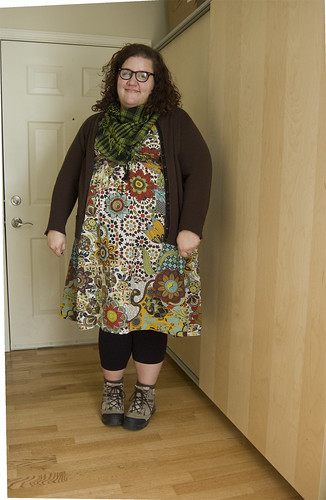
(I wore this to go applepicking, hence the hiking boots.)
Print sundress from Avenue;
brown cardi from Jessica London;
green-and-black plaid scarf from Marshalls;
leggings from Avenue;
beloved hiking boots by Columbia Sportswear.
More after the jump.
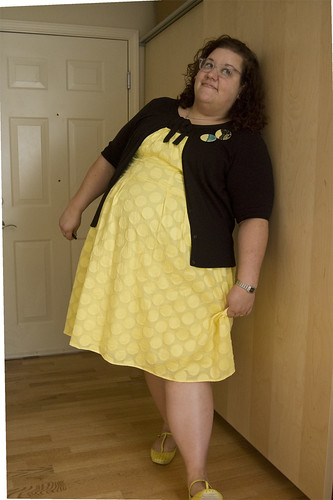
Yellow dot dress is by Calvin Klein (by way of Ross);
black tie-neck sweater is from Torrid,
two fabric buttons came from Etsy a really long time ago,
yellow t-strap flats by Frye (via eBay).
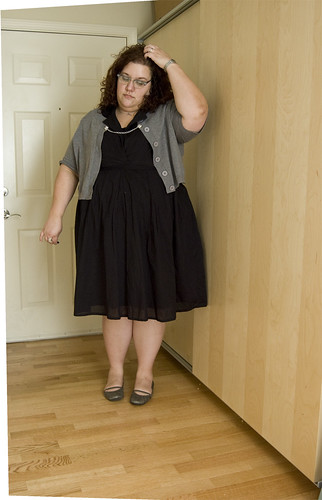
Black dress from eShakti.com;
grey cardi from Torrid;
sweater guard is vintage, via eBay;
pewter flats that really need to be retired came from Nordstrom a few years ago.

Earlier this week, over on Jezebel, there was a post and a series of comments that left me pretty conflicted.
Okay, that’s an understatement. The truth is, it pissed me off.
The post begins with a discussion about a piece on the Today show about “Trash the Dress”, a popular trend amongst quirkier brides, which involves a post-wedding photoshoot in which the newly-married “trash” their expensive wedding garb by climbing trees or having a food fight or performing open-heart surgery or some other messy, unexpected, amusing task which may or may not result in their wedding dress being to some extent injured or ruined, while a photographer takes pictures. This trend has actually been around for years, but Today is evidently slow to pick things up. My own feelings on this practice, being a non-wedding-loving person myself, are pretty apathetic. I do expect that once the trauma of wedding-planning is over, it might be cathartic and fun to blow off steam by symbolically or literally destroying one of the central pivots on which so much wedding stress rotates. In the US, at least, the wedding dress is arguably a garment with more intensity of purpose and expectation placed upon it than any other article of clothing in our culture. I have known otherwise-sane women to be driven nearly mad by Dress Trauma: finding samples in sizes they can try on; deciding on a style that they personally like, that is not miserably uncomfortable, and which will not offend or scandalize anyone present; wrestling with the often-obscene cost of a garment meant to be worn for just a few hours of one’s life; having alterations made; worrying about whether the altered dress will still fit once the big day arrives. So yes, I can vaguely see the attraction to the “trash the dress” trend without thinking it’s something I’d ever necessarily want to do.
The Jezebel post’s author, on the other hand, is upset by the dress-trashers. Why? Because it’s wasteful, when there are rape survivors in Uganda who don’t have wedding dresses.
Now that I have your attention, I’ll again ask you to go read the Jezebel piece, it’s not long, and it’s like a perfect illustration of When Discussions About Privilege Go Horribly Wrong. I’ll wait.
Before I move forward with my own criticisms here, I’d first like to take a moment to make a full disclosure of my feelings about weddings: I’m not so into them. I did not have one, myself, because doing so struck me as wasteful, self-indulgent, and just plain boring. It’s not something I ever dreamed about or wanted for myself. I don’t particularly enjoy attending weddings either. It’s simply not my thing. My husband and I were married in the council chamber at City Hall, just the two of us, and I remember the experience with probably more fondness and tenderness than I would have if I’d spent the time and money for even a modest affair. That said, I strive to avoid being judgmental of folks who do go the route of the Big Honking Wedding. It’s their event, and even if I don’t understand the appeal, I am willing to respect the right of other folks to express themselves in their own way.
(The only recent exception to my “weddings, meh!” philosophy was the “Forever” wedding dance video on YouTube that circulated this summer; and I’m convinced that’s not so much because it was a wedding, as it was that one of my secret wishes in life is to someday be able to burst out into a group dance number in public. And also because the beauty of having friends and family who’d do that for you is pretty powerful. If you have not watched the video, I strongly recommend it.)
The Jezebel piece takes its terrible turn when it attempts to compare the indulgent wastefulness of dress-trashing with a charitable organization in Uganda, recently profiled in British Marie Claire, that seeks to facilitate weddings for women who are rape survivors of Uganda’s ongoing civil war. As these women were not only raped but in some cases kept as prisoners, their chances for marriage were thought to be zero. Enter a Nice White American Lady to sort it all out.
…[H]aving fallen in love, many of the grooms were unable to come up with the traditional dowry, let alone the trappings of a wedding. And planning marriages amidst the chaos and despair of the camp was a challenge that the newly-married Katie Karpik appreciated. They raised the money for a wonderful wedding, and six couples were able to get married – in dresses donated by British women to an organization called Jireh Women. More than 50 gowns and bridesmaids dresses were donated, and Karpik says they’ll continue to use the gowns for future weddings.
Karpik is a 25-year-old woman from the midwest who went to Uganda to do relief and missionary work, and met her husband, a Ugandan pastor, there. Here’s a nice picture of the two of them. They live and work in one of the two hundred or so displaced persons camps in which those rendered homeless by Uganda’s twenty-year civil war reside. I am absolutely certain that Kate Karpik is, indeed, a nice person with good intentions, who believes strongly in trying to help the people with whom she lives and works. However, there are a few aspects of this situation that are deeply problematic, and which go totally ignored by both the original Jezebel post and the stream of comments that follows.
Allow me to break it down for you.
It’s entirely possible that Uganda has absolutely no cultural wedding practices at all, and therefore would require the imposition of Western standards of wedding dress in order to be, y’know, civilized about the whole wedding thing. It could very well be that prior to the introduction of white polyester satin to their primitive culture, Ugandans didn’t have weddings at all. But somehow I doubt it. Well-intentioned or not, the colonialist implications of this are shocking, and even more shocking is the fact that not a single commenter has mentioned it. Sure, the humanitarian work of trying to help these women get married is no doubt well-intentioned, but how dare anyone suggest that the fucking lack of a shitty white dress was the primary or even a freaking tiny ancillary obstacle in this scenario, or that supplying the dress is an aspect of it that even deserves lauding?
Oh, fuck this. I’m not going to even pretend this is a possibility. I’m going to the most basic and accessible reference source we’ve got: Wikipedia. Check it:
A Gomesi, also called a Busuuti, is a colorful floor length dress. It is the national costume for women in Uganda… The Gomesi is only worn on special occasions such as funerals, and weddings. The Gomesi is worn at wedding ceremonies during the introduction, also known as the Kwanjula. During the Kwanjula, all female members of the groom’s family are required to appear dressed in Gomesi. (Source, also see the image at the top of this post for an example.)
Could it be that, yes, Uganda has its own wedding attire, likely varying by region and class position, but nevertheless, it’s intact. And maybe it’s just a bit insulting to impose our own “THE DRESSES THE DRESSES OH GOD WILL SOMEBODY PLEASE THINK OF THE DRESSES” wedding culture, since we’ve been running this colonialist game for centuries and it never gets less offensive and wrong. Maybe less time might have been spent shipping Western wedding gowns to Uganda (which, incidentally, ALSO costs money, not to mention the cost to the environment of the shipping process, etc) and more time spent enabling these women to get married in the standard wedding attire of the country in which they live. Though the Western wedding dresses were donations from women in the UK, I think it’s a fair bet that the cost of shipping alone could have paid for traditional wedding apparel in Uganda, and probably made up some of the dowry too. It’s true there is an outside chance that producing traditional wedding attire in the camp itself was not possible for one reason or another–I don’t know the exact circumstances–but I still maintain that it would have been more appropriate to try to make that happen. Here’s a picture of some of the newlyweds in their Western attire.
I’ll say it for the third time: I am sure that Katie Karpik is a very nice white lady, and I have no doubt her motivations were exclusively to bring these women an idealized wedding they likely never thought they’d get. I also don’t doubt that Western wedding gowns are rare in Uganda, except amongst the upper classes, and likely nonexistent amongst the displaced poor most affected by the civil war, and as such, wearing one really is a once-in-a-lifetime opportunity. But it’s still troubling, and still offensive. For the same reasons it’s troubling and offensive when Vogue puts a $10,000 bag on the arm of a poor woman in India and calls it fashion. In the Vogue situation, it’s the exploitation and objectification of an exoticized “other”; in the Ugandan wedding-dress case, it’s the imposition of a dominant Western culture over endangered local traditions. Both are forms of neo-colonialism.
I’m not disgusted because I think helping women in Uganda is a bad idea. I’m disgusted partly because I think the approach is misguided. I’m disgusted more because the only reason anyone is really feeling this story is because it’s a soft, cheery tale with an easy happy ending. Sad brown women are raped, driven or taken from their homes, but then they get married! And we get gratifying pictures! The end. Sure, these women’s marriages may be happy tales to a point, and sure, I bet the experience of being married in an expensive dress gave these women some wonderful memories they’ll never forget. But it’s incredibly difficult to argue that a set of lovely images makes a lack of clean drinking water less of a problem. And a pretty wedding does not ensure that the rest of these women’s lives will run their course happily ever after.
This is how colonialism works: it operates by first othering a different culture as “primitive” (and occasionally “noble”, and always vaguely sad and impoverished), and then by setting up the story that the imposition of non-primitive Western culture is helpful to the people in question–the subtext is that Western/globalized culture is superior to all other cultures, and thus by imposing it we’re bringing those behind the curve up to speed with the rest of us developed-nation types. Except it never really does bring anyone up to speed. Especially when we’re talking about nations filled with brown people. It instead works to keep the colonized subservient, as a natural resource to be pillaged, and inferior, as a spectacular counterpoint to the high culture of the colonizing nations. The prevalent thinking in Great Britain, during the height of their empire, was that they were doing India and some of Africa a great service by colonizing them and enforcing British rule; clearly, if these folks knew what they were doing, they’d be as advanced a civilization as those in Europe. So maybe they need a little help. This is history, of course: we don’t colonize like we used to, when the sun never set on the British Empire. We no longer make a habit of powering into sovereign nations to install our own regimes–often toppling existing leaders or systems of government in the process–that we can control for our own benefit from afar. No, today we’re far more subtle than that. Most of the time.
Technically, what I’m describing may be called postcolonialism, as the colonialist era is largely thought to have ended after World War II. But I struggle with the concept of colonialism being past, since it seems to suggest that it’s all over with, and what we face now is the after-effects, when I’d argue that the colonizing forces have never stopped, they’ve just changed forms. Anytime a Western nation imposes its culture or its priorities on a nation that cannot defend itself against the imposition, that’s colonialism in action. The fact that Karpik’s efforts are at least partly driven by her missionary work is even more troubling, given the long and bloody history of colonialism being used to bring Christianity to the heathens. Colonialism is always rooted in good intentions, in the idea that we are doing good by bringing our superior culture and knowledge and religion to the poor suffering unwashed brown people of the world. But good intentions do not make it a right action.
Which brings us back to Uganda.
In this specific situation, each of these dresses probably represents more money than these women see in a year of work. Life expectancy in Uganda is around 50 years. The average per capita income is around $300USD per annum (depending on where you look, parity rates argue that this equates to around $1430USD of purchasing power). Nearly 30% of Ugandans don’t have reliable access to clean water. That’s three out of ten people, who don’t always have safe water to drink.
And we would dare suggest that one of the more important issues here is a lack of adequate wedding dresses. One of the lasting “benefits” of this wedding-dress relocation program is supposedly that the dresses will go to start a wedding-dress rental business in the area, enabling the women there to develop a source of income. Creating work and sources of income are good ideas for sure–but do we really want to do it by importing a ridiculously overblown wedding culture that serves no long-term purposes or needs for the community? People don’t generally need wedding dresses, in the same way they need access to clean water or reliable systems of agriculture to produce food. I mean, I can read that Heidi Montag’s spent $30,000USD on an Hermes bag and I may want to punch her in the face, but at least I can turn on a tap and have drinking water whenever I want it. It is an enormous privilege to have an expensive Western wedding dress, absolutely. It represents resources and money and power that the Ugandan women living in these displaced-persons camps will never have access to; but when these people are dealing with living circumstances that may involve genocide, military corruption, and serious human rights abuses, the solution to this situation is not to ensure that each woman has access to a wedding dress. The solution is to give them access to what the wedding dress represents.
The Jezebel author acknowledges that the comparison between the “trash the dress” trend and the Ugandan wedding situation is an unfair one. Of course, that doesn’t stop her from making the comparison anyway. I would argue “unfair” is a mild term for it, given even the cursory research I’ve done into political matters in Uganda and the circumstances of these camps. It’s truly insulting. The comments are awash with people opining not the problematic colonialist implications of the Uganda wedding effort, but the offensiveness of dress demolition when that dress could be carefully packed away their dress in a closet for…. some future yet-to-be-determined unknown purpose. Possibly to drag out and show a daughter at some point, so said daughter can laugh at the ridiculousness of styles past. (This is certainly the only post-wedding purpose my own mother’s dress ever served.) So much more responsible than throwing it in a landfill! One commenter observes:
Trashing it is much more offensive from an environmental standpoint. How many of these trashed dresses do you think end up in landfills? If the choices are keep your dress in your closet so there’s at least a chance it will be used again someday, or destroy it and throw it out, the Earth appreciates the former.
Reality: once an item is produced, at some point, it will be going into a landfill. Even if you recycle it for some other purpose, like a christening gown for your kid, or whatever people do with the old wedding dresses, someday, even a hundred years from now, it will all wind up in a landfill. Environmentally-speaking, you’ve committed to sending those materials to the landfill as of the moment you bought the dress. If that bothers you? Don’t buy the dress. It’s only by NOT CONSUMING that you can avoid contributing to waste.
Elsewhere, some commenters suggest that women should feel compelled to donate their overpriced confections to US charities for poor women. I suppose that’s slightly less offensive than the Uganda situation, though I think supporting a wedding culture that makes women feel like shit for not having an expensive wedding dress is far more damaging than just not having the damn wedding dress in the first place. And the self-righteousness with which the suggestion is delivered, and with which those who trash their dresses instead are condemned, is more than I can take. It would seem that to some, trashing a wedding dress is far more offensive than bulldozing Ugandan culture.
Here’s a solution, for those so concerned about waste: don’t have a wedding. Don’t buy into an industry that exploits and perpetuates women’s insecurities and gender stereotypes. Don’t contribute to global warming with all the labor and fossil fuels that go into your Special Fucking Day. And perhaps most importantly, don’t buy some ugly-ass astronomically-priced wedding dress, and send the money you would have spent directly to a displaced persons camp in Uganda instead.
“Wait, Lesley!” I hear you exclaim, “Surely it’s not unreasonable to want to have a wedding!” You’re right; it’s not unreasonable at all, and it’s your privilege, and I’m not going to call you irresponsible for wanting a wedding day that fits the cultural norm. But the least you can do is shut the fuck up about how other people celebrate theirs. Even if it means they’re being edgy and playing paintball in their wedding gown after the ceremony, or rolling around in manure, or whatever. Even if it means you have to restrain yourself from forcing your priorities and expectations on cultures that really don’t need your help, and make efforts to understand, appreciate, and respect difference and where your assistance would be put to better use.
As a piece of general advice: get over yourself.
As I’ve gotten older (and here I use “older” cautiously since I’m only in my thirties), one of the more unexpectedly pleasant aspects has been my growing invisibility to younger people. I’ve been fat my entire life, and as a result there hasn’t been a time when seeing a cluster of young men (or, for that matter, young women) out in a public place– especially in a scenario when I have to walk past them–didn’t stiffen my back and set my teeth on edge in anticipation of the coming harrassment. But my age is slowly taking that away. Few groups are as offensive to the cultural consciousness as youthful fat people, because it’s like a car crash of antithetical concepts: if youth is beauty and fat is ugly, than a young fat person is willfully bastardizing the treasure of youth. Or so some would have you believe. Combine this with the natural inclination of young people to be powerfully fixated on physical appearance and you have a recipe for an environment that’s especially hard on fat kids.
Recently I was walking into a local department store, and a cluster of boys in their late teens were standing near the front doors, talking. A slender young woman walking in front of me passed them, and all three watched and assessed and traded insights. As I approached them on my way out, I felt that familiar adrenaline rising, fists clenching, prepared for fucking war, as though I’m waiting, someday, for the time when I will inevitably, finally snap and physically assault a person for saying the wrong thing to me at the wrong time and in the wrong tone of voice (it may still happen, someday).
But the boys barely glanced at me. And I could relax, reminded that I’m slowly becoming irrelevant, which is troubling on some levels, particularly ones relating to sexism, but is a massive relief on others.
One of the more common sentiments expressed by the women of More to Love was the ultimate goal of “feeling beautiful”. While the objective truth of an individual person’s beauty is up for debate–and acknowledging the question of whether an objective beauty exists at all, being ultimately in the eye of the beholder–the feeling of beauty is something else altogether. It’s internal, it’s visceral, it’s a deep, penetrative assurance, it’s something you get in your very cells. It’s not necessarily something that has any visible effect on how symmetrical a person’s features are, or whether her hair is shiny and flowing, and so forth. It’s not tangible.
When the fat women of reality TV told of how they “felt beautiful”–to the object of their affections or just to the television audience–my husband would ask me, often with a bit of a sideways glance, “Do I make you feel beautiful?”
This is a question with a complex answer and likely one I’ve never fully expressed with accuracy. I would typically tell my husband, “I believe that you think I’m beautiful,” and, “You make me feel loved,” both of which are true, but neither of which is the same as feeling beautiful myself. The fact of the matter is that I don’t feel beautiful, pretty much ever. Before you frown at this sympathetically, dear reader, allow me to also note that I don’t feel as though I’m missing anything in this way. I am, frankly, uninvested in being beautiful.
I don’t receive hate mail very often at all; maybe a couple times a year. This surprises me considering I am pretty open on this blog, about my background and my size and what I look like. I would expect telling the story about being nicknamed “obese” as a kid or frequently posting photos of myself here, would make me a favored target. But on the rare occasions when I do get hate mail, it’s only ever a slam on my appearance, and given that my lack of beautifulness is probably the least sensitive part of my psyche, I’m perversely grateful for this.
My most recent anti-admirer said something to the effect of my being painful to look at, which did nothing so much as remind me of Angela Chase and “You’re so beautiful, it hurts to look at you,”. This is especially apt considering that when Angela suggests this phrase as something she wishes someone would say to her, it’s difficult to imagine it happening then, to a skinny, self-absorbed teenager whose awkwardness is part of what makes her appealing, but who probably wouldn’t get broad majority support for a vote of “beautiful”, at least not at that age, in that situation. When My So-Called Life was on the air, Angela Chase and I were the same age–actually, I think I was a year older–but at the time I could only feel her insecurity and her sad teenage pain and I heard her voice her wish for the most romantic thing she could imagine hearing and I connected with it. I watch her now and can only think of how young she is and that while the character is relateable and her story compelling, she is also somewhat embarrassing, in retrospect. Were we all like that? Were we all so hopefully and hopelessly self-involved, so committed to being special and unique and beautiful in whatever way we choose to define it?
Elsewhere, the November issue of Glamour has arrived and, as promised, features more naked plus-size models and a lot of self-congratulatory back-patting on Glamour’s part for their progressiveness and willingness to buck the oppressive norms of the fashion industry… at least for one article in one issue. This piece is likewise steeped in the language of beauty, advocating that women of a certain size sure can be beautiful, boy howdy! But of course there are limits–lest anyone think Glamour is irresponsibly promoting self esteem and self acceptance, they are sure to remind us that “obesity is a significant health problem,” and that these models aren’t obese (except when they are).
It’s fun to play at being beautiful, like little girls playing dress-up in our mothers’ clothes. Everywhere we look we’re confronted with messages instructing us that to be beautiful is to be feminine, or at least that we ought to aspire to beauty even knowing that the vagaries of popular culture and genetics may ensure that it’ll always dance just beyond our grasp. This unites women as much as it divides them and sabotages and swallows energy that might have been better put into non-beauty-focused endeavors. As critical thinkers, we ought to be aware that being beautiful is an option and not a requirement. Even for the aforementioned women, who shoulder a disproportionately-high measure of the beauty burden.
You do not have to be beautiful. It’s not your responsibility to be beautiful, for yourself or for anyone else, not for your family or your partner or your friends or some stranger on the street who finds your face unpleasant (and let’s be real here–the most beautiful woman you can imagine will occasionally have folks thinking she looks busted). “Beautiful” is a loaded concept, encumbered with implications far beyond the dictionary definition. It’s a vehicle on which we can put our deeper worries, our fears that we’re not good enough, our insecurities, our sadness. It’s easier to say “I feel beautiful!” than it is to say “I feel confident!” “Beautiful” is a feeling that’s okay for a woman to express; often, “confidence” is not. But that’s a conflation of two discrete concepts. When we use it in this way, “beautiful” becomes a code word we employ when we can’t get at our deeper feelings, or at least when we can’t express them in a culturally-acceptable way. Feeling beautiful is often about nothing so much as feeling accepted, loved, appreciated, respected, and feeling those things about oneself from the inside, as well as feeling them as they are expressed by other people.
When my husband asks if I feel beautiful, I have to say no; because I never feel beautiful by its strictest definition; because I am not a beautiful girl. I am rather a woman who knows where she stands, who feels comfortable and confident in her own skin, and yet who struggles daily with living in a world that tells her repeatedly that she shouldn’t feel this way, that she has no right to feel this way.
Our beauty, or our feelings of beauty, are often feelings we guard as ferociously as we would a priceless treasure. Probably because for many of us this feeling comes all too rarely. But if I might interrogate our assumptions for a moment: what do we really mean when we talk about feeling beautiful? We mean that we feel good about ourselves, don’t we. We mean that we feel happy and confident and alive, and the fact that this combination of feelings is so rare and so magical and so intoxicating that we have to call it “beauty” just breaks my heart.
That feeling is beautiful. But you don’t have to be beautiful, to feel it.

I apologize for my extended silence. Last week I developed a bog-standard head cold, which is a masterpiece of irony considering the rate at which I’ve been going through hand sanitizer in vigilant preparation for the Great Bacon Plague.* I do have a few substantial posts in the pipeline, but I thought this was important enough to make a fluffy announcement about.
Longtime readers are aware of my professed love for eShakti, the quirky India-based online clothing shop; most particularly my adoration for their plentiful and diverse year-round dress selection. eShakti has always had standard sizes to a 26W, which I just barely fit, and would do custom sizes for larger folks, but at an additional fee. Well, whilst shopping the eShakti site tonight I discovered that it seems they’re now implementing standardized sizes, free of additional charge, all the way up to a 38W, which according to their size chart would accomodate a 65″ bust, 59″ waist, and 58″ hips.
Some folks have had issues with eShakti’s customer service; I haven’t had any problems personally, but you might want to check out the eShakti tag on the Fatshionista LiveJournal community just so you’re well informed of possible problems. Overall, though I think this is a hugely (pun intended) positive development for extended sizes.
* No offense to bacon. I still love you, bacon!
EDIT: Sadly, the extended sizes seem to have vanished from the site for now. Custom sizing is still an option, though. I’ll keep y’all updated.
I was leaning against a sign that read “Bus Stops Here” and jamming to some Dresden Dolls, my trusty guide dog sitting politely at my left leg. He laid down impatiently as the minute hands ticked and still no bus in sight. Then, out of what most docs wouldn’t call peripheral vision I spotted a figure stooping for a pet-by.
What is a pet-by, you ask? It’s when a knowing pedestrian sneaks in a pet or smooch or otherwise grossly boundaries-crossing form of affection at an unsuspecting service animal. Not to be mistaken with human grabbings or other forms of harassment but nonetheless devious and irritating for both animal and human handler.
Without missing a beat and sans usual snark I said loud enough for passerby to hear that “that was a shitty thing to do.” There, I said it. That was a shitty thing for person to do. Ask first, respect my answer, move on. Clearly knowing petting wasn’t allowed, ze sneaked on by, hoping I wouldn’t notice. Too bad my dog alerts me, not liking unknown human touch too much.
Dude was having none of it. He turned around and screamed at me until I took my headphone out of my ear. “What?” I asked, hands outstretched in that “you were hoping for cookies” pose. “You fucking fat bitch, I’ll do what I want.” He then stepped toward me and my dog, reaching around me to get at said dog now cowering behind my legs. Nice guard dog, there. Mama bear instinct roared to the front and I in my 5′5 frame stepped between him and dog, pushing him away. Don’t get between me and my dog or I’ll cuttabitch, right? Except I didn’t. I pushed him back and said “don’t you ever, ever touch my guide dog.”
Now it gets interesting. Like any high school bully he looks around for witnesses. Like any blind fool I don’t, I can’t tell. No one is rushing to my aide so I assume we’re alone to duke it out. Incredulously he turns around, starts to walk away and skips a beat. Returning to face me he says “you fucking fat cunt, fuck you. I’ll do what I want.” He then spits directly into my face – hitting my nose and mouth. Stunned and disgusted I reach out with my right hand and slap him in the head. Hardly enough to leave a mark, not nearly hard enough because I well, I don’t hit people. He comes back into my face and says “fat fuck, take a jog.” He reaches out, punches me in the arm (ooooh no visible marks!) and walks off.
That’s it. His manhood is preserved. A stranger from across the street walks over to me and asks if I knew the guy. Clearly, since we were fighting and all. If I had known him it would have been ok. Since I didn’t….well he felt bad. Luckily the bus finally came, I grabbed my dog and dignity and left.
You fat fuck. You fat cunt. Not once was my vision or disability a part of our interaction except in the objectification of one of the tools of managing my disability. But my body, the tomb encasing who I am was grounds for insult and injury. I walked out of the house in my favorite shirt and brand new favorite green skirt, wearing fun shoes and jamming to some fun tunes. The sun was out and I was donning pigtails. Then dude came along and suddenly I felt ugly and unworthy and fat. Not fat in a two-whole-cakes sort of way, in a fatabulous fatshionista sort of way, but in a bumbling, poorly dressed, eats too many cupcakes and drinks soda sort of way. In that I’m a waste of humanity taking up too much space sort of way.
Rarely do people comment on my fatness. Perhaps it’s because they first have to acknowledge me as human, and as a person with a visible disability so rarely does that occur. But when it does I’m struck by how on-target the insult is for me, how sharp that word is. The word I use every day, the word that took years of unpacking for me to allow to roll off my tongue. That word that is so little of who I am, outshone by blindness, queerness, poorness and yes, first-generation-American-ness. Yet here it is, the first line of attack in the most ableist and sexist of situations.
This should have gone up on Friday, but I was out of town for a long weekend, so better late than never.
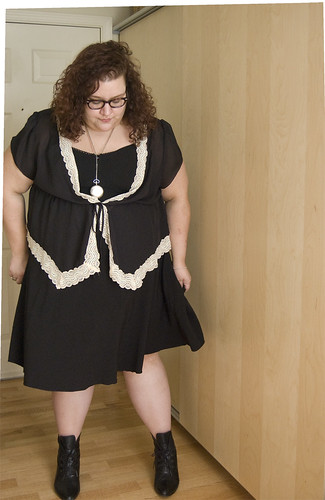
Black dress is pre-pink Torrid (I think it’s the only pre-pink item I have left; it used to have red tulle that poked out of the bottom but I cut that shit off);
bedjacket is Torrid of about four years ago;
80s granny boots are vintage, via eBay about six years ago (when I was thirteen, I had the same pair–same brand and everything–in white);
pocket watch (worn as necklace) also via eBay.
More after the jump.
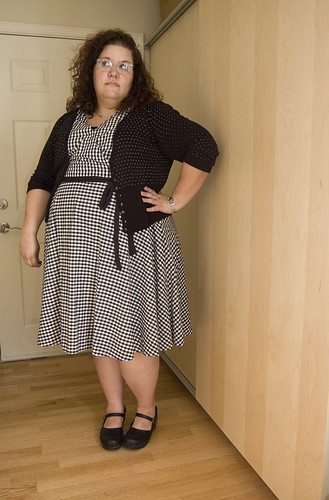
Black & white gingham dress is Donna Ricco,
black and white pindot cardi is Lane Bryant, by way of a fatshionista sales post,
shoes are Dansko.
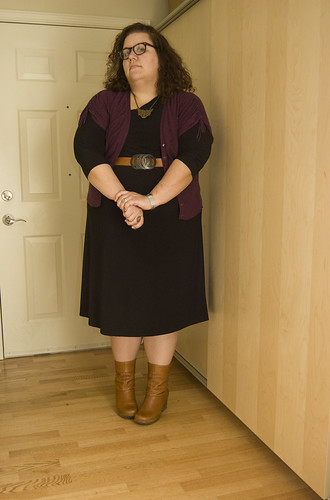
Black sheath dress from Igigi,
purple cardi over is Lane Bryant by way of Marshalls,
brass “mothra” necklace from ragtrader on etsy,
belt and buckle from Steel Toe Studios,
amber ring was a gift from my mom,
boots are (discontinued) Dansko.

What I had originally devised as a small and sweet antidote to the More to Love poison that’s been coursing through my veins for the past two months has turned into a fairly substantial project. There are a great many happy fat people in relationships out there who want to tell their stories, and thus I’ve created a gallery site to begin to showcase them. Hence, my dears, I draw back the curtain on the Museum of Fat Love. You can find the MoFL’s temporary home here.
It’s far from finished, as I still have pictures and stories aplenty to upload, and a more substantial permanent website is coming. Also, I am still cheerfully accepting submissions from anyone, in any variety of romantic relationship, who’d like to be included. I’ve been surprised by how emotionally-moving this collection is so far; the fact that it’s affected even a haggard anti-romantic like myself is evidence of the power of taking control of our own representation as people worthy of love.
That said, Fat Love cannot be narrowly defined in the limited romantic-relationship sense. And I feel a certain loyalty to those who are unattached, for, in truth, before I was Happily Partnered, I was Happily Single. (As a child at summer camp, I was awarded “Most Independent Camper” two years in a row for a reason; though I’ve little doubt, in retrospect, that this was one of those scenarios in which everybody got an award, it’s still telling that my independence is what people remembered about the ten-year-old me.) Prior to meeting the person I’d eventually marry–and, if I’m being honest, even after–I was never one who actively sought serious involvements or long-term relationships or bemoaned, inwardly or outwardly, my lack of coupledom. I often went places and did things alone–things like movies, meals, shopping, even driving from Florida to Massachusetts when I was twenty–and enjoyed myself just as much or more than I would have if I’d done the same with a friend or a date. I was more surprised than anyone when I partnered up, though now I wouldn’t change it for the world.
Fat Love isn’t simply about loving a fat person or being a fat person and being loved by someone else; it’s about loving yourself. You may have the most devoted partner(s) in the world, but that doesn’t mean much if you never understand why they love you; loving yourself is primal and key to human happiness, whether you’re in a relationship or not.
Thus, I am now also inviting individuals to share themselves and their stories of self-love. You can be accomplished at body acceptance, or not; you can be happy, or not; you can be a poster child for fat-stereotype-busting, or not; but you must be honest and true. If you’d like to participate I ask that you include a picture and tell a story of your size-acceptance journey, and let me know if I can use your first name. (And yes, you can submit to both the couples gallery and the individuals gallery, if you’re up for it.) You can email your contribution directly to me here, with “Fat Love” in the subject line.
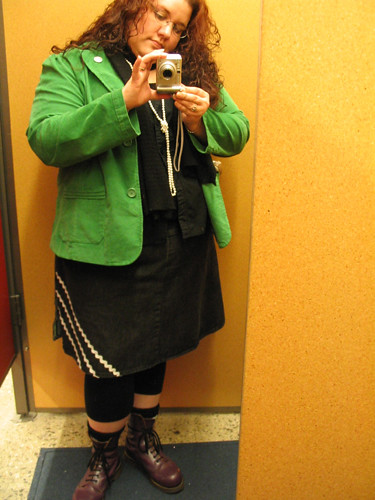
On the recent piece about size acceptance on Good Morning America (I originally wrote about it here), there was a tiny soundbite from a doctor, wearing a white coat and standing in what looks like an examination room, saying that she believes size acceptance, as a movement, is really just an excuse for gaining weight.
And it may be. Like any philosophical position or perspective, size acceptance means different things to different people, and therefore has the potential to serve a multiplicity of different purposes. I’ve no doubt there are large numbers of folks who come to size acceptance because they’ve gained weight and they’re tired of flagellating themselves about it. I don’t actually think there’s anything wrong with that; people’s relationships with their bodies are private, and so they should be. Therefore, if someone comes to a body-positive way of thinking for that reason, I’m hardly one to tell them they’re doing it wrong. More to the point, calling fat acceptance an “excuse” for gaining weight suggests that there is never an “excuse” for gaining weight, which further suggests that gaining weight is always inexcusable under any circumstances and you clearly have no self-control you foul butter-eating fatass. The unspoken subtext here is that it’s never okay to gain weight and so people who do should feel badly about themselves and it’s irresponsible to tell them they might accept their bodies as they are.
It is a pretty universal and unavoidable truth that bodies change over time. We get older, our mobility shifts one way or the other, we have ailments that come and go (or stay forever), some of us have children, some of us change medications, with the result that most of us, eventually, get a little fatter and a little thinner by turns, depending on circumstance. The “thinnest” stretch of my adult life thus far–thinnest in scare quotes because even at my thinnest I was wearing a size 18/20–took place between 1997 and 1998, as a result of overwork, overstress, and significant depression. I have had to train family members not to ooh and ahh over the few pictures of me that exist from back then, because while I was markedly thinner, my face is drawn and pale, and my eyes are empty. I am incapable of looking at those pictures without feeling my heart break for the sad young woman I was; all I can think is that I want to take her to lunch and gently pat her shaking hand and tell her she’ll be fine in a few years. So it’s hardly a surprise that my “thinnest” period is not something I look back on with wistful memories.
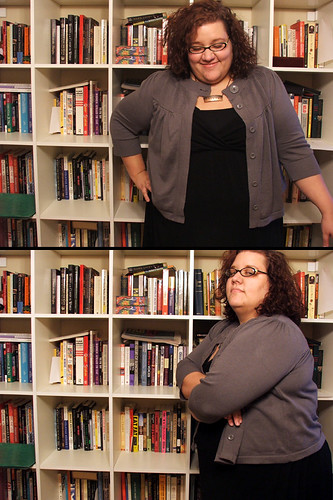
On the other hand, my fattest period is the happier, saner, work/life-balanced one I’ve been on for ten years now.
It’s unfathomable, given the cultural expectations on the subject, that a fat person is anything but constantly-expanding, like an inflating balloon. If fat is an unnatural state, then needs must that its maintenance be accomplished through unbridled voracious eating and a strong commitment to being as inactive as possible. I don’t purport to represent all fat people everywhere; there are fat people gaining weight and I am not disputing that. Nor am I dismissing those people as unworthy of size acceptance. I can only speak for myself, and I have neither gained nor lost any measurable amount of weight in a long, long time. To be exact, I’ve just realized recently that as of 2009, my size hasn’t noticeably budged in a decade.
I know precisely when it changed last: in early 1999 I moved in with my then-boyfriend, now-husband, to an apartment in a smaller city just north of Boston. Prior to this, as an undergraduate student, I’d lived in Boston proper for four years, a good fifteen-minute walk from the nearest public transit station though I only rarely took the train anywhere unless I was going across the river to Cambridge. At the time I was walking at least seven or eight miles on a typical day, just to get where I needed to go, from home to school to work and back again. The move to a more driving-focused area meant I walked far, far less; couple that with my also becoming a graduate student around the same time (which is arguably one of the most sedentary pursuits in the whole damn world) and over that year I gained something between fifteen and twenty pounds, and went up a clothing size. By late 1999 my weight had stabilized again, and since then my size has been remarkably predictable; in truth, I still have (and still wear–those that aren’t hopelessly outdated, anyway) a few dresses I bought around that time.
It’s actually a bit of a marvel, even to me, and makes as strong a case for set point theory as I can personally imagine. Over the past ten years I’ve been a strict vegetarian, and I’ve been an omnivore; I’ve been robustly healthy and I’ve also been sick to the extent of needing abdominal surgery; I’ve worked out religiously five days a week for years, and I’ve also been terrifically sedentary for equally-long stretches of time. And despite all these changes my size and my weight has held steady; I’ve neither gained nor lost anything of significance. The stretch marks on my belly, which I developed first during weight gain in high school, and again during my last weight gain in 1999, have faded to near-invisibility. My body has changed, insofar as my late 20s saw my fat shifting a bit, and I have more of a squash shape now whereas I used to be more of an apple. Nevertheless, my body and its heft, the occasional fat-shifting upheaval notwithstanding, are wonderfully familiar and natural and predictable to me, and I suspect it’s because I have learned to trust that my body knows what it’s doing, and I’m pretty astute at telling when something is wrong.
It’s an affront to almost all of the conventional wisdom on size and weight, I know, but it could just be possible that–if not as a result of the damage to my metabolism from strict and continuous dieting during my more formative years, then maybe a result of heredity, or just plain dumb luck–this is my size. The medical community as well as cultural expectations would have me believe that fatness on my scale, the lofty heights of the 300+ pounders, is unnatural and impossible to maintain without an extreme regimen of donut-scarfing and, when full, rubbing myself with lard so that I might absorb more fat through my very pores.
But so far as I’m concerned, the medical community and cultural expectations can go fuck themselves. They don’t live in here, with me, and a million research studies on the bodies of a million fat people still won’t ever tell my unique story. Because–and I should make this the tagline at the top of this blog because I say it so much–all bodies are different. I may get no fatter but that does not mean that someone who does shouldn’t be encouraged to realize and accept their normal weight and to come to a place where their body isn’t a rebellious monster to be mastered but is, instead, the treasured and cared-for vehicle through which they experience the world. Fat people are not a pathology and they are not a monolith. They’re different. Just like thin people.
I read comment threads on news articles. I do this, and invariably then I’ll sigh and mourn the death of human intelligence, and wish I hadn’t bothered. But then I do it again, anyway. It’s an opportunity to get a sense of what some folk are thinking; what they wouldn’t say out loud to an open room but feel entirely safe saying in text as a stranger among strangers.
Right now, the US is in the midst of a vigorous debate over healthcare reform, which has been by degrees depressing and maddening, and unsurprisingly this has been a popular subject on all forms of the news- and commentary-driven media. The comment threads to many of these articles provide a wild diversity of approaches and opinions, but always, there seems to be at least one person who opines the great injustice that is their potentially having to help pay for some fat person’s healthcare. Combine this with the growing support for implementing some kind of “fat tax” (which, sorry folks, won’t affect this fat person’s wallet, as I never drink soda, nor do I eat snack cakes) and you have a small but vocal minority of folks who think fat people just aren’t punished enough when it comes to healthcare, and that the fat should be forced to either pay more or be shut out altogether. I’m not going to link to any particular comment thread here, but read through the responses to almost any article on the fat-tax or the “obesity epidemic” and you’ll find some guy who thinks he’s a fucking genius for having come up with this idea.
And you know, the reality is, health care costs are skyrocketing out of control. It’s probably not unreasonable, in a logistical sense, to punish the folks more likely to go and be sick (but not to up and die, as they are relatively cheap healthcare recipients) by making them pay more for their coverage (if they’re allowed to have coverage at all). In fact, I have a better idea, one that would likewise save the industry quite a bit of money in healthcare costs.
Let’s just punish all sick people.
It cuts out the middleman. After all, it’s the sick people of all walks of life who are costing the US billions in taxpayer dollars that could be better spent blowing people up halfway around the world. So, henceforth, I propose that anyone who gets sick immediately has their coverage slashed and their premiums raised to pay for all the coverage their stupid sick selves will inevitably require. You’re diagnosed with lung cancer? Tough luck, you irresponsible oxygen-breather. You get critically injured by a drunk driver on your way home from work? Better have your checkbook on you when you get airlifted to the hospital.
Obviously, I’m being glib. It’s a preposterous suggestion. The truth is that this is how insurance works: we all pay, so that the some of us who require healthcare at any given time can access it. That is the purpose of insurance, to pay into a collective system that we can then draw on if we require it. This means some of us will pay in more than we take out, and some of us will take out far more than we put in. But that’s how insurance operates and how it always has. There’s a term for putting money into a system that only you can access, and only when you want to: it’s called a savings account.
Now, if you want to punish the fat because you truly believe that all fat people are necessarily and irredeemably ill at all times, even though I disagree with you, we should think about that proposition. Because ultimately, if that’s what you believe, you’re talking about punishing sick people for using health insurance for the purpose for which it is intended: to pay for medical treatment.
Let’s just mull that over for a minute here.
The money you pay into health insurance helps to pay for the healthcare of countless individuals whose life choices you may not agree with. You may help to pay for the HIV medication for someone who contracted the disease by having irresponsible sex. You may help to pay for chemotherapy for a person who developed throat cancer as a result of smoking cigarettes. You may dislike this; you may think these people are stupid for making mistakes that impacted their health. But you also probably realize that not everyone who engages in these behaviors will end up with these illnesses, just like not every fat person gets diabetes. It’s a roll of the dice. You still don’t get to say, “I don’t want my insurance premiums to pay for so-and-so’s healthcare because I disagree with their choices.”
The trouble with focusing on personal responsibility in regards to health is the reality that not everyone who gets sick is personally responsible for it. Not even fat people. There are plenty of folks who maintain totally “unhealthy” lifestyles by current standards, smoking and drinking with gusto, cooking everything in lard, and still persisting into their eighties and nineties. And there are also a great many people who are obsessively meticulous about the things they eat, and the exercise they get, and the environment in which they live, yet who still wind up dying too young from some unthinkable accident or some unpredictable disease.
Should healthcare only be made available to the virtuous and conventionally-attractive among us? Or to people who aren’t poor and who can therefore afford such things as quality food and gym memberships? Would you argue that only people who are well-educated, or people who are Christian, or people who are able-bodied should get full insurance coverage? Should healthcare only be offered to people who have never failed to report a symptom that resulted in a late diagnosis of a treatable disease? Is healthcare only for people who get themselves screened for breast cancer or colon cancer or prostate cancer at the appropriate ages and as often as recommended?
Is healthcare only for the physically perfect and morally pure?
These questions are a natural extension of the suggestion to restrict the coverage and punish the millions of Americans who qualify as being under that questionable umbrella of “obesity”, for having no self control or discipline, because this argument’s proponents also tend to accept the fallacy that fatness is easily enough managed with a little motivation. And what the “charge fat people more!” comments really come down to, in plain English, is people expressing that they don’t want to pay for certain people’s healthcare because they just don’t like those people. But that’s not how the system works, and arguably it shouldn’t work that way, because that would set a precedent for anybody who didn’t want to contribute to the healthcare of a particular group of people (people who are gay, for example, or people who are legal immigrants, or people who have a history of drug or alcohol abuse, and so on) to make a case against it.
For all the protestations of “fairness” and “equity” on the part of those who feel cheated by fat people allegedly soaking up all the precious healthcare, that’s an awfully unjust way of thinking.
 Two Whole Cakes is a blog written by