A couple of interesting points about this. First of all, it’s on Style.com, the internet version of Vogue, and a site hardly known for their thorough and exhaustive reporting on plus-size-accessible fashion. It’s actually on the front page of the site today, which is pretty fantastic.
More than that, however, I love Ditto’s candor about one of the outfits pictured that was put together in a hurry, that it’s basically a sheer sheath “and Spanx and a bra, and shoes, and that’s kind of all there is to it.” There’s an inventiveness and DIY flavor to Ditto’s style that’s both appealing and accessible to femme-inclined fat folks of all persuasions, and while I’m not always her biggest fan, I really dig her capacity to be out there and be so normal about it. This is what stylish fat girls do, especially those of us who are outside the inbetween-range of plus sizes: we make fashion of out the shit other folks dismiss or discard, or, as stitchtowhere and I have both described it, we make love out of nothing at all.
Happy Halloween, kids. It’s been such a rollercoaster of a month, I have no costume plans, so if I do wind up throwing something together tomorrow (we have a couple of party invites which we may or may not accept) it’ll be a Wacky Surprise.
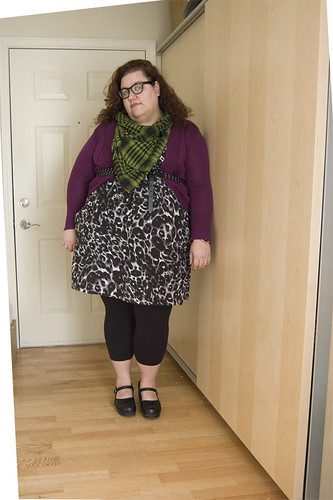
Leopard-spotty dress is from Evans;
purple cardi is really old, from Target;
leggings are really old and from Avenue;
double-wrap belt is really old and from Torrid (remember when Torrid sold leather belts? wistful sigh);
green plaid scarf is from Marshalls;
black Marcelle clogs by Dansko.
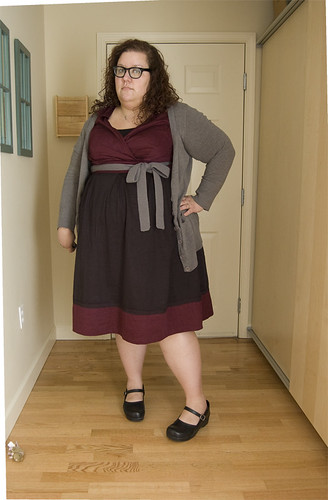
Burgundy-and-black dress is from eShakti.com;
grey cardi is from Torrid;
grey tie belt is from another, different sweater;
clogs are Dansko Marcelles.
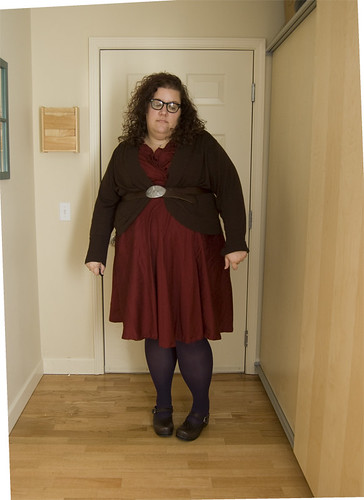
Maroon dress is from eShakti.com;
brown cardi is from Target;
belt is from Steel Toe Studios;
buckle is from Fosterweld on Etsy;
indigo tights from Avenue.com;
clogs are Dansko Merrie.
In the absence of my own content as of yet this week, here is a delicious link buffet.
First: Why Fat Studies (and All Identity Studies) Hurt Higher Education*: The author argues, in a nutshell, that when it comes to identity politics and academia, ne’er the twain shall meet. Or at least that when they do, it’s bad for academia. I don’t actually disagree that identity studies can be (note I did not say “are”) problematic in a higher-level academic context–arguably this is why in many cases while “women’s studies” continues to be an undergraduate major, at the grad level it often morphs into the more theoretical and less real-world-focused gender studies. But I do have a few gripes. For one:
Academics in [English and History] approach their disciplines with differing viewpoints, and from those differing viewpoints come differing intepretations [sic], and from these differing interpretations we get the beautiful intellectual debates we imagine higher education offers, and from these intellectual exercises we move closer to our goal of finding truth and reason in the world.
But Fat Studies, like all identity studies, begins with the end in mind. The conclusions have already been determined: fat people are oppressed and down-trodden, victims of an insert-terrible-adjective-here system and insert-another-terrible-adjective-here society.
I won’t debate that there are folks working in fat studies for whom this is true, though in my experience there are as many for whom it isn’t. My gripe here is that this sort of presumptive approach is by no means restricted to identity studies–it’s rife within pretty much every academic discipline to varying degrees. It is, frankly, a central part of the culture of academia.
The difference that the author is missing here is that identity studies by their nature are not invested in finding “truth and reason”. They are invested, rather, in the deconstruction and dismantling of what is popularly assumed to be “truth and reason”. It’s true that folks in traditional single-discipline fields (Hi historians! Y’all know I love you) may think this is, at best, a stupid waste of time, and, at worst, offensive to their entire worldview. And that’s fine; they don’t have to participate in it. There’s a reason why historians scoff at Foucault’s pretenses to historical study. But to blame the rise of more interdisciplinary and activist-influenced fields for causing a future Collapse of Academe is probably a little short sighted and alarmist.
Says the author:
Analysis of the ways in which fat people are portrayed in the media or represented in history, literature, and the arts is a fine intellectual pursuit if that’s what interests you. I do not intend to suggest I’m wise enough to decree what should and should not be discussed and debated in college classrooms. In the best world, anything would be fair game.
I’m left to wonder if she understands what “fat studies” even is, if not a field in which the “analysis of the ways in which fat people are portrayed in the media or represented in history, literature, and the arts” is recognized as a legitimate pursuit and is actively supported. The unfortunate reality–as true now, I’m sure, as it was when I was a grad student attempting to look at fat through a theoretical lens years ago–is that the majority of these traditional single-discipline fields energetically oppose the study of fatness within their disciplines. It’s easy enough to say “just do history and focus on fat!” but without some seriously open-minded colleagues that’s going to be a difficult proposition at least.
…Open inquiry and higher education are destroyed when pursuits like Fat Studies are enshrined. They are political movements operating under the guise of intellectual departments.
Because politics and intellectualism have nothing whatsoever to do with one another. Outrage!
Next: Protect us from abuse, says woman beaten for being fat. Last year, a London woman was physically attacked during her commute, while her attackers called her “fatty” and asserted she was too fat to be on the train. This has inspired some to label the attack a hate crime, and a new movement in the UK to speak up in favor of size-related discrimination laws like those passed in San Francisco a few years ago.
As I don’t live in San Francisco I can’t speak to the efficacy of the laws there, but I’d love to hear from readers who can, and from anyone familiar with the growing demand in London for action on this front.
Lastly: Nightclubs for the plus-size begin to weigh in. This is an AP article about fat-friendly nightclubs, specifically Club Bounce in Long Beach, CA. It’s filled with the standard conflicts between the fear of fat people being enabled to not hate themselves, and the begrudging acknowledgment that feeling badly about oneself is not a good motivator for weight loss (which is, naturally, the life’s goal of every fat person… isn’t it?).
My clubbing days, long behind me, were limited to subcultural punk and goth spaces at which the only folks turned away at the door were those wearing (intact) jeans or baseball caps, and in which there were fat folks aplenty mixing with thinner ones, so I’ve never experienced this kind of appearance-based discrimination on a night out. Have any of y’all been to one of these specifically plus-size friendly clubs, and if so, what did you think of the experience?
Honorable mentions (to which I have nothing to add except Hell Yes):
Nick from Axis of Fat and Hayley from Fashion Hayley talk fat fashion on Australian TV.
From Racialicious, Et tu, Amy Poehler? What’s so funny about desiring a big, black woman?
Gabi at YFF has an interview with Amber Riley of Glee, and I’m really jealous.
—
*Note: I am aware that this is a conservative-leaning website, but I’m not one to dismiss ideas out of hand just because they come from a different political perspective (especially when they provide so many more specific reasons for rejecting them). I frankly wish more folks on the conservative side of things felt this way .
There’s a quaint little shop that’s opened up in my ‘hood that I’ve discovered I enjoy. Though it has no knowledge of two whole cakes it does carry whatever my fellow hoodlums sell or trade in. In bright green and annoying font I passed by grudgingly, surely they’d have nothing for me. I had just discovered a decent Goodwill, my thrifting was complete! But lo, after a friend gallantly shoved me through the doors I discovered…..Torrid pre-pink.
While an entire post could be dedicated to Torrid’s pre-pink days and my love for whomever brought in their pre-pink items, I digress. I was pretty pumped to walk into a neighborhood trendier-than-thou shop and find things in my size. Granted I found all of 3 things in my size but that’s a Big Deal in the fat thrifting world. Aside from a few amazing vintage hunters (Cupcake and Cuddlebunny, Re/Dress, a few I’m leaving out on accident) and your local fatswap, thrifting in the fat world can be downright depressing.
So here I am, finding some dresses, trying them on, loving one. One fit amazing from the under-boob down. I mean really amazing. I wanted to pull out the knee-high boots and flogger and hop on over to somewhere dirty, perverted and happy. The rub? Side boob. Lots of it. I mean talk about boobage. My G-cups weren’t running over necessarily, more like storming the gates…and taking the underarm fabric with ‘em.
I walked around that hipster haven and asked several women what they thought of the dress. M’eh was the overall opinion, side boob was the culprit. Yet the cleavage was excellent. Got me to thinking….why the front and not the side? Is this the bastardized cousin of the mullet? What gives?
Then I bought the dress. I had lofty ideals of reformatting it into something more lacy on top, maybe some fantabulous black lace additions, something chic and slutty. Instead, I’m embracing my side boob. I want a side boob revolution.
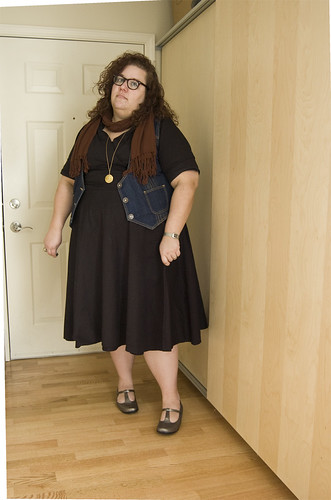
Black wrap dress from Curvy Girl Clothing (discontinued);
denim vest (ha) from Torrid;
brown fake-pashmina from eBay;
brass locket from katinkapinka on Etsy;
metallic t-strap flats by Privo.
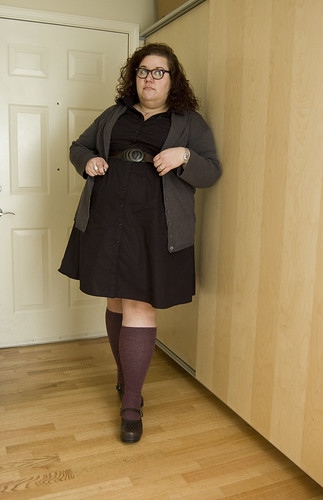
Black dress from Lane Bryant, via AJ Wright;
grey silk cardi by Jones New York, via Peter Harris;
brown belt and steel buckle from Steel Toe Studios;
tweedy knee socks from Sock Dreams;
“Merrie” clogs by Dansko.
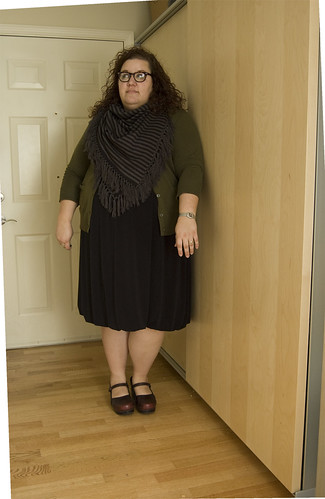
Black bubble-hem dress from Lane Bryant many years ago;
green cardi is Jones New York by way of Marshalls;
giant grey-and-black stripe scarf is Steve Madden, also by way of Marshalls;
clogs are Marcelles by Dansko, in cordovan.
If you’re a woman eating in public most people will consider it performance art and a judgment invitational. You can expect comments on the type, quantity, the good-for-youness, and your chosen food receptacle. The only thing that might draw more attention to the fact that you are a woman eating, is if you happen to be eating salsa out of one of those sombrero-style hats constructed out of nachos, especially if the chips are extra crunchy. Actually, I take that back–if you’re a woman who has the gall to eat in public people basically react to you as if you are loudly and theatrically consuming a novelty hat.
And it’s annoying. And there are times when I will actually avoid eating around others because anything other than “that looks delicious!‖and let’s be honest, sometimes even that, disrupts my frenzied shoveling my enjoyment of what should be pleasurable hour of sustenance. We all eat. Sometimes lots, sometimes a little, hopefully what we’re eating is always delicious. Can we, as a society of people who require food to live, work, and play just accept this as such and move on?
Of course not.
Scene: classroom, graduate seminar. A colleague of mine mixing her salad–we are on break– in some sizeable tupperware–which you know, allows for tossing as opposed to just having the best stuff sink to the bottom or the formation of an unmovable, discrete ingredient layered brick. Witnessing this truly incredible feat of something someone has never ever done before ever in life, MY PROF takes it upon himself to loudly remark on the OMG SIZE of her SALAD BOWL. Because anything bigger than the palm of your hand is comically large, AMIRITE?
She turns red and says: it was the only clean tupperware! My boyfriend didn’t wash the other stuff!
The presenter–arranging his notes for the next half of the presentation- sees she’s uncomfortable and joins in her defense: the bowl is just big, it’s probably not full!
I, being one of those insufferable radicals who disagrees with the premise that a woman should have to defend her choice of fucking tupperware–and nevermind that, her choice to eat at LUNCH TIME– blurt out the following:
I love it when people comment on what women are eating like it’s their business! It’s totally a class move!
And no one says anything. Though one colleague and I exchange glances. and it’s awkkkkkkward. And then the presentation resumes.
Evidently I’m taking a page from my mentor Lesley–one of the best Lesleys OF ALL TIME– and opting to be fat and mouthy in public versus just plain old fat. The latter is way too status quo and way more likely to lead to easy career opportunities and we absolutely can’t have that. I do everything the hard way. It’s my schtick!
There are so many wonderful existing resources for folks who are new to the concept of privilege–which I will define myself momentarily–that I am often hesitant to throw my own hat into the ring. Occasional Fatshionista contributor Julia has a lovingly-tended collection of links here, and I really wonder if whatever I say is just going to be a poor approximation of what others have said better before me.
That said, that list of links can be a bit overwhelming at first, to the reader to whom “privilege” isn’t a word with a specific definition, so here’s a general explanation for starters, produced especially for my beloved Fatshionista audience.
To begin, let’s differentiate the type of privilege I’ll be discussing by giving it a capital P. Privilege! This isn’t the broad dictionary-defined privilege you might immediately think of, which is colloquially associated with the special rights or advantages of a select few, and is typically applied to folks who are very rich or very powerful or both at the same time. The Privilege I’m bequeathing with a capital P, on the other hand, is a very specific concept originally deployed by folks working in academia, law, and social justice, and refers to the Privileges which members of non-oppressed or majority groups have, and which members of oppressed or minority groups do not. For context, one example might be the reality that a person who is born White in the US has certain built-in advantages over a person who is born Black. A White person convicted of murder is statistically less likely to receive the death penalty, for example, than a Black person. This doesn’t imply that the White person’s life is automatically all wine and roses, as is often assumed by many people new to the Privilege idea, but that owing to institutionalized systems of racism and oppression, the White person simply will not have to deal with some of the obstacles and injustices that are posed to the Black person. Nor is this meant to suggest that the White person is individually responsible (or “guilty”) for his or her Privilege, any more than anyone can control the circumstances of their birth. (For more of my own thoughts on White Privilege specifically, head back in time to this post.)
A more controversial (or–to put it more optimistically–advanced!) use of the Privilege concept is found in size-acceptance circles as it speaks to relative body size. One can argue that people who live on the smaller end of the fat spectrum enjoy certain Privileges over those who live on the fatter end. Smaller fat folks have a broader array of clothing options to choose from, for example, or may have less anxiety when flying since they’re not as likely to be identified as fat enough to have to buy a second seat, or they may be less likely to be routinely harassed by their doctor to consider weight loss surgery.
Now, this is not to imply that smaller fat folks are not still subject to cultural fat hatred. Indeed they are. Privilege and oppression exist on a spectrum, and are also intersectional, and having one privilege does not render one immune to oppression on other fronts. A slender Black woman may not have to deal with being discriminated against or attacked for being fat, but she’s still subject to pressure from racist and misogynist forces. A fat White disabled woman may not face racism in her daily life, but will indeed still be confronted with prejudice based on her size and mobility.
As a general rule, the people who most notice Privilege are the ones who don’t have it. Privilege is invisible to those of us who possess it, unless we push ourselves to see it, like peering forcefully at an optical illusion–do you see the young lady, or the old woman? Once you do manage to see both sides, they become impossible to ignore. You can try to forget, but you can’t unsee them. They’ll pop out at you, unbidden.
So why care? And why care whether other folks care? If we can’t undo our Privilege, whatever Privilege we may have, why bother? Well, I care because, as I’ve said above, once I became aware of Capital-P privilege, it started jumping out at me everywhere I looked, and is even now always hovering around the edges, like some shadowy intangible figure I’ll never get a handle on. And when other folks are dismissive of Privilege, it feels like they’re being terribly insensitive and cavalier about something that I take incredibly seriously.
I argue that increasing one’s awareness of Privilege is important not because one has to atone for one’s Privilege, and not because one is somehow personally responsible for the system under which we live, and under which the Privileged benefit; it’s important because acknowledging Privilege is about recognizing the forces that create our culture and our opportunities in life. Recognizing privilege is about understanding the silent systems that create inequality and injustice, whether they take the form of a fat baby being denied health insurance or a transgender person being targeted for their difference and beaten in the street. In its simplest form, understanding Privilege is about trying to understand people, trying to grasp why some folks have a harder time of it than others. It’s about making efforts to connect on a real, honest level with people who’ve had very different backgrounds and experiences than my own. It’s essentially about deeply and profoundly giving a shit about injustice and the forces that divide us.
That said, Privilege is one of the most difficult social justice concepts to communicate effectively, because people inevitably respond to it by becoming defensive and indignant. And friends, I understand. Hell’s bells, do I ever understand. Imagine if you will, Lil’ Lesley, newly arrived in grad school, taking a class in Whiteness (the very idea of which was boggling, as prior to that it hadn’t even occurred to me that race was something that affected me) and anti-racism. The course instructor, an older Black woman, was relentless and ferocious in pointing out the privilege and the general lack of critical thinking around race amongst my overwhelmingly-White classmates. But I’m not a racist, I inwardly protested, like so many before me, completely missing the point. I was defensive! I was indignant! I was insulted!
I was wrong.
Years later, I would repeat this process in a very personal context, with my husband, only this time I was the relentless Privilege-pusher and my husband was the defensive, indignant, insulted resister. I have since seen, from a distance, this process taking place in countless members of the Fatshionista LiveJournal community, sometimes over months and years. I’ve seen it begin, in some cases seen it come through in a huge flood, in some cases seen it slow to a trickle, seen it ebb and flow, roll in and out like an endless tide.
You don’t have to care about Privilege, nor do you have to care about social inequality, nor do you have to challenge yourself to broaden your understanding of culture and social forces. But I do. I have to, because I can’t unsee what I’ve seen or unlearn what I’ve learned, because for me, talking about size and bodies is inexorably interwoven with broader issues of social justice. I care about building a culture and a movement that is honest, in which these things are acknowledged and hashed out and battled over and not swept under the carpet, in which the infinite diversity of voices and experiences are heard and appreciated and recognized.
You don’t have to be a part of that movement. You can choose to only take from it the aspects that suit you, and walk away from the rest. But I think you’re missing out if you do.
EDIT: The podcast is up! You can listen to it on the web here (click the “Listen to this show” button at the top of the page), or get it via iTunes here.
While I’m waiting for the podcast of my radio debut (warning: some of those comments will cost you mightily in Sanity Watchers Points) to go up, I wanted to make a point about self-reference in the context of broader conversations about fatness, since this is something I did today, and I’m always conflicted when it happens.
Let’s be real here: I am publicly fat every day of my life. Every day that I get up, make myself presentable, put on a fabulous outfit, and go out into the world, I’m being Fat in Public. That’s the truth.
When people see me being Fat in Public with my mouth shut, they can project anything they like onto me. They can pretend I’ve got some horrible fat disease. They can assume I’ve got mobility issues. They can figure my self-esteem is in the gutter, or that I’m on a diet. I’m not really pressing their boundaries too much; I’m not attacking their assumptions simply by existing.
When I’m Fat in Public and being mouthy about it, well, then I become a problem. I start being critical; I start trying to make people think; in some cases I even have the gall to try to change folks’ minds. In any conversation about fatness, I can hang tough with the best of them, and aspire to the lofty heights of dissociated, unbiased logic–but there will always be a pall over the conversation, and that is the reality that I am fat and thus I have a personal stake in the discussion. In these situations, the elephant in the room is me.
I have this difficult relationship with using myself as an example, as I did today on NPR. On the one hand, it’s inaccurate and unfair to hold myself up as The Acceptable Fat Person. I’m not. More than that, I don’t want to be. When we divide ourselves up into Good Fat People and Bad Fat People, some folks are still getting the short end of the stick, and I’m fighting for the basic human dignity and respect of all fat people, regardless of their habits. I’m here to say you don’t get to hate fat people simply because they’re fat. That’s not allowed. It makes you a jerk. Stop it.
That said, in my individual case, the fact is I really do go to the gym–but not to lose weight, rather because I actually like going to the gym. I really do prefer to eat a diet of whole foods I’ve prepared myself, and mostly vegetables or whole grains at that–but not to lose weight, rather because I actually like the way they taste (plus I enjoy cooking). For me, weight loss is not even something I consider as being within the realm of my own possibilities. And I’m completely fine with that. It doesn’t make me sad or disappointed. I honestly don’t even think about it. Though I am aware others are scandalized by the notion, I really am comfortable with being this fat. I ought to be, since I’ve been this fat for many, many years.
Using myself and my own experience is real, and it’s what’s missing from so many conversations about weight and health–the voice of the person who exists outside the prevailing discourse of fat as necessarily (and deservedly) unhealthy, and fat people as necessarily (and deservedly) unhappy. I am neither unhappy nor unhealthy and I grow tired of being portrayed as both. This is my experience and my life, and rather than using myself as a representative for us all, I’d rather open and hold the door for the everyone else–even those with experiences far different than mine–to speak up and be heard. I am a person, and an individual, just like you. I’m no less moral, no less human, no less pure.
I’m just a little bit fatter.
Have you visited the Museum of Fat Love lately? I’m slowly catching up on submissions, and would always love to see more. Send me your story and picture to join the ranks of the happily fat-coupled.
In other, equally exciting news, this morning I had a fabulous time participating in a roundtable discussion on fat and culture on NPR’s On Point. There will be a podcast version available soon, but until then you can check this list for a broadcast near you.
There will be a forthcoming blog post in the next few days, in which I talk more about the radio experience, which was totally new to me and great fun, plus the challenges and rewards of being a Public Fat Person. But right now I need a giant mug of green tea and a few moments of relaxed silence.
Ever wonder what your intrepid Fatshionista blogger sounds like? Tomorrow’s your chance to find out. Feel the performance anxiety as I resist my natural inclination to talk too much and too fast! Thrill as I try not to lisp!
Yours truly will be joining national treasure Kate Dailey and an as-yet-unknown Medical Representative Kenneth Thorpe, public health expert, for a chat about fat tomorrow morning at 11AM EST on WBUR’s On Point with Tom Ashbrook. You can listen live from the internets here, or you can download the podcast version afterward (link forthcoming).
Positive vibes and well-wishing gladly accepted. I’ve never done radio before, so this will be an entirely new experience for me.
 Two Whole Cakes is a blog written by