Warning: I generally don’t do “trigger” warnings, but these two videos are pretty disturbing to me. Given that I am not real easily disturbed, I figured it’d be smart to give y’all a heads up about that.
The Washington Post has an article up today reviewing Jillian Michaels’ latest effort in her life’s mission to save us all from french fries, a new TV series entitled “Losing It With Jillian”, which premieres tonight on NBC. In “Losing It”, Michaels goes to the homes of fat families — in the first episode, half of the family is gastric-bypassed and still fat — to, I don’t know, abuse them into giving a shit. Oh, it’s hard for me, my dears, to describe these shows with any semblance of objectivity, because frankly I find them revolting.
Luckily, Washington Post writer Hank Stuever has more patience, and does a fine job of breaking down the nuts and bolts of this new series. Stuever rightly says of reality television in general and weight loss shows in particular:
[I]t’s about the underlying rot and the psychological baggage. To get it off, you gotta get it out. Crying is exercise. “Losing It With Jillian” takes what was good about “The Biggest Loser” — the weigh-ins, the workouts, the touchy-feely fussbudget who is Jillian’s co-star, Bob Harper — and replaces it with all that oopy-goopy lard of the sorrow of being fat. It encourages people to find the supportive Hallmark greeting card that is folded up deep within one’s soul.
I have it on good authority that Jillian Michaels is a lovely-enough individual in person. I’ve not had reason to doubt this, likely because I’ve never managed to consume a full episode of The Biggest Loser, the popular weight-loss reality show which she co-hosts, in one sitting. And in her favor, Michaels was clearly uncomfortable being lumped in with anti-obesity whipping girl MeMe Roth and bizarre sociopath The Anti-Gym Guy (whose actual name I always forget, but as I am no more than a nameless “chubby” to him then he can be the nameless Anti-Gym Guy to me) on Dr. Phil’s “Ultimate Fat Debate” episodes. On that panel, Michaels tried to emphasize that she only trains people who employ her to do so, and that she does not go around shouting at fat people for free. Oh, and she doesn’t believe in being evil to fatasses just because you can. I want to believe her. But it’s difficult to reconcile that with this sort of behavior:
\Or these unscripted, oops-didn’t-know-the-mic-was-live comments:
Y’all, I am burned by Jillian’s hot fat-hatin’ fire. Are you burned by Jillian’s hot fat-hatin’ fire?
Jillian Michaels is a troubling figure to me, even without extensive exposure to her antics on The Biggest Loser. I know there are folk out there, even fat folk, who adore her. Adore her. The comments to both the videos above were filled with Jillian Michaels apologists falling all over themselves to defend her and her rage-alicious ways; indeed, the title of this post came from a comment on the first example. It seems for some people Michaels can do no wrong, even when she is way out of bounds. Personally, I had Physical Education coaches in my school years whose demanding teaching methods were but a fraction of what Michaels employs, and all they accomplished in me was the cultivation of a deep and seething hatred for team sports, one that persists to this very day, though seventeen years have passed between me and my last P.E. class.
It’s not simply Michaels’ fat-hatin’ that bugs me, nor is it her penchant for yelling. My problem is that her methods of engaging and motivating her clients is frighteningly close to a relationship which in any other context we would call abusive. Working off the two clips above exclusively — two clips I chose pretty much at random from a multitude of possibilities — I can make this case. For one, Michaels dehumanizes the fat people she works with (”They’re not like normal people”, “half-dead”). She seems to think the brains of fat people have been compromised such that they can only respond to repetitive screaming, not unlike wayward cattle. She makes threats, not just to their physical safety, but to their very lives (”The only way you’re coming off this damn treadmill is if you die on it”). Her abuse is calculated to break her clients down until they weep, and even then she doesn’t let up. She is unpredictable, with a vicious and quick temper, and is apathetic toward (if not gratified by) her clients’ discomfort, be it physical or emotional. There’s even elements of codependency in there, as it’s only when the fat people in question behave as instructed that her mood might change and they may receive some encouragement or support, which is only meted out in doses small enough to keep them craving more. And before any of this happens, the people she trains must first be convinced that they cannot possibly survive without her, that their lives prior to this introduction were worthless, their bodies but hollow shells — or, in this case, shells filled with soulless fat.
And people love it. They say, yeah! That’s what these fat people need! They need to be abused!
And fat people love it. They say, yeah! That’s what I need! I need a stranger to scream hurtful things at me while I exercise!
My loves, if the person your best friend was dating exhibited these behaviors, what advice would you give? Would you say, “I’m sure s/he has your best interests at heart,” or would you say “In fact, you really were an insignificant piece of shit until you started dating so-and-so,” or would you say, “It’s nothing less than you deserve”? I rather hope you would go with something along the lines of: “This relationship is toxic and horrifying and I will do whatever you need from me to help you get out of it.” To put a finer pop-culture point on it, Jillian Michaels is basically the Joan Crawford of physical training. No matter how vicious and unstable her behavior may be, at the end of the day all we want is for you to love us, Mommie Dearest.
Oh, I am aware that people who hire her do so of their own free will; indeed, most abusive relationships begin that way. But let me be clear: if a fat person wants you to scream at, humiliate, or otherwise demean them, that itself is a problem.* It is a problem because it illuminates the fact that so many fat people believe they deserve humiliation and disrespect, and also believe that these things are their only means of finding health and happiness. That their immorality has to be beaten out of them, emotionally or otherwise. That their evil has to be exorcised. That they and their bodies are not entitled to care and dignity but only to punishment and pain.
It’s not just Jillian Michaels who is responsible for this cultural phenomenon; abusive trainers have been around for as long as there have been gyms to train people in. But she is, at this moment, the single most visible example, and she is the only one with a hugely successful television series which is helping to shape — for better or worse — our national consciousness about what it means to be fat. Thus I’m using her here to illustrate this very ugly and abusive aspect of our culture. It’s difficult to argue that Michaels couldn’t be “successful” with her clients if she were less monstrous, unless Michaels herself really does believe that her clients cannot understand the potential benefits of nutrition and exercise without being berated into obeisance, that fat people aren’t quite people at all, and that they need to be rescued from the fat scourge robbing them of their humanity.
Self-respect and self-esteem are not things that are delivered automatically along with a new, slimmer body. How you do or do not value yourself is something that you will carry throughout the bodily changes that will inevitably take place in your lifetime. If you love yourself unconditionally — as you should, even if no one else does — then fatter or thinner, you are at home in your body, and you neither want nor need abusive outsiders to instruct you on how to survive. This model of weight-loss-by-abuse is irresponsible, designed to produce good television more than to encourage healthier lifestyles. Our hatred of fat bodies is enabled and reinforced; if Michaels, who claims to do this because she cares, is allowed to berate fat people under the auspices of doing them a favor, then certainly I am free to openly mock the next fat woman I see. Even if she’s with her family. Even if she seems to be having a good time. How dare she. The popularity of Jillian Michaels, in spite of (or because of) her abhorrent behavior, illustrates that we as a culture are continually and passively consuming media that underscores the idea that fat people are asking to be malevolently attacked simply for daring to exist.
On an individual basis, Michaels’ abuse may make her clients lose weight, and her clients may even swallow the idea that simply weighing less entitles them to feel better about themselves, but this kind of self-confidence ultimately rings hollow, as it’s not rooted in their own selves, but instead is tied to Michaels’ approval. What happens when Michaels leaves, as she ultimately will, and they are left without the only person they believe can save them? A person cannot care for a body they’ve been so thoroughly trained to alienate and despise, and when they are utterly lacking in the basic tools that would enable them to reclaim their bodily autonomy and self-respect. Michaels may think that she cares — many abusers do — but her methods are poisonous, both to the people she trains and to our culture as a whole.
—
* At least it is when it happens in an environment that doesn’t involve mutual negotiation and the establishment of a safe word in advance.

My dear Marianne wanted Fatcast flyers to take to Wiscon this weekend, and so I rapidly assembled the glorified CS2 font-sampler above as a quarter-sheet flyer.
Since I brought it up, how are you digging the podcast so far? We’ve covered the doctor, fatshion, and an assemblage of minor political points, including life as a fat goth in the 90s. Our next episode — which we recorded last week and will be posted as soon as I finish editing it — deals with language and the idea of “safe space”; the episode after that, recorded last night, discusses how fat-hating culture can lead us to question reality. This Sunday we’ll be recording an episode on Fat Travel, with Marianne (and possible guest star) joining in from her Wiscon hotel room.
The truth is, we began this endeavor on a bit of a whim, and have been truly shocked at the positive response to what is, in essence, a live, often-spur-of-the-moment conversation recorded and slapped up on the internets with almost no editing. I do have a long list of topics I’d like to cover in the future — everything from going to gym to eating as a political act to “fat allies” — but I also want to know what y’all want to get out of this podcast. What subjects do you hope to hear about? Are you interested in us doing interviews with topical individuals? (For example, we’re trying to work up a time to do an interview with Lucie of LucieLu on the joys and sorrows of trying to run a small online plus-size clothing shop.) Do you like it just the way it is and want us to change nothing?
My sincere thanks, as always, to all of you who read and listen and comment (or don’t comment). You make me a better communicator and activist and I continue to be humbled and amazed that the media I make is of value to some folks.
Somehow I’ve managed to go a few years now without an official comment policy. Well, I suppose I’d always had one, though it was nebulous and existed only inside my head and was primarily rooted in my intuitive sense of a commenter’s willingness to have a civil conversation, versus a commenter who is more into the idea of hearing their own voice. As a result, my comment policy has been less draconian than many, as it’s very rare that I run across a reader communiqué that I simply refuse to engage with. Hell, even hate mail occasionally gets play! Given that comments here have always been moderated, I’ve been able to just flush the rare shit comment out of the queue with little reluctance and even less explanation.
Though historically I’ve thought that comment policies on blogs written mostly by one person were sort of unnecessary, lately I’ve come to appreciate their usefulness, not so much as strict rules to follow but as guidelines offered to would-be commenters on what sort of comments are unwelcome. I don’t actually expect it will stop the unwelcome comments — they get deleted from the moderation queue anyway — but it might help some readers to avoid phrasing well-meant comments in ways that are problematic, either to me or to my other readers/commenters.
Hence! Here is a comment policy, in the form of a list of things likely to be deleted (though there are always exceptions):
1. Comments that assure me that you hate me and my fat, or that I am unacceptable or dangerous (this is the best) or whatevs. For one: BOOORRRING. For two: I don’t write this blog for personal validation. TRUFAX! I write it to send critical thinking about bodies and fat out into the world. If you disagree with those ideas, and refuse to even imagine a situation in which you’ll ever feel otherwise, and moreover are not interested in discussing this stuff in a constructive and thoughtful way, then that, also, is totally cool. So cool, in fact, that you needn’t waste characters typing it out and sharing your feelings with me. The world is filled with amazing people with very divergent ideas about life, and that is a wonderful, beautiful thing, but it does not mean that you get to express those ideas whenever you want, with no regard for the context.
2. Comments that betray a lack of familiarity with me individually but which make assertions as though familiarity is assumed. Example: “You should get a gym membership, and eat more vegetables!” Very occasionally I will engage with such comments, if I’m feeling patient, but ultimately doing so kind of reinforces the idea that I must defend my tenuous position as a “good fat” (i.e., one who goes to the gym and eats like a Buddhist) on demand, which itself is insulting and offensive. My message to you is to lurk more. Constantly justifying my existence is tedious and brainless, especially when all the information you could want about my exercise and eating habits is already on this blog, in more topical circumstances.
3. Concern Trolling. For those who haven’t heard this term before, concern trolling happens when folks post comments that are attacks cloaked under a disguise of heartfelt worry. Example: “I think you’re great and it’d be awful if you died tomorrow under an avalanche of ten thousand cupcakes which you were trying to eat because you do that all the time.” Alternatively, “My brother/aunt/cousin/elementary-school BFF/gardener/acupuncturist spontaneously died of The Fat and you should consider eating less and exercising so it doesn’t happen to you too!” This guideline is a bit more flexible and intuitive, as many comments that others would instantly dismiss as concern trolling I will often read as genuine queries, and respond to with the benefit of the doubt.
I get very little in the way of problematic comments, to be honest. Maybe once a week I’ll receive a comment that I have to think about before I approve it. Maybe once every two or three months do I get a comment that is so candidly (and often hilariously) awful that deleting it isn’t even a question, though occasionally I will first share it with friends for the LOLs. The policy above really boils down to 1. Don’t be a jerk and 2. I will decide if you’re being a jerk. I welcome dissenting voices that can communicate in thoughtful terms that resist the urge to attack me personally, and a readthrough of recent comments bears this out.
A big part of activism is a willingness to put oneself out there, knowing it makes you a target. I’m not much the kind of person to argue that the more haters one has, the more effective their work is. I think hate is ugly and — perhaps most offensively — unproductive. Hate is the antithesis of constructive communication and critical thinking. I got no time for that in my life. So my habit is and has always been to smile at my haters and to try to find common ground — or at least to find something we can both laugh at together. I am often successful.
But still, one has to draw the line somewhere.

Remember Hairspray? I refer, of course, to the 1988 John Waters masterpiece, the radical film that captured the finest moments of Ricki Lake’s career, and that first introduced an 11-year-old me to the majesty that is Divine.
Now, remember how a few years ago they remade that landmark film into a watered-down piece of crap starring Zac Efron and some fat girl who’d only ever been on Broadway been slinging ice cream for a living (Edit: I was confusing two different actresses, oopsy), with John fucking Travolta in the role that Divine made famous?* THE MIND BOGGLES. But yes, it happened. The fat girl in that movie was Nikki Blonsky, a cute little pudgedumpling who would subsequently attain gossip-column infamy for a public fistfight with a former contestant on America’s Next Top Model. In an airport. You can’t make this shit up, kids. Sadly, Blonsky is probably best known for this event than for much else she’s done since, which is a shame given that she seems to be a talented performer.
But hey, let’s hope that’ll change for her with her starring role in Huge, a new hour-long drama on ABC Family premiering June 28, based on the Sasha Paley novel of the same name. The main thrust of the story focuses on two girls headed to fat camp; April wants desperately to lose weight and is there by choice, while Wil is being forced to attend by her parents and is more interested in subverting the system by gaining weight. In an unexpected turn, Blonsky is cast as the rebellious would-be gainer Wil, while the much smaller Haley Hasselhoff is the eager-to-diet April.
My expectations for this, as in most television series that attempt to deal with fatness, are very low. But it’s worth noticing given that — see the cast photo above? — this is one of very few TV shows to feature multiple fat characters in starring roles, instead of one fat token to play the best friend or the sassy neighbor. Often one fat character is enough, when it’s not too much, and shows with multiple fat castmembers are exceedingly rare. (I’m thinking of Roseanne, but after that I’m stumped. Anyone?)
Which is why I’m also mentioning a new series on CBS, due in the fall, by the guy who made some other shows that some people seem to like (Two and a Half Men, and Big Bang Theory). I don’t watch sitcoms (unless Family Guy counts) so I can’t speak to the quality of his previous work, but this series is called Mike & Molly, and tells the story of two fatasses who first encounter one another at an Overeaters Anonymous meeting (GROAN) and subsequently fall in love. In a reversal of the usual circumstances, the sassy smart-mouthy characters on this show are the skinny ones. OH FUN. I’ll be honest with you, kids — this show looks positively awful to me. But decide for yourself! The promotional trailer is below. Again, potential-for-terribleness aside, this is the rare show featuring two clearly fat actors in the leading roles, and as such deserves a look.
What are your thoughts? Are you looking forward to either of these shows?
—
*In truth, I was surprised to find that Travolta delivered a pretty great performance, and was possibly the thing I enjoyed most about the whole movie. But I admit that with reluctance; the original is still superior.

I am having a moment.
I’m hoping to capture this moment here, while I’m having it, and while this semi-embarrassing flood of memories is untainted by my having overthought and reassimilated them all into something that actually connects to the now. Much of what I write here on this blog could be classified as memoir, and I am occasionally asked how I manage to be so candid and transparent about my life. Part of the reason is because I look back on these things with the distinct impression that they happened to someone else. The person I was in high school became a stranger to me when I left Florida; the person I was in college and then grad school did the same when I succumbed to reality and went to work for a living. In fact, I am not so different now — I am still thoughtful, introverted, outspoken, strong-willed, occasionally arrogant, and unabashedly fond of a spotlight. I spent much of my formative years figuring out ways to reinvent myself into a new casing for the same set of characteristics I’d always possess, like a catepillar who could only ever become a series of pupae, and never the butterfly of his imagination.
Later, I’d decide that transformation was overrated. I gave up (yes! gave up!) trying to become something I wasn’t — academic, artist, femme fatale, muse — because what I am is interesting and unique and remarkable already. This is equally true of you, whoever you are. Sometimes it’s okay to give up. To borrow from Rachel Maddow’s commencement address at Smith College this weekend: some dreams are bad dreams.
My moment began as a conversation on Facebook between some friends from high school, which inspired a pulse-quickening memory, which provoked research, and which ultimately evolved into time travel via the insane capacity of the internet to collectively remember things we’ve forgotten. There is backstory: when I was sixteen I decided that nearly everyone who went to my high school was terribly boring, not least because no one knew about the music I liked (never mind, for now, that I liked the music I liked to some extent because no one else knew about it) and the music I liked was, at the time, the single most important thing in my life. In retrospect my taste in music was hardly distinguished so much as it was intentionally obscure. At any rate, I went to every all-ages show I could afford — someday I’ll tell you the story of realizing a guy in the mosh pit at a Bad Religion show was in my class, and the devastating dismissal I received when I attempted to chat him up about the show in the hall at school the following day — searching for someplace different to belong. I was too soft and brainy for the punks; I wasn’t angular or awkward enough for the goths. What else was there?
I discovered The Hot Moon Cafe via a guy named Jason, whom I met on the internet.* It was a DIY-flavored coffeehouse, a ramshackle improvised affair that looked like something a clutch of displaced bohemians might have assembled via dumpster-diving whilst squatting in a strip mall. Though today I’d likely give such a venue the side-eye, at the time it was the most perfect place on earth, a unique oasis of invention and acceptance where all sorts of local musicians, poets, artists, and other experimenters could assemble and be relatively assured that no one would laugh at them or their efforts — or at least not out loud, or at least not in their faces. This isn’t to suggest that everyone there was talentless or a hack; that would be inaccurate. But we were terribly young. And most of us — certainly I can speak for myself — didn’t really know what we were doing.
Many of the finer points of those days are lost to me. I can’t remember the name of the guy who owned the place, though I recall what he looked like, and the same goes for many of the employees. I can remember the feel of the spaces, the motley assortment of mismatched chairs and tables, the local art on the walls, the graffiti, the mug I preferred, which was heart-shaped and years later I realized began its mug-life as a receptacle for a Pick-Me-Up Bouquet. I was there often enough, several nights a week, for awhile, to have my very own mug, yes. Today, for the first time since the 1990s, I suddenly remember this guy**, who worked at Hot Moon and in whose bedroom I first saw DOOM — yes, the video game, you thought I was going to say something else, but tell me you are not surprised that I remember where and when I first saw the fucking mother of all first-person shooters. Today I remember the woman who played acoustic shows consisting of her own songs mixed with multitudes of Melissa Etheridge covers. Today I remember this band***, a regular fixture at Hot Moon, with whom I even once traveled, with another friend or two, up for a road show somewhere in the north of the state, though I can’t for the life of me recall where. One of these friends was a year or two older than me, and she published zines about music. Remember zines? Midnight sojourns at Kinko’s making copies? Casual competition over who could discover the best new music first, and get credit for spreading it around? I remember social struggles and sadness and people who were my friends and then who suddenly weren’t, for one reason or another. There were no fights, not that I recall — but there were currents and eddies, and we would swirl around one another for awhile before peeling off and drifting somewhere else.
Wednesday nights were open mic nights. I read poetry. Yes. I read high school poetry, embarrassing, trifling, self-righteous, loud. I did! No, there’s more: I sang. This gentleman, whom I’ve not even thought of in a decade prior to today, played guitar so I could sing The Murmurs’ “You Suck” as loudly as possible (I know, I know, I am flushing with embarrassment even now) and, if I recall correctly, the occasional Violent Femmes song. Like everyone else mentioned here, I rediscovered this guy this morning via the time portal that is Facebook, and he looks exactly the same as he did sixteen years ago, and is somehow simultaneously incredibly attractive — how I failed to notice this at the time baffles me. We live too much inside our heads, as teenagers, don’t we.
It was at Hot Moon that I impulsively kissed a boy I didn’t know in front of a table full of people. I was terrifically innocent and physically-insecure, back then — so mired in the years of loathing my body that it was inconceivable to me that anyone could find me attractive. I look back now with my eyes wide and a wry grin: my god, I was a fucking eunuch! But it was all right, and it probably kept me out of trouble. It was at Hot Moon that I met out queers my own age for the first time. It was, indirectly, Hot Moon that spurred me on to Boston for college, a strange city far, far away from my known world, but where places like Hot Moon were plentiful, and where the bands I liked regularly came to play.
I also remember the newfangled girl-fronted music that was cropping up around then, and even today when I hear some of those songs, that forgotten teenager wakes up a little. I remember hearing Alanis Morrissette’s “You Oughta Know” for the first time in the parking lot of a Miami Subs at 2 o’clock in the morning, the radio DJ announcing it as a new song that was “probably inappropriate” to play during the day. I remember seeing Morrissey for the first time in the video for “The More You Ignore Me, The Closer I Get” on 120 Minutes (thus began a long and predictably tragic love affair with Morrissey and The Smiths). That teenager persists, when these songs materialize over the speaker systems in department stores or reworked as television-commercial soundtracks.
The hell of it is: I’ll never outrun that girl, no matter how much distance time piles between us. When I remember these things it’s like a reluctant homecoming, to a place where I know I’ll never live again, a person I tried to leave behind. No, I haven’t made peace with certain chapters of my youth, no matter how forthright and plainspoken about them I may be here. Some things still aren’t settled. Some things I regret, some things I have forgotten and stubbornly remember, and some things I wonder if others remember or stubbornly forget. Did I make an impression, back then, and what was it? Who was I? I’m still not sure.
A few years after I’d left Florida, when I was a junior in college and living in Boston full time, I ran into a guy from my high school, and though we were on friendly terms we were nowhere near close enough for me to call him a friend. He was surprisingly happy to see me, and after we exchanged the basics of what we were up to, he said, “Wow, man, I always thought you were so cool in high school.” I was astonished and blew past the compliment to get the hell out of there. I couldn’t imagine that anyone in my class thought of me as “cool”; at school I mostly felt isolated, resentful, the fat girl the popular athletes launched spitballs at. It’s true that the more time I spent at Hot Moon, the more confident and less affected by classroom drama I became. I knew I had somewhere to go. I had a community, out there, at Hot Moon and beyond, full of people like me, who cared more about album release dates than football scores, and more about self-expression than social gravitas. I was now awake to it, and if I had to follow it straight up the east coast to Boston I would.
So that was the moment I had this morning, this unexpected tsunami of adolescent flashbacks dating prior to the great divide, half my lifetime ago, when I left South Florida for cooler climes. Though I did find plenty of like-minded friends in my new home, I never did find another Hot Moon, but then you can never recapture that sparkling delirium of your first love. And you wouldn’t want to.
—-
* This was around the same time as Worst Date Ever, though luckily Jason was my own age and a vast improvement on Worst Date’s many… inadequacies.
** In fact, right now as I am writing this I remember that when I skipped the prom, I went to see his band play at Hot Moon instead.
*** Their whole 1995 album can be downloaded under Creative Commons at that link, and as a result of the CC licensing may well be used as bumper music in a future episode of Fatcast.
They’re real, and they’re spectacular: A review of the film A Matter of Size
By Lesley | May 17, 2010

Note: I have been liberal with the spoilers in the following review, with the expectation that many of my readers may not get the chance to see the film. However, I have held back some of the more central plot points, so there are plenty of surprises left should an opportunity to see it arise — and if it does, take it!
When an email landed in my inbox offering me free passes to see a A Matter of Size, I was dubious. But there was a warmth evident in the trailer that I didn’t expect, and my interest was piqued. So it came to pass that my husband and I appeared at the charmingly shabby West Newton Cinema on a quiet Sunday afternoon, collected two free small buckets of popcorn to go with our free tickets, and settled in to see a film about four fat guys who quit dieting and learn sumo wrestling.
The brilliance of including free popcorn was not lost on me.
Our hero is Herzl (acted with immense charm by Itzik Cohen), whose weight loss failures are legendary, and who is kicked out of his diet club by the club’s leader — a woman both subtle and monstrous at the same time — for continually gaining weight and thus imposing a negative drag on the morale of the club’s other members. The experience is reminiscent of old-school Weight Watchers weigh-ins, public and humiliating, where weights are called out to the assembled and congratulations are offered to those who have lost. Though Herzl pleads with the club leader repeatedly for another chance, she refuses, and eventually his anger comes to a confrontation in front of the whole group, in which Herzl is outspoken in his criticism of dieting and announces that he is starting a “sumo club†for the fat people of Ramle, the town in Israel where the film takes place.
There is more to the story, naturally. Herzl suffers the barbs of his well-meaning but often-harsh mother, who berates him about his weight while simultaneously plying him with food. The film captures the complexity of these family relationships and conversations about weight with nuance and great care; Herzl’s mother can be vicious in her comments, and yet we’re never allowed to doubt that she loves her son. Indeed, the only thing approaching the standard “but what about your health?†preaching comes from Herzl’s mother, and we are led to believe that she does so because Herzl’s father’s weight “killed†him — which it did, as we later learn, though not in the way one might assume.
The fate of Herzl’s father is an unexpected punchline to a joke we weren’t aware we were being told, and that is a good example of the humor employed in this film. There are no cheap fat jokes here; the closest thing to them are the examples in the film’s trailer, but in the context of the whole story, they don’t play out in the way you’d expect. The size-based humor comes across more like affectionate in-jokes than an excuse for malicious laughs at the hapless fatties. I’ve said before that I don’t have a problem with fat jokes, so long as they are funny — it’s just that so few of them are. The fat jokes in A Matter of Size manage this feat admirably.
Over the course of the film, Herzl falls in love with the winsome Zehava (played by Irit Kaplan), also a member of the diet club. She, along with three of Herzl’s friends, originally quits the club in favor of Herzl’s sumo plans, though she subsequently waffles throughout the film between self-acceptance and dieting. Zehava is both fat and a fully realized character who moves through the story with a very human mixture of confidence and self-doubt. She tries to bring feminism to the women of the local prison where she is a social worker, and later, when she and Herzl are about to have sex for the first time, she expects to do it with the lights on, while Herzl is the one reluctant to be seen. Notably, neither character is portrayed as either sex-starved or sex-crazed, nor as fetishized, but instead they are normal people who simply like each other.
Later, when Kitano, the sumo coach and owner of the Japanese restaurant where Herzl works, tells Zehava “there are no women in sumo,†and that she cannot participate, it’s clear she had honestly intended to learn sumo as an equal member with the men, and her exclusion is both enraging and painful to watch. She later tells Herzl that of course she isn’t upset, no one can hurt her anymore, that she has “elephant skin†owing to a lifetime of being mistreated for being fat — even as she cries over her disappointment. The subtext is overwhelming: this is a woman looking for somewhere to belong, and if she cannot belong to sumo, then she will return to where she can belong, the diet club. Herzl repeatedly attempts to talk Zehava out of her continued dieting efforts, and when she asks if he’d be upset to have a “babe†for a girlfriend (forcing us to ignore for a moment that actress Irit Kaplan is stunningly beautiful and thus a babe in her own right), Herzl simply says he probably would not dump her over that. But Herzl also asserts more than once that he loves Zehava just as she is.
The film’s self-acceptance themes extend throughout the other characters. Gidi, one of Herzl’s friends and a member of the sumo club, comes out as gay, and the revelation is treated with a sweet and shrugging nonchalance by his friends, which left me astonished, especially considering this is a group of men engaged in a whole lot of near-naked physical contact with one another. The only punchline squeezed from this subplot occurs when Gidi, whose internet-enabled discovery of bear subculture is positively heartwarming, interrupts to tell the group about a recent date with a remarkably conventionally-attractive bartender. As he begins, Aharon, the outspoken and insensitive counterpoint to Herzl’s earnest optimism, half-jokingly tells Gidi to shut up and be grateful that they accept him without beating him up. Aharon himself is a piece of work, given to racist comments about the Japanese restaurant workers, and initially dubious about sumo, but even he evolves into a better person by the story’s end. (On a personal note, I am compelled to mention that the actor who plays Aharon, Dvir Benedek, is unbelieveably gorgeous. Seriously kids, I rarely swoon at people in the movies but this man is resplendent to look upon. I am fluttering my hands around my face even as I think about it.)
I left the theater thinking this may well be more radical and genuine in its dealing with the lives of real fat people than any narrative film I’ve ever seen, and yet it never for a second comes across as preachy or heavy-handed. There is an enormous amount of naked fat flesh onscreen — most of it male — and the filmmakers are refreshingly unabashed about using real numbers (Herzl, for example, weighs about 340 pounds) or real near-naked fat bodies, which are beautifully filmed. The sheer volume of screentime spent showing these men wearing only enough to protect the very pinnacle of their modesty somehow, magically, imparts dignity and demands respect. These men are fat — not Hollywood-fat, but legitimately fat — and there is very little shame about that, and what shame exists is rapidly dispensed with once the sumo mawashi are put on. Herzl goes from standing on the scale in the diet club with a pained grimace, his eyes screwed shut, to standing on a scale in the woods during sumo training and laughing uproariously, all of these men laughing with abandon, one by one, as they see their weights. I sat in the theater myself, agape with wonder, pondering the question what must everyone else in here be thinking? For me, the sight of unabashedly fat flesh is normal, familiar, not something to be hidden or avoided — but wouldn’t this be astonishing to other people, who hadn’t seen it before?
In this film, there is no final weight-loss redemption, a possibility I dreaded throughout. Even Zehava, after a particularly ugly exchange with the diet club leader, eventually comes around to Herzl’s way of thinking. Dieting is portrayed and discussed throughout the story as a pointless endeavor, doomed to failure, and certainly not the sure route to happiness that conventional wisdom would suggest. Meanwhile, the sumo club trains extensively, and yet no one loses weight; they simply become fitter and ultimately better people.
I told you it was radical.
Over the course of my research on the film I discovered that Dimension has acquired English-language rights to A Matter of Size, which has been wildly well-received on the festival circuit. I would be surprised indeed if an American remake could manage to get through the story without offering some weight-loss-based deliverance for its characters, or without making some overtures with regards to the “health†of the protagonists. More than that, I am dubious that an American version is capable of reproducing the warmth and subtlety in the original, every moment of which is saturated with a belief in its message of self-acceptance and an abiding and familial love for its characters, all of their idiosyncrasies and imperfections included. A Matter of Size is certainly a comedy of grand proportions, but it’s also a love story: a love story about self-love.
A Matter of Size was directed by Sharon Maymon & Erez Tadmor, and written by Sharon Maymon & Danny Cohen-Solal. More information about this film and future showings can be found at the Menemsha Films website. A Matter of Size is now playing at West Newton Cinema in West Newton, MA. See the link for showtimes, and do support your local independent movie theaters!
Â
I rarely go out to see movies anymore. So many of them are disappointments, and leave me resentful of having wasted my money and two hours (or more!) of my life.* Instead I read a great many reviews, even of films I have no interest in, and thus I can limit myself to only watching the films that really appeal to me, while still keeping some small awareness of that aspect of popular culture.
All of this is a roundabout way of getting to the part where I was reading Roger Ebert’s review of the romantic comedy Just Wright, starring Queen Latifah, and I unexpectedly stumbled upon a paragraph on Latifah’s body that gave me pause:
Latifah has never been fat. She has always been plus-size. There is a difference. She is healthy, fit, carries herself with confidence, and looks terrific in “Just Wright†in the kind of clothing a physical therapist might feel comfortable wearing. If you’re dragging around feeling low about yourself, you want to know her secret.
I read this through two or three times, and thought to myself, “Self, something about this paragraph is sitting badly with me. I think I should work through it, using my words, and maybe something blogworthy will result.”
Ebert’s commentary above is certainly indicative of a persistent shift in how we talk about bodies and size. I won’t debate his first point: I’ve never considered Latifah fat myself, but standards of fatness are wildly subjective**, and so there are, no doubt, as many folk out there who think of Latifah as a whale of unfathomable proportions as there are folk who think of her as, euphemistically, “plus size” in an okey-dokey way. So I won’t debate his second point either. However, I would like to dwell for a moment on the third.
“There is a difference.”
Longtime readers know there are few intellectual exercises I enjoy more than unpacking language and, to borrow from Charles Augustus Milverton***, boggling at terms. Indeed, “plus size” and “fat” are distinct concepts, but not exclusive. Fat people are uniformly plus size by necessity, but not all plus size people are fat. You can be both, neither, or plus size, but not fat alone. “Plus size” is a matter of accessibility; fat is a matter of substance. The difference Ebert mentions here is rather one of personal appreciation and semantics. One could read the above as suggesting that Latifah isn’t fat because fat people are not “healthy, fit,” they do not carry themselves “with confidence”, nor do they look terrific. (Pish-tush, dear fats, for the moment let us set aside our objections though we know these assertions to be far from universally true.) These are, after all, the examples Ebert uses to identify Latifah’s lack of fatness. Fat is still bad. Plus size is… almost good?
“Plus size,” like its sister euphemism “curvy”, is typically deployed as code for a few distinguishing characteristics that separate the body in question from the more negative connotations of “fat”. Primarily, “plus size” implies “proportional”, usually a standard hourglass figure, but scaled up. It’s an attractive body that mostly looks like the idealized thinner version — the distinct waist, the wider hips, the bustline in balance with both — but… thicker. The problem with this is that there are millions of women of all sizes sharing in this culture who do not fit that description, and who are thus led down the garden path to believing that their salvation lies in either Machiavellian attempts to remake their shapes (through surgery, deprivation, or abuse) or, if and when they meet with failure, resenting or even hating their natural bodies. There are fat women without narrow waists; there are slender women who lack rounded hips; there are women of all sizes whose breasts fail to comform to a size aesthetically in step with the rest of their bodies. Both my inbox and the comments on this very site are rife with the struggles of women trying to pull themselves from the self-loathing pit while impossible beauty standards (helped along by the fashion industry and the media) repeatedly push them back down again.
Any culturally-imposed standard of “acceptable” body size and shape is going to be exclusive and harmful. This is not to suggest that people aren’t entitled to individual concepts of beauty. Absolutely we are. All of us. You may like what you like, and as I’ve had recent cause to explain, I am fine with you not finding me or my shape attractive. But the imposition by culture of universalizing standards of acceptable appearance is damaging to women. The elevation of whiteness is damaging to women of color. The elevation of “proportionality” is damaging to the majority of women born without a body that naturally adheres to that shape (for an historic example, see centuries of corsetry; thank heaven for the miracle of surgical intervention today!). The elevation of thinness is damaging to fat women, certainly, but also to fat men, and also to people of all sizes who needs must spend their lives worrying about the alleged risks of becoming fat: a sudden loss of “fitness” (which only thin people possess and all thin people have), a lack of confidence (link very NSFW), and a failure to look terrific (get back in your muumuus, you fatasses!).
I suspect Ebert’s effort here is not to cast aspersions, but to note that Latifah is an attractive woman who manages to be successful in spite of having a body outside the established norms of Hollywood, and to quietly point out how silly those norms are. Indeed, my inveterate optimism insists that his comments are well-intentioned. Unfortunately, their context only serves to underscore a rising sentiment that while “plus size” may someday be all right, “fat” is still bad. Good intentions be damned, that still creates an arbitrary standard of acceptability, albeit one that is slightly larger than the current one.
Some would argue, I’m sure, that Ebert should restrain himself from mentioning Latifah’s size at all — what does it have to do with the film? But I’m on board with bringing the subject up. Changing our body-culture begins by changing our discourse, and our discourse only changes when we’re willing to talk. But first we need to dispense with euphemisms and moving the goalposts and recognize that universalizing standards of acceptable bodies are not only inaccurate and unjust, but limiting and harmful. Then the success of a plus size actor like Queen Latifah could be a sign that, Howard Stern’s loathsome objections aside, the success of a fat actor like Gabourey Sidibe may not be such an impossibility after all, and that it may someday be talent and screen presence alone that result in an actor’s stellar career — not her ability to be thin.
—
* I am seeing A Matter of Size this weekend, courtesy of the film’s distributors, and I have high hopes for it, so watch for a review here next week.
** Often, amongst size-positive activists, “fat” translates into “as fat or fatter than me”.
*** Anyone who catches this reference without googling has my love and respect for the ages.
 Hey, remember these? I’ve been picking through my Formspring queue after an absence of several weeks. Here’s a couple of recents; ask your own (or read the rest) here.
Q. If someone offered you the chance to wake up tomorrow at a weight which was “appropriate” for your height, would you take that chance? And, do you believe a fat person’s answer to this question reflects their true degree of fat acceptance?
A. I don’t believe in true-believer tests. As I always say — repeatedly and emphatically — body acceptance is a process, often one without a clear conclusion, and certainly one without a finish line. We are raised from birth in a culture that teaches us to criticize and dissociate from our bodies. Some of us, in undoing this education, try to celebrate and reclaim our bodies, which can be positive. But none of us are given the option to just live according to our own unique abilities and limitations, without judgment (positive or negative) from without or within.
Thus, acceptance is a lifelong endeavor, a hill we keep climbing not because we expect to reach the top, but because we don’t want to roll all the way down to the bottom again.
Speaking for myself, if someone offered me the chance to wake up “appropriate”, I would politely decline. This does not make me a superior person. There are lots of factors besides my level of self-acceptance that inform this decision. For one: I tend to resist authority, and accepting such an offer would be, in my mind, accepting an authoritative cultural construct that devalues bodies that look different from normalized expectations. For another: my size does not negatively impact my movement, my happiness, or my life, so I do not have the conflict between believing in acceptance and yet knowing that a change in size might help some bodily ailment. For another, my body has been this size for many, many years, so I do not have to struggle with accepting a body that’s suddenly changed on me, while quietly wishing I could have the old body — the familiar one — back again. I’m in a deeply privileged position to answer this question, and my answer says less about the seriousness of my commitment to fat activism than it does about my individual circumstances.
So far as I’m concerned, the main long-term goal of fat acceptance as I preach it is not to elevate fatness in particular, but is to reshape our culture such that bodies of all sorts are respected and valued, and such that our existing, narrow beauty standards are abolished. Though the self-acceptance struggle of fat folks is a unique and specific challenge, the struggle to not hate our bodies is practically universal, an ideology we learn and re-learn from cradle to grave.
I have a problem with that, and that is also why I would decline a miracle of “appropriateness” — because there will always be people struggling with body loathing, and I can do more as a real-world example of living without shame if I’m doing it in the body I have.
Q. Describe the worst date you ever went on?
A. I’ve not had many bad dates; I’ve had awkward dates, and boring dates, but very few that were truly, indubitably BAD. That said, I do have one worst-ever date story that is pretty epic.
When I was seventeen I was active on what we used to call message boards (this was before we had things like chat, let alone IMs, dear children). On one of these message boards — a fansite for a cult TV show — I met a gentleman who lived in a heartland state and who liked me a great deal. We shared an innocent flirtation for several months, one that eventually turned into daily email correspondence. None of it was ever anything more than friendly bantering and teasing, of the sort I engaged in with many of my friends.
Well, said gentleman decided to come to Florida. The possibility was proposed — or at least I read it this way — as a purely coincidental thing. He planned on vacationing in Florida, and oh! I happen to live there too, so he could visit me! How fortuitous!
We made plans to meet up for lunch the day he arrived. He called from his hotel, letting me know he was there and I could pick him up anytime. He tried to tell me his room number, but even at seventeen I was a savvy young woman, and so I demurred, instead suggesting we meet in the hotel lobby, telling him I would call from there.
Red flag #1.
I drove to his hotel. I had a vague sense of what he looked like, based on one or two badly-scanned photographs of his head. But I was wholly unprepared for the dude who met me. In case the following sounds superficial, I beg your understanding based on the fact that I was seventeen and though many (actually, ALL, which is stunning) of these items would be considered the height of ironic hipster fashion today, they were absolutely horrifying at the time.
The smiling man who approached me in the hotel lobby was nothing like I expected. He was in his mid-thirties (red flag #2). He had a mullet. Not a fashion mullet: a real mullet (red flag #3). He wore tiny jogging shorts, an ancient faded t-shirt advertising some local business, striped tube socks PULLED ALL THE WAY UP, and high-top Chucks (red flags #5 through #7; the Chucks get a pass).
(In retrospect, maybe he was a prototype Dov Charney?)
I was a little… surprised. I’d spent time amongst geeks and nerds of many stripes in my time, and yet I’d never seen someone so completely oblivious to conventional standards of appearance. Even in South Florida, this guy was underdressed for anything more than yard work.
But! We went to lunch. I told myself, “Self, you’re being a shallow jerk. He is a nice guy! At least keep the lunch plans, and having followed through on that you can drop him back at the hotel and that can be the end of it.”
We went to Bennigan’s. I had a bowl of baked-potato soup, though I was completely without an appetite. This dude was not merely awkward, but was also an oaf and a boor. Most of his humor was offensive. He seemed to expect me to laugh simply because he wanted me to. Once lunch was over, I invented an excuse to drop him back at his hotel.
“Oh. Well, what else are we going to do while I’m here?”
It was with a terrible sinking feeling that I realized this man expected me to entertain him for the full week. I stammered out a valid excuse about work and preparing for a trip the weekend following (both true) and fairly smoothly made clear that I would not be able to ferry him around all week long.
He was sulky at this. “Well, can you at least take me by a car-rental place, so I have my own transportation?”
Sure, whatever. We went back to the hotel, where he ran inside to get directions to the nearest car rental agency. Believe me, it took a lot of self restraint not to just drive away right then. Armed with the location, we drove off to the car rental place. I parked and went inside with him.
Hey guys, guess what? If you have a suspended license for DUI, most car-rental places won’t give you a car! Did you know that? I could have guessed it, even being too young at the time to rent a car myself, but it came as a shock to our visiting gentleman, who took his anger out on the hapless car-rental employee.
Red flag #… whatever, too many red flags.
After he harrassed the poor clerk for several minutes, a manager arrived to point us at a less reputable car rental agency that may be willing to rent a car to an unlicensed driver for a premium. We drove over there.
He got out of the car.
As soon as his door was closed, I drove away.
Never saw that dude again, nor did I respond to the numerous emails he subsequently sent, by turns manipulative, passive-aggressive, and rage-filled. I have since felt grateful that he was simply an idiot and not a real predator.
After that, all of my future bad dates were mild experiences.
The end!

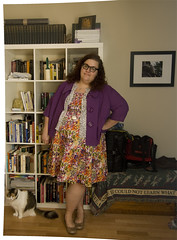

purple & black leopard print cardigan from Marshalls,
green & black scarf from Marshalls,
black t-straps by Nina Dolls.

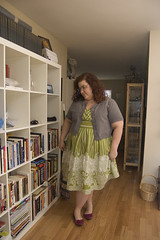
grey & white spotted cardi from Old Navy;
purple jacket from Lane Bryant;
pocketwatch from eBay;
gold flats by Clarks.
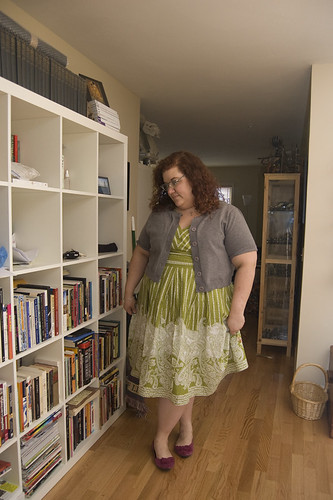
old grey cardi from Torrid;
fuchsia flats from Target.
In Fatcast news, iTunes has been insufferable about updating our page in the iTunes store with any reliability and/or speed. If you’re subscribed to the podcast, the new episodes will download immediately, but they seem to be taking four or five days to appear on the show page for individual downloading. Of course, you can also listen or download at the Fatcast website anytime you like.
Last night Marianne (who finally procured a Space Camp headset!) and I recorded part two of the episode about The Doctor (heh), and it should be up by Saturday at the latest. Due to both of us having various weekend commitments for the rest of the month, we’re going to be recording several more in the next week or so and stagger their release, so you can reliably get your two whole cakes’ worth on a weekly basis. Our wholehearted thanks for everyone who’s listening and giving us such wonderful feedback.

In part one, Danelle was cast out of her clique and I began the sensitive process of carving a more permanent space for myself in same. Following this excerpt are my thoughts on the boys we worshipped, the existence of “frenemies” even before we had a word for them, and our late-1980s hairstyles.
I shamelessly present part two of the recently-unearthed memoir written by my fourteen-year-old self.
—
2: R-E-S-P-E-C-T
In every clique, Danelle made sure I didn’t get too close. She wasn’t stupid. If she wasn’t accepted, then she made sure I went with her. And this was when she was allowing me to take part. She made sure that no matter how much of an outcast she was, I was always on the sidelines to catch her when she fell.
Danelle also had a series of boyfriends in middle school. The first was a real jerk named Donnie, whom I proceeded to develop a tremendous crush on in the following year. Then was Zack, an even bigger jerk whom Beth proceeded to develop a tremendous crush on in the following year. Then was Sean, and then another Shawn, both completely undesirable. Last was Andy, to whom Danelle remained disgustingly devoted for the remainder of middle school.
But Zack was the worst. I can remember one Friday early in the school year, and there was a dance that night, for Halloween or something. Danelle was “going” with Zack, and the three of us were sitting at lunch talking about it when Danelle said, “Why don’t you get Annie a date?” Now this was a mistake to begin with, because Zack did not like me in the least. So, as a joke, he proceeded to walk up to every guy in the cafeteria, even ones he didn’t know, and ask them if they would take me to the dance. I begged him to stop. I begged Danelle to make him stop. But Zack kept right on as boy after boy said no and added some comical commentary. And Danelle just laughed and laughed at Zack as I tried not to cry.
I called Cindy that night after Christina went home. We talked for quite a while. It was fascinating. I had been sitting with them for months and here it was the first time I had spoken to one of them on the phone. But what was most fascinating was that Cindy actually had a brain in her head, and opinions and insights. She was like me, I guess, a slave to her master for so long that if she were offered freedom, she would probably turn it away. We talked about school, and clothes, but mostly about Danelle.
“I would bet anyting that she’ll sit down tomorrow and act like nothing happened. Either that or she just won’t come to school,” I said. Danelle dealth with social conflicts by not going to school for a week.
“She wouldn’t dare sit with us.”
“Of course she would! She would and she will. At least until she finds someplace else.”
“Maybe she’ll take your place in the library,” Cindy laughed.
“Now that I think about it, though, Christina probably wouldn’t let her sit with us. Christina would make her life hell,” I giggled.
“I know, right?”
Michelle called me later that night. “Is Christina there?” she snapped impatienty.
“No…” I answered. “Maybe you should try her house.”
“Well, she’s not there.”
“Then they’re probably at dinner.”
“Why didn’t you go with them?”
I knew she wanted me to say that I wasn’t invited. “I’m not allowed. I’m grounded.” I lied.
“Annie, you’re never grounded.”
“Well, now I am.”
“Why?”
“Because I haven’t cleaned my room.”
“Oh, sure. Well, don’t let me keep you.” I could hear the satisfaction in her voice and I hung up fast so that she would hear the click.
“Christina, you’re going to make us late. Again,” I complained from the edge of her bathtub. She stood at the sink fussing with her hair in the mirror. I was waiting for her to be ready so we could walk to the bus stop. It was 7:30 AM.
“Will you just relax? Michelle isn’t even here yet.”
“Michelle probably went ahead. If she’s not there by 7:20, we’re supposed to leave without her, remember?” I said, rather meekly.
“Well, if you don’t want to wait, then go on ahead. It’s fine with me,” she snapped convincingly. But I know otherwise. If I left, I would have to endure the silent treatment on the bus. So I shut up and waited.
Ten minutes later, we were sprinting across Marshall Road as bus began to pull away. Fortunately, Michelle saw us and told the bus driver to wait. I fell backward into a seat and sat wheezing for several minutes. Michelle glared at me. Only she would get jealous because I was late for the bus with Christina.
Danelle wasn’t at school. I wasn’t surprised. I was surprised, however, that she hadn’t called me last night to make sure I was still her friend. We talked about her at lunch. I was in line with Beth and Cindy. I was just saying that Danelle was probably planning on being absent for the rest of her life when Beth squealed, “Omigod! It’s Zack! He’s looking at me! He’s coming over here! Omigod! How does my hair look?”
“You look fine,” Cindy and I said at the same time.
“Hi,” Zack said, grinning. Donnie was with him. Donnie was not only Danelle’s ex-boyfriend, but Beth’s too. “Can we cut?”
“Sure!” Beth piped. As they got in front of us, Beth tossed he hair and smiled at Cindy and I. I noticed the triumphant look that Zack gave Donnie. It said, See? She thinks I’m God.
As we stood there, Zack and Donnie seemed to multiply. More of their friends wanted to cut, and then friends of the friends wanted to cut, and then friends of the friends of the friends wanted to cut, and so on. Eventually, we had been standing there for fifteen minutes and not moved an inch. I got out of line in favor of the salad bar.
Personally, I saw Zack as a manipulative airhead (if there is such a thing) who never spoke more than five words at a time. And even then, every word was monotone and monosyllabic. Of course, at this point, I NEVER in a million years would say anything less than favorable about him to anyone.
There was somebody I didn’t recognize sitting at our table. But then again, it had been a week since I had been to lunch. Brittany was sitting eating her lunch and Lara stood at the end of the table talking animatedly to them both. I sat down virtually unnoticed for five minutes.
“Oh, hi, Annie. When did you get here?” Brittany grinned at me.
“I’ve been here,” I said, but nobody was listening. The mystery girl looked very much at home, eating all the croutons out of her salad and listening avidly to Lara’s latest episode. From the conversation, I deduced that the girl’s first name was Kathy, she was new at the school, and that she had Mr. Greenberg for English. That was about it.
“You’ll like it here,” Lara told her. “The school kind of sucks, but the kids are mostly nice.”
I couldn’t help it, I laughed.
—-
All of these things are true, but some of them do come back to me more vividly than others.
For example, the story of Zack asking boys to the dance on my behalf in the cafeteria. When I say above that he asked every boy, I literally mean every single one. The cafeteria was arranged in rows of long, long tables with attached benches, not unlike prison cafeterias in the movies. Zack began at the last table and methodically made his way through at least a third of the cafeteria, asking every single boy to take me to the dance. What amazes me today is that I wasn’t more destroyed by this experience. I guess kids are resilient.
Zack was a slight blue-eyed blonde, his hair stiffened into fragile-looking spikes with a generous application of hair gel. Donnie was a dumpy little brown-haired boy stuck in that unfortunate phase some boys experience, in which his face hadn’t seemed to come together yet. I had quite a crush on Donnie — one of the few people in this story whose real name I forget — until a terrible humiliation he foisted upon me on the playground after lunch one day, a humiliation which I’m relieved is not documented in the above story. Donnie had a nickname: “Stud.” I shit you not. This twelve-year-old pipsqueak called himself “Stud”, and somehow convinced others to do so as well. Donnie had a comeuppance toward the end of our seventh grade year that I cannot clearly recall, but I remember that afterward I no longer regarded him as a dashing, confident, and intimidating boy, and instead came to see him as pitiable and a little pathetic.
Christina and I grew up together; we lived on the same street, with one house between us, going back to kindergarten. Michelle lived around the corner from us both. We spent a huge amount of time together, the three of us, endless sleepovers, playing Nintendo, riding our bikes to the frozen-yogurt place we visited almost daily. We would go with Christina to her gymnastics classes; we would go out to dinner with Christina’s parents, who in retrospect seemed never to cook and instead ate at various inexpensive restaurants almost every night. Those are the memories that have stuck with me, and the cruelty described in this story seems to have happened to someone else, in another world. Though the word did not exist back then, Christina was the very definition of a frenemy. This will become more apparent as things unfold.
As a final note: our hair. There are two situations above in which hair is important enough to be noted. We cared deeply about our hair back then, because it wasn’t simply styled: it was a damn architectural production. I refer, of course, to the “Pouf”, a hairstyle that was the height of fashion at the time. A pouf was created from a set of bangs, in which the bangs further back on the head are teased, ironed, and/or hairsprayed to stand straight up, while the rest of the bangs were either spiked forward or curled down and frozen in place. Beth had the most perfect pouf of anyone I’d ever seen — it was perfectly round, as though someone had crafted a donut of hair and stuck it to her forehead. This is well documented in a yearbook photo, and if that yearbook were not in storage in my father’s house in Florida I would be scanning it to share with you all.
All of this is to say that hair was very important. I fully believed that the lion’s share of Beth’s and Christina’s popularity came from their success with their hair. My hair, on the other hand, was stubbornly curly and thus ill-suited to poufing, a fact for which I was secretly grateful because, even then, I thought that hair looked fucking ridiculous.
 Two Whole Cakes is a blog written by