I have been quiet this week because I have been sick. Unfortunately, I’ve not been quite sick enough to justify staying home lying in bed and re-watching episodes of Rome (compelling storytelling of the finest quality) and Robin Hood (terrible and yet delicious, the Chicken McNuggets of UK television). Rather, it is the kind of sick where I’m quite capable of going to work and getting things done, I just make a lot of upper-respiratory noise in the process.
So because I am not feeling especially articulate, this is a post about my cats.
A year ago, following the loss of our much-beloved elderkitty, Bean, to heart disease, we adopted two bonded cats from the Northeast Animal Shelter in Salem, MA. We call them Rufus and Penny. When I first met them at the shelter, it was Penny, in the moment outgoing and meow-y, who caught my attention, but it would turn out that Rufus, sleeping in the back of the cage, was the star of the show. Rufus eventually drew a lot of attention, as it was around this time that I was doing a series of interviews that would ultimately take shape as a profile in the Boston Globe. I mentioned Rufus in the course of the interviews because he was (and is, though now slightly less so) very, very fat. 26 pounds’ worth. This earned a mention in the profile — I guess for its quirky appeal — and once the piece was published I was inundated with angry emails from people accusing me of animal abuse and threatening to call the pet police on me.
Apparently the fact, acknowledged in the article, that Rufus was already hugely fat when we adopted him was not important. Nor was the fact that he and his sister Penny, who were abandoned at the shelter, showed signs of extreme neglect. For example, Rufus, prevented from thoroughly grooming himself by his prodigious belly, was so covered in mats that his whole back had to be shaved. You know what can happen when a cat gets shaved in a shelter environment? The shaving can cause tiny nicks in the skin, and the stress of the shelter can suppress the cat’s immune system, and they can then get ringworm. Epic, horrifying, full-body ringworm, requiring months of confinement and hundreds and hundreds of dollars’ worth of vet visits and various treatments (only the most expensive of which finally worked, of course), not to mention the insanity of twice-weekly lime-sulfur dips, which smell even more grotesque than you’d expect by their name. For six months, Rufus was basically a flaky, scabby, sad-eyed mess confined to one room and don’t even ask what the final cost of fixing him was because I don’t want to think about it. His skin issues happened in concert with a serious hepatic illness in our 14-year-old eldercat Oberon (who has just this week been diagnosed as hyperthyroid, poor lamb — I am not looking forward to twice-daily pills for him), so that during those six months we were regular fixtures at our local animal hospital.
I can’t even tell you how many times we heard amazement from disbelieving folks, that we were doing all this for a cat we had just adopted and had no pre-existing relationship with. As a result, the email threats I received just made me laugh and think, man, if you send the MSPCA to our house, they will shake our hands and thank us for being such outstanding and committed pet parents to a cat with such dramatic issues straight out of the gate. Many folks would have delivered him right back to the shelter, and understandably so, as ringworm, once introduced to a home, can persist in a dormant state for literal years, and not only is treating the cat prohibitively expensive, but decontaminating a space can involve removing carpet and burning or otherwise destroying all porous material, as it may contain ringworm spores.
The people who were surprised at our commitment to Rufus were mostly people who’d never met him, though. Everyone remembers Rufus. People who’ve met him in real life always ask about him, and even readers will occasionally send me emails inquiring how Rufus is doing. A year on, Rufus is marvelous, and his skin issues are a hazy memory. Here he is sleeping. Here he is with a marshmallow on his head. Penny, always a bit harder to pin down, as she has the typical calico-crazy, is likewise well. Here she is in her frightened persona. Here she is looking like a Bond villain.
Oberon, with whom I have shared the past thirteen years, continues to be lordly and magnanimous in his willingness to share his house with me and my husband and the other two cats, as ever.
Dealing with Rufus’ skin problems was an unexpected challenge for me, not just insofar as they applied to him individually, but because I had this voice in my head repeating, damn, if only he could groom himself like a normal cat, I bet his skin would be fine! In retrospect, this thinking was along the lines of the doctor who prescribes weight loss for everything from a sore throat to a repetitive stress injury. It continues to be sobering that I found myself thinking this way. Rufus’ health is excellent, today, even though he’s still a fatass, holding steady at 23 pounds (despite a strictly-measured and damned expensive all-natural grain-free high-protein diet) and nearly spherical. But for as long as we’ve had him, Rufus hasn’t developed a single mat on his back, because in our house he’s regularly brushed and petted. It turned out it wasn’t so much his fatness that was to blame for those problems, as it was his being neglected and stressed out. In a loving environment that accepts and accommodates him, he has thrived.
Not that this is a metaphor for fat humans. No. This is a post about my cats.
A tale of rejection and woe from the aptly-named “Forbidden Journey” at Islands of Adventure.
By Lesley | November 15, 2010
 I am a theme park person. By this, I mean that I am a person with a certain affinity for theme parks. A thorough knowledge, you might say. A special interest bordering on fixation. I have mentioned this on the travel-themed Fatcasts, especially as it relates to my emphatic adoration of Disney World. I am not, truly, a Disney fan in the general sense, as I have seen and heard proper Disney fans and their passionate regard for all things Disney makes my own feelings look downright cold by comparison. But my knowledge of Disney theme-park trivia is broad and varied and consistently surprises folks who tend to think of me as about the least-Disney-like person they know.
I am writing, at present, from the idyllic vacationland known as central Florida, home to Disney World as well as the less-interesting (to me, anyway) Universal-owned parks, Universal Studios and Islands of Adventure. Until this weekend, I haven’t been to either of the Universal parks for a decade at least; they’ve always struck me as less fully committed to the forced smiley-face insanity of the Disney parks, and while the Disney employees and fans (often the same thing) have fully drunk the happyland Kool-Aid (myself, glassy-eyed and sedated, included), Universal has always felt a bit more contrived to me. Doubtless, on one of my many childhood trips to the World I was injected with some virus that floods me with an opiate-like euphoria in the presence of a particular fiberglass castle, or a certain geodesic sphere.
We went to Islands of Adventure last Sunday on the prompting of my in-laws, with whom this vacation was taking place. They wanted to see the new HarryPotterland, being fans of the source material. The big new attraction, Harry Potter and the Forbidden Journey, is a purportedly groundbreaking thrill ride that melds motion-simulation with a track-mounted KUKA arm. Just trust me when I say that this is a big nerdy deal in thrill-ride technology.
However.
As it turns out, when this ride first opened, some park patrons had… problems. Fit-related problems. To be blunt, this brand-new ride was remarkably unforgiving to even those with mediocre fatness, or to some women with sizeable racks. In order for the ride to operate, an overhead restraint system must lower to a certain point. Racks and bellies alike interfered, and many sad fatties were denied their ride based on safety concerns.
Which is valid, certainly — no thrill ride is worth risking life and limb over. But the required dimensions seemed, based on reports, to be unexpectedly specific. After all, there are thrill rides in many theme parks that accommodate fat riders just fine — rides far more aggressive in their abuse of physics than the motion-simulator based Harry Potter ride. Thus, the ride’s rather precise limitations were surprising for an attraction that would have broad appeal to lots and lots of park guests. Forbidden Journey’s size issues were enough of a problem, with hundreds of would-be riders being turned away every day, that in September Universal was compelled to modify the restraint system on certain seats to handle more flesh.
I knew all of this going in, including that there would be special fatty lines for the modified seats, though I couldn’t find any straightforward assessment of how the fat-checking actually worked. Would I have to self-identify as a Fat? Would I be marked and pulled from the line by appearance? Even though I was pretty certain I would not qualify even for the modified restraints, I felt compelled to run through the process to bring the experience to y’all, my faithful readers. And so, here we are.
Immediately outside the ride entrance are two test seats. The idea is to lower one’s corpulence into the seat and pull down on the restraint while watching the status lights on the apparatus. If one can pull the restraint down until the light glows green, said person is fine for any of the ride seats. If the light only hits yellow, you’ll be needing a fatty special. If it stays red, you’re too fat for this shiz, porky. Go get another butterbeer. The test seats were host to a small fatty convention, as folks took their chances. My husband succeeded in getting a yellow light. My light flickered yellow, briefly, but seemed to prefer red. Well, we were getting in line nevertheless, to play this bitch out.
The ride queue is elaborately themed to various sets from the films, and was nearly-empty at the time we were there, so luckily the wait was not long for the final fat reckoning. Coming up to the ride loading area, there was a set of turnstiles manned by a park employee, and just beyond was another set of test seats, with their own special attendant, whom, in the spirit of the context, I am calling the Sorting Fat. As we waited at the turnstile, I watched as the sad-faced female half of a couple was denied a yellow light and escorted to an exit door shrouded in darkness in the background. Even now, I am not sure if these folks were self-selecting or if the Sorting Fat was pulling people from the line. I may have been able to bypass this test and gone directly to the ride — where I probably would have been booted anyway. So instead I hesitated near the test seats while the Sorting Fat, a slender, kind-faced, and fair-complected youth in the requisite Harry Potter hat and robe, returned from having escorted the last set of too-fats through the exit to Potterland oblivion.
We both spoke at the same moment. Awkward. “I was asking if you were waiting for me. I guess you are,†said the smiling boy who would be passing judgement on my ability to be flung around by a giant robot arm. Into the test seat I go; it fits my hips fine, which is usually where my fit-troubles lie. Arms up, the restraint is lowered. Through the padded U-shape of the restraint, I watch the eyes of the Sorting Fat flicker from the light status panel to my face. With a surprisingly genuine expression of regret, he says, “I’m sorry, you won’t be able to ride today.†Today! As if there is hope for the future! As I disengage my enormousness from the test seat, I immediately wonder at the sensitivity training this kid has probably had. I can almost imagine him going home at night and weeping a few silent tears for the fats whose theme park experience he has been forced to blight so. I am on the verge of asking about the extent of Universal’s Be Nice To Fatties training, but my husband had flung himself confidently into the test seat for a second check. Oho, but he is stuck at the red light as well! Even though he had yellow at the ride entrance! Joined in too-fat-for-Harry-Potter-ness as we are in matrimony, together we are escorted to the exit, which does not lead to a den of giant spiders hungry for human flesh, but rather to the gift shop.
I round the corner as the Sorting Fat holds open the door, and then double back, touching him on the arm. I ask his name, and for the first time he looks a bit nervous. “Keith,†he says. Keith did a wonderful job, I have no problems with him. What I have a problem with is the need for Keith’s position in the first place. For myself and my husband — who groused the rest of the day about Universal’s extreme volume of suck — the denial was annoying, but not something likely to ruin our trip. We are both more likely to blame the ride’s lack of capacity than to internalize the guilt and shame of our collective failure to fit in, especially since I have never been sized out of a ride before. But for the park guest who is unprepared for ejection, this experience could very well be devastating and humiliating, the ruin of a trip meant to be an escape from the sharp reality of everyday life.
I live in metro Boston, and Massachusetts is one of the more slender states in the US, so I am usually the fattest person in the room in most circumstances, and I’m quite accustomed to that. In these southern theme parks, however, the fat is plentiful, and I spent the better part of the remaining day noting which of my fellow guests would also be denied entrance to the Forbidden Journey. Certainly, when it comes to vacation plans, you pays your money and takes your chances, and nothing guarantees that you won’t have a bad experience. But even for me, a person pretty well insulated against self-loathing, the experience of being sized out of this one ride rendered me uncharacteristically reluctant to check out other rides for the rest of the day. I didn’t want to repeat it, you know? I had the distinct impression that I was simply being tolerated, and not welcomed, and given the price of admission that left me more than a little resentful of the faceless entity that is Universal’s theme parks division. I felt unusually self-conscious, and if that was my reaction, I can only imagine the effect on people who lack the tools I’ve developed to cope with this sort of experience.
The next four days were spent in Disney World, where I have never been sized out of any ride, even if the seats in the Hall of Presidents are a little snugger than I’d like. I’d love to tell you that Forbidden Journey was an awesome ride and that Universal has taken steps to improve accessibility for a diversity of sizes, as many thrill rides do. Alas, the attraction’s name proved just a bit too literal for me.
Last May, I was invited to present as part of a panel entitled “Fat Politics and Sexuality in the Face of Hate: A Forum on Rights You Didn’t Know You Needed” in New York, alongside some noted luminaries of fattery, namely Katie LeBesco, Substantia Jones, Zoe Meleo-Erwin, and Marilyn Wann. It was a good time, even though I ridiculously waited until the last minute to figure out what I was going to say. I wound up explaining — in a manner of speaking — the origins and significance of “two whole cakes”.
The video above captures my individual ten-minute talk. For the first five minutes you can’t see me much at all through Substantia Jones’ lovely head, so just trust that I was gesticulating wildly with my hands, as I am oft wont to do. Eventually someone moves the camera.
What I say in this video really does sound like something I wrote quickly and emphatically, but then sometimes those are the things that resonate most with people. (To my occasional chagrin.)
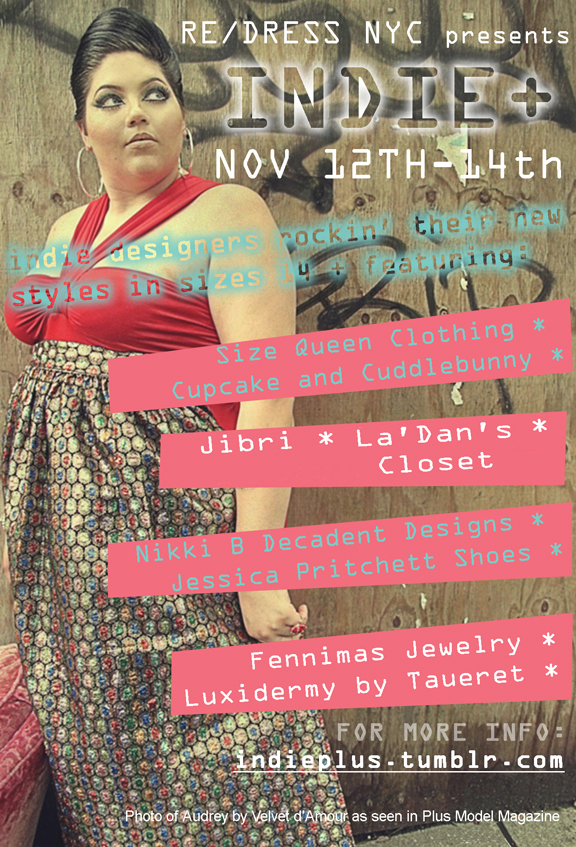 This weekend, Re/Dress NYC is playing host to an indie designer extravaganza, beginning with a fashion show on Friday night. You can be certain that if I weren’t due to be 30,000 feet over New York at the time, I would be there, particularly to see the reveal of Cupcake & Cuddlebunny’s new line. Luckily, my dear Marianne will be on hand to represent. And shop. And wear some possibly-ridiculous hats. I shall instruct her to look extra fat to make up for my absence.
More info can be found at the Indie+ Tumblr. Buy your tickets here.
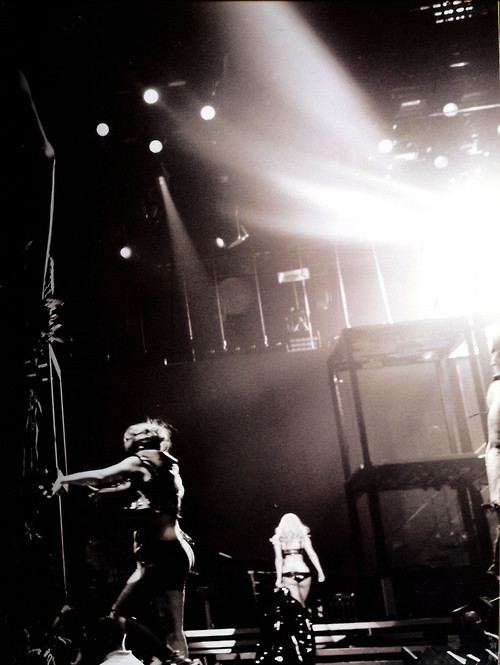 A couple weeks ago, following a short Twitter exchange, Meghan Vicks — who is one of the editors over at Gaga Stigmata, the amazing critical e-journal I totally would contribute to on a daily basis if only I could give up this annoying habit of sleeping — asked if I’d be willing to participate in a collaborative written discussion on Lady Gaga and feminism. Given my demonstrated interest in Gaga-analysis, I leapt at the chance to contribute. The end product includes some outstanding points of discussion on gender, bodies, objectification, (in)authenticity, crazy shoes, and the state of Camille Paglia’s lawn. I even got the chance to float my theory of Gaga as harbinger of a postgender cultural shift, and to revisit the “Telephone” crotch shot. It was a very good time.
You can read the post in all its lengthy thoughtfulness here: Free Bitch Feminism: The Post-Gender of Lady Gaga.
 [Short version of the below: I am changing my blog home from fatshionista.com to blog.twowholecakes.com. You can grab the new feed here.]
There are a number of reasons.
Fact is, “fatshionista†doesn’t really belong to me. It belongs to you.
Fatshionista, both word and concept, originally started as the name of a LiveJournal community founded by Amanda Piasecki for the purposes of carving out space to discuss fat style within a politically-savvy, social-justice-minded, fat-friendly context, without being overrun by the usual crap about the garments that are most “slenderizing†and ticking off lists of the things fat folk should never, ever wear. In LJ!Fatshionista’s halcyon early days, it was an environment both radical and intimate. Both of these things have changed in the intervening years, as the community has grown — and grown and grown — and has come to envelop members at many different points along the body-acceptance spectrum. What we sacrificed in political purity we made up for in scope, and many people new to these ideas benefited in the bargain. “Fatshionista” evolved into much more than a clever portmanteau; it became an identity.
Off-Livejournal, over the past few years, “fatshionista” began to proliferate through the internets, and a broad and diverse community of independent fat-fashion bloggers took root and flourished. I couldn’t even begin to tell you, at this point, how many blogs use some variation of the word “fatshion†in their titles. And I could not be more pleased about that — it’s a powerful word, a radical word, a word that puts “fat†right up front and center, a word that fat-style revolutionaries can throw out as a rallying cry. It’s our word, our identity, but it’s not my name.
My original vision for fatshionista.com was very different than what you see there today; frankly, it never occurred to me that my own writing would be enough to draw an audience to the site. It still surprises me that so many of you come here just to read the words I string together (or rather, glue together with a prodigious use of fuckwords and adverbs). The old site was not built with this in mind, and is thus technically-clunky and has been plagued with feed issues, security holes, and various and sundry other idiosyncrasies since day one. This new WordPress site will operate more smoothly as a traditional blog, and I will still be posting the occasional guest posts as they present themselves. Also, it will finally have a reliable RSS feed.
Oh, I’ll keep the fatshionista.com domain probably forever, and in the next couple days I will set it up to automatically redirect to this new site. The old site will live on as an archive for as long as the code holds up; while I’ve managed to import most* of my own posts, the comment threads, where many of the best conversations happen, will remain at fatshionista.com.
Otherwise, the content (cranky profanity-riddled rants) and mode of operations (half-assed) here will carry on as usual. Do you have an idea for a guest post? Email me about it. Have you recently emailed me and not yet heard back? I don’t always manage to respond to every message, but I probably have a half-composed draft that will go out to you eventually. Are you not on my blogroll and think you should be? I may have just forgotten about your site! Let me know it.
As always, I thank every single one of you — commenters, doubters, and lurkers inclusive — from the bottom of my enfattened heart for your brilliance, your patience, and your support. There is much to be optimistic about, as y’all represent a growing movement to be critical of what culture and media have taught us, about our bodies and about who we are and about what we’re allowed to be.
—
*Posts going back to April of 2008 have been brought over, semi-successfully insofar as being complete in their original text but lacking their original comments, which bums me out a lot. I was altogether unsuccessful in getting posts from the site’s launch in October 2007 through April 2008 imported, owing to the limitations of my early Joomla install.


A few folks, in a few places, have criticized my decision to formally contribute to the conversation began by Maura Kelly’s Marie-Claire-sanctioned fat-hate blog, arguing that my doing so somehow validates the original post, or that I wasn’t mean enough to Kelly, or that my submitting a response helps Marie Claire benefit by the uproar. On the first two points, the specific reason my response guestblog did not directly mention Maura Kelly nor her preposterous and abhorrent post is because I felt strongly about using the opportunity to create space for a discussion on a subject very close to my heart — the way fat people are represented (or not) in media. I believed, and still do, that berating Kelly further would just be unseemly, not to mention unproductive, after so much abuse had already been heaped upon her.
On the third point, I will readily cop to the fact that I didn’t even consider Marie Claire’s site traffic. I don’t do this stuff for fame; there are far easier ways to be famous. Nor do I do it for fortune, because, shockingly, being a loudmouthed fatass pays sweet fuck-all. Rather, I do it because I am passionate about body politics, because people suffer as a result of our toxic culture of self-loathing, because I want to help fix it and make it better. That’s it. The terrifying reality is that I do this work because I am an activist who believes strongly in these ideas and for no other reason.* So yeah, if somebody says, “Hey Lesley, wanna write something on a giant-ass ladymag website about fat and stuff?” my answer is very likely going to be “FUCK YES” because it gives me a chance to reach a huge new audience of folks with my wacked-out and occasionally-radical ideas, and that may result in another brick or two knocked down from the giant fortress of culturally-mandated body-hatred that’s trapped us all.
For me, the real question is why wouldn’t I contribute a response? Because some folks at Marie Claire are fat-hating jerks? Man, if I turned tail and ran at the sight of every fat-hating jerk I would have quit this scene a decade ago. I did not just fall off the back of the fat truck. Nor is this my first time at the fat rodeo. When it comes to the cultural forces that need subverting, Marie Claire is just one behemoth of many. The way we reach people and change things is not by keeping our hands clean and spectating this bullshit from the outside; it’s by getting elbow-deep in the muck and speaking our rights aloud even to people who refuse to hear us and do not care. Not all of us can do this all the time and maintain our sanity; this time, I stepped up for the opportunity to get dirty. Next time, it might be you.
The important issue here — yes, more important than Marie Claire’s ad revenue — the issue that affects the lives of anyone who does not comply with the current standards of what makes an acceptable body, is that of visibility. Because fat people are rarely represented and seen, except in the context of diet ads, “obesity epidemic†hand-wringing, and weight-loss reality shows, it makes sense that the prevailing conventional wisdom would be that fat people are all unhappy, unhealthy, unworthy, unloved.
Last year, I created the Museum of Fat Love as an antidote and a push-back against the sobbing Spanxified tragically-rolly woefulness of More to Love, a one-season reality show that took The Bachelor and remade it with a bunch of fat women gunning for the attentions of one oafish lump of a dudebro who, in his defense, was very complimentary of non-slender women. The response to this little project was overwhelming, and this underscores the need for more positive images of fat people in love, either with their partner(s) or with themselves.
This weekend, I will be reanimating the MoFL as a Tumblr, and I’m currently accepting new submissions from couples, friends, and individuals. Your submission should include a photo (no smaller than 600px, please) and your story, with as much or as little detail as you’d like to share. The only requirement is that at least of one the people involved should identify as fat. The original MoFL can supply plentiful examples.
Change starts when people show up; it starts when we are willing to be visible and unashamed in our bodies, no matter how fervently our culture may argue that we should not be seen. Email your lovin’ to mofl@twowholecakes.com.
—
* That said, if someone wanted to give me a full-time job as a loudmouthed fatass, I certainly wouldn’t turn them away without hearing the offer first, on the off chance that anyone has such an opening. Wouldn’t we all love to make our living doing something we really believe in?

ETA: At their request, I’ve also submitted a “counterpoint” guestblog to Marie Claire, arguing in favor of more body diversity — including fat people! — on TV. You can read that here.
The gorgeous image to the left is borrowed from the Museum of Fat Love, which hasn’t been updated in forever but is still pretty swell as a static exhibit. I have plans to turn it into a Tumblr next weekend to expedite further updates.
Hello, my darlings: faux-brainy ladymag Marie Claire has shared with us a fresh horror, repellent even by the abysmal standards of ladymags. See, a lady named Maura Kelly blogs for Marie Claire, and she wants us all to know that she thinks fat people in love are ICKYYYYYY.
I wish I were making this up, I really do.
Kelly’s editor pointed her at a CNN article that discussed, in part, the new fatcentric (and shamelessly unfunny) sitcom Mike & Molly.* The fatphobia bingo in Kelly’s resulting post** is plentiful: all the greatest hits are represented here, such as “being a bit overweight is one thing, but these people are obese!â€; “no one as fat as X can be healthy!â€; “fat people are exactly the same as drug addicts!â€; “fat people are using up all the healthcare!†and so forth. I ain’t even trying to deconstruct that shit because — my many bloggings to the contrary — I do get so weary of repeating myself all the damn time. Indeed, the first time I read Kelly’s post through, after receiving the link thanks to sharp-eyed reader Marieke (and many other sharp-eyed readers via email and Twitter subsequently!), I thought it was a hoax. A bit o’ satire. Well done, too! It just seemed impossible that such a perfect compilation of the standard “ew, fatties!†fare could be real. But I’m pretty sure it is straight up. I’d be happy to be wrong; oh my dears, if I am wrong, I will laugh and nod and wag my fat finger at Maura Kelly and say, aw man, you really had me going! But I don’t think that’s going to happen.
After a million bingos, Kelly finally gets down to brass tacks and says:
So anyway, yes, I think I’d be grossed out if I had to watch two characters with rolls and rolls of fat kissing each other … because I’d be grossed out if I had to watch them doing anything. To be brutally honest, even in real life, I find it aesthetically displeasing to watch a very, very fat person simply walk across a room — just like I’d find it distressing if I saw a very drunk person stumbling across a bar or a heroine addict slumping in a chair.
There’s something weirdly refreshing about this garbage, as it is “brutally honest†and doesn’t attempt to couch itself in “but I just care about your health, dear!†nonsense. Nobody really cares about the fat stranger’s health; that’s just a story we tell ourselves so we feel less shallow and cruel for thinking they’re disgusting. Maura Kelly finds fat people “aesthetically displeasing†to look at, in any context. Even a fatty just walking across a room is gross-out central for Maura Kelly. Maura Kelly certainly doesn’t want to see people with “rolls and rolls of fat†(dudes, how I LOLed) making out like horny teenagers. EWW!
But wait! It gets better! This is the part where I began to suspect shenanigans, because, well, the very next paragraph begins:
Now, don’t go getting the wrong impression: I have a few friends who could be called plump. I’m not some size-ist jerk.
…
……
………GUYS GUYS I KNOW.
This right here is a textbook example of one of those moments as an activist where I have to laugh uproariously, lest I cry big fat oily tears of obese sadness, or alternatively, arrange to have a dump truck filled with Criso unload its lardy cargo on Maura Kelly’s lawn.***
My question: If candidly thinking that fat people should not be visible in public does not qualify as “size-istâ€, then what in the name of Delta Burke DOES qualify?
The inanity continues in the post, with Kelly helpfully doling out such sage and heretofore unknown advice as “eat right and exercise!†whilst assuring the poor stupid fatties that “YOU CAN DO IT!†in what is one of the most insipid and clueless bits of diet-cheerleading I’ve seen in print in a long-ass time. She then gives the fatties of Mike & Molly “points for trying†since they’re in Overeaters Anonymous; I guess they just get points for daring to have jobs and stuff when they should be sequestering themselves in the Fat Monastery until they achieve thinness and earn the right to be seen in public like “normal†people.
In Kelly’s weak defense, her final sentence is a question: “Do you think I’m being an insensitive jerk?†Yes. Yes you are.
For a little perspective, it’s true that this is a throwaway article on a silly dating blog on a ladymag site. I will admit I find it a little odd that the same blogger has an article less than a week old that attempts to address anti-gay prejudice; feeling grossed out by gay folks kissing is bad! Feeling grossed out by fat people kissing is okay! Thanks, Maura Kelly!
My rage at this sort of brainless blogging is that despite the lack of critical thinking involved, it has the power to totally ruin someone’s day. It is difficult enough for many fats to just get out the door in the morning knowing that Maura Kellys exist out there; posts like hers are the equivalent of being told, totally unbidden, that they’re right to be nervous and afraid because yeah, everyone really is grossed out by them. “Hey there fatty! Just in case you dared to forget for an instant that you are disgusting and worthy only of disdain and revulsion from a sizeable portion of the people upon whom you foist your fatness every day you dare to step out of your house, here’s a stark reminder! You’re not actually a human being! You’re a gruesome pile of hideously malformed flesh, undeserving of love or affection or even just basic human dignity! No kissing! No walking! Hide your shame! Oh, and by no circumstances should you even consider having any kind of a life until you are thin — by whatever means necessary. Have a nice fucking day!â€
Nobody really needs to hear that, because fat people are people, for heaven’s sake, and we have jobs and friends and hobbies and relationships and families and the right to go out and do all of that without being told we’re offending the delicate eyeballs of people like Maura Kelly. Once all is said and done, this isn’t really about Maura Kelly, though it’s easy to use her as a punching bag since it’s her name on the post. Fact is, Kelly is hardly the only person to cop to this attitude, and though I’m using her name a lot in this post for comedic effect, Maura Kelly really represents the mindset of lots of people who are not named Maura Kelly.
To be clear: you’re not required to find all fat people attractive, certainly, but Kelly’s comments above are dehumanizing and offensive and really have no place associated with a widely-read publication such as Marie Claire. This is not simply because their candor subverts the standard feel-good ladymag message of “Love yourself! (But not too much!)†but because sentiments like those expressed in Kelly’s post are bad for everyone: they make fat people feel terrible about themselves, and they make thin people terrified of becoming one of those disgusting fatties they so revile. Everyone’s humanity is lost in the equation. We are reduced to being just bodies, not individuals.
As a personal note to Maura Kelly, on the off chance she reads this far: I was in New York last week with my husband, and we did a whole lot of walking around, and we probably kissed in public a few times, like we often do, rolls of fat and all. If you saw me out walking in the city, or receiving affection from someone who loves me, and that grossed you out, I sure am sorry!
Oh wait, that’s not what I meant to say. What I meant to say was: if you saw me out walking in the city, or receiving affection from someone who loves me, and that grossed you out, then fuck you. I worked hard for the confidence and strength to go out in public wearing what I want and doing what I want even in the face of anonymous abuse and insults from helpful strangers; your delicate sensibilities are not my problem — not anymore.
And that goes for anyone with the same ideas. Have a nice fucking day!
—
* Full disclosure: I just realized I was quoted in this particular article, though Kelly does not directly take issue with anything I said.
** I’ve only skimmed the comments, and did so after writing most of the above, so I am aware that Kelly reveals some pertinent information (like being in recovery for an eating disorder, which maaaay be influencing things) there. However, most folk won’t read the comments, and so I am treating the original post as the standalone piece it will be for the majority of its readers.
*** This is not actually something I would do, for the record. It would be cruel to the Crisco, which should fulfill its delicious destiny in a pie, or encasing fried chicken.

Last week, a senior news analyst, Juan Williams, was fired from NPR. This happened as a result of comments he made on the oft-reprehensible Bill O’Reilly’s punditry show on Fox News (a network that is also oft-reprehensible, and as my husband and I walked past Rockefeller Center whilst in New York last week, my husband favored me and the surrounding folk with a somber whistling of “The Imperial Marchâ€). O’Reilly, in a bit of stupidity that might be funny under different circumstances, was persisting in his belief that Muslims, in general, are responsible for the September 11 attacks on the World Trade Center and the Pentagon.* In response, the soon-to-be-unemployed Juan Williams said:
“I mean, look, Bill, I’m not a bigot. You know the kind of books I’ve written about the civil rights movement in this country. But when I get on a plane, I got to tell you, if I see people who are in Muslim garb, and I think, you know, they are identifying themselves first and foremost as Muslims, I get worried. I get nervous. “ (Source)
Yep. Yep yep yep. Here this guy’s just being honest, saying the shit everyone thinks and nobody says aloud, and he gets fired!** And he’s written about civil rights, which means he’s totally innoculated against bigotry! In solidarity with Williams’ dumb ass, I want to offer some other bigoted straight talk of my own:
When I see a male-appearing person on the street, I get nervous. Because he’s identifying himself first and foremost as a male, and most rapists are men. Therefore, he’s probably a rapist, and he may try to rape me.
When I see a Black guy out in public, I get nervous too. Because he’s identifying himself first and foremost as a Black person, and television and culture have conspired to teach me that Black men are probably going to rob nice white girls like me, or at least are on the verge of shooting someone.
When I see someone wearing a big old cross around their neck, I get worried, because she’s identifying herself as a Christian, and is probably out trying to prevent women from having abortions, and is certainly opposed to equal marriage.
When I see someone using a wheelchair or a cane or some other assistive device on public transportation, I get tense, because they are identifying as a disabled person, and I don’t know how to treat them, and I may be afraid that their disability is icky or contagious.
When I see a brown person at my place of employment, I get apprehensive, because he’s identifying as a Latino person, and I’ve been told that brown people are illegal immigrants who are taking over by having lots of children who don’t speak my preferred language.
When I see a woman in the supermarket wearing a headscarf, I get uneasy, because she’s identifying as a headscarf-wearing-person, and I assume she must be overly warm, or horribly oppressed, or both at the same time.
When I see a person who looks to be Native American driving a car, I get worried, because he is identifying as an American Indian and is therefore probably an alcoholic who is driving drunk.
When I see a gay-appearing man coming out of a public restroom, I get edgy, because he is identifying as a gay-appearing man and I figure he must have been hitting on some dude in there.
When I see a fat person in the waiting area of the doctor’s office, I get suspicious, because she is identifying as a fat person and I think she is using up all the healthcare and there won’t be any left for me.
When I see a child boarding an airplane, I get concerned, because I know he or she will sit behind me and either cry or kick my seat the entire flight.
Literally believing some or all of the above ridiculous examples is not surprising; these are things we learn to think about people who look or act different, mostly because of our culture, occasionally because of personal experience. Allowing these assumptions to rule our lives is more than a mistake, however — it is an egregious example of inhumanity.
The lithograph at the top of this post dates from around 1852, and depicts the capture of of three young girls by American Indians. Then as now, the fear of difference was critical to American culture. Indians were not thought of as proper people, you understand; they were heartless savages who would descend upon helpless young females — a symbol of the very future of civilized white folk — with no reservations. That these events did occasionally happen is less important than the vigorous spreading of this fear throughout the young United States, even without the aid of mass media. Fear is a powerfully American trait; fear is part of who we are, historically, as a nation.
Now for an uncomfortable truth: if you feel nervous when you see a person in “Muslim garb†on an airplane, then you are a bigot, according to the broadest definition of the word, that of “a prejudiced person.†Don’t get mad, though! We’re all bigots, to some degree or another, because we live in a culture that teaches and reinforces and rewards our bigotry with privilege. Being a bigot is not itself an unforgiveable offense, as for most folks this is practically unavoidable in one area or another. It’s true: you can even write books about civil rights and still be a bigot in other respects. What is unforgiveable is our too-frequent failure to fight these assumptions and stereotypes as they persist in our own minds, and as they manifest themselves in our shared world.
If I see a shady-looking dude who seems to be following me as I walk alone as night, I’m going to take precautions to get to a well-lit area with other people as quickly as possible. I do this because I’ve learned to fear rape. That said, I need to be vigilant in understanding the difference between fearing all men as possible rapists and only fearing the ones who act shady and may be a legitimate threat. No, the difference is not always clear, but I choose to not let that concern rule my life and my choices. We fight through these feelings and stereotypes and assumptions because that is how we can best try not to be bigots, and how we can not live our lives in fear.
More to the point: even if I may initially feel nervous when I see a person on a plane in garb that I may think of as being “Muslim†— and sometimes, if my guard is down, I do — I work hard to push past it, because I know that it’s bullshit and it’s bigoted and it’s wrong. I instead try to focus on my astonishment at that person’s bravery and conviction in wearing what they want to wear even in an environment where it may draw negative attention and overt derision. I wonder how many dark stares they’ve endured between the security checkpoint and the gate; I wonder if they felt the suspicious scrutiny on their backs as they passed; I wonder at the stress and the sadness and the unfairness of it all. Blaming a large and diverse group of individuals for the terrifying actions of a scant minority is wrong. Fearing people because they look or move or dress differently than you is also wrong. That fear is what keeps us apart; that fear is what destroys understanding and leads to arguments and fistfights and endless, endless, endless wars.
Don’t let this fear rule you; recognize it when it happens, accept that these assumptions exist within you, and learn to see the circumstances of it clearly. Why am I feeling this way? Where is the feeling coming from? Is my fear appropriate to this situation? Fear is kneejerk — it relies on adrenaline and a lack of critical thinking. It is best fought with compassion and an open mind.
Neither of which we are likely to find on Bill O’Reilly’s show, admittedly. But I think we can fight this battle without help from people like him.
—
* I do wonder where O’Reilly would stand on the laying of similarly all-encompassing blame on other groups for nation-changing social horrors — say, the blaming of all white people for colonial slavery.
** I ain’t even getting into the idea of “Muslim garb†as being a visible roadsign posted on all observant Muslims. Here is a Tumblr that addresses that better.
The winner has been chosen! To keep things fair, I had to move a few comments back to the moderation queue temporarily as some folks commented twice, which is fine in general but that would have given them extra entries. The number generator at Random.org picked number 36, and so the winner is:

Yay! I’ll be in touch to get your address!
For those of you who didn’t win, you can still buy a copy of Burly #1 for the ever-so-reasonable price of US$5 at the Burly Press store. Huge thanks to everyone who entered!
 Two Whole Cakes is a blog written by