Now that spring is here (or in any case, I can be relatively certain that it isn’t going to snow) I’ve been thinking a lot about fat and cycling. I bought a new bike this year, for the first time ever—all of my previous bicycles had been chosen for me, first by my folks, and then by my (now former) partner, a bicycle mechanic and avid cyclist.
For a very long time I have had a love-hate relationship with cycling. It started when I was a child and continued well into my adult years. I loved the freedom of it, the speed (I don’t drive so cycling is really about as fast as I go), the carefree feeling of just hopping on my bike and going wherever the spirit moved me. When I was growing up, my little red Supercycle with its white banana seat represented the quickest way to make an escape from bullies or a bad scene at home. My bike enabled me to be just as light and fast and strong as all the other kids I knew. I lived in an area that was just starting to be developed, which meant that in order to get anywhere interesting it was necessary to have wheels of some description.
In my adult years, I also loved that cycling was something that connected me to J, my bike-boy boyfriend.
I didn’t love the fact that, as I got older and transitioned to a more age-appropriate ten-speed, cycling aggravated many of my long-standing health issues–my carpal tunnel, my asthma and allergies, an old knee injury–and I also didn’t love that I always felt a bit like a circus act when I sat, hunched over, rolls of fat rippling gently in the breeze, perched atop my bicycle like a bear in a tiny car. It made me sad that J and I were never able to bond over our mutual love of cycling; he liked to go fast, and far, and I didn’t really feel equipped to do either.
I knew for a long time that my ride–a mountain bike that J had customized, with shocks, knobby tires, and a large, heavy frame–was not for me. The chain knawed away at my clothes, no matter how I rolled or tied or bound them, meaning the bike tended to have an adverse effect on my fatshion choices. I always felt too bent over, my fat belly uncomfortably compressed and being pushed up into my chest as I pedaled, my trendy cycling jersey (a gift from J) bunching up attractively around my middle. The seat was too high and too small for my fat ass. I didn’t feel comfortable riding in traffic because the bike was so heavy and clunky. J had me pretty much convinced that it was because I didn’t ride enough, that I just needed to get out more and my body would adjust. It was a message I was so used to hearing from a variety of sources that I didn’t really question it.
The week before we broke up, J and I took a trip to Boston. While there, we decided to rent bicycles and go on a cycling tour. When we got to the shop, they rented us hybrid bikes (a combination of elements from both mountain bikes and their sleeker, speedier cousin, the road bike). I had never been on a hybrid before, and the moment I started to pedal along on the sidewalk, I knew things were going to be different. The hybrid was lighter than my own bike, which meant that I was able to carry it over my shoulder like a conquering hero as I ascended a pedestrian overpass. It was faster, which meant I was able to keep up with J without feeling even the slightest asthmatic tickle in my chest. And a more upright riding position was easier on my wrists and back. As I propelled myself around the Back Bay Fens, I realized that for once I didn’t feel as though I were trying to squeeze myself into a mold I wasn’t meant to fit.

The weekend that J broke up with me, I broke up with my bicycle. I managed to restrain myself from throwing either one off the balcony (if only because the debris would have inevitably landed on my mother’s terrace several floors below).
Shopping for a new bicycle was harder than I thought it might be. I had been somewhat insulated from this by having my own live-in bike mechanic, but the cycling industry is predicated on thinness. Sales staff in many bike shops don’t really know how to fit fat kids for accessories. Friends of mine have experienced outright fat-hate in some of these establishments. There’s a bit of an attitude of “fatty needs to get the hell up out of our sport, you dig?†As for my part, I have learned that if a fat girl walks into a bike shop asking for a hybrid bike, sales staff will automatically assume she wants a cruiser bike.
Now, don’t get me wrong–there is nothing wrong with cruisers. I love the gorgeous, paint-and-chrome classic look of them, and they are definitely the height of comfort and style. I think they would make a fine addition to any fatshionista’s collection.
However.
People kept trying to talk me out of the hybrid bike I wanted, all the while talking around the big fat reason they felt the way they did. It’s more of a commuter bike, they told me. I don’t know if it’s the right size for you. I don’t know if you’d like the riding position. The thinner tires mean you have to have really good balance. Maybe you’d be more comfortable on something that has a smoother ride. Or, most memorably, I have two female friends the same size as you and they both bought cruisers, and they love them. (That’s right, because all fat people are the same, forever.)
I won’t get into the shenanigans involved in my purchasing the bike (there were some issues with shipping charges) but in the end, I finally got the one I wanted. I had them add a chain guard (so I can finally wear the outfit of my choice while riding my bike) and a basket (into which I can put a baguette and some flowers as I tool around town in a floaty dress on a summer afternoon).
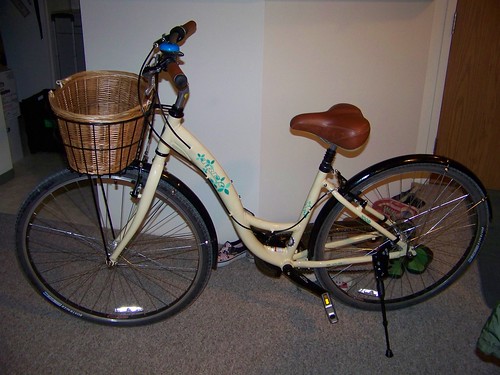
I peeled out onto the pavement a few weeks ago, and oh man, it was glorious. I can’t remember the last time I went so fast. I whizzed down a main thoroughfare, cutting in and out of traffic, taking corners on a dime, keeping pace with the vehicles alongside me. It At one point I rang my bell at a little kid dancing on the sidewalk, who pointed and said, “Look at that fat lady on the bike!†I don’t know how his mom replied (she looked mortified) but in my opinion, the kid’s tone had been one of admiration. I felt like I was back on my little red Supercycle again, racing to the end of the block, ready for life’s next big adventure.
Possibly our gallbladders are meeting in a bile-soaked, laparoscopic heaven.
By Lesley | May 9, 2008
I’ve been trying to write something about this book – Half-Assed: A Weight-Loss Memoir, by Jennette Fulda – but I just can’t get past my incoherent babbling and frothing-at-the-mouth phase, into my articulate and calm critical-discussion phase. I haven’t read the whole thing, just excerpts. I’m not sure I can read the whole thing without being angry the entire time.
What I have read are most of the bits about the LIFE THREATENING GALLBLADDER REMOVAL AT THE TENDER AGE OF 24 and WITH NO FAMILY HISTORY OF GALLBLADDER DISEASE therefore FAT IS TO BLAME (wow, where have I heard all THAT before?), used rather cavalierly in the blurbs being used to promote the book as evidence of fat’s long-term plan to kill the author (blurbs no doubt intended to surf the big flabby wave of Obesity EpidemicTM media rhetoric). Unsurprisingly, reading the gallbladder-related sections made the place where my gallbladder used to be tangibly hurt.*
Generally I’m a big big defender of individual body autonomy as a separate issue from more far-reaching body politics. But this is personal to me, and thus I’m having a deeply personal reaction. When somebody tells a body story remarkably similar to my own, and what they get out of it is that fat acceptance is a bunch of meanies hellbent on making dieters feel guilty (which, WHAT?) and that having gallbladder surgery as a young adult means GREASY FAT DEATH LOOMS EVER NEARER… well, I get a little offended. It’s not the same as a friend wanting to improve hir health (or even lose weight) for individual reasons, which I can solidly get behind, in the interest of loving and supporting my friends. But this… this is a stranger talking about a body that clearly represents my body. In a big published book reaching ten or fifteen people (oh, but I kid Seal Press). It represents my body but not the way I feel about it.
Certainly, having a gallbladder attack sucks like a terrifying supermassive black hole of suck. There’s not enough suck on this whole planet to adequately describe the misery of passing a gallstone. It’s some of the most frightening and intense pain ever. I know. Likewise with gallbladder surgery. I went into surgery thinking it’d be a breeze, outpatient-style, and was shocked at the traumatic reality of the aftermath (such as my surgeon absolutely marveling, astonished, that I was standing and walking and using the bathroom by myself the next morning – I thought I was supposed to be standing and walking by then – I thought I was supposed to be surgeried, recovered, home and out of the damn hospital within 24 hours!). And to some extent I can even understand how someone, particularly a young person, could be so impressed by that experience that it would motivate them to do everything anyone might suggest they need to do, in order to be Healthy.
But weightloss don’t put gallbladders back in the abdomen, y’all. For my part, I came through surgery more in love with my body than ever, for what it could do and what it could survive. I came through more committed to fat acceptance than I was before, because my gallstones were the result of having spent my childhood and teenage years on a rollercoaster of dieting and weight cycling, up and down, up and down. I came through believing that other fat people needed to be told what I wasn’t back then, that constant dieting and weight cycling can and usually will injure your overall health.
This book upsets me because to some extent, it’s speaking for me without my consent. I don’t bear the author any ill will – her experiences are real and being a memoir, all she’s got to write about are, in the end, her experiences. I get that. And I do still affirm the right of the author to do whatever she likes with her body.
I still feel wronged, somehow. Call it a personal problem.
* This weirdness happens anytime I think or talk about my own gallbladder experience, mine having taken place !!!AT THE TENDER AGE OF 23!!! – I’m not sure if having done it a year earlier means I get extra points in the fatty-gallbladder Super Bowl, or if it means I should be dead by now, or what.
One thing I hate is that the term “regular sizes” seems to imply that anything outside the size 0-12 range is “irregular.” At my retail day job, I bite my tongue and use the actual size range to answer any questions when asked where “the regular sizes” are. The snarky demon in me, looking for a bit of mischief, wants to say, “Oh, all of our sizes are regular. You won’t find anything irregular about them. We haven’t stuck size 22 sleeves to a size 7 blouse or anything like that.”
Of course, the fit-for-polite-company-and-mixed-crowds me, the one who recognizes that buying clothes can be frustrating enough (at any size) without having a sales clerk start getting all Randal Graves on them, keeps her mouth shut and wonders why people say “regular” without thinking.
I generally avoid discussing medical studies and/or “BUT FAT WILL KILL YOU!” type media here. This is for a few reasons. One is that I vigorously believe that my health is nobody’s business but my own, and that other folks’ health is no business of mine. So I tend to just shrug and turn the electronic page when these endless “Obesity Epidemic” screaming-and-running-in-circles articles do cross my path. At the end of the day, all I can really know is my own body, and my own health, so I keep my attentions there, regardless of these studies’ assertions of the Zillion Gruesome Ways that my fat is supposed to spontaneously try to kill me, any minute now.
Another reason is that, in my totally nonmedical and unauthoritative opinion, these studies are mostly a lot of crap. Most are funded by drug companies, or individuals on the payroll of the behemoth diet industry – both of which groups have an obvious interest in reaching certain conclusions. (DAMN Y’ALL, did I just allege widespread bias in medical research? DID I GO THERE? Yes, I certainly did.)
That’s why articles like this one, on msnbc.com – Got a big bottom? Now a reason to be glad – do get my attention, however briefly.
“I think it’s an important result because not only does it say that not all fat is bad, but I think it points to a special aspect of fat where we need to do more research,” [study author Dr. Ronald Kahn of Harvard Medical School in Boston] said.
I don’t pay attention to this article not because I think OH YAY, NOW FAT IS OKAY! I think fat’s effect on health is wholly subjective and dependent on the individual. It’s not because I fall into the so-called “big bottomed” category of primarily-subcutaneous-fat-havers, because I am just as skeptical of this study as I am of the ones that hysterically warn of my impending fat-imposed death.
I pay attention to this article because it’s another example of how much we really don’t know. We really don’t know what fat does, how it affects our overall health and longevity, whether it actively causes things like cancer or is merely associated with them (which is a huge difference, incidentally), or why it is that some fat folks spend their entire lives healthy as a proverbial fat horse, while others have significant fat-associated (notice I did not say causal) illnesses. We just don’t know.
I’m interested in this sort of article because it contributes to ambiguity in the conventional wisdom of how fat impacts health. And that’s a refreshing change.
I’ve recently been rediscovering the joy and despair of scouring eBay for plus-size vintage (motivated by the ever-fabulous stitchtowhere’s powerful thrift-fu), and while I do occasionally find something in my size that does not cost a million dollars, most of what I uncover is stuff that is just barely too small for me.
In that vein, and in the interest of sharing already-scarce fatshion resources, I’d just as soon start sharing some of these awesome finds here.
The dress I found today is just such an example: a rayon 1940s-era dress in a cheery floral print, just a couple inches too small for me on all fronts. Heartbreaking! Hopefully someone reading this can fit it, and likes it as much as I do.
(Just to be clear, I have not sold on eBay in many years, and get nothing for promoting strangers’ auctions here. I am doing so exclusively in the interest of helping other fashionable fat folks to find awesome vintage gear. So there.)
About
By Lesley | May 4, 2008
In December of 2004, the Fatshionistacommunity on LiveJournal was originally founded by Amanda Piasecki, with this mandate: “Welcome, fatshionistas! Here we will discuss the ins and outs of fat fashions, seriously and stupidly — but above all — standing tall, and with panache. We fatshionistas are self-accepting despite The Man’s Saipan-made boot at our chubby, elegant throats. We are silly, and serious, and want shit to fit.” More than that,Fatshionista is a size-positive movement fighting against body-hatred and fat phobia wherever they persist, and which argues that all bodies are worthy of respect.
Since then, the many aspects of Fatshionista have been featured in Bitch, BUST, Time Out New York, The East Bay Express, The New York Times, The Boston Globe, The Guardian, the Associated Press, and on ABCNews.com, as well as on numerous blogs and websites like Jezebel, Newsweek, and The Daily Beast. Also Brazilian television, and what I am told are some fairly popular sites in China and Italy.

Lesley Kinzel has been engaging with fat activism and social justice politics for over a decade. In that time she has also collected two Master’s degrees, one in developmental psychology with a specialization in media literacy, and another in gender and cultural studies. Lesley’s efforts to talk about fat really loudly with as many people as possible have included getting her writing published in Newsweek and in Geez Magazine; being profiled in a feature article in the Boston Globe; having her blog twittered about by Roger Ebert; serving as a guest for a roundtable discussion on fat and culture for NPR’s On Point; and being quoted in the New York Times, twice. She blogs about body politics, popular culture, and Lady Gaga videos at Fatshionista.com. Lesley is working on her first book, on being a radical fatass, with which she hopes to poison the minds of millions with self-acceptance and body love. This time bomb is expected to be published by The Feminist Press sometime in early 2012.
 Lesley was profiled in January 2010 in the Boston Globe, so you can read more about her here .
The Occasional Contributors:
etana can be found saving daily the masses from destruction and oblivion without doing much more than leaving hir house. Caught in boxes and bags and what could only be described as shoddy workmanship, ze is often forced to educate the masses on mass. Ze is an unrepentantly fat, blind, first-generation American, poor, hyper-educated, queer cyborg and not unpleased about it. Ze contributes to Breath and Shadow, an online disability publication and co/moderates several disability-related communities on livejournal. Ze also published Restricted Zine: voices on sexuality and disability in 2005.
stitchtowhere is a size twentysomething twentysomething who’s fat in (and at) the Canadian prairies. She blogs here, and on livejournal under the same name. Recently, she joined the fabulous ranks of the fatshionista mod squad and helps co-moderate the community on livejournal. She’s comitted to size acceptance, HAES, thrifting, wardrobe remixing, poetry, and D, her partner of the last seven years (not necessarily in that order). Despite what the Horse People will tell you, she doesn’t believe that tiny ponies are furniture but she is–owing to a particularly traumatic summer camp experience–convinced that donkeys are ten kinds of evil.
Tara is a twenty-something biracial high femme New Yorker by way of DC and Richmond, VA. She is a lover of fatshion, makeup, and figuring out ways to live fabulously on a dime. She’s been blogging about fat, fatshion, race, and glamorosity for the past 7 years, she’s a co-moderator of the fatshionista livejournal community, has contributed at Racialicious, and is the fatshion and beauty< correspondent at FemmeCast. Her other interests include: Scrabble, foodie dilettantism, abstract collaging, books, crusading for social justice, and eating pizza in her underwear.
Other bios forthcoming.
A crowded room has fifty two empty chairs and twenty three occupied with purses, coats, and people. Slowly bodies trickle in, slowly voices rise in greeting and fall to whispered conversations among friends, family or co-workers. Tap, tap, tap on a microphone at the front of the room and silence begins.
There’s an artist and a message to be heard, righteous rage to be felt, fists pumping in the air. There’s a beat to absorb and a rhythm to sway along as the air gets thick with harmony and indignation. There’s an honesty in a room used for higher learning on any other day.
There’s a corner of the room where she sits and a corner of the room where their eyes avert to. There’s a smile for her trouble and a glare for her struggles. She can’t be them, she can’t be like them. She isn’t theirs.
There’s a violence in the assumption and a wound left on her body, not seen. There’s a sound like thunder in her ears and a fist clasped tightly under her left thigh. There’s a sway as the room grows dimmer and she’s there, not there, still there.
An empty room full of promises for someone more obvious or more vocal, perhaps more literal or literary, an understanding. And a tangled web of commonalities and complications with the segregation of the revolution hangs heavily in the doorway.
—————-
Writer’s note: Today is Blog Against (Dis)Ableism/Ablism day. (dis)Ableism/Ablism is the discrimination of and against those who identify as or are marked as disabled. This includes visible disabilities and those that cannot be clearly seen or read on a body. The disability rights movement has been tirelessly working to end discrimination against the disabled alongside fat, queer, race, gender, sex, and age activists but are rarely acknowledged or included in the universal struggle against inequality. While our struggles and oppression are no doubt different they are connected and intersect with other communities including race and gender.
It’s time for both recognition of this intersection and inclusion of this community across the board.
When I first saw this dress on the Lane Bryant website, I thought it looked like a Victorian nightshirt. Maybe a hospital gown.

I ordered it anyway, because I had a coupon and I enjoy a challenge. I’m glad to report that I was pleasantly surprised by what I recieved. For the past couple of seasons, Lane Bryant’s dresses have been far more miss than hit with me. There’s an abundance of cheap-feeling synthetic knits and obnoxious patterns, both of which are fine in moderation, but it’s seemed to me like both of the above, together, in various combinations, was all they had to offer as of late. Thus, I ordered a hospital-gown-looking dress, simply out of gratitude that there was a dress on the site not made of polyester and not emblazoned with unimaginative and uninteresting florals. It’s cotton! With subtle stripes! I have to give it a try!
And with it, I did the following:
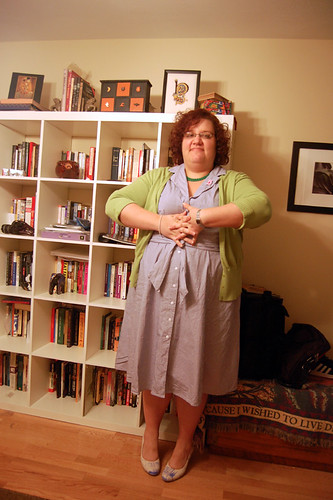
The dress is much more crisp and fresh looking in real life than it is in the unfortunate website representation; setting aside for the moment the extreme creepiness of LB’s head-chopped web images, I find bad pictures are an annoyingly common problem with Lane Bryant in particular (Torrid is a serial offender in this arena as well). Based on the nightshirt picture above, I had expected this would be the sort of dress that works fabulously when correctly styled, but looked drab on its own. I was wrong. The dress can totally stand by itself. It would be against my nature to wear it that way (MUST. LAYER.), but it’s nice to be reasonably assured that on a hot day I could shed a few dozen layers and still look good in the dress by itself.
And speaking of Torrid.

I gave this green cutout dress a shot because, well, it’s green, and I cannot resist green. Add to that the fact that it was on sale and I’m surprised Torrid didn’t just automatically bill me for it and ship it directly to my house as soon as it came into stock. The dress also looked lightweight and roomy and just plain pretty, all good attributes in a spring dress.
And I received it! And all was good in the land of green dresses. Except for one little, piddly, ever-so-inconsequential thing.
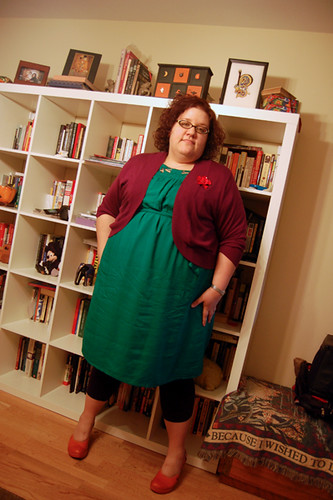
It’s made of rayon. I stopped buying woven rayon ANYTHING in the early 1990s, because if I did anything other than stand perfectly upright and motionless in a quiet room, within a matter of hours the damn garment would look like something designed by a Shar Pei (oh, I had such a collection of gorgeously soft and flowy rayon blouses by Esprit way back when, all of which required gratuitous ironing and still looked like rumpled rags by the end of the day, but I digress).
I hate wrinkles, but I hate ironing more. You can see my conundrum. I hadn’t actually realized just how bad the wrinkling was on this dress until editing the photographs. And when I did, I – this is so embarrassing – I actually attempted to photoshop the wrinkles out. I did. I admit it. I failed spectacularly, given that I am not in any way talented with photo retouching. But I tried. It’s a very, very wrinkle-prone dress, and I have to make my peace with that.
Aside from that, it’s not a bad garment, not by Torrid standards, which I generally identify as being overpriced and middling quality. Next time I wear it, I will either forego the sash or wear a different belt altogether, as the included tie belt wouldn’t stay put, and just shriveled itself into a wrinkled rayony rope anyway.
Next time: I am in search of cotton eyelet sundresses. Also, catalog whispering at its finest.
There’s an interesting article up on the Today show website this afternoon, discussing a Self magazine poll of women and their eating habits. It draws a distinction between “disordered eating” and proper eating disorders, such as anorexia or bulimia, and reports that 65% of women in the US have disordered eating patterns.
Even more frightening, the SELF survey reveals that an additional 10 percent of women suffer from outright eating disorders such as anorexia and bulimia, meaning that a total of 75 percent of all American women — three out of four — eat, think and behave abnormally around food.
The cognitive dissonance of this particular media message of “You should be worried about disordered eating!” alongside the more constant background drone of “You should be worried about the Obesity EpidemicTM!” is, well, perplexing. How do we lose weight, if not by dieting? What does dieting ultimately do to us, if not create an unnatural obsession with what we eat?
The article also delineates a Handy List of worrisome, “You Might Be A Disordered Eater If…” warning signs:
* A very strong fear of gaining 5 pounds
* Following strict food rules
* Dieting for more than three-quarters of your life
* Use of diet pills or laxatives
* Fasting or juice cleanses to lose weight
* Overexercising
* Cutting entire food groups from your diet, except for religious reasons
* Eating the same “safe†foods every day
* Extreme calorie restriction
* Thinking about food more than 50 percent of the time
* Obsessive calorie counting
* Intentionally skipping meals to lose weight
* Bingeing or vomiting
* Smoking for weight loss
* Lying about how much you’ve eaten
* Weighing yourself daily, if it becomes obsessive.
* Consistently overeating when you’re not hungry
* Eating a lot of no- or low-calorie foods
* Having concerns about your eating or weight that interfere with your life (e.g., you won’t see the doctor)
* Considering foods to be good or bad
* Visiting pro-anorexia or pro-bulimia Web sites
* Adopting a vegetarian diet solely for weight loss
This is probably the most fascinating part of the article for me personally. Y’all, I’ve been a fat activist in varying forms since 1997. I am an intuitive eater. I fancy myself as having a healthy emotional relationship with both my body and with food, one that gets healthier every day that passes between me today and the many years I spent eating “disorderedly” as a child and teenager. And yet I can nod and say yes to many of these, sometimes as remnants of my past food and body issues (for example, a fear of gaining weight, when I am most content maintaining my current size), and sometimes as positive spins on the negative connotation (for example, I am inclined to argue that thinking about food more than 50% of the time is fine, if your food thoughts are happy, anticipatory, appreciative ones).
On a broader basis, I can apply most of this list to every woman I know. Including my coworkers. Including my mother. Including fat-positive people.
We live in a culture which (women especially, though others are not immune) teaches us from the earliest ages to eat according to the guidelines above. We learn it from the TV, from magazines, from our families, from our friends, in books, in grocery stores, at bars, at church, at work. I was recently shopping at a Torrid, and while ringing up my purchases, the cashier asked her coworker anxiously, “Are chicken quesadillas fattening?”
(I was sort of agog at the question. I mean, what the hell does “fattening” mean, for one thing: more fattening than a carrot? less fattening than a twelve-pound cheesecake? And secondly: well, DUH. Girlfriend, anything smothered in cheese is hardly going to qualify as a low-calorie food, unless, of course, the cheese is some awful low-fat Pretender to the Cheese Throne.)
There is no “outside” of this culture of food angst and body hatred. We all have to live in it, those of us who unwittingly embrace it and those of us who consciously stand against it, together. Ultimately, it fails at its primary goal anyway: it doesn’t make us less fat. Eating disorders and disordered eating patterns are becoming more and more common, but obesity [sic] rates keep going up. We (meaning everyone, not simply fat people) are not suffering to be thin. We are suffering to be unhappy, unhealthy, physically and emotionally. We are suffering to be always just a little bit fatter than we want to be, to always be just off the mark. There is no end to it. There is no finish line. There is no perfect.
There’s just you, and me, and the bodies we live in, and the food we eat. It should be a simple equation. It isn’t. The article linked above pins down disordered eating patterns into tidy little identities: calorie prisoners, secret eaters, career dieters, purgers, food addicts, extreme exercisers – bite-sized descriptors of our fucked-up-ness. It refers to “the disorder next door”. Disordered eating is pandemic in the United States. And we have dieting and our national obsession with weight to blame.
“Dieting is a national pastime for women,†says Margo Maine, Ph.D., an eating disorders specialist in West Hartford, Connecticut. “As a society, we don’t see the problem.â€
Nope. We’re all too distracted by the fear of getting fat.
It’s been a crazy year for some fatties ’round this here parts. I have been silently (or not so silently) suffering the death of a loved one to pancreatic cancer. I sat in the hospice surrounded by family as she suffered her last pieces of life on earth and listened to her choking death.
I cried a lot.
The funny thing about her death was not so much the way it happened or how long it took to claim her life but rather the way her body changed as a result. Always a fat child/teenager she lost weight as a young adult. she was an inbetweenie for a while and everyone applauded her. After 3 children she was thinner than she had ever been and was feeling pretty happy with her body.
Except that that’s when the cancer was figured out. Her rapid weight loss and ‘trim’ figure were the result of a cancerous tumor and an aggressive illness ravaging every single one of her organs and blood cells. She couldn’t hold nutrition in or around her.
As with any aggressive cancer treatment, she lost her hair and her strength. She also lost what was left of her size. Dying at under 95 pounds, she was finally as thin as she had ever wanted to be.
At her wake, loved ones were heard saying that at least she can now sit and watch from heaven with the thin *healthy* body that she never had. Bitterly, I noted that she had been quite thin for quite some time. Teary eyes reminded me that she was too sick to enjoy it. In fact she was healthiest when she was largest.
I’ve struggled with that knowledge. As I read more and more obesity epidemic propaganda I battle my own demons and those of my dearly dead.
She was healthiest when she was fat. She could enjoy life and her family when she was fat.
Now that’s a commercial you won’t see on television any time soon.
 Two Whole Cakes is a blog written by