On being in The Boston Globe, getting photographed, and self-perception.
By Lesley | January 12, 2010

Look kids, I’m in the venerable Boston Globe! I was interviewed for the article in question over a couple of weeks back in November and December, though at the time I had no idea it was going to be printed by such a conspicuous institution. I first read the above (and wrote 99% of this post) at 4AM this morning. I’d be lying if I said I wasn’t nervous about it—I totally, totally was. Of course, upon seeing the online version of the article, the first thought that broke through my brain was damn Lesley, why didn’t you wear a less wrinkle-prone dress? Fortunately, the photo they chose for the front of the section—OH YES, there is a GIANT picture of me in mid-guffaw on the front cover of the G section—is less a wrinkle-showcase and actually looks surprisingly like me in real life, plus it should please those of you who scold me about not smiling in pictures enough.
[As an aside: I’m not reading the comments over there, because, frankly, I’ve read the comments on Boston.com before and am pretty sure I know what to expect. If the ensuing conversation holds to the usual levels of wackness, it will include, but not be limited to: some people passionately wishing me ill by some fat-related doom; some people passively-but-ominously observing that while they don’t actively wish me fat-related doom, fat-related doom is coming for me nonetheless; some people wondering how the Globe can possibly justify publishing anything not on the subject of unemployment, the economy, and/or local sports right now in These Troubled Times, and bemoaning this evidence of irresponsible journalism; and some people exasperatedly opining that if SOME people can’t handle a little snow during a New England winter, then SOME people should move south and shut the hell up about it. If you have the sanity watchers points to spare and care to engage, I wish you Godspeed, with a warning, to borrow from local hero Barney Frank, that it may be more productive to argue with a dining-room table. Should you persist, you are a stronger person than I.]
Of this experience so far, the most illuminating aspect was being professionally photographed. Now, over the years, I’ve been photographed, often in costume or a great deal of makeup, by many photography-student friends in need of a friendly and patient model, but this is the first professional photo experience I’ve had, assuming childhood pictures slumped over a fake plastic log at Olan Mills don’t count. The photographing involved just over an hour of standing, leaning, dancing, reclining bemusedly on an antique sideboard (sort of bummed these pictures have not come to light, as I suspect they are HILARIOUS), and twirling. It was strangely exhausting, enough that I may have to back up off my usual high levels of Top Model snark and acknowledge that being so acutely aware of every part of one’s body AND at the same time remembering to smile (with your eyes) and not look like you’re concentrating on being so acutely aware of every part of your body… well, it’s hard, kids. I was surprised by the difficulty. Models, I salute you, and I am grateful I will never be one of you.
While the shoot itself was great fun (heaven knows I love me some twirling), the anxiety I felt between the end of the photo session and the printing of the article was something I’ve not felt in a long time, mostly because this represented my handing control of my representation to someone else. It was sobering. I’ve talked about the power of photography to influence our perception of ourselves before, and the anxiety took the form of wondering, “What if I don’t recognize the woman in those pictures?” It’s been years since I’ve looked at a picture of myself and given a mortified shiver at the prospect—”Do I REALLY look like that?” I already know that I look like that, and am untroubled by it. Moreso, I don’t expect everyone to agree with regards to how I look —- fuck, y’all, we live in a culture in which folks can’t even come to a broad consensus on whether Angelina Jolie is hot or unappealing, and we have millions of public photos to use for reference in our endeavors to make that determination. The wonder of self-acceptance isn’t that it makes you instantly attractive to everyone; it’s that it makes you not particularly care whether other folks uniformly find you attractive or not. Too often any kind of fat-positive talk is inaccurately distilled into the idea that fat people just want other folks to find them pretty. In my case, I am far less invested in being seen as attractive than I am in being seen as interesting. I will take interesting over bland broad appeal any day of the week. And yet, the publicness of this whole thing was so unfamiliar, and still is. It was me challenging myself to be personally and individually vulnerable, and to be able to live through it, and even more, to thrive on it.
The truth is that the image of ourselves most of us carry around in our heads rarely matches the image we’re projecting in reality. This becomes a problem when we allow ourselves to get so wrapped up in trying to be our fantasy selves that it turns into paralysis. During the shoot, I really didn’t care about how I looked; it was only [over]thinking it later that I began to worry, that I began to wonder if I should have held back more, been more restrained. Second-guessing myself. This is pretty preposterous. Why put on a persona that isn’t me? Why pretend to be the freshly-pressed and perfectly-coiffed person I ain’t? The only way to fight the fear of being seen is to learn to accept yourself as others see you; instead of trying to change your outside to match the fantasy in your head, I’d suggest you change the image if yourself in your head to more accurately reflect the person you are.
Personally, I find that twirling with reckless abandon is an excellent antidote for an overabundance of self-restraint.
ETA: To head off any folks coming over from the Globe who want to ream me for having a fat cat, allow me to clarify. We adopted Rufus in November, at which time he weighed 26 pounds. He and his sister had been dumped outside the shelter, and were clearly neglected, as Rufus was so covered in mats he needed to be shaved. Having fed him an appropriate diet at an appropriate rate, he’s since lost three pounds. I’ll love this cat no matter what he weighs, but I wanted to clarify that Rufus’ fatassery is not due to my efforts, but rather was well in place when we adopted him. More info on Rufus is here. Thanks, loves.
The longer i’m a part of FA the less I’m willing to ignore negative body talk from clueless family, uninitiated friends, and total strangers. I feel like all the work I’ve put in on size acceptance amount to some sort of Fat Powers–and with great powers comes great responsibility– and that I should be harnessing said powers to make the world a better, more size-positive place. I think about what a difference hearing anything fat positive would have made to a self-loathing teenage me and it seems wrong–if socially advisable–to hold my tongue.
I believe there is something significant in receiving overt/covert approval from a confident-seeming stranger when you feel like an unloveable beast. I am continually humbled and surprised by the messages I receive about my fatshion photos. It’s both scary and encouraging to me that my unapologetically posting pictures of my fat ass on the internet encourages people to hate themselves a little less. Without cracking the particular low self-esteem chestnut of whether a person ought to place value in what other people think of them, I think that a little “permission” (for lack of a better way term), can go a long way to making someone stare a little less hatefully at their reflection. Don’t get me wrong, it’s extremely unlikely for a person to go from “I shouldn’t be seen in public!” to “pass the holographic hot pants!” on account of some unexpected cheerleading from someone they’ve never met. On the other hand, words are never without weight, and a few kind–or even just neutral–words can make a world of difference when you’re walking around in a dark cloud of self-loathing, expecting people to say the worst, almost daring them not to.
Around the time I started hanging out with the person who was to become my significant significant other, I thrifted a pair of (then heinous to me) dayglo lime green nylon athletic short shorts. It was the late 90s, the tale-end of grunge, and these were the sort of shorts–the sort that Jack Tripper might have worn jogging in 1978–were calculated instruments of social suicide.

artist’s rendering courtesy of friendlymilk
I’d just been through the sort of cliched boyfriend-cheating-on-you-with-your-best-friend break up that so often occurs in a high school setting and I felt like a damn fool. And since I was a fat teenager–aka expert wallower and inspired in the art of self-deprecation–I concluded that the only way to deal with this was by publicly donning Shorts of Shame & Negative-Attention Seeking Angst. They were awkwardly high-waisted. They cut into my thighs. They made unpleasant creaking sounds when I moved. I singled myself out because i felt unworthy of anything but scorn– they were everything a fat girl who ever hoped of being pretty, accepted or popular should avoid, and so I wanted every part of them.
Since high school is a hell mouth and most people feel like they are the benevolent advisors of all fat people (for their own good, dontcha know?) my efforts at self-sabotage were all too successful. Everyone remarked on the shorts in horror. Friends threatened to break into my room in the night and burn them. One especially “concerned” friend went so far as to tell me that if I continued to parade my fat ass around in those shorts I couldn’t really expect anyone to ever want me again now, could i?
So, when one of my co-workers at the grocery store asked me if I wanted to hang out with him there was no question what I would wear.
We went roller blading. I was sure he’d take one look at my wobbly dayglo ass and a) tell me I looked like shit b) tell everyone at work how I looked like shit, and making me the laughing stock I obviously deserved to be because I was fat and some jerk broke my heart (ah, teen logic.)
What actually happened was rather anti-climatic, and (therefore) totally jarring: 1) he never said a damn thing about them or how I looked at all 2) he wanted to see me again. it’s a bit sad to think that someone i hardly knew choosing not to be critical about my appearance/fashion choices was enough to distract me from feeling like shit at that point in my life, but honestly, it was.
Now I could really give two shits if people dig on my fatshion, but if I’m going to be dead honest, a big part of getting to a place where i could be all “eff this I am effing stunning in these metallic hot pants”– was having people around me refrain from telling me what i, as a fat person, did or did not deserve to wear (or do, or say, or eat, or think….)
it’s ridiculous to admit, but those lime greens shorts and the reactions–both expected, and not–that they provoked, haunt me. they’ve become this complex signifier that informs my fat politics online and in the physical world. They remind me just how serious a seemingly “throwaway†topic like fatshion can be to someone who’s just making their first strides towards body acceptance. That sometimes just letting something slide, is like the equivalent of saying “you’re good, you’re alright, you don’t have to change.â€
There are definitely times when I don’t adore what someone is wearing, but if it’s clear they love it, and more importantly, if they are putting themselves out there for the first time, sometimes the most important feedback you can give someone is to pull your punches and tell them to keep posting/trying shit out. It is not a tragedy for someone to never learn that, to your eye, their pants on a particular day ought to have been an inch longer. It is, however, a tragedy for that person’s first experience with FA to be a million tiny nitpicks that, in their vulnerable state, seem to confirm all the things they are already thinking: I don’t deserve style, I can’t look good anyway, no matter where I go, people will treat me like shit, and I deserve it.
There are a lot of so-called “well-meaning” people in our lives lining up to tell us fat people how our very existence proves we’re doing it wrong. Family members, friends, teachers, sales people, health professionals, makeover presenters, all do their best to make sure us fatties feel like shit, like we should hide, that we are unworthy of having fun in any circumstance; let alone something as meritocratically-structured as fashion. A lot of people new to FA are going in with shaky egos, and expecting the worst. And you might disagree, but I am of the opinion that fatshion is an FA gateway drug. If a person feels like they’re maybe doing one tiny thing right, it might be enough to put a dent in that wall of self-doubt/loathing that most of us start building from the first moment somebody derides us for our size. Don’t do people any favours by cutting them down before they’ve even found their legs.
On a new year, Amanda Palmer, school uniforms, and being ferociously ourselves.
By Lesley | January 5, 2010
I spent the eve of 2010 at Symphony Hall in dear Boston, watching Amanda Palmer play (in every sense of the word) with the Boston Pops. That night gave me many things to think about, the most immediate at the time being a vivid reminder of the complications of wearing a dress, and a crinoline, and a pair of tights, and trying to use the restroom, which my husband will tell you I need to do approximately every thirty seconds, every day, all day long. It has been many years since I’ve had cause to wear a crinoline anywhere, for any purpose, and yet in the time when I DID have reason to do so, I wore crinolines fairly often. The crinoline was a much-loved part of my clubbing costumes, from the years when I went to clubs multiple nights a week, and dressed for the occasion (i.e., college). However, peeing in such a getup is a huge production, as once the deed is done, inevitably some part of the dress/crinoline ensemble is stubbornly caught under the waistband of one’s tights such that one practically has to disrobe and redress—all in a typically-unpleasant nightclub bathroom stall—in order to remedy the situation.
But the louder thought ringing through my mind post-concert was about how challenging it is simply to be ourselves, and how challenging it is to even know what that means.
Amanda Palmer, for the unintroduced, is a somewhat eccentric artist and performer. I tend to instinctively rebel against fannishness in any form, so I will instead say that I have a keen appreciation for what Palmer does and for her willingness to be herself, even when “herself” is an odd-shaped cog that doesn’t fit in any known machine. For Palmer to be a raging mainstream success, we’d have to build a whole new cultural apparatus to fit her. As it is she tends to flutter on the edges of popular culture, one of those figures who creates powerful reactions in people, some of whom are madly in love with her, some of whom can’t stand her at all. Pre-show, Palmer performed a couple songs with one of the other artists playing in one of Symphony Hall’s function rooms; when she’d finished, I turned to leave and was nearly mowed down by a cluster of teenage girls bolting through the assembled crowd toward Palmer as she exited, the collected force breathlessly exclaiming “ohmygodohmygodohmygod” endlessly as they went, ostensibly bent on catching Palmer before she got through the door. Powerful reactions, from people who relate, or who want to relate, who want to know the person they think knows the answer to “who I am” and “how shall I be that person”. Palmer works hard at being who she is and being successful at it, and while this may never gain her broad popular approval, her uniqueness and her quirkiness and her unselfconscious trueness to herself are more precious than gold to those who, in the course of being themselves, are also put outside the normative world. Amanda Palmer, and folks like her, help to validate the existence of those people who think they are so terribly alone in their outsider status. And that, more than anything else she does, is why I admire Amanda Palmer.
Now, let me tell you a story, of a teenaged Lesley, and of socks and school uniforms.
As a kid and teenager I often stymied my parents with my stubborn refusal to participate in whatever trends were rampant amongst my peers; more than that, I developed a habit of actively avoiding anything understood to be popular. One parent or the other would say, “Oh, is this what you kids are into,” and I would recoil, aghast, wanting nothing to do with what you kids are into. I suffered a compulsion to distinguish myself, occasionally to my social detriment, but occasionally to my advantage. This was well in place by the time I reached high school.
A week or two prior to the start of classes my freshman year, I was to report to the school to be fitted for my uniform, which would then be ordered and delivered the first week. I was shifting, by choice, to a Catholic high school after spending my elementary and middle years in public institutions, so the uniform concept was new to me, though I found the idea thrilling because I’d seen Girls Just Want to Have Fun many times and imagined myself in Helen Hunt’s brilliantly-accessorized, transformable ensembles. I saw the uniform as a blank slate on which I could perpetrate all manner of subversion, of the uniform, and of myself. I also saw it as a way to belong. It was deeply appealing, a creative challenge.
The fittings took place in two classrooms leading off the school cafeteria, one for boys, and one for girls. We stood in line until space opened in the appropriate classroom. Later, it would happen that the classroom where the girls’ fitting took place would be where I’d attend my first theology class, required for all students, and where I’d be pleasantly scandalized by hearing the teacher say the word “fuck” (he was quoting from The Blues Brothers at the time). The cafeteria, on the other hand, I would never once in four years utilize for its primary purpose of sitting down and eating—being in South Florida, sitting out on the patio was preferred year-round, and if it rained, we’d sit on the concrete floors of the outdoor breezeways.
Of course, I didn’t know these things then; I was just being fitted for a uniform.
The uniform components were two pieces: a stiff, woven button-down shirt, white, with the school’s initials in navy embroidery on the left front breast pocket; and an equally-stiff woven navy plaid box-pleated skirt, with a button and zipper closure on the side. When my turn came to enter, I found the room occupied by a number of girls quickly trying on an assortment of uniform pieces to determine what size to order. I approached a woman at the desk at the front of the room, who reached into one of the many open brown boxes behind her and handed me a shirt and skirt to try on, amongst the other nervous would-be freshman girls wrangling blouses and skirts over their civilian clothes, as fully undressing seemed out of the question (I still am not fond of community changing-rooms). I attempted to put the blouse on over my t-shirt; it was too small. I pulled the skirt over my jeans: it wouldn’t even button, it wouldn’t zip an inch. I brought them back to the desk, sheepishly, though no one had asked me—or anyone there—our size, but instead they looked us over like we were cattle at auction and guessed based on what they saw. The woman handed me another shirt and skirt, from another box. The shirt fit marginally better, buttoning up without trouble, though it was, in retrospect, brutally tight across my shoulders and upper arms. The skirt was still hopeless. I brought it back again, caught between feeling angry at being so misjudged and embarrassed at being so apparently large (I was 14 years old, and wearing a women’s 18/20 or so at the time). The woman mumbled something apologetic, her eyes on the order forms on the desk in front of her, and then she turned and dug through another box for a moment. Eventually she waved me toward the boxes stacked two high beside the desk, bursting with chaotic heaps of discarded white poplin and navy plaid: “See if you can find something that fits.” I don’t remember her actually speaking to me before this point, I just remember her handing me garments without making eye contact.
I went into the boxes and dug. Too small, too small, too small. Everything was far too small and I knew it. It seemed the blouse I’d been given was the largest size they had; though now I regret not demanding they order me blouses in the next size up, at the time I was still a true believer in the power of numbers, so I was simply relieved to (technically, if not comfortably) fit a blouse marked as a 16, and not to require special consideration. As I pulled out skirt after skirt, looking for anything larger than a 12, I felt my panic rising. At this point in my life I’d spent a few years buying the largest size in the straight-sized store, even when it was so tight as to be painful, because in 1990, succumbing to plus sizes would have been Style Death, my only options a Lane Bryant a thousand times more matronly and shapeless than today (if such a thing is even fathomable), or the abysmal torment of mail-order catalog doom. If avoiding that fate meant having to lie on my bed and breathe deep in order to zip up my size-18 jeans from Lerner’s, then so be it. But here, in the terrible land of unforgiving woven polyester uniforms, what if the largest size wasn’t an option? Inside my head I couldn’t even conceive that larger sizes than those represented in these boxes existed. I imagined myself being turned away from the school simply because they didn’t make a uniform skirt to fit me.
But finally, at the bottom of a box, neatly folded and untouched by teenaged-girl hands prior to my own, I found a skirt marked an 18. I grasped it like a drowning man clutches a life preserver and unfurled my plaid victory, waving it like a flag to the rest of the room, which blessedly ignored me. It didn’t matter if it didn’t fit now; I would figure out a way to make it work. Pulled over my jeans, buttoned and zipped, it was gasp-inducingly tight at the waist but I didn’t care. Triumphant, I brought my too-tight blouse and too-tight skirt back to the desk where the women were filling out the order forms. I would bring that particular uniform set home with me that day, as everyone did, to have a uniform to wash before the first day of school, when the rest of the ordered items would arrive. I ordered five too-tight blouses and three too-tight skirts.
(Little did I know I would keep and wear those same blouses and skirts for four whole years. The blouses were so tight in the arms as to make it difficult for me to reach forward and down to pick up a pencil if I dropped one on the floor; the unyielding fabric kept my arms half-immobile except for a narrow range of comfortable movement. The skirts I would cherish as priceless, because my sophomore year the uniform code changed and the skirts were traded for culottes, and oh my friends, you cannot imagine the horror that is me, an apple-shaped fat girl, in knee-length plaid culottes. Those of us with skirts from the prior year were allowed to keep wearing them, and thus I treasured my waist-constricting, breath-impairing skirts for the rest of my high school career.)
Unfortunately, I would discover before long that the uniform did not eclipse style fads in the prevailing culture at school. In fact, it just narrowed the field. The axis on which the trends at my high school revolved was socks. Yes. Socks. I learned rapidly that the correct socks were E.G. Smith slouch socks (which, astonishingly, have only recently been discontinued by the manufacturer). These were cotton socks that came in many colors (including tie-dye) and were meant to intentionally bag loosely around one’s ankles, not unlike legwarmers. Because they had no elastic at all, by day’s end one’s EG Smith socks had often slumped over the back of the heel to drag on the ground, which made keeping the lighter colors clean a challenge. The inventive could fashion sock garters from standard rubber bands, hidden by folding over a narrow cuff at the top of the sock, which many of us did. These pretentious socks were also criminally overpriced; as I recall, on back-to-school shopping trips in high school, at the late lamented Florida-exclusive department store Burdines, the social status afforded by a single pair of these name-brand socks would cost you between $12 and $14 (tie-dye was more expensive). In 1990.
(It’s just occurred to me that I am talking about socks I bought almost twenty years ago. Shudder.)
Yes, I bought some of these ridiculous socks, with the vivid “love, eric” printed in gold ink on the sole, to identify them as the real thing and not some knockoff. And I wore them, briefly, to see how it felt to fit in. Except it didn’t work; I still never felt like I fit in, even in a school uniform, even with the correct socks, even dressed like everyone else. The longer story of how I came to attend a private school is a topic for another post, but a large part of it was rooted in my overwhelming social isolation in eighth grade, and my belief that attending a private school, instead of going on to the public high school with many of the same people who’d known me in middle school, would give me a chance to reinvent myself. The uniform aspect would seem, on the surface, to give me the option of blending-in, if I felt so inclined, or standing out, if I was feeling my inner Helen Hunt. I thought of the uniform as a fresh sheet of paper on which I could write my identity every day. I thought of the uniform as a costume in which I could hide. But it failed. I was too awkward, too brainy, too big, in multiple respects, to blend in, and I was still myself, in a uniform or not. I was bursting at the seams—literally, figuratively, in every conceivable way. It wasn’t long before I’d cast aside my EG Smith socks in favor of odd legwear collected from clearance bins and discount stores, patterned kneehighs, fishnet anklets, anything that spoke the opposite to the giant cotton slouch socks that everyone else seemed to covet and favor. Because it seemed to me, even in those hoary teenage years of trying to figure out who I was, that a sizable part of being myself meant standing as a contradiction to popular conviction. It meant not just being willing, but being compelled to be visibly different, to provide a counterpoint to the norm, and accepting the abuse as well as the admiration that a life of even subtle subversion seems to attract.
I cannot shut up about the things that are important to me. I have to speak up, I have to break down the culture I see and the world around me, I do it on this website and I do it in my three-dimensional life. I don’t know how to live any other way; I don’t know how to be any other person. And as difficult as this can be, I’m grateful because I have the sublime luxury of knowing who I am, and of knowing how to live as myself, brightly, and cacophonously.
Being who we are—being, ferociously, ourselves—is both an act of terrible bravery and an act of desperate survival. Let this year, and every year, be a time for knowing yourself, and for being true to your convictions.
Happy new year, my loves.
Note: I write lots of stuff that gets posted elsewhere, because I am often stymied by my need to be Very On Topic on this blog. Starting today, I’m taking a to-hell-with-that approach, and will be sharing more of my other writing here, most of which really is pretty topical (at least on the social justice politics/pop culture criticism tip) but may not be explicitly fat-related. If you hate this, I am sure you will tell me. Thanks, friends.
Friday night, my husband and I went to see Avatar in 3D. My husband thinks it was one of the best movies he’s ever ever seen in the history of ever. I think it’s probably a movie worth seeing in a theater, to draw your own conclusions. My own assessment, in numbered-list format, is below the jump. It may be spoilery — as much as my read of a story you’ve heard a hundred different versions of already CAN be spoilery — but at least you were warned.
I hereby present my Avatar-related issues, in no particular order. Except the first one.
1. The length. The length of this movie is a problem. These days I pretty inevitably leave movie theaters saying, of almost every movie: “That wasn’t bad, but they could have trimmed fifteen minutes off and it would have been better.” I like my stories tight; I like the films I see to be precisely edited, with everything there for a particular reason, and nothing included just because, eh, well, we shot it, we may as well leave it in. Or because the bit-part in this scene is the cousin of the producer. Or because the studio wants a summer blockbuster that’s at least 120 minutes long because of whatever weird focus-group reason. So me, complaining about a film’s length, is hardly a new phenomenon, though typically my fantasy edits are less than thirty minutes in total.
In this case, I left Avatar saying: my god, that movie could have easily lost an HOUR of filler and been improved by the subtraction. Possibly as much as ninety minutes. I started checking my watch about an hour and fifteen minutes into this thing. That’s right: an hour and fifteen minutes along, and I thought surely we must be nearing the end of this two-hours-and-forty-minutes-long movie. You can imagine my aghast expression when I realized how much I still had to go.
2. The story. Yes, it was predictable, but that alone wouldn’t necessarily have been enough to ruin it for me, as there are many standard story tropes told and retold that still manage to entertain. The problem was that it was also boring. The effects were impressive and the visuals were striking, but I like a little content with my form. Here’s the whole plot: advanced-civilization-dwelling outsider is reluctantly accepted by an exoticized “simple” culture to find his own people are totally evil and thus fights alongside his newfound pets community against his own species to overthrow the bad guys and save the (alien) world. That’s it. Everything else is incidental, and chances are if you’ve imagined any subplots off the top of your head, they’re there: the hero’s romantical connection with the alien princess; the showdown with the vicious military jerk who just digs killing stuff; mean corporate suit only interested in profit; a few noble deaths of disposable-but-endearing supporting characters.
Oh, and of course, the magical substance that the soliders and corporate (relocate blue aliens + mine planet + ??? = profit) sleaze are after, the reason for the conflict? Is called “unobtanium”. I shit you not. Why they didn’t call it MacGuffanium is beyond me.
3. The characters. The aliens (i.e. “natives”) are terrible, painful caricatures of pretty much every aboriginal people, to the point of being completely unrelateable as individuals, even if they weren’t also nine feet tall and blue and made from computers. The human actors were marginally more, well, human (the ones played by Main Guy, Sigourney Weaver, Michelle Rodriguez, and Dorky Guy, anyway) but we didn’t get to see much of them in that form. I get that this movie thinks it’s saying colonialism sucks – but when it says it using so many stereotypes and with the inevitable white guy hero as the dumb savages’ goddess-picked savior, well, it lacks the oomph it might otherwise impart. I went in prepared to find the whole “noble savages” angle annoying and/or frustrating, but mostly it was hilarious. The stereotyping practically crossed over into satire, particularly during the big blue YAY TREES rally toward the end.
Also, didn’t get enough blue wang from Watchmen? Avatar gives you barely-concealed blue boobs. I’m not so much against nudity in a general sense, but this was seriously distracting. I don’t even want to know how much dialogue I missed while trying to figure out whether the main blue heroine was wearing a bra top or a big necklace or wow, I can totally see like 80% of her boob there, and is that a nipple?
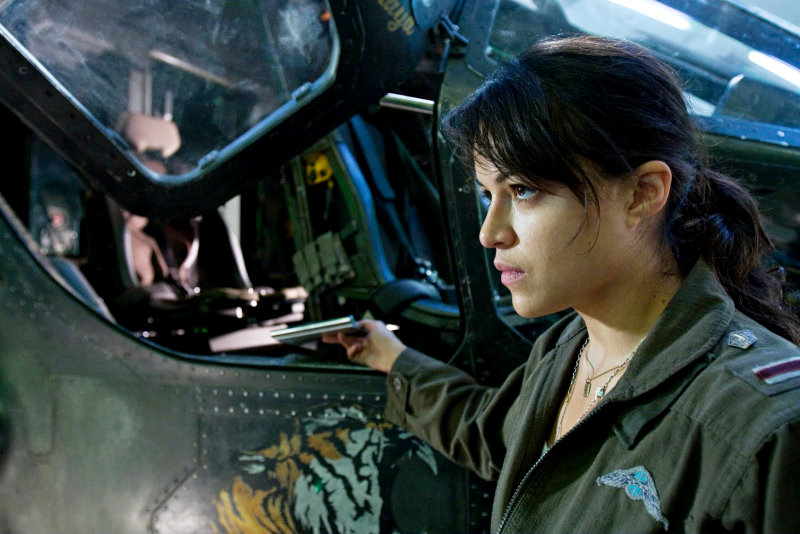
4. The actors. This one isn’t all bad. Sigourney Weaver is awesome in everything. Michelle Rodriguez is so hot. Crazy, crazy, crazy hot. On-fire hot. Even just looking slightly bored? Hot. Michelle Rodriquez could make anything appealing, even a run-of-the-mill midair battle sequence that could have been cribbed directly from Battlestar Galactica’s cutting-room floor. My only complaint here is that this movie was not about Sigourney Weaver and Michelle Rodriquez systematically wiping the rest of the humans off the face of this distant planet, preferably whilst exchanging witty buddy-comedy dialogue (like Sigourney could be all “I’m too old for this shit” and it would be charming).
My other minor issue was with Main Guy, whose name I forget no matter how many times I read it. Main Guy is our cocky wheelchair-riding former-marine hero, who fumbles into this Highly Sciencey Mission because his twin brother was supposed to do it, but inconveniently got himself killed, and since growing an avatar costs a lot of money they figured they’d toss Main Guy into his dead brother’s avatar because, being twins, their nervous systems should match up okay. Never mind that Main Guy, as he likes reminding us, is not Sciencey but Soldiery. As it happens, (surprised faces on) it turns out it’s precisely His Warrior SpiritTM that enables him to be accepted in Bluetown. But anyway, this is not a gripe with the character so much as it is with his speaking voice, which went something like this:
American american american american !!AUSTRALIAN!! american american.
What was amusing about it was it seemed entirely an individual-word problem. Often when actors slip out of accents, they shift subtly between sounds over the course of sentences and conversations. With Main Guy here, it’s just a random word here and there. “Did,” which sounds particularly different between American English (with a short i sound) and Australian English (more like an ei sound), was a common offender that leapt out. It honestly left me wondering why this dude had to be American in the first place. Given that reference is made to an Earth where “nothing is green”, we’re looking at a dystopian profit-driven distant future, yes? Why would we assume that all the security forces working on this distant planet come from the US? I think it’s actually MORE likely they’d come from a variety of places, especially considering the film is pretty clear on the fact that these offworld soldiers are glorified mercenaries. So why not let Main Guy just be Australian and talk with his own damn voice?
(I kind of expect James Cameron has an intensely idiotic explanation for this, like, “Oh, but Australia was destroyed during The Great Superintelligent-Kangaroo Uprising of 2365, at which point we razed the continent from orbit and now use it as the planet’s main landfill.” And then he’d think, hell, I bet I could get somebody to give me $300 million to make a movie about THAT, too! And then he’d do it, because James Cameron is kind of a dick.)
To sum up:
Was it pretty to look at? Absolutely. The 3D effects were crazy, and not badly used, and positively restrained with the cheap OOH-WOW tricks, like glowy space bugs that seem to buzz around outside of the screen, or sparkling embers drifting down out of the night sky after a fire. And the planet feels surprisingly real and near, with a few dumb exceptions (silly lumbering hammerhead-rhino monsters; the Magic Untouchable Flying Killer Dragon that our hero forces into submission with minimal effort; the heavy-handedness of the whole “SEE, THEY’RE CONNECTED WITH NATURE! LET ME BEAT YOU OVER THE HEAD WITH ADDITIONAL PLOT CONTRAIVANCES TO MAKE SURE YOU GET IT” theme). But the recycled story and the so-bad-they-almost-cease-to-be-offensive (think of a little kid’s drawing of an American Indian with arrows sticking out of his head) Noble Savages and the heavy-handed BE GREEN! message made it difficult for me to get truly lost in Cameron’s vision for more than fifteen to twenty minutes at a stretch before some terrible bit of dialogue or totally predictable plot twist snapped me back to reality.
At which point, I’d check my watch again. As a filmmaker, Cameron’s world-building skills are without equal. I only wish his storytelling was half as good.
Hello, my dears. I apologize for the lack of Fatshionista in your life lately; the past month has been a little off the rails for me. For example: on Thanksgiving, my closet collapsed. By “collapsed” I mean the rod and shelf from whence things were hung? Fell down. Rufus was seen skulking from the scene immediately before its discovery and my husband has posited that possibly he tried to jump to the top shelf and owing to his bulk, pulled the whole mess off the wall. (I think this is unlikely.) Regardless, it was pretty spectacular in an oh-god-please-kill-me sort of way, and further underscored the reality that I own far too many cardigans. I won’t even mention the shoes. All of this is to say thanks for your notes of concern, I am very much alive and have not been swallowed into the black hole formed by the incredible mass of my cardigan collection. Indeed, my closet has since been rebuilt — we have the technology! we can make it better, stronger… faster? — with my own two hands in a catastrophically frustrating two-hour extravaganza that actually took five hours last Sunday night. It is now bi-level and I have shelves for shoes to live on. Closet Destruction 2009 was only one minor setback over the past month, so you can use your imagination for the others.
As a result of the multitude of distractions, I’m a little light on content lately, but I did want to highlight this, which I discovered via the indispensable Vintage Ads this morning.

Click to embiggen, if you’re into that sort of thing.
It really wasn’t that long ago that these sorts of images were common. And, sadly, given the current atmosphere of racial backlash in the US right now, in some quarters they still are (post-racial America, my fat ass). So, while I get that many of us see the above and think, “Wow, that’s offensive,” we don’t always have the words to articulate why — we know we’re seeing something taboo, something bad, but when faced with having to explain it to someone else, having to outline why the above image is so loaded with meaning beyond the basic image it presents, we’re often at a loss.
Thus, I present to you: my unpacking of a problematic image.
We’ll begin with the image itself. The woman in the picture above is a woman of color, and not a white woman. I am personally inclined to think she is meant to be a Black woman, for reasons I’ll get into below, though she could ostensibly also be Latina. The lack of advertisements (and editorials) that feature women of color are often a sticking point for critics of women-focused media today, but this is a good example of how it’s never so simple a matter as injecting more women of color into magazine layouts; it’s about how said women of color are represented. The woman in this image, given her pink uniform and apron, and the text of the ad which references servants, is clearly a maid in the house of a well-off family, more likely than not a white family. If you have a Racial Stereotype Alarm in your head like I do, it should be going off pretty loud right about now. Though we like to think we’re far removed from seeing images like the above in daily life, the truth is that stereotype of the woman of color as housemaid is very much alive and well in American society. Thus I’d argue that while we may no longer allow ourselves to so candidly exploit this archetype as the ad above does, our culture really hasn’t evolved very far from thinking of women of color as domestic servants — or perhaps more precisely, from thinking of domestic servants as typically being women of color.
The fact that this woman is also fat is not incidental, as this aspect underscores one of the most easily-recognizable racial archetypes out there: the mammy. The mammy is unencumbered by intelligence, soft as a pillow, loyal as a dog, and wants nothing more than to devote her whole life to the care of her white employers. She has no passions or ambitions of her own, but exists exclusively to service her so-called betters, an unchanging mother figure to everyone in the household. It’s unlikely that all of this is meant to be transmitted by the image above — in truth, I doubt the artist thought very hard about it at all — but the fact remains that these are very common connotations with this image of a fat Black woman working as domestic labor.
Moving on, the text of this ad has a lot more to impart as well. The woman’s talk bubble says, “I’se sure got a good job now!” Reading this from the perspective of the intended audience — white women of means — the “I’se” denotes a lack of education, another stereotype of both people of color and domestic staff. Because folks learn to speak as much by listening to those in their community as they do from their schooling (or lack thereof), the implication here is that not only is this woman stupid, but she lives in a family and community of people who are also stupid, by mainstream standards. This lack of grammar also suggests lower socioeconomic status, just in case this weren’t already clear, given that the woman in question is cleaning up someone else’s home. So here we have a woman who’s already working a job considered, culturally-speaking, to be a position that is at least somewhat demeaning, and the ad’s copywriter gets to add insult to injury by imitating his idea of Black American speech. To be clear: I am not myself suggesting this is appropriate or true, but suggesting that in a culture that stereotypes the Black woman housemaid as stupid and shiftless, actual Black women who work in such positions may be read by dominant white culture as being demeaned by “fulfilling” the negative stereotype.
The rest of the talk bubble’s speech is just as troubling, though for different reasons. The ad is meant to sell a kitchen time-saver, namely, an “electric sink” with a disposal and top-loading dishwasher. Housework becomes “easier” and less “tedious”, plus your dishes are safe from “handling” (though unless this sink can also levitate the dishes in and out of the dishwasher, “handling” seems pretty inevitable). The woman, who is ostensibly using the new contraption for the first time, says she has “a good job now!” If she were a white housewife, this could mean she has more time to sit around and smoke cigarettes and ignore her children, a la Betty Draper and the malaise of many well-off white women of this time (see The Feminine Mystique). But because the woman in the ad is a Black woman, the expression suggests a reinforcement of an additional stereotype: laziness. Her job is “good” now not because it affords her the luxury of leisure time — something most working women of color in the advertisement’s and the contemporary time periods don’t have much of — but because it involves less work.
It can be argued, convincingly, that making this close a reading of something ultimately ephemeral is at best a waste of time and at worst a self-indulgent exercise in which folks like me can put our culturally-underappreciated critical skills and knowledge to some use and pretend they serve a useful purpose. But the truth is that these images, disposable though they may be, shape how we see ourselves, and how we see each other. Knowing how to read them, and how to explain their problems to others, is a practical skill if it cuts down our culture’s racist/classist/fatphobic assumptions and lays bare their meaning. And my analysis above is hardly authoritative or comprehensive — part of the indisiousness of these bits of media is that they can be read so many different ways, from so many different angles. Do you think I missed something, or misread a cue? Contribute to the process: leave a comment and let us all know.
Further reading:
Fatness and Uplift: Not a Post about Push Up Bras, by the brilliant Julia.
101:(Re)Defining Privilege
Given this is a holiday week here in the US, and I’m expecting an influx of out-of-town family for most of the week and into this weekend, I don’t anticipate having time or energy to post much of substance for the next several days. So I’m re-sharing a video that was among the first things I ever posted to this site when it launched a couple years ago: Cass Elliot performing “Dream a Little Dream of Me” live on the Smothers Brothers Show, circa 1968.
Enjoy. And have a fantastic holiday, loves.
Only the one this week. See previous post.
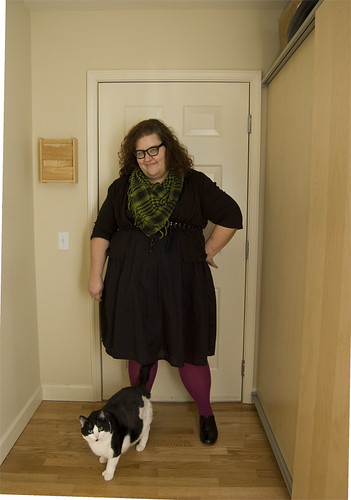
Black dress from eShakti.com;
black cardi from LB, years ago;
studded suede belt from Torrid, also years ago;
purplish tights from We Love Colors;
green plaid scarf from Marshalls;
shoes are vintage Capezios;
orca from Northeast Animal Shelter in Salem, MA.
Hello, my loves, and apologies for my prolonged silence; my husband and I were out of town for a short vacation last week, and, unsurprisingly, my blogging has suffered.
In other news:
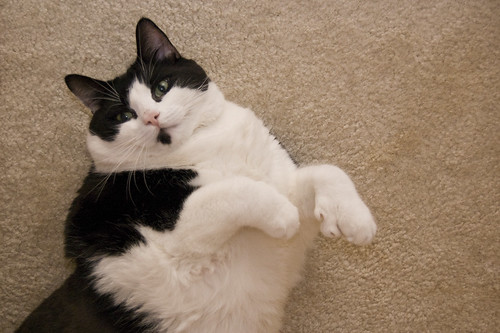
This is Rufus. Rufus is one of a pair of abandoned cats my husband and I adopted from the Northeast Animal Shelter in Salem, MA this weekend. Rufus is also the fattest cat I have ever met. He weighs 26 pounds. I did not intentionally seek out this gigantic cat, but rather we chose him and his sister for their easygoing personalities and overall friendliness (the simpler to introduce them to the remaining Lord Cat of our household, a 13-year-old Maine Coon mix). In fact, I didn’t even realize how very fat Rufus really was until we got him home. He waddles. He’s sort of bowlegged. He has trouble cleaning himself properly. Rufus is going to need some additional help, particularly in the grooming arena. It’s very strange how assumptions about weight even bleed through to our relationships with animals (some other interesting thoughts on the subject can be found here); I have no idea how Rufus got so fat, and I have no idea whether a regular diet (the same as the other cats get) and increased activity (the same as they other cats get) he’ll get any smaller. Currently, he’s a bit like a watermelon with legs. I may very well have signed myself up for regular cat-butt-wiping duty for the next eight years or so.
(Some of you are recoiling in horror right now, I know. Meanwhile, those of you with cats are nodding sagely, because you understand.)
And I’m okay with that. Because he’s just the sweetest, most love-hungry cat I’ve ever met.
Whew. I made a whole post without getting into anything heavy. This is a first. Share your fat-cat pictures and stories in comments, if you’ve got ‘em.
Tomorrow, the long-awaited and much-buzzed-about (not to mention awkwardly-titled) Precious: Based on the Novel Push by Sapphire opens in theaters, and unsurprisingly, the reviews are overwhelmingly effusive thus far. As much as I’d love it if Hollywood felt compelled to send me a screener of every movie with a fat protagonist (c’mon Hollywood, it’s not like it happens often), they don’t, so I’ve yet to see it myself.
What I have been watching, in the absence of the film, is the way it’s being discussed around the web, and most specifically the way its star, first-timer Gabourey Sidibe, is being treated. Latoya Peterson has done a chunk of this work already, posting some of the “WTF moments” she’s found most egregious to Jezebel.com, and evidently her call-out was cutting enough to inspire a public response from one of the reviewers she takes on, David Edelstein of New York Magazine.
From the trailer alone it’s apparent that Precious is a movie that will likely result in 99% of the white people (and probably some people of color too) who see it spending two hours shifting uncomfortably in their seats over their unexamined (or even thoroughly-examined) attitudes about the intersections of race and class. But looking through these challenges, it’s Precious’ size that’s not being too-overtly discussed; it’s likely that folks talking about this movie are already bending under the heavy load of Precious’ relentlessly sad story–abused by both parents, pregnant by her own father, illiterate, seemingly locked away from any manageable path out of her terrible circumstances–that they’re unwilling to further compound the issues by also calling her fat, at least not more than once.
People are more willing to mention, however obliquely, the way Gabourey Sidibe’s body is seemingly in contrast with her oft-cited bubbly and cheerful personality. Whether these folks really believe that most fat people are necessarily unpleasant and miserable, or whether they’re confusing the actress with her character, remains to be seen. But even the film’s director has gotten in on it:
Lee Daniels says: “She is a special girl and, I think, unaware of it. She is either in denial about her physicality or she’s from another planet. She is evolved. She is so secure about who she is.” (Source)
An astonishing amount of the language around Sidibe’s self-confidence and comfort in her own body is wrapped up in these mystified expressions. Doesn’t she know she looks like that? Should someone tell her? While I’m sure Daniels meant the above as a compliment, look at the options we get: 1. Denial that she looks so completely antithetical to cultural beauty ideals. 2. Alien from a planet where “her physicality” is “normal” and acceptable. 3. Evolution beyond an awareness of her body. Note there is no choice for “thoughtful acceptance” or “refusal to allow mainstream beauty standards to dictate one’s self worth”. If we as a culture assume that being self-confident and at ease with oneself is in direct opposition with being fat, isn’t that a problem?
From the David Edelstein review, a passage that I’m sure has been pulled out and blogged about a hundred times already:
I’m not judging girls who look like Sidibe in life, but her image onscreen is jarring to the point of being transgressive, its only equivalent to be seen in John Waters’s pointedly outrageous carnivals. Her head is a balloon on the body of a zeppelin, her cheeks so inflated they squash her eyes into slits. Her expression is either surly or unreadable. Even with her voice-over narration, you’re meant to stare at her ebony face and see nothing. The movie is saying that she’s not an object, but the way that Sidibe is directed she becomes one. It’s only in a couple of heavy-handed fantasy sequences (she emerges from a theater in a bright-red gown to popping flashbulbs) that her eyes are windows to the soul. (Source)
Edelstein says that though the film’s message is that Precious is not an “object”, Daniels’ choices in how he’s filmed her make her appear as one. I would argue that it’s not the film that does this, but a culture in which we have no context for a truly fat, dark-skinned young Black woman to be a protagonist or a hero. Indeed, our culture would remove big pieces of Precious’ identifiable humanity for each of the two physical characteristics that make her different from most everyone else we see in leading roles: her fatness, and her Blackness. If it’s difficult to recognize Precious’ humanity, it isn’t because of the lighting or the angle at which the camera is seeing her; it’s because we’re not accustomed to seeing women who look like Precious portrayed as fully human. We’re used to seeing these women painted as ravenous animals, or the punch lines of jokes. Edelstein’s inclusion of a line from Shallow Hal in his rebuttal to Peterson is particularly telling of the extemely limited frame of reference we have for very fat women in film–and no, Bridget Jones does not count.
Gabourey Sidibe says of the character:
“I recognized Precious and Mary in friends and family that I’ve ignored in the streets. That’s what drew me to the role; just the reality of a girl like this. We walk by her all the time,†26-year-old Sidibe told the Defender. (Source)
We walk by her all the time, and we ignore her. Symbolically, on the purely aesthetic basis of images we see in mainstream visual media, it’s true that Precious embodies an otherworldly, untouchable, alienness, though arguably it is Hollywood that is the “another planet” that Daniels invokes, while the rest of us living out here in real fucking life see her often, even if we do cautiously look the other way when she passes by, as if her outsider status were contagious. And ignoring her is the ultimate removal of agency and power. Ignoring her is worse than silencing her, worse than telling her she doesn’t matter or that she’s worthless; ignoring her asserts that she doesn’t exist.
As troubling and occasionally enraging as the conversations around Precious’ (and by extension Sidibe’s) body may be, at least we’re having them, and having even the most distressing exchanges is an improvement over the silent and passive denial that people who look like Precious are real and worth seeing, and worth knowing, and worth recognizing as precious no matter their context.
I had reason today to thumb through the archives on this site, something I do embarrassingly infrequently. It’s as though the archives are a cluttered attic and I keep finding shit waaay in the back I’d totally forgotten about.
In my time-travels I ran across a few seasonally-appropriate posts that may appeal to some folks who missed them the first time around.
1. Tutorial: Defrumpifying a Cardigan: This is my first (and only) alteration tutorial, which I put together because The Public Demanded It. If you use it, or have used it in the past, please let me know how it worked out.
2. Belts for all, belts forever: I am pretty notoriously bad at being a Fatshion Authority Figure, but I felt compelled to talk about my belt obsession and how you, too, can wear a belt.
3. Lesley’s Late-Season and Therefore Possibly-Not-That-Useful Guide to Tights: I talk about the tights I like and don’t like, and why. This makes a nice companion piece to the annual exhaustive tights extravanganza on the Fatshionista LiveJournal community.
 Two Whole Cakes is a blog written by