
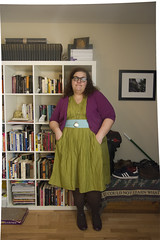
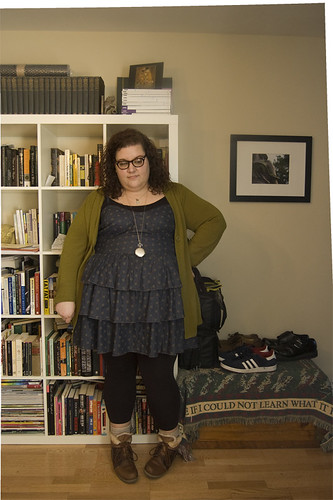
green cardi from Avenue’s $5 sale;
black leggings, I don’t remember;
woolen socks, ibid.;
pocketwatch from eBay;
sheepy boots by Maxine of Canada.

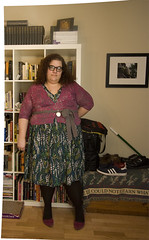
purple cardi from Torrid;
pale blue leather tie-belt from Viktor Sabo on eBay;
pocketwatch (standing in until I get a new battery put in my wristwatch), also eBay;
dark grey tights from Avenue (old);
dark purple ruffley flats from Target.
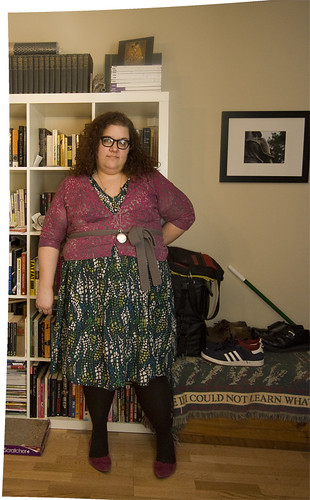
pink splotch-print cardi from Marshalls;
grey tie belt from another sweater;
black tights ?;
pocketwatch, eBay;
pink flats from Target.
“You don’t get to say that to me anymore”: Some thoughts on dealing with parents
By Lesley | February 11, 2010
NB: I am not a therapist. The closest thing I have to a credential in this area is my first Master’s degree, which was an interdisciplinary deal combining developmental psychology, family studies, and media literacy. That said, most of what I offer below is just old-fashioned personal advice, which is based on my own experiences as much as it is my academic background. Deploy my suggestions at your own risk.
One of the more common questions I get is how to deal with family when you’re trying to find a path to self-acceptance. Unsurprisingly, this is one of the most difficult questions to answer. Families are all so different. Some are wildly communicative, some are not. Some are close, some distant. All have skeletons and secrets. All have sore points and rough patches. But the finer points always vary.
We face a particular challenge here, because our families tend to know us best, and those who know us best are often those most resistant to big sweeping changes in our lives, our choices, and our identities. And it’s hard to make those changes when we’re dogged by the doubts and questions of the people who know and love us best.
This is a once-upon-a-time kind of story.
As a teenager, when I wasn’t wearing my school uniform, I basically lived in baggy jeans and my enviable collection of t-shirts for bands you have never heard of. It was a uniform that felt far more safe and familiar than the too-small skirt and blouse I wore to school, and it enabled me to hide the exact dimensions of the body underneath. I was a couple years into college and fat activism before I began wearing clothes that fit me. After my sophomore year, I lived in Boston full-time, and since then have seldom been in Florida for longer than a week at a stretch, in order to visit my family.
Things change when you have that much physical space between you and the people who brought you up; even if you continue to be emotionally close to your parents, as I was, you lose the day-to-day reality of seeing one another, the little habits, the inevitable changes: your dad’s hair going grey, your mom’s discovery of QVC, a favorite meal, a favorite song. I changed too — my nascent fat activism was only one example — but as I was there for the changes, and even orchestrated them, I noticed them less.
So it came to pass that on a trip to visit my father many years ago, I sat on the floor of his study (there was only one chair, and he was in it) and walked him through the use of some program or other on his computer. I wore one of those girl-cut tees, from Hot Topic’s new-at-the-time plus size line, and jeans. We finished, and as I stood up, my father blurted, almost like an explosion, apropos of nothing, “You’ve gained weight!”
I hadn’t, in fact — the jeans I was wearing were a pair that I’d worn in high school, and they were bigger on me now, but I was wearing a shirt that didn’t balloon over my body, and the rolls I’d always had were visible. I presumed even then that his comment was based on being able to see me, as much as it was on any perceived change in my size. But it wasn’t just the inaccuracy of the statement that got me. It was the tone. The tone with which these words were delivered was a deeply unsettling mixture of astonishment and accusation. It ripped through me like a rusty blade. Yes, it did, although by this point I was lecturing to undergrads about media representation of women’s bodies, and holding forth on fat acceptance in front of fifty students with nary a flutter of doubt. His words hit me like an unexpected wave, when I’d lowered my guard for just a moment, and carried me right back to my fifteenth year, in my dark bedroom listening to Tori Amos’ “Silent All These Years” on the local indie radio station, my ear pressed against the speaker on the boom-box, secure in the knowledge that I could never be happy, that no one could ever truly love me, that I would always be disposable and disgusting and isolated, until I lost enough weight. (Go cry, emo kid.)
I went into that old bedroom and closed the door. My husband — though we were unmarried at the time — was there. I sat on the bed and stared blankly into the air. D looked at me, and after a moment’s silence, asked, “What’s wrong?”
I explained. D told me I had to say something. “I can’t,” I whispered. He insisted. “I can’t!” It was a still a whisper, but ferocious, certain. Those words wouldn’t even form in my mouth. I couldn’t tell my father that this hurt me. It was an impossibility. I may as well attempt to flap my arms and fly.
D would not let it go. He assured me, repeatedly, that it was a thing I was capable of speaking aloud. And if I was capable of speaking it, why would I keep it to myself? And yes, why not try? What would happen? Would I be struck mute, never to speak again? Would the language come out all garbled, like speaking in tongues? Would lightning hit me and pin me to the floor? Few of us manage to escape the desire to please our parents, to make them proud of us, even those of us with the most troubled parent/child relationships. We have to navigate the tricky straits of being true to ourselves and the people we want to be, while still feeling afraid of our choices disappointing the people who raised us.
After a few minutes, I left the bedroom. I squared off in front of my unwitting father in the middle of the house. I told him that he had made a comment about my size, and I needed to talk to him about it. And then I said,
“You don’t get to say that to me anymore.”
I got as far as “don’t” before my voice broke and I knew I wouldn’t be able to avoid crying. I was embarrassed but let it go. And why not. Why hide that pain, why bury it now. It was like the dam that’d held it all back for so many years was failing, and instead of shoring it up, plugging the cracks, I brought my fist down and crushed the whole thing. I told my father that those comments hurt me, that they had always hurt me. I told him my body was not something he had a right to pass uninvited commentary on, and I didn’t care how normal this had been when he was just trying to help, when I was growing up as a fat kid who didn’t want to be what I was. I knew his intentions were pure; I knew he just wanted me to be happy. But it damaged me. It damaged me right down to my bones.
My father was shocked, I suppose, but bless him, he tamped down any defensive impulses and listened. Or perhaps he was just too astonished to do anything else. He apologized. I didn’t get into the nuts and bolts of body acceptance right then; it wasn’t the time. I finished my piece and I walked away. Back into my old bedroom. Back behind the closed door.
I felt, ironically, a hundred pounds lighter.
I don’t recall if I ever, aside from this moment, formally announced my intention to stop trying to lose weight. But this interaction opened the door. It would be years before my family would accept my acceptance, and it would only come after extensive conversations about my weight and my health and my happiness. It began because I stood up for myself for the first time; because I had a moment in which I couldn’t sit by and quietly swallow my rage any longer. I think we all have this point, where the pressure builds and we have to open ourselves up and let it all fly free.
I don’t have magic answers for dealing with parents; I sincerely wish that I did. So often the things that inspire these revelations to family are unplanned and unpredictable, like the story I relate above. How you handle these conversations will depend heavily on your relationship with your family and the dynamics you have in place. You can’t just talk size acceptance with the people that have known you this long; everything you say, on both sides, will pass through dozens of filters of experience and understanding, and neither you nor I can accurately predict how things will unfold. That said, I offer below a few basic tips for having these conversations in a productive way, if you think the time has come.
1. Be patient. It took you a certain amount of time and big thinking to come to the conclusion that size acceptance may be the best option for you. It’ll take your family at least as long to get there too. In most cases, parents’ primary motivations for everything they do are the health and well-being of their kids; in most cases, parents are trying their very hardest simply Not To Fuck This Up. It will take time for your family to assimilate any new perspectives, as they don’t have the same motivations you do — you may be spurred on to size acceptance because you believe that the prevailing thinking around food and weight is causing you harm, by cultivating disordered eating patterns, compulsive dieting, or low self-esteem. Your family cannot know what really goes on in your head here; they can only take your word. And convincing them can be a long-term process.
2. Know yourself, and know your reasons. Body acceptance is very attractive on the surface, and can seem like an easy fix for a failure to lose weight and the attendant self-loathing and insecurity that can go along with the idea that your body is a problem. But though it looks easy, unfortunately there’s nothing easy about it; it is in fact a long hard uphill slog, with the wind in your face and the peak you’re trying to surmount always masked by clouds. Arguably, it’s harder than dieting. Sliding back into old ways of thinking is always possible, all the moreso if you’re confronted with constant challenges and disbelief from people you love. If you don’t really know why you are doing this, and if you don’t really believe in it yet, then talking to your family about it is going to be much harder.
3. Know your arguments. Going into conversations with family fully armed with useful information makes these discussions go a lot smoother, and also means you’re less likely to feel personally attacked because you’ve been challenged on a question you can’t answer. Read Linda Bacon’s book, Health At Every Size; it gives a thorough, qualitative analysis of our traditional thinking around weight and health, and how it may be inherently flawed. Bacon uses the term “weight neutral” which I like a lot, as it describes this very different mindset around health in a succinct and direct way — we’re not talking about IGNORING health altogether, we’re just talking about dealing with the subject in a way that doesn’t privilege weight loss as a priority over everything else. If your family is particularly fat-phobic, and many families in which fatness runs in the blood are, then using terms like “weight neutral” may get you further than proclaiming your fatassery loud and proud.
4. Be optimistic. Your family loves you. At least, if you think it’s worth talking to them about this, then you are probably relatively certain that they love you. They want you to be happy and healthy and fulfilled. If they object to your size acceptance, odds are it’s because they believe it will negatively impact these three aspects of your quality of life. Also, be aware that individual family members may well be fighting internalized fat hatred of their own, and you may be unknowingly forcing them to confront feelings about their own bodies, feelings they’re not willing to analyze right now. They may be pushing back on you, but it may be as much about their own feelings and fears as it is about yours. Remember this, and be kind.
5. Be open to the possibility that your family may never understand your choice. That said, even in this circumstance you are within your rights to respectfully acknowledge their feelings while asking them to likewise respectfully acknowledge your choices about your own body, and not to harass you about them. Mom still pushing diets on you? Calmly and firmly explain that you are not interested. If she persists, set boundaries by politely excusing yourself from the conversation, and either ending the phone call or leaving the room. Explain to your family that while you can respect their position, for the health of your relationship you all need to come to some kind of truce on the subject, even if this means simply agreeing to avoid the topics that may lead to an argument.
In the additional-reading department, there was a wonderful article in the November issue of O Magazine (of all places!) that deals more specifically with weight struggles between mothers and daughters; you can read it here. I’d like to open the floor now for readers to share their stories and experiences working through these issues with parents and other family members. Do you have additions or subtractions to the above? Did you have a moment in which you “came out” as fat to your parents? What was your experience? Was your family supportive? If you’ve succeeded in forging a truce, how did you go about it?
 I keep thinking your questions are going to eventually slow to a trickle and then evaporate completely. This may yet happen, but it’s certainly not the case right now. Recently I’ve answered questions on everything from Rufus’ current status to whether I wear dresses to the gym. So, as usual, if you have a question, get thee to my formspring.me page and ask.
Today I’m reproducing two recent questions and answers. The first is notable as a representative example of the truly unimaginative trolling publicly-unapologetic fat people occasionally have to suffer. It’s nearly impossible to take such inquiries seriously, but I do make efforts to be civil and truthful.
The second, after the jump, is a long and rambly musing on marriage and Lori Gottlieb’s new book Marry Him: The Case for Settling for Mr. Good Enough, which may or may not make sense but which took me a very long time to write. The subject has probably been covered more coherently elsewhere, but these are my two four fifty cents.
Enjoy!
Q. Why are you so fat ? , its disgusting really .
A. I’ve only written about 100,000 words on this subject just in the past year alone, but since you’ve asked so thoughtfully, I’ll sum up: It was gnomes. Magical invisible fat-making gnomes.
My fatness was first hewn out of flesh from one of the gnomes’ sacred pigs (a majestic animal that was, alas, ritually sacrificed for this purpose), and then, after an arduous process of transubstantiation, I was given life and sent forth into the world for some mysterious as-yet-undisclosed reason, though my suspicions are that bacon is somehow involved. This is where all fat people come from, and having revealed these facts to you and the world at large by answering this question, I will very shortly be spirited away to the gnomes’ reeducation camp, if I am not hanged for treason. That is the truth.
So farewell, my fat-disgusted friend, I hope you appreciate my heavy sacrifice, as I appreciate the heavy burden you must bear in being forced to witness the fatness of all who waddle forth from the gnomes’ secret pig-sacrificing fat-person-building bacon-worshipping kingdom.
Even now I hear them at my door. My time is short. Farewell, farewe—!
Q. Have you read the article “Marry Him!” over at The Atlantic? http://www.theatlantic.com/doc/200803/single-marry What are your thoughts on it? I’m a single fat woman about to turn 30 and reading this has left me annoyed, but also a bit anxious.
A. Most of what I’ve read of Lori Gottlieb’s brand new one-woman campaign to destroy feminism (I am using hyperbole, here, mostly) has left me feeling nauseous at best. Because she is not entirely ridiculous; there is a point, buried deep in her creepily marriage-centric “settling” chatter, that is reasonable. The point, carefully extracted, is not to raise one’s expectations of marriage so high as to render them impossible to scale. I don’t know that this is the point she is intending to make, but it’s something we can take away from her work to quell the predominating queasiness.
I am, myself, a woman who got married at twenty-six, though reluctantly, as I’d never intended to be married before thirty, if at all. For me, marriage was little more than a legal formality, making “official” a relationship that we’d already decided was permanent. And it’s true I didn’t marry for “passion” or “intensity”… but this is not to say those things weren’t there, just that they did not factor into my decision to marry. I married because my husband and I make wonderful partners, we are best friends, we challenge each other, we check each other, we always drive each other to be smarter, we often drive each other up the wall. I married because it seemed logical to ensure legal protections for this relationship, given the opportunity, though the relationship itself was unchanged by the legal recognition. Marriage, for me, was less a romantic issue than one of making public and legally binding a promise to be full partners as we travel together through life (my husband often said back then, when people congratulated us on our new marriage: “We were married already. This was just signing a document.”). The promise existed whether we were married or not.
By way of example; several years ago the Massachusetts (where we live) legislature was debating an amendment to the state constitution that would ban gay marriage, which had been made legal via a supreme court ruling a year or two before. Fortunately, this amendment was voted down, but during the debate my husband and I emphatically agreed that should gay marriage be struck down in favor of civil unions, we would get divorced and apply for a civil union instead, as neither of us could live with the prospect of remaining “married” if “married” was a word of which non-straight couples were deemed unworthy. Like this, Gottlieb’s quandry is as much one of language as anything else; she seems to think you either date or are married, and if you are not going to marry the person you date, then you should date them no longer.
What a waste.
To some extent, you could argue that I did what Gottlieb proscribes, but to describe this as “settling”, in my opinion, betrays a profound misunderstanding of how marriages truly work, and what they are good for, and why people want them enough to risk their lives to fight for them. It would also be an unfair and needlessly vicious slam on my husband, who, while being far from perfect, is an amazing and wonderful person.
My husband and I didn’t have a wedding. We were married by a justice of the peace, who happened to work for the city, whose name I have long since forgotten, at our local city hall. No one was in attendance but ourselves. It was all paperwork, and when we said the words — they make you say the words, even alone, at city hall — it was sweet and moving, but only because it was a recognition of what we already had. It wasn’t the beginning of our journey. It was just a waystation on the road to somewhere else, somewhere more interesting and exciting than an early 20th-century city building with dark wood paneling and art deco stained glass where we once had a long piece of paper stamped with an official seal.
Gottlieb seems to be saying: this is the system. Just live with it. Do what they tell you. Don’t fight. Don’t question. Don’t carve your own path. And more than anything else, don’t wait. Gottlieb seems to be trying to speak about marriage from her own experiences as a single woman, and the experiences of the single women she knows. But Gottlieb’s lifelong failure to recognize marriage in, as its root, a personal problem. She and her single-lady friends are astonished to find themselves considering marriage as a primarily-practical matter, about sharing childcare and enjoying reliable human companionship, and not one composed chiefly of candlelit dinners and hours of intense conversation about the depth of your love. To me, this would indicate that Gottlieb just hasn’t talked deeply with very many married people in her life. Most of her revelations are things we all realize with age, and are not particularly brilliant or even insightful.
I will always say of marriage: If the person you’re marrying is not your best friend, you’re doing it wrong. Don’t bother. Don’t keep to the system, if it doesn’t work for you; change it. These rules aren’t written in books; they’re not compulsory or enforced. Marriage, ultimately, is just one option of many, for a life. Marriage alone, without a rooting in friendship and simpatico, it won’t make you happy, and it’s entirely possible to be lonely and married, and it can be a loneliness far more devastating than the kind you may feel when you’re alone. In fact, it won’t even make your life easier; it will make it more complicated, because decisions you could once make alone now require debate in committee. It will make it more frustrating, because even in the best relationships, the underside of having a spouse and best friend who knows you better than anyone is that they also know how to push your buttons. It will make it more heartbreaking, because your pain in life is doubled to include the pain of the person you love. All in all, marriage is not a cure for unhappiness. It’s hard fucking work. Not unlike raising kids, it can be extremely rewarding work, but for all Gottlieb’s expectations of shared household responsibilities, she ignores the reality that married couples don’t just fall into step with each other as if by magic; there are struggles and fights and occasional despair. A shared life means sacrifices, it means not always getting to do things the way you want to do them, it means having to put your own wants and needs aside in favor of your partner, now and again. We do this for children because we have to, in order to keep them safe and bring them up right; but we do it for a spouse because we choose to, eyes open, not because they will not survive without it, not out of obligation, but because this is what you do for a marriage.
Thus, don’t worry. Make friends, fall in love, be hurt, be adored, just take it all in and don’t worry about filing singly or jointly until the time comes, if you decide it should come at all. Your life is your life, and to paraphrase Neil Gaiman, it’s all you get. You make your choices, you have your regrets, and even married people have those, sometimes even about their marriages. For Gottlieb, it’s easy to look at married people’s yards and proclaim their grass greener from her vantage point in her lonely lonely yard. And that may be the case for her. But everyone is different. No one can tell you whether marriage is your goal, where your happiness will spring from, how many children will you have, will they be blue-eyed?, who will remember you and why, what to do in order to eventually lie on your deathbed, aged and glassy-eyed, sighing, “I’ve had a good life.” There is no universal prescription for your time on earth. Only you decide what and who you are, and with whom you spend it. And that’s how it should be.

“This week, on a Very Special Unstapled….” Trigger Warning: This week’s recap touches on both alcoholism and WLS.
Last week: Carnie is a giant fatass (though she says it like it’s a bad thing). Dallas tore through Carnie’s pantry. Carnie went back to work at The Newlywed Game. There was farting.
We begin this week’s episode with Carnie confessioning that she woke up this morning feeling as though her whole world was “wrong”. And if that weren’t bad enough, Dallas is here, and he’s wearing a shirt with the sleeves still attached. OH MY GOD now I feel as though MY whole world is wrong. Dallas, sleeves? Why?
They head out to the back deck with their yoga mats and begin the pre-workout stretching. Dallas asks Carnie if she’s been doing the workout without him. She says no. In fairness, in my experience, doing that kind of choreographed workout by oneself is boring at best. This makes it an exercise form very unlike, say, putting Lady Gaga on as loud as your neighbors can stand and free-form dancing around your living room in your underwear, which is a workout best done alone. Not that I would know. But following choreography without a leader can be frustrating and seriously unfun. (Here, I almost made a joke employing the word “CHORE-eography” but I have refrained. Be grateful.) At least with a DVD or something there’s a pretend-person there with you, shouting encouragement with a deranged smile.
Carnie says she hasn’t been doing the workout because she hasn’t got the time, which may in fact be true, but I maintain that if you’re doing a workout that you enjoy then you tend to make the time, just like we often make the time to do the things we really want to do, and the things that are most important to us. Dallas has picked up on Carnie’s propensity for complaining during exercise, and explains in confession that as soon as they began, Carnie was in fulll-on whine mode. “The first move we did, she started complaining immediately,” says Dallas. “I had her in down dog, a simple down dog.” That’s downward-facing dog to those of us who don’t say it frequently enough to require an abbreviation. As Dallas pushes Carnie into position and she groans, he tells her, “That doesn’t hurt you,” and she says, emphatically, “Yes, yes it does!” He calls her a liar, and Carnie gets angry and asks why she’d say it hurts if it doesn’t. And damn it, Carnie is right — her trainer shouldn’t be telling her if something hurts or not; he should be supporting her and trying to work with her to find a routine that she is happy with and wants to do, not working against her by forcing her into positions that are painful and expecting she simply ignore her dislike for her workout and do it anyway. You don’t get disgusted and disbelieving when someone says they’re in pain; you say, okay, let’s try something that doesn’t hurt you. Because exercise, contrary to popular belief, can actually make you feel good, really really good! But only if you’re doing something that works for you, and what works for you may be very different from what works for other people, and it’s just possible that nobody else will be able to tell you where you’ll find that exercise holy grail.
But what do I know? I’m not a former professional wrestler.
Dallas then says he doesn’t even want to finish the workout. Carnie’s all, “But we just started!” Dallas proceeds to make this all about him and his hurt feelings, guilt-tripping Carnie into just swallowing any pain she feels, or, as he puts it, “You have to breathe through that uncomfortable [bleep], and do the [bleeping] workout, or not!” Carnie says, “You’re being a little bit hard on me today,” to which Dallas sighs dramatically and rolls his eyes. Do they teach this kind of emotional manipulation in physical-trainer school, or is it something you pick up on the job? I have to side with Carnie on this one; I’d be wary of any trainer whose primary interest isn’t making sure you’re comfortable with every movement, as that personal trainer is going to drive a person further away from exercise, not closer to it. Guilt and shame may work to an extent as motivational factors, but they’ll never work as well as helping someone find their individual drive and desire to do the thing in question. Having said that, drive and desire come from within and don’t require a personal trainer on the payroll to maintain, but guilt and shame do.
Dallas’ hurted feewings aside, they move on. He keeps asking Carnie, with thinly-veiled sarcasm, whether this hurts, or that, it seems every few seconds. Finally Carnie says, “You’re making me [bleeping] crazy right now! Who [bleeping] cares, let’s just do it!” Dallas laughs at her. Laughs. At her. Carnie’s not laughing. Here’s an idea: trust the client to tell you when something is painful. Clearly Carnie has no problems whatsoever with expressing her discomfort. Let her tell you when something isn’t working. Bleeping hell.
Carnie then tells Dallas pretty much what I just said above: “You know me, if it hurts too much, I won’t do it.”
After her workout, Carnie’s late to meet Rob and Lola for lunch at some sandwich shop. Rob is frustrated and feels like they’re “low on her list of priorities” when she’s late like this. After a series of comments to his young daughter about how annoying it is that mommy’s always late, he gets sick of waiting, orders food for himself and Lola, and they start eating. Carnie’s on her way, apparently being driven to the counter-service sandwich shop by a car service, like she’s Edina bleeping Monsoon. She arrives, apologetic, and Rob is in full-on passive-aggressive snit mode. He doesn’t want to fight in front of Lola so he suggests they leave. Carnie confessions that it’s clear Rob is feeling resentful but he’s not expressing it to her. No shit, sherlock.
Carnie’s off to see DanielBrian at the salon. She confessions: “I don’t drink anymore, I can’t overeat, I have all these boundaries in my life and really the only place where I don’t feel those boundaries is at the salon with the bubbies.” She alerts 50% of DanielBrian to a patch of grey hair, and he’s on her with a coloring brush before we can blink. Carnie asks DanielBrian if he and DanielBrian would be willing to come to The Newlywed Game this week, as they’re having their first same-sex couple. Of course, because all gay couples are automatically interested in every other gay couple in the world, just like straight couples! Oh wait. Carnie identifies the gay in question as “the guy from Star Trek.” (link) DanielBrian says, “Who knew that he was gay?… Spock looks like the one that would be gay.” LOL.
Carnie’s back in the car, now being ferried to the studio to do a promo interview for the gay-happy Newlywed Game episode in question. As she’s prepped to go on camera, she makes mention of a “tiny penis microphone” which, okay, is funny. They’re both via satellite to some morning show, George Takei from New York, and Carnie from LA. They do their little morning-show dance, and again it’s impressive how tear-the-roof-off-the-sucker vivacious Carnie is in front of the camera. George Takei, of course, just talks in that amazing voice of his and I’m rapt.
Commercial. Oh, it’s the talking frosted mini-wheats. I seriously can’t eat that cereal anymore because the animated wheats in the commercial are so unbearably cutesy.
And we’re back. “Here we go for a pressure-packed day on The Newlywed Game,” says Carnie in confession. It’s Gay Day! Carnie confessions further: “I love gay men.” So much that she collected two of them! Oh, but I kid. Carnie and George meet in the hall at the studio, where George says something lovely about Carnie’s charm, and Carnie informs George that with his voice, he could say, “[Bleep, bleep, bleeper, bleepybleeping, bleeperbleeper, bleeped, bleep bleep bleep] and it would sound great.” It’s sort of a compliment.
Elsewhere Dee Dee and Carnie’s Mom are taking Lola out for a snack. Dee Dee confessions that they talked with Carnie about her desires to cut back on Lola’s sugar intake… and evidently they decided that respecting Carnie’s parenting decisions was a dumb idea, because they’re taking her to a frozen yogurt joint and loading her up on candy toppings. Carnie’s Mom says: “I want her to remember me as grandma giving her fun things, not just with a piece of celery or a carrot.” Huh. True story: as a child I was never big into candy. Even Halloween candy failed to hold my interest after the first day. But give me some celery or a carrot or a piece of green sweet pepper and I was yours til the rattle. It’s just possible that kids crave sugar and consider it “fun” because we give them so much freaking sugar. Dee Dee confessions that when Lola’s with her and her sister, “it’s kind of like our job to break the rules.” Great. Dee Dee and Carnie’s mom coach Lola in how she should lie to her mother about what they ate. I wish I was making this up, y’all, but sadly I am not. It’s seriously bleeped up. And then, as Lola is finishing off her candy pile, we get a shot of Dee Dee and Carnie’s mom looking at the kid all wide-eyed, like, OHNOES, WE GAVE HER SUGAR. They realize Lola will soon be bouncing off the walls. Carnie’s Mom says, “We’re in trouble!”
Dudes, I cannot fathom that there are people in the world this stupid — O FUN LET’S GIVE THE CHILD SUGAR… UH OH WE GAVE THE CHILD SUGAR! — so I am going to blissfully assume this is creative editing or something.
Back at The Newlywed Game, Carnie’s feeling amped. Also on this “celebrity” show, though not gay-coupled, are Peter Brady and his wife, and two random people from The Biggest Loser, of whom Carnie says, “God bless, I’ve been in their shoes.” The questions are rolling, and everyone’s laughing and having a grand old time. There’s a short shot of DanielBrian afterwards talking about how difficult the questions were: “We’ve been together 18 years, and I couldn’t answer some of them.” Eighteen years! My hat is off to you, DanielBrian! As an aside, I’d actually been feeling slightly guilty about calling them DanielBrian lately, as surely I should be able tell them apart by episode four, but then I see this shot and feel completely justified, as they really do look like twins. I have no idea who is who. Maybe if I could put an asterisk in Sharpie on one of their foreheads, but without that kind of help, DanielBrian it is and DanielBrian it’s going to stay.
On the show, George and his partner win, so yay for the gays!
Later, we’re back at Casa Carnie, which this week I learned used to belong to Tom Petty, and that Dave Grohl and the singer from Korn are neighbors. In this article, Rob also mentions seeing Mr. T shopping at Bed Bath & Beyond, and okay, so there may be SOME benefits to living in a house with a wall around it.
Carnie’s in the kitchen when Lola and Dee Dee and Carnie’s mom get back. Lola rips through the house like a tornado. Carnie asks where they went, and Lola, being a child psychotically high on sugar, immediately says, “Ice cream shop!” Dee Dee asks her to clarify what she really ate, I’m assuming by this she means the lie they’ve instructed Lola to deliver, but Lola, out of her mind on glucose, says “Candy!” Awesome. Then Carnie’s mom actually confessions, “Lola blew it.” Seriously. Are you fucking kidding me? It’s the child’s responsibility to lie more than it is your responsibility to make appropriate choices for her? Carnie confessions that her mom raised her and her sister “basically alone” and that she appreciates that, but seriously Mom. What were you thinking? Carnie’s mad, and understandably so. She confessions: “I want her to enjoy her time with grandma, I want her to have fun and have great memories, but they don’t all have to be centered around sugar.” I am actually with you, Carnie. Damn, alert the media!
Commericial. Wow, like three credit-counseling services in a row. I guess they know their demographic.
Carnie’s going over to DanielBrian’s place, which, merciful heavens, where the bleep do these guys live? It looks like a hotel lobby. It’s mammoth. There is a giant aquarium and enough sofas to seat fifty people. Carnie sits on one of the many couches with DanielBrian and before long starts crying. She misses Rob. DanielBrian is supportive and kind here, telling her she’s going through a rough patch, and is very sensitive, and finally Carnie sobs, “I really miss having a drink, bubbie.” And this is heartbreaking, unqualified. For those who aren’t familiar with the basics, following her gastric bypass surgery, Carnie became an alcoholic, and eventually went into rehab, motivated by her desire to start a family with Rob, and not wanting to do it as a drunk. What’s worth noting here is that there is a demonstrated connection between weight loss surgery and alcoholism. I’m not going to post links here because of the trigger factor, but if you’re up to it you can run a google search and get a plethora of links, many even from pro-WLS sites, warning against the increased risk of alcoholism post-surgery. There isn’t a clear answer as to why this is the case. Some argue that’s simply an “addiction transfer” from food to alcohol; some say that the surgically-altered digestive tract means alcohol affects you much more powerfully, almost on a level with so-called hard drugs; and some who’ve had the experience think that there is something as-yet undiscovered about the surgery that creates a craving for alcohol where one may have never existed before. There are loads of incredibly depressing personal stories posted online from people who claim to have never been drinkers in their whole lives, until after WLS, at which point they suddenly and inexplicably began to crave alcohol like nobody’s business.
I’m not going to get into this any deeper other than to acknowledge that this is yet another example of a potentially life-ruining side effect of weight-loss surgery that nobody talks about in our haste to cut up fat people’s bodies and try to make them thin. I am inclined to think that fifty years from now, we will look at weight-loss surgery in the same way we look at lobotomies today: with shock and horror, and wonder at how anyone could think that kind of destruction would repair a damn thing. (Apologies to my beloved friends who’ve had WLS, but my feeling on this is likely not a surprise to any of you, and is not a reflection of how I feel about you as an individual, nor a judgment on the very personal decision you made, but simply my thoughts on the procedure itself.)
Carnie cries, “I just want to have a glass of wine, and just escape… just escape.” Poor Carnie, man. She doesn’t feel like she can talk to Rob. DanielBrian tells her she needs to express all this to Rob and tell him she needs his support. He’s right, and it’s a good friend who’ll sit with you and sympathize while you cry and stress. Carnie pulls it together. DanielBrian says: “You’ve got a lot on your plate right now,” and Carnie responds, “And I wish it was enchiladas and donuts and chocolate… I’d eat the whole [bleeping] thing!”
Back at the house, Carnie is sitting on the sofa, looking at a picture of herself and her mom “when we were doing Hollywood Squares.” Rob comes in and she shows him the picture, saying, “Isn’t that pretty?” Rob nods. Carnie says, “I think I want to go back blonde.” Rob says he’s told her a million times that he hated her blonde hair. Carnie is says, “I feel like you were hornier when I had blonde hair,” but he doesn’t seem to hear it, or want to, as he keeps cutting her off mid-sentence. He says he prefers her hair brunette, or more natural. Typical guy. A note, to the single ladies in search of straight guys to date: straight dudes NEVER, EVER look at a girl and think, wow, she has beautiful hair! They will only notice when they DISLIKE your hair. Rob says that Carnie doesn’t listen to him.
Rob describes them as ghosts passing in the house, and Carnie beckons him to join her on the couch, which he does, stiffly (not THAT kind of stiffly). She asks Rob if he thinks it’s normal for people to not have as much sex after they have kids, and Rob says sure, it’s normal. Peaks and valleys. Carnie wants to see a sex therapist. Rob reluctantly says okay, though he thinks it’s a judgement on his “character”.
Commercial. Blah.
OH, they’re going to a sex therapist right NOW. Surprise! The sexy lady asks what they want to work on. Carnie feels unattractive to Rob, and, in fact, believes she is “physically revolting” to him. The sexy lady says “those are strong words!” and Carnie agrees that they are. Carnie has a tremendous amount of anxiety around sex, and man, that’s a hot turn-on. Rob says it’s exhausting to have to affirm Carnie all the time, particularly when he needs some afffirming too. The sexy lady asks them to imagine the “perfect sex life”. Carnie says Rob never comes on to him, and Rob says WHOA, no, I’m the only one who initiates sex! Carnie says they’ve “fizzled” and she feels “lost”. When asked what would happen if things don’t change, Carnie says she doesn’t like to think about that, and Rob picks right up on it: “What you’re saying is, if things don’t change, this is the end of our relationship.” Carnie’s all, well, I dunno, hey look there’s a vagina pillow over there. Hmm.
The sexy lady confessions in some zen-garden looking space that though Carnie SAYS she’s upset about the lack of sex, it’s about more than that, and feeling desired and loved, et cetera et cetera. Duh. Carnie just wants to meet halfway. As stubborn as these two are, I am not confident that this will happen anytime soon.
Next week: Carnie talks about her dad, and in a clash of reality shows, gets a tattoo from Kat Von D, or at least someone who looks like her. Til then.
This week’s poll results:
The question was…
Would you buy a Carnie-Wilson-branded vibrator?
No, 36%
EXCUSE ME?, 35.6%
This poll offends my delicate sensibilities, 13.1%
Maybe, 9.9%
Yes, 5.4%
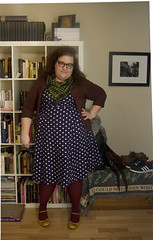
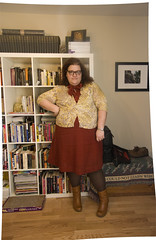
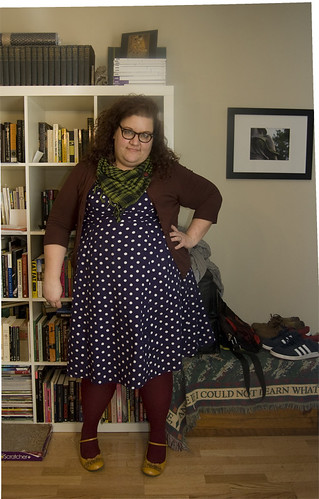
brown cardi from Marshalls
(FINALLY DO YOU HAVE ANY IDEA HOW LONG I HAVE BEEN LOOKING FOR A DECENT BROWN CARDI);
green & black plaid scarf from Marshalls;
burgundy tights from We Love Colors;
yellow flats from Target.

(I’m really sad they discontinued this style, and didn’t make it in more colors);
yellow snake-print cardi from Marshalls;
brown tights from Avenue;
boots (discontinued) by Dansko.
It’s Friday, kids, and that means it’s time for another installment of Kirstie Alley’s Twitter Wisdom! This week Kirstie gives us choices, and muses on the nature of power and oppression.

Kirstie demands you choose.
The saga continues… after the jump.

Kirstie demands you choose some more.

Choose! (Apologies, but… green or blue avatars? What does this mean?)

Kirstie reveals her selections. I certainly would have pegged for a coyote person, so this is revealing.

Kirstie on freedom. (I struggle here not to make a “one thousand monkeys at one thousand typewriters” joke.)

Kirstie on oppressive regimes. For context, Kirstie’s teenage daughter also has a Twitter account, and she has lately been suffering harassment from trolls, which is categorically not okay. Though Kirstie has plenty of trolls of her own, her responses to the people contacting her daughter have ranged from the vague references above, to just short of outright death threats.

Kirstie demonstrates mercy. Mites have rights too.

Or maybe have sex with an angel and accomplish both. I don’t know.
In other strange pop culture connections, this week Kirstie exchanged tweets with Dan Cortese, who was in Italy for some reason. (Being unemployed? Who knows? Regardless, he’s in Italy and I’m not, so my snark here is blunted.) Some will remember Dan Cortese as the host of MTV Sports in the 1990s, but I remember him chiefly as the Burger King spokesperson on those inexplicably annoying “BK TeeVee” commercials, also around the mid-90s, for which I have never been able to muster forgiveness, either for Cortese OR for Burger King.
Don’t know what I’m talking about, young whippersnapper? Oh, the magic of YouTube for preserving ephemera that would better be lost forever in the ether.
The questions keep coming, and I am trying my best to provide my own plucky brand of homespun wisdom and advice. Want to join the conversation? Click over to my formspring.me page and read the 75 mostly-anonymous questions and answers I’ve posted so far, or ask me a question of your own. Below, I answer a recent question about size and space.
Q. How can I reconcile taking up more space? The hardest part for me, and what can easily derail my day, are the bus rides to and from work. My esteem can be pretty well massacred by the realization that people don’t want to have to be near me.
A. The issue of space — and how much space we’re individually entitled to, and how some folks resent our taking more than our so-called fair share — is so common, and it’s unavoidable for any of us who use publicly-shared transporation, including commercial air travel. I used to joke that if I wrote a fat memoir, I’d want to call it Adventures in Space, because so much of being a body of a certain size in public is about negotiating spaces that are sometimes just too small for us. Booths in certain restaurants, squeezing between clothing racks in a store, theme-park rides: all of these represent scenarios some fat folks have to think about a lot harder than smaller people. And I know, all too well, how a bad experience on the bus or train can ruin a morning, or a day or a week.
Here are some tips in list form:
1. It isn’t about you. It’s not. The people throwing shade your way don’t know a damn thing about you; they’re blinded by their own assumptions, which say more about them than about you, by far.
2. Or, it IS about you, but not how you think. I fly several times a year, and occasionally find myself on not-full flights. More than once I’ve had a seatmate rocket to an empty seat next to a smaller person, and had to fight the urge to take it personally. Until on one flight, a woman seated next to me asked a flight attendant if she could move, and before she did, she paused to tell me, very kindly: “I’m not moving because I don’t want to sit next to you, but I think you will probably be more comfortable if I do.” Oh, I almost cried! It was such a simple, judgment-free acknowledgment of the limitations of space on an airplane. It’s cramped. It’s uncomfortable even for smaller people, and worse still for those who are fat or tall (or both). Assuming that everyone is looking at you with disgust will only make you feel badly, and more than that, it’s probably not universally true.
3. Even if you are getting legitimate bad vibes from someone, you cannot, in the moment, amend the space you occupy. In other words, you canna change the laws of physics, captain. You will take up the same amount of space whether you are anxious and uncomfortable, or relaxed and unapologetic. Remember this and try not to get bogged down in those negative emotions; they don’t help the situation, and only make you more self-conscious. Some people will project their own expectations onto you no matter what you do, but you don’t have to soak them up; they may impose negativity on you, but that doesn’t mean you have to accept it. Wear headphones, read a book, tune them out, live your life.
Never regret the space you take up. Occupying space is an inexorable part of existing, and regretting it or feeling guilty about it can take a tremendous and exhausting emotional toll over time, as you are, in essence, allowing yourself to feel badly about being in the world. The stranger on the bus who might make you feel badly will likely forget the encounter as soon as he or she gets to work, if not sooner; you shouldn’t carry it around with you either. If someone doesn’t want to be near you, focus on the bright side, remember who you are, and that you’re more than what they see… and enjoy the extra space.
Oh, this is just what I needed today. As a counterpoint to the extreme self-consciousness of famous fat ladies like Carnie Wilson and Kirstie Alley, below is a clip of the always-wondrous Gabourey Sidibe talking about her Oscar nomination on Good Morning America.
Gabby is a treasure because she is completely at home in herself, at least she is now, and I hope she will continue to be in future, and I hope she has a fantastic career regardless of her size. She is entirely human, and she is normal enough that I feel enabled to call her “Gabby” like I know her personally, which I do not. Her enthusiasm is infectious. We want to root for her not just because she is the underdog — though she is — but because she is so like us, or like a family member we love, or like a friend we don’t see often enough. We want to root for her because some people are so astonished that anyone who looks like Gabby could possibly have any depth that they witlessly confuse the actress with her character. A nigh-universal assumption about fat folks, especially fat folks who are also not white, is that they’re all unintelligent, unhappy, pathetic, and pitiable. Though the character of Precious may, on the surface, be seen by some as fitting these descriptions, the actress Gabby does not. In fact, it’s nearly impossible to watch her as herself for more than a few seconds and seriously argue that she’s any of the above. What’s fascinating to me is that while the role and the character she portrays may not do much that is new for cultural representations of fat folks, especially fat folks of color, Gabby herself, just being herself, talking on late night television or popping in on Good Morning America — she is, individually, a revolution.
When I talk about representation, what I mean is the predominating picture that media paints about certain marginalized groups. When I say “marginalized”, I mean those people who don’t get “normal” roles in the television and film worlds that govern so much of our discourse, but instead get stereotyped or caricatured. The fat best friend of the (thin) heroine. The disabled person who inspires the (able-bodied) hero to do good. The black dude who tries to rob or rape the (white) heroine. The poor stranger who gives perspective and bequeaths the wisdom of poverty to the (well-off) hero. And it goes on. These stereotypes are generally presented in contrast to the protagonist, and it’s the protagonist with whom we’re expected to identify, while the supporting pieces serve their purpose to draw the hero out, to make him a deeper character without having any depth of their own. Precious is unusual in giving us a main character so different than what we’re accustomed to, and challenging us to relate to her over the course of the film. Even when we don’t want to. Even when we’d rather turn away, like we would if Precious were a living person on the street, and not a comparatively safe image on a screen.
Gabby, however, takes this further by not only making us want to relate to her as an actress, in opposition to our comfort level, but by also being, herself, a contradiction to what we expect fat black women to be. She is smart, engaging, funny, and above all, charming. I keep reading folks acting like Gabby is the rarest jewel on earth, that nobody else in the world could possibly look like her and have even a tenth of her self-confidence and appeal.
Bullshit.
Gabby represents me. Gabby represents my friends, people I know and love, first-person, real world. Gabby represents a lot of us that our culture and our media don’t believe exist; we are fat unicorns, frolicking in fields of candy flowers, having the unfathomable gall to be happy and enthusiastic and funny and real in a world that demands we be apologetic, and shamed, and chastized, and isolated. My heart bursts with joy when I see this woman on the television because, yes, I feel recognized, and I feel validated. I’m here. I’m real. It’s a miracle. It’s a bloody fucking miracle of impossible proportions, more than I expected, now, ever. How can this be happening? It is.
There I am. There she is.
Over the weekend, the lovely and talented Joy Nash left a comment on the Kirstie Alley’s Twitter Wisdom post that read, in part:
“Your posts are forcing me to see her humanity and I don’t like it one bit.”
Here, Joy has said something in a few words that would have taken me pages to explain. I want to take a moment to explain my approach to being so hard on fat celebrities, whether it’s via extreme satire, snarky recaps, or simply being a smartass in my usual way, while still trying to recognize that humanity.
The really real reality is that famous people are still people. They’re simply people with an audience, and occasionally with very strange lives. (Not to mention houses with walls around them.) They’re not evil, nor are they sainted; they’re just flawed, conflicted disasters like the rest of us, trying to get by on their love of performance. And that’s not something to be ashamed of, even when the media they make is terrible. They’re following their dreams, and being willing to do so publicly is admirable.
To be precise, I don’t think Carnie Wilson is a bad person. I don’t think Kirstie Alley is a bad person. I am rather made deeply sad when otherwise smart, outspoken women are laid low by body hatred. And sometimes, I have to laugh at things so I don’t cry. Hence: the snark. It’s easy to look at celebrities who frequently spout body-hating garbage and think they’re merely perpetuating a system of fascist beauty standards that hurt far more people than they benefit, and that’s true. But famous people struggle like the rest of us, if not more, because their exposure is that much more dramatic. It’s one thing to have your mother or your significant other give you a hard time about being fat; it’s something else entirely to hear it from TMZ.com, or to have it impact your ability to succeed in your career. Does that mean famous folks get a free pass? Fuck no. I can’t speak for everyone, but they get more scrutiny from me because they have a voice that reaches more people, and thus has the capacity to change things more than the average person. It’s true they don’t have a responsibility to do so, and it’s their right to do whatever they want with their bodies, but I also have a right to be angry with media figures who choose to actively support and distribute ideas that I believe are deeply damaging to the rest of us. It doesn’t mean I hate these people; I don’t know them enough to hate them. It simply means I’m holding them to a certain standard, even knowing I’ll be forever disappointed.
Carnie and Kirstie and a million other nameless women like them are living with blinders on; we all thought there was no alternative to hating ourselves, to deprivation and self-loathing and misery, until one day we discovered otherwise. Some people find new ways of being through friends or acquaintences, on the internet, or by accident. They randomly, or bravely, pick up a book that uses the word “fat” in novel and shocking ways, and lots of other words, in contexts and implications they’d never before considered. Some people see a confident fat woman performing, in a play or a song or a television sitcom, and they suddenly realize she is amazing, and they realize they can also be amazing. And some people see the light on their own; they get so fed up and so angry that one day they open their eyes and where once there was a long, dark corridor running in only two directions, fat and thin, that there is instead a vivid and multifacted three-hundred-sixty-degree universe all around, shimmering with infinite diversity and infinite possibilities, and they see that the fears that were shackling them to sadness and self-loathing are just wisps in the wind. What is the worst part of being fat? Hating yourself. Stop hating yourself, and being fat—or just not being thin, or just being in your body, whatever your body may look like—becomes a routine experience. When you hate yourself, you will always find things to hate; no matter how much weight you lose, you will never be satisfied, because the person you are will not change. It is necessary to accept ourselves for any of us to develop real security and self-esteem. It’s only through acceptance, of all our lives’ changing circumstances, internal and external, that any of us will find our happiness.
So remember this, whenever I’m viciously skewering some fat-hating famous person on the end of my invisible internets-pen: I’m doing it because I expect more from people with this kind of cultural power, because I want everyone on this whole bloody planet to find a peace with themselves that doesn’t rely on a number on the scale. It comes from a place of hope, and not hatred. Think of it as tough love, and I’d do no less for anyone, no matter who they are.
Here’s a shocking confession: I don’t really watch much television. There are but a few shows I follow methodically. Mad Men. Sons of Anarchy (SO underrated). Also, So You Think You Can Dance, when it’s on (when is it on next?). And there are other shows I watch when I happen to notice them. Man vs Wild, because Bear Grylls is completely off his kit and I’m fascinated that someone gave him a television program. The Universe and those crazy Planet Earth series in HD, because they’ve practically got narcotic effects. Sometimes Family Guy. My husband is a huge fan of Metalocalypse so I wind up seeing lots of that — actually, I should say, I wind up seeing it over and over again.
I think that’s about it.
This is all to say that my lack of television-exposure is useful in writing these recaps, as I am able to point out and laugh at things that might blow right past those who watch this stuff on a routine basis. But it also has its drawbacks. By the end of the More to Love recapping extravaganza last year, the concept of spending another hour in front of the TV taking notes was almost unbearable. To give a sense of my so-called process: each episode of Unstapled is thirty minutes long, with commercials. Subtract the commercials and you get, what, twenty-three or so minutes of show. It takes me between 90 minutes and two hours to recap, with the resulting post being around 3,300 words. The hour-long More to Love was a horror of even more ludicrous proportions, requiring between three to four and a half hours of watching and writing for each recap (usually spread over two days), which averaged around 5,000 words apiece. I do this for free. Why do I do this for free? I have no idea. I am sick in the head. Also I love writing, for any reason, which itself may qualify as a form of head-sickness. It’s true that if I had an editor (and I’m sure some of y’all wish that I did) the results would likely be shorter, but I’d still write them first in their original long-ass state.
Also in meta news: Unstapled is repeated about twenty times in a single weekend, clogging up my DVR like a dead rat in a drain. It actually caused my DVR to delete a bunch of episodes of The Universe I was saving for the weekend, so to speak. It’s as if Unstapled is forcefully trying to take over my already-limited TV-watching life.
And because some folks have asked, we have confirmation that “the staples are intact”. On the Bonnie Hunt Show:
This short interview was very illuminating for me, not so much because it says anything earth-shattering, but because it’s broadly illustrative of Carnie’s appeal. For all of her random ambitions, the truth is that Carnie does nothing so well as she does being herself, which is an extraordinarily relatable, likeable, and sympathetic person. I’m not saying this to be mean; I think that possessing that indescribable human magnetism is a tremendous gift, and putting it to work for you takes a lot of smarts. But the only potentially high-profile careers it can net you are talk show host (check), reality TV star (check), and possibly life coach (I anticipate this will eventually happen, once Carnie discovers the internet, or more specifically, Twitter).
But enough procrastinating: on to the episode.
Previously: Carnie spends too much money. That’s basically it.
As the episode begins, Carnie and Rob are taking Lola to the park. Carnie confessions that there’s been a lot of tension between her and Rob and that it’s only going to get worse as she begins her Dallas Regimen, and her job on The Newlywed Game starts back up. Rob runs around on the grass, playing with Lola when Carnie’s iPhone rings (her ringtone is the one I use for my morning alarm, so for a moment I think I’m dreaming this… if only). Rob wants Carnie to come “do some stretches” or reinvent yoga with him and Lola; on the phone Carnie says, “Well, that means I’d have to bake tonight. I’ll do the best I can,” while frowning.
Carnie explains via the magic of confession: “Right in the middle of my precious family time, my manager calls with an order from Sweet Harts!” You know, even though “confessional” is the Reality-TV vernacular for these interjections, Carnie’s version is very much not your traditional version. She is styled and coiffed and made up. There is no crying. She talks like she’s doing a voiceover on The Wonder Years, only without the clever self-awareness. It’s all simple exposition and no emotional revelation. And the perk is way over the top. It is actually a perfect example of how this show fails: it’s too polished, too controlled, and it feels like we’re seeing nothing that Carnie is not explicitly comfortable with. This may not be the case, but it sure seems that way. Her problems and imperfections may be real but in this context, they feel scripted, like everyone already knows how this series is going to end, everything has already been written and they’re just playing it out. Television may be like that, but life is not.
Back at the park, Rob is trying to get Carnie off the phone, much to Carnie’s annoyance. Rob, who confessions more in the traditional vein, is pissed. When Carnie finishes her conversation and tells Rob she has to bake tonight, he’s even more pissed. They have some tense “family time” at the park and then it’s back home so Carnie can pull a bread pudding out of her bum. Not literally. We hope.
The following scene accomplishes the totally unexpected: in the space of about ten seconds, Rob takes all the sympathy and likeability he’s built up with me thus far and first sets it aflame. Then he casually pisses on it.
We cut to him and Carnie standing awkwardly somewhere in the house: a hallway? Again, it feels totally staged. Rob says, apropos of nothing, “What happened when I walked around the corner, the other night? I looked in the kitchen, and what were you doing?” Carnie responds: “I was eating cheesecake. I know.” Rob’s giving her a thinly-disguised guilt trip, and Carnie confessions that she was caught with her hand in the cheesecake jar at midnight. Yeah, we figured that out. So, as “punishment”, Rob is “making” her get on the scale. OHO, me hearties, you read that aright. Fuck you, Rob, and fuck your idiotic hair as well. Carnie climbs aboard the doctor’s-office scale and closes her eyes while Rob adjusts the slider-things. He says, “Oh my god,” which, seriously, if it were possible for me to punch someone though the television, Rob would be unconscious on the floor right now. Carnie says, “WHAT?” and opens her eyes. She’s gained five pounds. WOE. WOE AND MISFORTUNE. LET US REND OUR GARMENTS, MORTIFY OUR FLESH, AND WAIL AT THE UNTHINKABLE TRAGEDY. Carnie wails, at least, but moments later she’s back in the kitchen baking. Evidently they have a dog, which I hadn’t noticed before. It looks like either a Boston terrier or… that other breed of dog that sort of looks like a Boston terrier. A French bulldog?
While Carnie bakes, she trips that she’s only got a few minutes to finish and clean up (i.e. hide the evidence) before Dallas and his lady nutritionist friend turn up to begin the arduous process of whipping her into shape. “Wacky” Aunt Dee Dee is on hand to help, except she can’t figure out how to work the oven, and I feel justified at this point to note that I feel Dee Dee’s “wackiness” has been oversold. Carnie says “today is my last day for sugar” and she’s going to “milk it”. Then she tells us she’d bleep her bread pudding if she could. Again, she doesn’t say bleep, but this is what the show says, and frankly the thought of anyone fucking a bread pudding is distasteful enough to me that I’m just as happy to hold on to “bleep”. If you want to test Rule 34 you can do so on your own time.
Courtesy of the editors, they finish everything in time. Once finished, Carnie tells Dee Dee, “I’m going to pray, and then use my vibrator, and feed Lucy.” She can barely get “and then use my vibrator” out with a straight face. I can certainly appreciate the merits of battery-driven self-love, so I really want this comment to be charming but it feels weirdly exhibitionist to me. Plus, there is no word on whether it’s a Carnie-Wilson-branded vibrator prototype. (For the record: I would absolutely buy a Carnie-Wilson-branded vibrator.)
Dallas is in the front yard! Shit! And he is attended by a high-breasted woman who is also nine feet tall! When Carnie called her “hard-bodied” I didn’t know that was what she meant. Dallas tells us, “Today is phase one of Operation Carnie.” Wow, what with the dramatic music and all I’d expected him to come up with something more impressive than “Operation Carnie”. Dallas is sleeveless, in case you were concerned about the state of his upper arms. He and Nameless Nutritionist Lady enter the house with bags of groceries, and Dallas front-yard confessions: “You’ve gotta attack your opponent, and Carnie’s enemy is the empty calories that come from gluten.” OH, we’re going that way, are we? “This,” Dallas tells the front yard, with stock high-concept action-movie-trailer music raging in the background, “is what I call a Pantry Raid.” Dallas acknowledges this will be an attack on Carnie’s privacy, which he knows will be a problem for her, and the irony of this cannot be overstated. Oh what the hell: THEN MAYBE CARNIE OUGHT NOT TO HAVE A REALITY SHOW. Dallas tells us, “Gluten is the enemy, and especially for her, because she’s allergic to it.” I am not sure if Carnie is legitimately allergic or if Dallas is one of those people who thinks everyone is automatically allergic to gluten. If Carnie indeed has a legitimate gluten allergy and she’s not tending to it, then maybe she does need a ridiculous overtanned undersleeved nine-foot personal trainer to help get her shit under control.
The shots of Carnie’s pantry are… impressive. I try hard not to judge other folks’ kitchen stores, as that would make me no better than Dallas, and it’s possible they’re only showing us the “bad” food, or that the “bad” food is stunt food added to the pantry for dramatic effect. There are donuts and cookies and lots of candy. Dallas tells the front yard Carnie wants to “ease into” this change, to which Dallas says, “I used to be a professional wrestler! I don’t ease into anything!” I would love to say my response to Dallas is something constructive, like I want to punch him in the groin, but he just makes me sad. All of this makes me sad. Carnie has a pantry of forbidden foods because she’s spent a lifetime half on restrictive and punitive diets and half as a nutrition-damning free for all. Dieting doesn’t teach us how to eat appropriately and healthfully; it teaches us to ignore our natural hunger cues. And we learn it so well that many of us spend the rest of our lives with food as an enemy, and not as a pleasure, and with no appreciation for its use as fuel for the awesome things our bodies can do, and how different foods make us feel. Carnie may feel like shit all the time because she’s subsisting on food that makes her feel like shit, but she can’t even see that because her concepts of hunger and craving are so very fucked up.
Dallas is going to put a lock on her pantry. PSYCH! Okay, no he’s not, so long as she doesn’t “cheat”. Commercial.
It’s morning, and Lola comes into the kitchen for breakfast. Whenever Carnie sees Lola she puts on this super-happy high-pitched talking-to-children voice that is totally insane; it’s the voice some folks use when they don’t spend much time around kids. Lola wants chocolate chip pancakes for breakfast. Carnie explains they’re “going to be eating a little healthier right now,”—right now?—and proceeds to ask Lola what foods are healthy. Lola responds with egg whites, and vegetables. Carnie makes her egg whites for breakfast, with some fresh strawberries on the side. It looks really delicious, though I’m imagining the yolks and all their yolky goodness have not been wasted. Lola’s not particularly interested, and both Carnie and Rob are surprised when she tries repeatedly to leave the table. Sigh.
Oh yay, Dallas is here, for Carnie’s first workout in “ages”. They meet in the back yard with some workout mats. First, though, Dallas wants to measure Carnie. Or, Rob’s going to do it. Carnie, aghast, says, “How many wives would let their husbands measure them?” Can I see a show of hands? Mine is up. I’d file that in the “Who Fucking Cares” department. Carnie fails to understand that it’s really mainly women who give a damn about numbers as applied to bodies, whether they’re inches or clothing sizes. In fact, most straight men have no idea what a women’s clothing size even means. It’s like a different language. Rob underscores this by telling Carnie, “I see you naked every day, so just relax. You think adding a number to it is going to make a difference?” This is sane advice, but I still hate Rob and his stupid fucking hair. Carnie threatens to “barf, then cry.”
Okay, let’s document some numbers, kids! Actually I’m going to make this a competition. Carnie’s bicep is 17″. Mine is 19″, so I win! Carnie is horrified. Moving on to her bust, she reminds everyone “I’m a D, and I have implants!” Uh, okay, so this is a situation in which bigger is okay? Her bust is 47″. Mine’s 52″, as a B-cup and WITHOUT implants, so I win again. I think I should get a bonus point for my bust-fatness being all-natural. Carnie calls her bust “the only measurement I am proud of”. Moving on, Carnie’s waist is 51″. Oh shit, we’re tied! We don’t move on to the hip or calf measurement, which is a disappointment. At one point during the measuring, Carnie says “I’m so brave!” and my husband, who can barely restrain himself from shouting in disgust whenever Carnie speaks, tells me, “THAT’S not brave! What YOU do is brave!” Aww. Good husband.
The workout begins with some vague stretches and proceeds to what looks like Tae-Bo. Rob is working out as well, as a gesture of support, so Carnie knows “she’s not doing this alone”. Ugh. Dee Dee is present but not working out, and as Dallas, Carnie, and Rob punch the air furiously, she wanders over the to trampoline (DUDES FOR THE RECORD IF I HAD A TRAMPOLINE I WOULD JUMP AROUND ON IT EVERY DAMN DAY OH MY GOD), climbs on, and bounces a bit. Eventually Carnie, with barely-restrained exasperation, asks her to stop, because it’s “distracting”. Dee Dee goes inside and the workout continues. Pretty much every movement Carnie makes seems to cause her pain, including lifting an arm, if her constant outbursts are to be believed. She grimaces and looks entirely miserable. Hey Carnie, lots of things count as exercise, you know. There is bound to be something that doesn’t make you look like you’re going to cry. Once the punishment is over, she’s quite cheerful and thanks Dallas profusely.
Dallas leaves and Carnie and Rob go back inside the house, only to discover that they have some free time. They plan to meet in the bedroom for some hot longtime-married-couple sex. Rob goes to check the baby, who is napping. By the time he gets into the bedroom, Carnie is sound asleep. SAD TROMBONE. NO SEX FOR YOU.
Commercial. Hey y’all, Nutrisystem turned Marie Osmond into a slightly-more-slender bewigged horror! Impressive!
It’s Carnie’s first day back at The Newlywed Game. She makes a big deal out of seeing herself in a mirror with no makeup, when, seriously Carnie, if you’re 40 years old and your skin looks that good, you get down on your knees and praise the deity that made you thusly. Later, they put a ton of bronzer on her. Must be a TV-makeup thing. Carnie gets a visit from her executive producer, who apparently is some kind of huge game-show bigwig. He wants Carnie to be more dynamic, which means leaving the podium sometimes, and he has higher expectations of her this season. Right before hitting the stage, Carnie has another fart announcement, and again she toddles off to let it rip and dramatically wave her hand around behind her butt, ostensibly to disperse the smell. Whoa, maybe this is related to the referenced gluten allergy? ALL OF THE PIECES ARE FITTING TOGETHER. This is just like the end of Pulp Fiction. We then get a montage of Carnie doing her job, over which she explains that even though it looks easy, it’s pretty hard work, having to be “on” for fifteen hours a day. This I believe. She claims to love it, though, even though she feels completely overwhelmed and exhausted.
Rob is at home taking care of the kids, which involves playing guitar and singing. He is concerned about Carnie. “She’s not in any shape to stand on her feet or think on her feet for five episodes in a row,” he confessions. “It’s kind of like I’m a dad to her, as well as to the girls.” Hmm.
Back in the studio, during her final episode of the day, Carnie is “getting physical” by leaving the podium, and while she feels like she’s really connected with the audience, she’s wondering if she connected with the executive producer, who’s watching backstage. Commercial.
Carnie’s boss is, in fact, impressed with how she’s stepped up to the plate. Carnie gets home and is happy and vibrant and tired but adrenalized. Rob wants her to rub his shoulder and it looks like we get a second chance at The Sex. Carnie is massaging away, and then the cameraman has a prescient moment which inspires him to swing the camera over to the hallway leading to the kids’ bedrooms. AFTER he does this, Lola comes around the corner complaining of a bad dream, though she certainly doesn’t seem like a kid who’s either a) had a bad dream or even b) just woken up. In fact, she seems totally wide awake and undisturbed. Even her hair looks unslept-on. BUT THIS IS NOT STAGED, YOU GUYS. Carnie confessions, “When your kid has a bad dream, your whole world just stops.” They take Lola to bed with them and read her a story. I think this is supposed to make moms everywhere go OH WOW IT’S JUST LIKE MY LIFE! The end.
Next week: Dee Dee tempts Carnie with candy; the original Mr. Sulu is on the Newlywed Game (I am VERY EXCITED about this); Carnie tells DanielBrian (looking more tanned than ever) that she and Rob need “help” in “the sex department”; Carnie sobs about something unspecified (FINALLY, we make with the crying!). No word on whether there is more farting, but let’s hope for the best. Oh hai, reality.
This week’s poll results:
The question was…
Publicly announcing and theatrically releasing intestinal gas:
Never, 53.2%
Sometimes, in the company of close friends or family, 35.9%
Sometimes, in circumstances not listed above, 5.9%
Hell yes! I do it all the time! 4.5% (bless y’all)
Sometimes, if I’m drunk, 0.5%
 Two Whole Cakes is a blog written by