Last night I took my opa to see the Manitoba Opera’s production of La Traviata which translates loosely to something like “The fallen one,” referring at once to the protagonist Violetta’s courtisan past and losing battle with acute tuberculosis.
According to this article, opera execs/producers would also like the “fall” or decline to apply to the–specifically female–performers’ numbers on the scale.
(Can I just say how annoying it is that K. Prokosh feels the need to document her only drinking a glass of water? If I ever get famous I will do an interview where I dress up in some sort of victorian scuba gear (you know, with the the big giant fishbowl style helmets) and bring a bag full of crazy-ass food. throughout the interview I will pull out a whole ton of disparate “eats” like zoodles, celery, a zucchini, a thirty pound wheel of cheese, an entire baguette, several live parrots, turkey in a roasting pan etc etc out of the bag just to mess with the whole “this is what the interviewee is wearing/eating” trope of much body-policing and stupidity that is apparently now a prereq when you interview a woman in this patriarchal culture. Gag).
My opa–a lover of all things opera–is losing his eyesight (he has glaucoma & macular degeneration) so I pinched & scrimped & got together enough coin to get us amazing seats so that he could actually take in the performers. We were in the 4th row behind the orchestra pit, so close that I could see every sparkly bit of embroidery on the lavish costumes, the nuances of the performers’ facial expressions, actually hear their sharp intakes of breath.
Yali-Marie Williams, the fast-becoming world-class soprano who played Violetta, was FUCKING BREATHTAKING. The combination of her voice and stage presence actually caused my whole body to break out in goosebumps about a dozen times. While I do enjoy classical music/opera (often ambiantly while I’m cleaning house or you know, sitting down to a lavish ten course dinner with other like-minded uppercrust socialites like I like… a ha ha ha right, to the whole latter and “cleaning house” part of the former). I am definitely not one of its fierce and passionate champions. Believe me when I say that had we ever met in person Theodor Adorno and I would likely have come to blows over the snobbish classist tripe he wrote about popular music (as opposed to classical music)in his infamous screed “On Popular Music.” Believe me when I say that I didn’t expect to love and thoroughly enjoy La Traviata, but I did and it was completely owing to the talent of this exceptionally compelling and absolutely gorgeous Soprano whose ferocity had me completely smitten like a kitten after she belted out her first note. I actually only found this article because I was so taken with her that when I woke up this morning I commenced e-stalking her like mad googled her to learn more about her career & future engagements.
This woman is the sort of talent I get all starry-eyed and tongue-tied over. If I ever met her, I’d probably collapse into melty pile of groupie goo at her feet. She has MAD VOCAL CHOPS. I mean, christ she a won a competition that landed her a singing gig with opera legend Placido FUCKING Domingo fer cryin’ out loud. She studied performance at Julliard, and has a master’s in performance. She is a rapidly rising star with an ever increasing repertoire, lauded for her soul and impressive acting ability, and all Placido and much of the opera industry have to say to her in face of her impressive accomplishments is “lose some weight.” (I, on the other hand would probably alternate between “we’re not worthy” and “marry me” but then, this isn’t about me).
From where I was sitting (with my face practically on stage) I can tell you she is a 12/14 (not that her being either bigger or smaller than that size would make the unsolicited advice somehow permissible) at best, and while I would never expect a smaller singer to gain weight, I have to say that I couldn’t quite help but notice that her size (she’s also quite tall) is a part of her presence. To be sure, you can be a small person, with a large demeanor, but this woman just happens to be, as she states in the article I linked to, a larger person. When she isn’t stressed and is taking care of herself, this is the size her body wants to be. She is a self-identified “chubby” or “big” woman with a big fat commanding presence. She brought the whole fucking auditorium to their feet (yes HER performance specifically. Her particular curtain call is what prompted the standing o) and it fucking riles me to no end that she is being unceremoniously told by the out told that she has to change her body to keep practicing her art form, that she is having her body treated like the property of asshat directors and lazy marketeers.
“There are many things that can destroy you,” she says. “You get a lot of criticism. People believe because you are on stage they can tell you anything they want…”
Sad but true. Fuck you very much fatphobic patriarchy.
You would think that opera, which you know, has a whole fat valuing cliche seemingly built around it, would be beyond such a narrow-mind and body politic, but apparently not. From the article–which admittedly, had my journalistic integrity hackles up once the glass of water thing came up– I get the sense that while Williams is worried about her career (which she shouldn’t have to be… any person who would deny her a role would have to be a barkers douchehound) but that she also accepts her body, and has a lovely husband who values her for the fanfuckingtastic bombshell that she is.
“At auditions, they won’t even listen to me because I’m big. Nowadays it’s become that harsh. Can you imagine having that door closed in your face many times? … Have you noticed how many big people are singing at The Met? They’re not there… You have to become a big person to overcome [these obstacles]… I’m lucky* my husband loves me the way I am.”
I sincerely hope that she–and other women pursuing careers in opera–won’t put herself–or themselves– through dieting hell because there is absolutely nothing wrong with her/them or her/their body/bodies. You know, no one should go through dieting hell–which invariably damages your body and mind and, oh yeah, DOESN’T WORK– but I think it says something extra specially really fucking awful about the level of fatphobia and misogyny in the world when we feel to need to tell our fucking opera divas–women who we expect to be larger
than life, who we formerly praised for this virtue–that they need to reign themselves in and disappear (and not to mention compromise their health/ability to perform).
*It’s sad that society tells fat and and [insert any number of looksist descriptors here] people that we will be lucky to find someone who appreciates us as just as we are. Like it’s some sort of great and rare sacrifice on the part of (non-fat) others to actually find us attractive. I personally feel that Mr Yali-Marie Williams is at least equally–if not more–lucky to be with someone as talented and lovely as she is).
Via BoingBoing, here’s a Newsweek piece about a kids’ book on the thorny and pertinent subject of plastic surgery. Not plastic surgery for KIDS, that would be horrifying! No, it’s a book preparing kids for their moms’ tummy tucks, nose jobs, and (implied) breast implants.
I’m a bit bewildered by this, frankly. On the one hand, anything that helps kids process difficult topics is a good thing. On the other, IT’S A KIDS’ BOOK ABOUT PLASTIC SURGERY! I just… WHAT?
In light of the above, it’s little wonder that a 12-year-old might ask for breast implants for her 13th birthday.
Finally, to end this on a snarkier note: from comments to the BoingBoing post, here’s a collection of brilliant “commercials” that must be seen to be believed.
I would like to preface this by saying that I debated whether to post this, as I am reluctant to give this article any more attention than it rightly deserves. It really is a self-indulgent piece of garbage and I regret that I wasted time reading it. However, I did read it, and I did formulate a response, and so without further ado, here it is.
Before today, I had never actually heard of Ruth Fowler, author of a laughably misconceived and openly prejudiced article entitled “Flab Isn’t Fab.” As far as bloggers go, Ms. Fowler wasn’t even on my radar (which is not surprising, as she is not a super-engaging writer) and so it was a bit shocking to discover that she just plain doesn’t like me, despite the fact that we have never met.
I also wasn’t surprised to see yet another addition to the legion of diatribes on how dedicated, herculean overeating is the ONLY POSSIBLE CAUSE OF FATNESS, written by yet another person who has obviously never been fat (she did have fat parents, a fact she obviously resents) or done more than ten seconds of research in the fatosphere.
Except she has! In the middle of her “fatist” rant, she, as if at random, links to Kate Harding’s illustrated BMI project. I’m not really sure exactly if she thinks it is supporting her point or whether she is trying to tear it down. Maybe you guys can figure it out:
It seems nowadays we’re just either too fat, or too thin, and the real role models, the people who exercise occasionally, eat a balanced diet and have a healthy BMI are ignored.
Eh? The whole point of the project is that BMI is a ridiculous concept that has no relation whatsoever to size, health, eating, exercise, astrological sign, etc. Citing it is probably not going to help your case if you are trying to suggest that “healthy BMI” is the same as “not fat.” And if that isn’t what she is trying to suggest, then… I’m lost.
The thesis of Ms. Fowler’s argument is that fatties are fat because they are dedicated to eating, because they continue to eat after their bodies and common sense dictate they should stop.
She references an article that claims Britons were at their healthiest during WWII, due to rationing. However, when you actually read the article, it says no such thing (although a causality link is implied in the title). The article’s point is that people’s habits were healthier, and that people as a whole ate better, because food was distributed more evenly among Britons regardless of income, and the foods most readily available were also the ones with the most nutritional value–brown bread, vegetables, etc.
Even she seems to recognize that her own article’s premise is without foundation:
And where do people get the money to feed what equates to a small African village every day? Beth [Ditto]’s monthly food bill would probably pay my mortgage for a year.
It would, if Beth Ditto ate the amount that Ms. Fowler posits she is eating, based solely on (one can only assume) a completely groundless estimation of what she ought to weigh vs. what she reportedly does weigh.
Because I had never heard of Ms. Fowler, I decided that in the interests of a balanced viewpoint, I would read some of her other writings in an attempt to get a better sense of her as a writer. I came across this gem, a rant (I think for Ms. Fowler, “blog” is synonymous with “bitch about shit that pisses me off”) about how every time there is a scandal involving a sex worker, the same tired old stereotypes about sex workers are dredged up and recirculated:
Sex scandal? Suddenly everyone’s an expert! Because somebody knows somebody knows somebody who teaches pole dancing at Virgin Fitness and knows somebody who knows that Russian girl who used to strip at Pussy’s in Shoreditch and voila! An article is born! Like yesterday’s thoroughly tired article about stripping, which claims that “academic research has linked lap-dancing to trafficking, prostitution and an increase in male sexual violence against both the women who work in the clubs and those who live and work in their vicinity”.
Hmm, academic research – where? By whom? The author prudently withholds the information, which makes me think she’s a bit of a tease herself. Nor has the author thought it prudent to interview anyone in the industry she has chosen to Reveal Shocking Truths About (stripping) other than one disgruntled anonymous immigrant who obviously wasn’t particularly good at her job because the most she ever earned was £205 a night.
I have to trot out the phrase now, I have to say it. Yes, I used to be a stripper, and let me tell you, however objectified I felt on stage and in the Champagne Room, it was nothing compared to how objectified and humiliated I’ve felt having “my story” told and retold by journalists and interviewers who have not done my job, have probably never been in a strip club, and only venture forth to anywhere remotely connected to the sex industry in the hopes of revealing some whiff of scandal, some dark revelation.
Let me see if I understand this correctly: Ms. Fowler thinks it is ridiculous that people make broad pronouncements about a much-maligned group (of which she is a member) and back those statements up with some seriously sketchy pseudo-research. She feels objectified and humiliated when yet another article appears, written by someone who has never lived through the experience she has had, yet presumes to understand what she and everyone like her is all about.
Then she goes and writes an article about how fat people are “just wrong.” She explains that the kind of fat achieved by people who weigh 16 stone (a number she claims to be shockingly gargantuan) can only be achieved through “the consumption, python-like, of about six whole rotisserie chickens a day washed down with 16 pints of double cream, half a cow and probably the entire produce of Ireland’s potato farms, deep-fried and with a coating of beer batter.”
Now, here is where it gets personal for me. Because, you see, I have weighed 16 stone (that’s 224 lbs for the North Americans) and it is not unhealthy. (I say “have weighed” because I have no idea what my weight is now, since I haven’t voluntarily been on a scale in almost a decade, but I’m sure it’s got to be in the same ballpark). At that weight, I wore size 16 jeans, played organized sports, cycled to school every day, and was on a strict diet (which didn’t work, of course, because diets are bullshit).
When I was going to the gym more frequently, I probably weighed more than I do now, because I was building muscle mass, which is denser and therefore heavier than fat.
And keep in mind, I am only 5′3″ – 5′4″. Someone taller than me would be downright skinny at the weight I am now.
Frankly, I don’t think Ruth Fowler would know 16 stone if it hit her in the face in all its bootylicious glory.
I have more to say on this topic, believe me, but it’s lunch time and I have to go roast several pigs on a spit and start buttering twelve buckets of baked potatoes (with all the fixins) and a crate of corn on the cob, after which I’ll probably eat a few two-litre pails of ice cream and about a kilo of cookies, washing the whole thing down with several two-litres bottles of soda, of course.
You know, just an average day.
…BUT YOU DON’T.
In Me & you & everyone we know Miranda July’s character has “low ankles” & so her shoes always chafe her skin. She believes that it is the (obviously deviant) shape of her ankles, more generally, HER body, that condemns her to a lifetime of ill-fitting shoes & blistered & bleeding feet. When she’s at the department store, a shoe salesmen (who she ends up dating at the end of the film) gestures to her scabby ankles and says: “you think you deserve this pain, but you don’t,” and you can see her character’s whole body lift & lean towards him (like a plant towards the light). She, like many us in this aggressively self-policing Foucauldian panopticon of a society, has never considered that she was experiencing unfair & unnecessary physical & emotional pain as a result of crappy manufacturing, a deficit of fit options, a narrow standard of size/shape/construction that excludes most of the population. Being told that she ought not have to be ashamed or suffer for her particular individual body (part), so directly and matter-of-factly is revelatory & liberating. It is a sort of permission that allows her character to take more risks in love, art & life as the film progresses.
I stepped on a scale recently (with the idea of writing this post in mind) and I am about 245 pounds these days. My measurements – 48-42-55 at 5′3 – put me (in theory) in all sorts of size ranges depending on the clothing company & size chart. In practice, however, I’m wearing a 20/22 on bottom & a 18 on top. I’ve learned through different posts on a variety of blogs in the fatosphere that this (rather arbitrarily) is considered too fat to do things like tan in a tanning bed, go skydiving, & ride one of those teeny tiny miniature ponies. (None of which really feels all that regrettable to me, except for maybe that last part because small ponies – especially the ones that wear sneaker shoes – are very adorable, and I think I’d look most marvelous wearing some sort of cape & crown & riding one throughout my town). I’ve learned, from fat-hating society & industry, that I’m not supposed to feel angry or frustrated about arbitrary manufacture weight limits (or weak-ass ponies… kidding) but rather, that I’m supposed to shame myself & body into submission & slowly disappear until I’m considered a reigned-in & obedient & thin enough person to merit things like a fake bake & a safe jump from an airplane & a bedazzled saddle on a tiny horse. In the aforementioned situations, I know & feel pretty strongly that it isn’t the fault of MY body. While I might feel the pang of increased want brought about in situations of (perceived) deprivation, I realize that (being as we are, entrenched in capitalism and its attending ideologies of privation/saturation) it’s that & mostly only that.
It’s harder, much harder, for me not to feel body shame (& as if I deserve shame for my weight) when I’m putting the kibosh on going to a particular movie theatre (citing bad popcorn, small screens) beloved to my friends because the seats cut off my circulation in my hips after only a few minutes. & wow, do I ever feel like an asshole when I keep calling shotgun on road trips – not because I love the front seat, but because when I try to sit in the back (with two other people) I have to tuck my arms in tight behind me & hold my thighs taut & together, so as not to encroach on everyone else’s space. It is not easy, when I’m out with my writing group – where I happen to be the largest size – at the same popular diner/bakery we go to every week to admit that there is really only one place – the table with one armless bench side – in the whole restaurant that I can sit comfortably because of my size. As much as I am happy to talk about HAES & FA as general rules to live by with my (smaller) friends, I am hesitant to point out the ways my fat complicates things like concerts & movies & restaurants & amusement park rides because when such situations have been thrust upon me – one particularly dark day, while gaming with friends, a wooden chair runner snapped under my foot – the awkwardness of people’s reactions &, to be fair, of my own extreme shame & embarrassment are such that I never want to discuss it again. Much of the time it seems easier for me – and those in my company – if I just get to (or called shotgun on) the workable seating first, thereby avoiding the discussion all together.
A few weeks back, I ran late for Writing Group & my coveted bench spot was already taken. I winced and started to force my ass into the antique chairs with the arms that curve into a horseshoe (as if they were lucky!), arms that hit me at the very widest point of my long-torsoed body, arms that might be said to firmly embrace a smaller person but choke the life out of a fatty like me, & I thought about that scene in You & me & everyone we know. I thought about all the ways I do manage to assert my body & its worth & decided that, smooth social graces be damned, a second of discomfort/awkwardness for me & my companions was INFINITELY more preferable to two to three hours of me experiencing silent & sustained pain (and shame). So I* stood up looked at these women, & said:
“Can I sit on the booth side, because this chair is not rising to the occasion of fitting my most GLORIOUS ass?”
One woman laughed, and one looked surprised, and the third woman apologized, got up and offered me her spot on the booth saying:
“I’m sorry, I should have realized, since *I* [she’s a size 12/14] have to slide myself in and out or the chair comes with me.”
And yeah, I won’t lie, it was definitely kind of awkward for a second there, but surprisingly, I didn’t really feel humiliated.
Actually, I felt relieved and, if I do say so, a little bit empowered knowing that I’ll no longer have to rush to the restaurant for the coveted booth spot. Relieved, that if I’m in this situation with a different group of people, that I, having done it once, certainly have the ability to speak up again. More than that, I feel pretty proud that I was able to face the shame that many corners & sections of society would have me feel about my body and effectively say “No, actually, it’s YOUR tiny chair/attitude/saddle/tanning bed) that is inadequate, and I refuse to take responsibility or feel guilty on your behalf. It’s YOU, tiny chairs/saddles/skydiving instructors & equipment/tanning beds of the world who are falling short by failing to include & ME & all the other gloriously-bebottomed people like me because (among other things) we’re funny & smart & silly & smell pretty damn great. It’s you, who are not “up to standard” & therefore MAJORLY missing out.
* Not being a scene in a charming indie film there was, evidently, no dashing bench salesmen/waitor there, waiting in the wings, to give me absolution and back me up on the crappiness of the seating. But hey, it’s cool, sometimes we gotta do these things OURSELVES and we’re much better for it.
I hate Spanx. Not exclusively; I hate all shapewear equally. But I blame Spanx for polishing up the old-fashioned girdle – something from which most women today would rightly recoil in horror – and putting it in an adorably designed package with a retro cartoon lady on the front and making a tight, thick synthetic binding of the legs and/or torso sound like a Grand Revolution For Women Everywhere. When really now, call me a drudge, but I fail to see what is revolutionary about slightly compressing one’s shape (and, I’m sorry, the difference really is slight, and not worth the $36, or whatever ridiculous price these things retail for) through the judicious use of nylon and spandex to look culturally-acceptable in a certain article of clothing. I blame Spanx for reviving the concept of shapewear in general as a normal thing that all women have a responsibility (to themselves? to society?) to own and employ.
I had a brief flirtation with shapewear a few years ago. I tried the high-waisted shaping-shorts, but the high-waist bit just rolled down no matter what I did, up to and including trying to tuck the top edge under my bra. Foiled by backfat! I tried a more traditional shaper cami, but by the end of the day my midsection felt suffocated and I in general was miserable and ridiculously cranky. There was a palpable, measurable sense of relief when I took the damn thing off at the end of the day, after ten hours of being Spanxed, and that drove home to me how stupid and uncomfortable I was. And most strangely of all, the shapewear cami actually made me feel angry at my midsection. WHY ARE YOU SO STUBBORN, MIDSECTION? Why do you make me punish you? It was quite sickening. And all of this, just to wear jersey wrap dresses.
Let’s break this down: I weigh over 300 pounds. I generally wear between a 24 and a 26 in women’s plus sizes. My shape is galaxies away from being an hourglass, and no amount of compression (spanx-style or via the more effective but now outdated corset) is going to give me a curvy waist. Eventually I wondered what the hell I was wearing this crap for. Its effects were no doubt only noticeable to me – 99% of the folks who see me every day think “Fat!” and go no further; they aren’t thinking, “Wow, if she only had some minor smoothing effects over her midsection, she’d look 150lbs lighter!”
Nothing, short of amputation, will make me look 150lbs lighter. And frankly I don’t want to look 150lbs lighter. I decided those jersey wrap dresses looked fine without the shapewear, and any garment that didn’t, I could easily live without. Because I’m pretty opposed to shaping my body to fit an article of clothing – that simply reinforces the idea that my body, or your body or anyone’s body, is defective or misshapen, when really it’s the responsibility of the clothing to fit me, not the other way round.
The simple fact is, that’s not my body. It’s not my shape. And my shape is fine as it is. Stuffing my body into shapewear felt too much like abusing it, restraining it, depriving it of air, simply for not having certain contours. The very concept of finding shapewear comfortable would seem to indicate to me that I don’t find my normal body, in its natural state, comfortable. Which I do.
Now I’m not going to go so far as to say that you can’t be fat positive and also be a Spanx-lover. I know many fat positive folks who are also committed to shapewear in one form or another. However, I do think employing Spanx and its ilk on a regular basis does make being fat positive more difficult. If for no other reason than, logically, it’s hard to accept one’s body and even love it for what it is while simultaneously trying to reshape it to fit a certain standard (or dress). Even subconsciously the paradox is going to have an effect. My Shapewear Experience, I’m sure, is far from universal, but it’s all I have to work with. I tend to think that fat activism is most effective when we can normalize fat bodies – and to me, that means going out without Spanx, without giving a cursory nod to cultural standards, without compromising. I don’t judge those who do, but it’s just not my way.
So I’m off the shapewear for good, and besides any broader activist implications, on a more intimate level my skin and my fat are much happier for it. My name is Lesley, and I’m an unapologetic anti-Spanxite. Burn your Spanx and join me.
I’m very into shirtdresses right now. Particularly cotton shirtdresses. I expect this is due in part to my unabashed longing for spring to, you know, actually start. Regardless of the reason, I’m constantly on the prowl for this surprisingly elusive item lately.
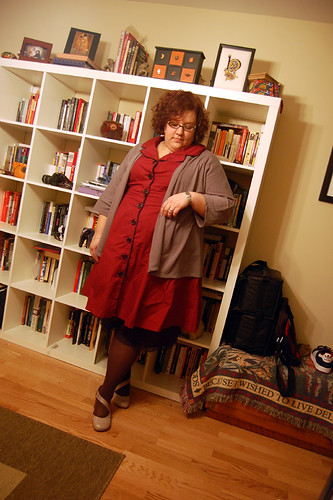
Exhibit A: The Sizzling Shirt Dress, by Mlle Gabrielle, currently on sale at alight.com. I dig this one because, with its big-button front, piping-embellished edges, and big collar, it vaguely reminds me of 1950s-era waitress uniforms. This dress is 100% cotton, which means it does not stretch, and it wrinkles if you merely look at it funny (the impressively-wrinkled version above is the unsurprising end-of-day result of my desk job).
On the plus side, it’s 100% cotton. I’ll never understand why it’s such a trial to find plus sizes in natural fibers. Though I don’t claim to speak for everyone, I will always take a nice crisp cotton dress over a slinky polyester jersey if given the choice. While it wrinkles like nobody’s business, and doesn’t have that luxurious stretch (at least not without a bit of spandex), cotton can always be relied upon to breathe beautifully, to launder without pilling (like so many cheap jerseys seem to do; see every Old Navy dress I’ve bought in the last three years), and to just plain feel better, in my opinion.
Overall I’m very pleased with the above dress. Sure, the shoulders and arms are a bit more closely-fitting that I’d ideally like, but then that’s a common experience for me and my giant ham-like upper arms. And sure, the included belt broke within literal seconds of my removing the garment from the package in which it was shipped, but hey, it was on sale.
Next:

Exhibit B: The Bridgewater Studio Print Shirtdress, from the Jessica London catalog, also currently on sale (I cannot honestly recall the last time I bought something that wasn’t on sale, but I digress). The image above is from the catalog, because I don’t have a picture of myself in this one as of yet. I bought this in the navy and white print, which I like a lot more than the color above.
The Jessica London website has fairly recently added user reviews to its item pages. This is pretty awesome of them, I must say, because my experience is that buying from catalogs is at best an inconvenient annoyance and at worst a major catastrophe. If I think too long about the amount of money I’ve lost to Jessica London and Newport News and their ilk in shipping fees for items I’ve had to return, I start to go all deranged and Hulkish. Thus, the reviews are pretty sweet, as it gives others the chance to warn newcomers off an item that looked just precious on the page but was in reality a horror upon receipt.
And sometimes I ignore their warnings.
The reviews for the above dress are pretty uniformly bad. Most of the complaints are about the size being too small, and the fabric feeling “cheap”. Hey, it’s cotton again. This partly answers my question of why plus sizes in natural fibers are so hard to come by – maybe lots of fat folks don’t like them. Regardless, I took a chance on this dress – thinking that the complainers were expecting something other than a light cotton dress – and I’m pleased I did. The fabric is a very nice, soft, woven cotton, and the dress fits like I expect a 26W to fit. My only gripe is the length. It’s just above the knee on me (I am just over 5′9″), which isn’t really a problem, as I enjoy shorter dresses, but I’d expected it to be longer based on the image of the model. (And besides, it’s really my fault for not paying attention to the skirt length measurement listed, which I just noticed, just now.)
That wraps up this dress report. Next time I hope to have good things to say about this dress and this dress, both from Lane Bryant. Given my recent failures at LB, though, I am not optimistic.
Pursuant to a conversation in the Fatshionista LiveJournal Community, I submit the following: this is the 1992 video for Morrissey’s song “You’re The One For Me, Fatty”. As critical as I am of pop culture (and not-so-pop culture), I’ve never been able to formulate a definitive opinion on whether this song and video are meant to be laughing with or laughing at the romantically-inclined fat girls of the world.
So what’s your opinion on this fine bit of songwriting?
(My Morrissey adoration is significant, so any verdict I present is subject to this conflict of interest, and is not objective in any way.)
Since, Peggy McIntosh’s White Privilege: Unpacking the Invisible Knapsack, has been in the buzz on the blog here, I was reminded of a piece I wrote in 2003. It’s modeled after the format of White Privilege: Unpacking the Invisible Knapsack, but in borrowing Ms. McIntosh’s form I am NOT trying to compare racism and fatphobia or trying to suggest that one is “like” the other.
If I’ve learned nothing else about the intersectionality of oppression within activist movements, it’s this: making connections between different oppressions and talking about how different groups of oppressed people can share information, strategies and support is awesome. Trying to compare or find ways in which one oppression is “just like” another one is totally not useful and erases the complexity and history of each oppression creating nothing but hurt and frustration in its wake.
I have always found it interesting (and I’ll be honest, a touch disappointing) that it took a white woman to spell out white privilege to white people when people of color had been spelling it out just as eloquently for some time before White Privilege: Unpacking the Invisible Knapsack, was unleashed upon academia. I don’t mean to sound ungrateful for its existence, because it’s a valuable tool for sure but it sometimes raises my “white translator” hackles.
That being said, this is my piece I wrote in 2003. I still agree with most everything here and I’m interested in hearing feedback on what a larger audience has to say about it:
Fatphobia: The Fat Elephant in the Room
(author’s note: it could probably benefit from a cleverer title)
1. If I walk slow or choose to take the elevator/escalator people assume I might be tired/have had a bad day and not that it’s because I am unfit & unhealthy.
2. Doctors don’t chalk up every symptom I have to my size and present weight loss as a panacea.
3. I won’t pay more for health insurance because of my size.
4.If I am in a romantic relationship with a person of the same sex it’s not assumed that it’s because I “can’t get a man” or “can’t get a woman.”
5. I can eat in public without people judging my food choices. Likewise I can be pretty assured that no one behind me at the grocery store is looking at what I buy to “see what makes me so fat.”
6. If I have a fat child people don’t immediately blame me for foisting my “bad eating habits” off on him/her.
7. I am paid more than a fat employee doing the same job.
8. I can be assured of seeing people my size in popular media (tv, magazines, etc.) If I am an actor I can usually be up for meaningful lead roles rather than the “comical sidekick” or be otherwise unrestricted in terms of what parts I’m allowed to play.
9. My size is not a consideration in my hiring process. I don’t have to fear being fired due to my size. I do not have to worry about being told that my size constitutes having an “unprofessional appearance.”
10. I can shop in most stores and find clothes in my size.
11. I don’t pay extra for my clothes because of my size.
12. I can be fit or pretty or healthy or a vegetarian or smell nice or keep a clean home and not be looked at some wacky exception to some rule about what people my size are “supposed to be like.”
13. I am never asked to speak for people “my size.”
14. When a person flirts with me I don’t have to worry that they’re doing it to have “good politics” and can genuinely assume it’s because they find me attractive.
15. I do not have to deal with people who fetishize me because of my size.
16. I am not asked to pay for two airplane seats. Or two train seats. Or two bus seats. Though often cramped, I generally fit into most places.
17. If I sit down on a crowded subway train, I do not get sneers from fellow passengers.
18. My size communicates very little to most people and is value neutral. That is, most people don’t assume anything about my values, morals, etc. because of my size.
19. When I go to an amusement park I don’t have to worry about fitting into rides. When I book a hotel room I don’t immediately think about how big the bathroom is. When I go to a restaurant or movie theatre or concert hall I can be reasonably sure that I’ll fit & be comfortable in their seats.
20. I am not used as a medical scapegoat because of my size. Medical professionals generally treat me with respect and believe me when I say that I eat healthy and exercise. Furthermore, if I require immediate medical attention I can be reasonably sure that an ambulance, an operating table, a gurney, an MRI chamber and other critical pieces of medical equipment will accommodate someone of my size.
— Amy Mendosa, 2003
— Edited 2008, to correct grammatical errors and to include accessibility to medical equipment as a privilege.
Hi folks. This here is the new blog format – it’s based on WordPress and as such readers shouldn’t really notice much of a difference, except for an increased familiarity. It makes for a handy improvement for me and the other bloggers, though.
The old blog is archived here for all posterity.
There is also a new RSS feed for the site as well.
If you run into any bugs or problems, please do me a favor and drop me a note letting me know.
 Two Whole Cakes is a blog written by