The spectacular Substantia Jones, the bodaciousness behind The Adipositivity Project (be warned, that link is not safe for work), sent me a missive yesterday, which read in part:
…Fashion Overdose needs a Lesley smack-down. The good news is everything in 4x and 5x is half off through Friday with discount code 4×5x. The bad news is it’s because they’re discontinuing those sizes, come January 1. From their mailing:
“Effective January 1, 2009 FashionOverdose will no longer carry 4x and 5x. Due to supply and demand. FashionOverdose wil add small, med, and large. FashionOverdose size wll start from Small to 3x.”
I’ve met these guys. I’ll bet they can be talked out of it, were you to rally your troops.
Then let the smacking commence forthwith.
I don’t have a whole lot of new stuff to say about this that I haven’t already directed at B & Lu’s on-again, off-again booty-call-like relationship with the 4Xs and 5Xs in their stable. At least Fashion Overdose hasn’t started to drift into the realm of reselling mass-produced crap at an insane markup, so they’ve got that going for them, but their admirable commitment to selling truly original garments fails to make up for cutting out the larger sizes.
I’m going to assume that Fashion Overdose has made this decision for the simple reason that their 4Xs and 5Xs are not selling. This is a company, after all, whose motive is in successfully turning a profit and not in dealing a blow to fatter fats everywhere. I think the fact that Fashion Overdose made it a point from the beginning to market to plus-size consumers – and to use REAL PLUS SIZED WOMEN as models – remains impressive.
What worries me is not what this says about the company, but about the market. While some folks in the 4X-5X range are often frustrated by the lack of stylish options available to them, it seems clear that they’re simply not shopping at the Fashion Overdoses and the B & Lus of the world. Possibly there’s just not a critical mass of people at these sizes who are interested in the styles these shops sell. Possibly a lot of people at these sizes want to wear fabulously loud clothing but are afraid, afraid it’ll make them a target, afraid doing so would demand a level of self-confidence they’ve not yet achieved. It’s remarkably difficult to convince oneself that’s it’s acceptable to wear ostentatious clothing when the tacit messages one is getting from all sides is that those clothes don’t (and oughtn’t) exist for you.
So this is ultimately less a smackdown, than a morose little meditation on the frustrations of being a fatter fat who’s desperately seeking style. Could Fashion Overdose maybe compromise, and continue to offer 4Xs and 5Xs as special-order pieces? I don’t know – I don’t know enough about their production capabilities, or about how committed they are to serving the fats under any circumstances. All I can say is that this decision makes me sad, both for myself, as a body that often straddles the line between mainstream plus-sizes and the Great Beyond, and for all the folks who are working toward a place where they believe their bodies are worth dressing up and showing off.

Floating heads are all the rage. In the fatsosphere and beyond, we get floating heads and elegantly draped bodices adorned in jewels and sparkle. Alluring smiles and dashing eye shadow frames perfectly pecked cheeks and the cutest dimples I’ve ever seen on a grown man. Hair is coifed and sexy and when not, attention is sought out to alter that. Our faces are our best foot forward.
Indeed. When one’s body mass index is slightly larger than say, 12 or so the shift in photographic presence goes from a full figure to a floating head. Not unlike a character from the Harry Potter series, nearly headless anyones can be seen trolling the internets and office desks of properly manicured spaces everywhere.
I wondered about this recently. I too have a large collection pardon the pun, of head shots. I like the way my cheek bones look in a down-tilted camera angle. I’m ok if you get me at the right angle…..so says the line of a favorite song. I like my round shoulders in a purple shirt. I like my disappearded neck fat. Is good – makes me look like a super star sans opinions on my health and weight status.
And I see these shots *everywhere* there can be a photo of a humanoid. In a recent fatshionista livejournal community thread there was discussion of posting full figure shots with blank heads. The discussion fell into “well sometimes there’s just nothing decent to say about someone’s outfit so I remark on their face, hair, make-up, etc.†Le sigh. How often do we hear that? “Oh you’ve got such a pretty face!†or “Oh I love love LOVE your make-up!†Well gee, thanks for seeing the neck-up. I’ve got this great rack draped in some awesome fabric and I found these sexy low-rise maroon pants and I’m wearing kick-arse knee-high boots. Let me tell you about my bra, too.
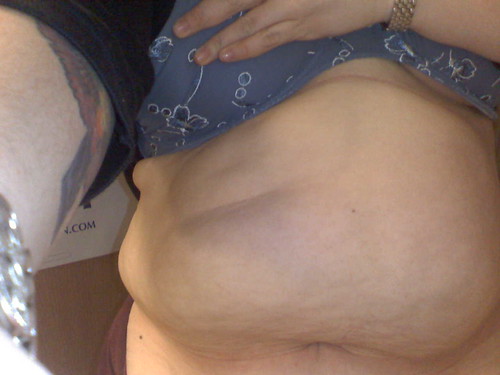
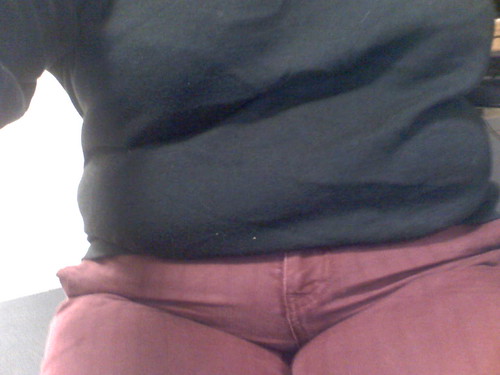
There’s a bellyshots campaign that Fatshionsita featured a while ago (yay!) via the awesome Lesley. There’s a revolution, fat style, to get bellies and belly-lovin all over the interwebs. Groovy. I can bear my belly for the world to stare at. My naked belly without the awesomeness of what I’m wearing today. That’s easy. That’s headless and nekkid and you don’t have to look at me as a part of fashionable, sexy culture. Just nekkid culture.
But what happens if we force ourselves, nay our culture to look at fat as part of culture? That’s what Fatshionista! Is all about, right? Force feeding fat fashion into the starving mouths of the fashion industry? Not giving them a chance to say cute face! Cute hair! But rather to look at the bodies that are rockin’ the industry.
Hm. What would that revolution look like? No longer would the headless bodies be signs of a dying culture, obsession, greed, over-consumption, media disregard for humanity and bodily integrity; instead it would mean fat revolutionary fashion force feeding sexy fat bodies front and center. Not giving one another an excuse to continue to ignore our bodies. Not giving in to these head shots. Hm.
With assistance from Random.org (the internet can do ANYTHING!), the winners have been chosen. This contest actually turned out to be much bigger than I expected, and I want to offer enormous thanks to two awesome readers – Anne of Jesus Saves, I Spend and Sarah TX, who both also received emails with these promotional gift certificates from eShakti, and who generously volunteered to share their unused codes with you all. So we wound up with way more winners than anticipated, which can only be a good thing.
The winners – who’ve been emailed their codes already – are:
AlexT
Tiffany
lilacpoohlover
notblueatall/Sarah
Linda W
chriskalen
Sarah C
Rebecca F
Kate O
Megan D
Congrats to the victors. And my heartfelt thanks to everyone who entered and who reads this blog regularly.
By now, if you haven’t heard about Oprah’s hand-wringing over her spectacular-though-unintentional comeback into the squishy open arms of Fat (welcome back, baby!), well, you probably don’t read very many size acceptance blogs. But I’ll break it down for you: Oprah’s regained weight. This confounds and saddens her. (Lather, rinse, repeat.)
This old fairytale reminded me of another old fairytale, though probably not one you’ve heard before.
When I was a wee lass, at eight years of age – coincidentally, around the same time that I was first becoming aware of my size, and the fact that I was bigger and had a belly when my friends did not – I loved unicorns. No, that is putting it too delicately. I was obsessed with unicorns, in the way that only a small girl in the mid 1980s could be. My room was decorated with unicorn posters. All my school folders were unicorn-emblazoned. I spent countless hours reading about unicorns in books from the library. I knew everything there was to know about unicorns. I daydreamed about them constantly. I was past the age where I still believed in Santa Claus, but I knew unicorns were real. I knew. I knew someday I’d find one, a massive, muscular white horse with a flowing mane of silk, and a single glimmering, spiraling horn. My unicorn would be able to talk and would become my best friend. My unicorn occasionally also had wings, because while I was generally uninterested in pegasuses (pegasi?), I very much liked the idea of a unicorn that could also fly. How I would find this unicorn-companion was beyond me; I was aware that though unicorns absolutely positively did exist, they were very rare. I probably thought that I would find mine purely by virtue of my unwavering conviction; that so long as I believed it would happen, it would. So long as I trusted in the legend and had faith, I had a chance of making it come true.
In 1985, the circus came to my town. I was a lucky kid, because every time the circus came to town, my dad would make sure we got to go. It was Ringling Bros. and Barnum & Bailey, and this year, there was something new, something remarkable, something I would never forget.
The circus would be exhibiting the world’s only living unicorn.
Oh, you can try to imagine my excitement. Imagine the most excited thing ever – like an overcaffeinated Jack Russell Terrier puppy – and then mutiply it by ten, and you might come close. My father, who raised me after my parents’ divorce and who was therefore intimately aware of my unicorn fascination, was probably almost as thrilled as I was, and built the anticipation daily leading up to the big event.
The circus day came. We went. I barely enjoyed the show; I was all on pins and needles, waiting for them to reveal the unicorn, waiting for the moment when all my faith would be justified. I remember almost nothing of that circus save my anxious anticipatory fidgeting. And then finally the moment came – a float came out and circled the arena slowly, a float bedecked with all manner of dazzling decorations building to a peak, like a tiny rolling mountain, and at the top were two unicorn-tenders and…. the unicorn.
Except it was not a unicorn.
The brilliant white stallion of my daydreams was missing, as was the glimmering spiral horn. Instead, I saw a largeish, long-haired, white goat, with a single thick and cylindrical horn, painted gold, perched awkwardly on its head.
For a moment, I tried to believe. I felt a flicker of panic as I realized what was taking place. I tried very hard to squint and make it real. But I just couldn’t do it in the face of this damning evidence. It was not a unicorn. I was being duped. I didn’t need an expert opinion; I didn’t need a genetic profile or a peer-reviewed study of the origins of the animal on top of that float. I could see it with my own eyes, right there, in front of me, in three dimensions. Fake. The unicorn was a lie.
My heart was broken. My father leaned down and jostled me – look sweetheart, it’s your unicorn! – and not wanting to disappoint him, I smiled and said yes, yes, it’s amazing, Dad.
But I knew. In that moment I knew then that unicorns weren’t real, with a final, cold certainty I never had when I was trying to believe they were. If unicorns were real, the circus would have no reason to create a fake one – and an appalingly bad fake one at that. Unicorns were a myth, and always had been, whether I believed in them or not. I cried, quietly. I mourned for weeks afterward, keening silently over the loss of my belief, over the realization that simply wishing for something doesn’t make it so, no matter how hard you wish.
The moral to this story – the moral I’d share with Oprah Winfrey or with anyone still fighting to become a fantasy self, still struggling to believe that they are exclusively and personally responsible for their alleged moral and disciplinary failures to force their bodies into a certain shape, to fit a certain arbitrary ideal, to satisfy the fairytale ending in which the heroine loses the weight and lives happily ever after and Never Has To Diet Again – the moral is this:
Unicorns aren’t real.
It hurts. I know. It hurts to let it go. It hurts like fucking hell. It hurts because of all you’ve invested in that belief. All the effort, all the conviction, all the sacrifice. I know. I know how realizing that the circus unicorn was a fake ripped through my tiny eight-year-old soul; I know how coming to terms with the fact that I will never, ever look like a model – even a plus size model! – was brutal and excruciating and frequently sent me into spirals of self-loathing and despair, even for a long time after I thought I was over it. I KNOW. But unicorns aren’t real. And trying to believe that they are even in the face of pretty convincing evidence to the contrary is both futile and a disservice to yourself.
The world doesn’t need unicorns for me to see beauty and magic in it. And as I get to demonstrate to myself daily, I don’t need to meet a certain standard of slenderness in order to be a happy, healthy, satisfied individual with a fabulous life.
Though it may not have been the one I’d set my sights on originally, that’s the truth I’ve earned. And I can live – cheerily, contentedly – with that.
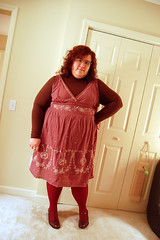
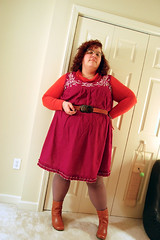
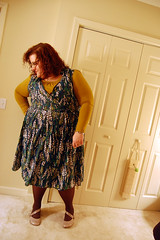
This may come as a total surprise (sarcasm!) but: I wear dresses. All dresses, all the time. Even on the rare occasions I’m wearing jeans out of necessity (like this weekend, in which I wore jeans and hiking boots to take pictures in the great dead outdoors) I’m wearing a dress over them. I made the original Dress Decision in 2006 – prior to that it was Just Skirts. I shifted to dresses because even though 90% of the skirts I was wearing were selfmade and thus accomodated my measurements near-perfectly, I found that the dress was far superior in ease of fitting and wearing on my particular body shape.
So, since then I’ve been pretty much dress exclusive.
It may also come as a surprise that I’m quite fat. Fat enough that I can only fit things at plus-size shops, and sometimes even then stuff is still too small in the fattest size.
Lastly, I live and work in the metro Boston area.
Combine these three factors and you’ve got the reality that my dresses, drawn from an already-narrow pool, need to be made adaptable all year round to all sorts of weather.
Thus: layers.
I layer the crap out of everything. I even layer in the middle of summer – I grew up in Florida and get chilled even in air conditioning, okay? – which has provided endless amusement and befuddlement to my friends. In the winter, though, layering becomes less a mild matter of “what if my office is cold?” than pure survivalism. Last year it occurred to me that beyond my usual cardigans and scarves and tights and leggings and legwarmers – and for the record, you can have my fucking legwarmers when you pry them from my frozen dead calves – that I could also be layering things UNDER my summer weight dresses. As you see above.
Even now, I can hear my fellow New Englanders exclaim, “Are you MAD? You’ll FREEZE in a dress in January! You will FREEZE to DEATH!” Lies, my friends, all lies and misinformation.
See, the dress isn’t really what I’m wearing. The dress is gift wrapping; the dress is just the attractive frosting on the more substantial cake* of my under and overgarments. Real winter dressing is just boring and ugly; it serves a purpose, and that purpose is to keep you alive, not to look pretty.** Because I am compulsive and greedy I like to do both. So (with the help of some northerly inspiration!) started putting on the normal winter garb and then throwing a dress over it. A turtleneck under a cotton sundress and I almost have a fancy-looking jumperskirt. A long-sleeved tee under a silk wrap dress and I won’t die when the temperatures fall below freezing.
Thus my suggestion to my dear readers with much-beloved dresses is NOT to let them languish sad and lonely in the back of your wardrobe til next May, but to bust them out of their summer-only purgatory and give them some winter exposure. The worst thing that can happen is, well, people will think you’re somewhat odd. Though I would argue the sooner you can stop worrying about that, the better off you’re going to be in a general-life sense.
———————-
* Who doesn’t love a cake analogy? MMM, CAKE.
** Here I mean “pretty” by my own definition, of course, which is not so much the “eeeee I’m liek a MODEL!” sense than the “I like how I look” sense. You have no responsibility to anyone to look “pretty”. Ever. Neither do I. If you dress with any concept of “prettiness” in mind, it should be exclusively because it makes you feel good.

Hey kids! You may remember my post about eShakti.com. You may have thought to yourself, “wow, self, I’d totally like to order from them but it seems like it might be a crapshoot, therefore I sure wish Lesley from Fatshionista would come up with a way to enable a probably-unnecessary personal purchase during the season where I ought to be shopping for other people and the economy kind of sucks anyway!”
Well, my dears, your prayers have been answered.
I have three $25 eShakti gift certificates to give away. They’re only good until December 31. You can get in the running for one of them by emailing the site – using either that link to the site email form, or directly to lesley @ fatshionista . com – with your name or psuedonym (I will post the names of the winners once this thing is done) and a valid email address. Because this offer expires at the end of the month, I’ll only be accepting entries until 5pm EST on Thursday, December 11, and will pick the winners (by random drawing) and notify them on Friday.
Good luck y’all. I’m here to help.
By now, I expect it’s fairly well-traveled news that Canadian airlines are being forced to comply with a decision by the Canadian Supreme Court, that all air passengers have a right to a one-person, one-fare rule. This is topical because of the obvious controversy in how this is being applied to fat people. Essentially, the ruling is that fat folks who are too fat to fit in one seat must be accomodated with a second seat, free of charge. It sounds like a nice thing for Canadian fatties, for sure, but the particular language states that this is applied to folks who are “functionally disabled by obesity.”
Now, “disabled” is a loaded word. For some people it’s a valued identity they want respected. For others it’s an embarrassment only mentioned in the proverbial whisper. Some folks seem to be bristling at this language because hey, not every fat person is disabled. Not even every fat person over a certain size. “Functionally disabled” is a little different, though. My understanding of this idea is that it’s just a multisyllabic way of saying someone’s physicality prevents them from using an object in the way others can. In this case, the physicality in question is size, and the object is a seat on an airplane. The language makes the body the problematic piece in this equation, when it could just as easily be argued that the seat is insufficient – even for many not-at-all-fat people. Is it the body that’s functionally disabled, or the arbitrarily-sized seat it’s being asked to confine itself to?
So there’s that.
But that’s not what I find particularly interesting about all of this.
What I find interesting is the resulting challenge facing said airlines, which are now expected to become authorities on drawing a clear and defendable line between a fat person and a not-fat person. There are a few possibilities here:
Robert Jarvis, a law professor with a specialty in aviation at the Nova Southeastern University Law Center in Fort Lauderdale, Fla., laid out four possible policies, and conveniently pre-graded them for difficulty:
* Easy: A traveler would simply self-declare as obese and receive an extra seat;
* Moderate: A doctor would give a traveler a note declaring the traveler to be obese;
* Difficult: A traveler would need a doctor’s note and meet an objective standard (such as the
Body-Mass Index), which would require an in-person measurement either on the day of travel or,
within 30 days before the day of travel;
* Hard: A traveler would need to take a physical exam from a doctor of the airline’s choosing.
Obviously, all of these options have individual problems and oddities. The concern with the first option is abuse – the idea that not-obese people would be turning up at airports claiming obesity in order to score some free extra room on their flight. I find this allegation hilarious and ironic, as it’s almost inconceivable that in any other context you’d have not-fat people lining up claiming to be fat (if only being fat had more obvious perks!). The remaining options all focus on the medical definition of obesity, which makes sense on the surface, but when you consider the fact that the medical definitions of obesity can have nothing to do with actual fatness – for example, do a little research and boggle at how many professional athletes are technically “obese” according to the BMI standard – it’s not a great method for measuring. Nor is it really an objective standard, as described in the quote above; you can have ten people who all weigh the same but who are shaped dramatically differently, depending on lots of factors besides height.
The experts are ahead of me on this, however:
Adam Drewnowski, director of the University of Washington’s Center for Obesity Research in Seattle, suggests that the extra seats be made available to travelers who bring a doctor’s letter and who have a BMI (Body Mass Index) of 35 or above… “A BMI of 25 is considered overweight. A BMI of 30 is obese. A BMI of 35 is medically significant obesity. There can be no argument,†Drewnowski said.
But Dr. Arya M. Sharma disagrees. “You can’t bring it down to a BMI. People’s body shapes are different.â€
Dr. Sharma would have airlines do what some theme parks do: stick a “sample” seat in the terminal so fat people can try to shove their asses into it pre-boarding the actual plane. Sharma sensitively suggests this could be someplace “private”, so’s not to humiliate the fatties any more than is absolutely necessary when you’re basically calculating someone’s ass-volume to determine whether they fairly warrant a second seat or not. Sharma says: “If they don’t fit in the seat, then they’re too big and they’ll need to have that extra seat. At no cost. It’s not rocket science.â€
Not rocket science, no. Rocket science is mostly math and concepts that can be measured definitively. Unlike fatness. That fascinates me here is this: what counts as not fitting? Is it only if it’s physically impossible to jam one’s hindquarters into the space provided? Fat is somewhat flexible, after all, and in some cases a person may be able to squeeze into the seat in question, but at the same time wouldn’t necessarily “fit”, or their fat might squish over or under the armrest a bit. Does discomfort count for anything? What about people who are fatter above the waist, who might unwittingly crowd a seatmate with their big fat arms?
My point being: how the fuck CAN you measure this, really? You can’t. Short of weighing everyone before they board the plane and charging by the pound to fat and thin alike, there is no universal standard that can be fairly applied across the board. It will always come down to somebody’s subjective assessment. This interests me because it beautifully illustrates the fluidity of body size, and the challenge of universalizing definitions (even medical ones) of where fat begins and ends. However subtly, the Canadian ruling and the subsequent scrambling of the airlines to comply can be argued as having a deconstructive effect on the broken tools we use to measure who is fat and who is not. Unlike BMI, this cannot claim to be a question of “health”, but is instead one of physics. What does it mean, not to fit?
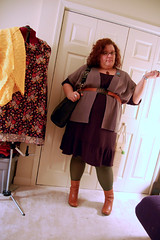
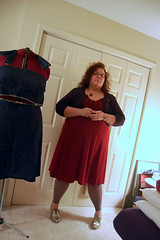
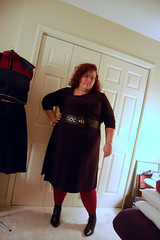
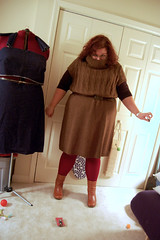

I don’t wear the exact same outfit twice. Ever. It’s true that I probably put a disproportionate amount of thought into what I wear every day – and this goes back to the days in which I discovered Style, during my heavily subcultural youth – but part of the reason behind this compulsive behavior is the strange block I have against wearing the same outfit more than once. I find having established outfits… unchallenging. Wearing the same ensemble in the same way multiple times certainly has its merits, and is likely useful to lots of folks whose line of work requires them to meet a particular standard of professional dress. I am simply too stubborn to do it. Thanks to my Flickr discipline I can flip back through nearly two years of outfit pictures*, and I am challenged to find myself wearing the same thing, in the same way, with the same cardigan or the same shoes as I’ve worn it before. To use the Flickr parlance, I’m strangely obsessed with the remix, with reworking or revising my wardrobe on a bloody daily basis.
Like many folks, I’ve found myself shopping less and remixing more in recent months, which has increased the fatshion challenge of creating something new from the same old shit. It’s like assembling a puzzle, trying to put together new combinations. Sometimes I’m successful to the point of people thinking I’m wearing stuff that’s wholly new. Sometimes I fail and am annoyed with myself all day. Fortunately the former happens more often than the latter. I take pictures of both, but I won’t often say which outfits I’m happy with or which ones I’m not. My work in these pictures is ultimately about visibility. Not in looking good on behalf of All Fatties Everywhere, but in simply being visible.
This is obviously a common theme around here. One of my early reads in fat activism was a book (at the time, new!) called The Invisible Woman: Confronting Weight Prejudice in America, by W. Charisse Goodman (and which can evidently be had on Amazon for a penny if you want it). It’s not the greatest fat book ever, but it floated an idea – a common one, it turns out – of fat women as being invisible in public discourse. It was the first place I heard that concept. I was fascinated with extending this idea, as others have**, to the prevalent media representation and the banalities of daily life in equal measures – the idea that fat people are, overwhelmingly, invisible and interchangeable in culture. And I didn’t like that.
There are lots of ways to not be invisible. One can be loud, one can be insightful. One can also be a physical assault on the eyes, which in my opinion cuts to the heart of the matter. I try to be all of the above, when I can. A small contribution is my nigh-pathological commitment to never looking the same way twice. It’s really only a tiny bit of subtle performativity, one that most folks probably never even notice, but it gets me through the day.
————–
* Some of those early ones are pretty, er, expressive, compared to my stylistic sensibilities today. Also, there is a rare picture of me in pants, plus pictures of my old hair. Memories.
** The issue of visibility works similarly when talking about any marginalized group, be it the effect of race, disability, sexuality, gender identity, etc., or any of these in conjunction with each other. But that would be a much, much larger post.
I’ll repeat the title, just to be clear: Amanda Palmer, of both solo career and as half the duo known as the Dresden Dolls, is not fat. I say this mostly from having seen pictures of her, since my only real-life experience was bumping into her in the audience at a Death in June show several years ago (and thinking, stupidly, where do I know that person from?, for about twenty minutes before figuring it out), but even given my very limited frame of reference, I can state with firm assurance that she’s not fat by any reasonable standard. She is, however, clearly made of human flesh, which is evidently not a real popular way to look when your record company is trying to sell your pop sensibilities to a broader (figuratively speaking, of course) audience.
A feminist UK blog called The F Word (yes, another one) has reported that Amanda Palmer is parting ways with Roadrunner, her record label, for refusing to promote her solo album and latest single. The reason? Apparently Palmer would not allow them to remove images of her “fat” [sic] belly from her latest video, embedded below, and thus the record company in question has branded her “uncommercial”, which is pretty clearly code for “uncooperative”.
Palmer’s fans and supporters have begun an online collection of belly images in protest, calling it – cleverly – a Rebellyon. There’s a fair amount of overlap with the existing Bellies Are Beautiful web gallery, so if you’re looking for more generalized belly love click over there as well.
This post is obviously a bit off-topic, since, as mentioned above, Amanda Palmer is most assuredly not fat. But this does illustrate the overarching cultural pressures and standards applied to popular images of women that put forth a certain idealized form, when that form does not actually exist. Removing Palmer’s belly from the video below would not make her skinnier in any authentic way; it would just remove the opportunity to show what one individual, natural, non-photoshopped woman’s body actually looks like. We don’t often get to see bodily differences – even subtle ones – in popular culture; every image, of every famous woman (and many men too), is pretty uniformly cleaned up and polished and perfected before it hits the magazine covers or the TV screen.
Thus, Amanda Palmer gets props from me if for no other reason than for not bowing to this shit. I may even have to reassess whether I qualify as a fan of hers or not.
The offending video, for “Leeds United”, is below. I can also personally recommend the album, which is quite good.
CNN’s next headline: New study reveals fatness is NOT dumbbell-shaped and carried in one’s hands.
By Lesley | November 21, 2008
I often deride CNN.com as the home of the random weight-loss success story recast as News Event. So the story this time is the standard triumph-over-adversity tale of weight loss through Diet and Exercise TM. Woman is Death Fat, her knees hurt, she gets out of breath taking a book off a table. Woman Changes Life, loses weight, everything’s magically awesome.* The story itself is unremarkable and pretty identical to all of CNN’s reformed-fatty pieces, but there is a beauty of a comment in this particular article.
After this woman managed to lose 100 lbs (The Hard Way, which makes her Extra Special!), to mark the occasion her personal trainer had a brilliant idea to “celebrate” her success:
“I had her take two 50-pound dumbbells and walk out to the street and walk back,” recalled Crawford. “When she got back she was exhausted and that’s the kind of weight people have to carry when they’re overweight like that.”
I LOVE THIS SHIT, y’all. It makes me laugh every damn time I read it. And I’ve read it lots and lots of times. Somebody somewhere is always thinking they’re being clever by strapping X pounds of weights to some poor dope and saying “SEE? THIS IS WHAT IT FEELS LIKE TO BE FAT!”
That’s not what it feels like to be fat.
Allow me to elaborate.
Your muscles, for the most part, get stronger or weaker based on how you use them on a daily basis. A 250lb person who lives in a city and walks everywhere will probably have great big strong leg muscles, since said muscles are being employed in the task of carrying 250lbs around all day long. A reasonably active 250lb person isn’t going to strain to carry their weight around if they’re used to doing so. Human muscles probably do have an upper limit of how much weight they can handle, depending on the individual and the activity in question, but generally speaking so long as a person is mobile, one’s muscles will adapt to carry the weight of the body in question. This is completely natural and makes sense from a biological perspective; to use an example unrelated to fatness, this also helps explain why pregnant women don’t suddenly fall down at eight months and can’t pick themselves back up again until they deliver. Muscles adapt.
So, to use my own enormous fatness as an example, I don’t walk around every day huffing and puffing and thinking, “DAMN, it’s like I’m carrying a 150lb-bag of sand strapped to my gut! Whew!” Nor do I walk around carrying my fat in my hands as though it were invisible dumbbells. I just… walk around. Like anybody with functional legs walks around. To borrow from the fabulous Hanne Blank, I leg-press over 300lbs every time I stand up from my desk. My legs are USED to that. It’s the only body they know, the only one they have known for over a decade. Human legs are not lawn chairs; they don’t have arbitrary and universal weight limits, past which they’ll simply buckle and fail.** Human legs, like the rest of the human body, are incredibly complicated and dynamic mechanical wonders.
Do some fat folks huff and puff and struggle with even simple movement? Sure. So do some not-fat folks. For a variety of reasons. But to take a smaller body, and ask that body to suddenly heft 100lbs of free weights for a short walk? Um, yeah, that body will be tired for sure, that doesn’t mean the action in any way, however remotely, resembles the experience of actual fat people as a monolithic group. Because fat people are not monolithic. Just like not-fat people. The argument that the experience of a not-fat person who carries something really heavy for like a minute of their life says absolutely anything valid about the daily, cumulative experiences of fat people – that suggestion is both stupid and offensive.
So what DOES being fat feel like, physically speaking? It feels a million different ways, depending on the individual.
In short, being fat feels pretty much exactly the same as it feels to be not-fat: subjective.
—————–
* Please note that I’m not dissing this woman personally – I don’t give a crap about her personally, and she is free to do with her body as she likes. I am dissing the combo factors of the near-universal and archetypal “weight loss success story”, and the fact that CNN publishes these articles like they’re actual news. FAT WOMAN LOSES WEIGHT, film at 11!
** …and then it’s back to Target to try to explain to the dude at the service desk that you brutally murdered a lawn chair because, well, you didn’t notice it had a crazy low weight limit, and also you are apparently so fat that your ass can DESTROY ENTIRE CITIES if not kept under tight control, and I suppose getting that money back is totally out of the question, though service-desk-guy may do well to remember that fatal weapon you’re not-so-secretly packing in back.
I mean, I’m just guessing here, that this could happen.
 Two Whole Cakes is a blog written by