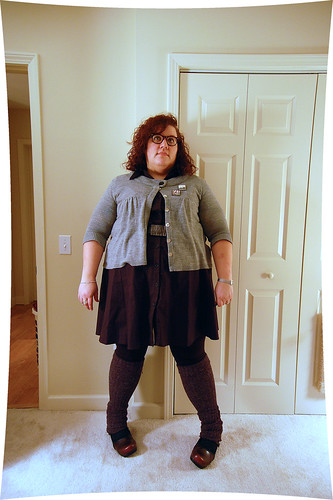
Today, this blog came up in conversation with my coworkers.** I’m pretty lucky to work in an environment where I can mention my blog where I (alongside my fellow bloggers) post potentially-narcissistic fatshion photos, profanity-riddled rants about challenging expectations (AKA the “fuck you” factor), and notices about the existence of fat-vagina-shaped sexual aids… and nobody trips.
At any rate, it got me thinking about the trickiness of being “out” as a fat person.*** I’m pretty overtly out as a fatty at work if only by virtue of having been there so long, and not being inclined toward remaining silent on the issues that are important to me, be they fat-related or in connection with politics, race, gender, and so forth. It is my considered opinion that coming out as a fat person – to friends, family, or colleagues – is a totally necessary battle and a vital step in one’s acceptance process. What good is having the knowledge if you’re not speaking it aloud?
Being out as a fat person means letting folks around you know that you’re not likely to participate in idle diet talk or body shaming, and are, in fact, likely to question or challenge it when you hear it (in my case, in a friendly and humorous way, though some folks prefer a more aggressive approach and that’s fine too). Being out as a fat person means being willing to talk about one’s fatness in a forthright way, even when it makes people slightly uncomfortable – the more I can help people to get over that discomfort, if only by being blunt and honest about my body, the less power fatphobia has over us all.
The fact is, fat activism is good for everybody, even people who are not fat, even people who don’t know it exists or who don’t think they need it. It’s good for everybody to hear about fat activism, even in circumstances and scenarios when they weren’t expecting to get hit with a dose of body love and social justice. Because everyone’s got a body story; everyone’s got an issue or an injury or a sad point or a sore spot. Fat activism starts with fat people but extends to everyone who lives in a culture in which beauty standards are dictated by a fatphobic culture; even folks who aren’t fat have to live with the fear of getting fat, which is a powerful thing.
This is not a new idea and it’s not mine alone; many brilliant folks have written on this with far more flowery (or academic) prose than I. Nobody should feel ashamed of their body, no matter what it looks like.
Ideally, that is what fat activism is for.
——
* Incidentally, that’s my much-beloved Alicia dress from SWAKdesigns, as previously gushed over here.
** I was telling them about this excellent mention of the site in Time Out NY, alongside a piece on the ever-fabulous Deb, proprietress of Re/Dress NYC. HELLO THAR, Time Out NY readers!
*** I’m unabashedly co-opting the traditionally-queer (as much as anything queer can be traditional!) use of “out” here because it just plain fits and I am not fond of reinventing the wheel. Also, there are similarities.
I have done something I swore I would never do again. I bought a girdle. Well, actually, a girdle and a pointy bra. But the girdle part is the part I had sworn off. I got these in black (probs NSFW). I’m buying them because I have been fantasizing about wearing a girdle and bullet bra to seduce my lover (who has a penchant for old fashioned underwear) for a few weeks, and it is one of my favorite fantasies, so much so I want to make it a reality.
Until recently, aside from an appreciation of the nostalgic aesthetic, I had a burning hatred for girdles. That’s because I have actually worn one as a fat hating and hiding device. I remember my first, a high waisted, shorts length, white panty-girdle that my mom bought me because we agreed that my tummy showed too much in my fifth grade graduation dress, and my “lumpy” body should be tamed and kept from public view. I was ten. Every now and then we would drag out that girdle, and I would squirm into its confines, but only when I had to look my best.
By seventh grade, I graduated to my mom’s hand-me-down girdles. They are a staple of her wardrobe (which is funny to me in retrospect, since at that time she was vacillating between size ten and fourteen, and I never thought of her as a fat woman, since I grew out of that size by middle school.) I sort of assumed that’s what most women wore, or later that my mom was just particularly old school in her approach to clothing.
In those days, we would crash diet together, so it seemed only natural that I wear one of her girdles when I wanted to be more presentable. This is before my great awakening of eighth grade; prompted by a horrible diet program we were doing together, and the fat-positive trainer I had lucked into (looking back that stroke of luck, where Marilyn Wann, who shared the trainer, became gym partner to a precocious fourteen year old me, it seems more like a miracle). Fat Activism and I just clicked, and I soon began the painful process of quitting the diets and explaining to my mother that I could no longer willingly participate in my own oppression.
Luckily, I am blessed with an exceedingly kind and progressive mother, who recognized immediately that she needed to leave me alone on this one. Eventually she would become a cheerleader and an ally for my Fat Lib efforts. So, I left the girdle behind, eschewing any pretense of faux-thinness, and uncomfortable gendered underwear. Girdles now seemed anachronistic, ridiculous and supremely oppressive, a view that I still pretty much hold for myself, with one big exception. Sometimes, girdles can be pretty fun and sexy. But it’s taken more than ten years for me to forgive the girdle for it’s past tortures.
Around the same time I discovered Fat Activism, I also discovered kink. That also just clicked with me. From kink came the idea of pain giving way to pleasure, experimenting with sensation and role-play, with its endless costume possibilities. Kink was one way I found sexual empowerment and it was crucial in shaping my sexuality. Over the years I had a couple of corsets. I thought deeply about the corset and its symbolism, since it is also synonymous with Victorian gender oppression. After a while I felt that I didn’t really need corsets to feel sexy or kinky, as I had in the past, but I always enjoyed the aesthetic and might like to wear one just for fun and dress up.
I never thought I would want to wear a girdle for fun. But now I view it as a sexy costume, kind of like a corset, but with an important difference. For me, the sexiest thing about a girdle isn’t putting it on, or wearing one, or how it feels or looks. It’s taking it off. It’s the thought of being released from this mold of what femininity is supposed to look like, and enjoying and appreciating my body for what it is. Enjoying the freedom of movement, the softness of the flesh, enjoying the sensitivity to touch that was so recently denied, and the way a fat body looks naked.
This idea has been percolating since I have stepped up my daily fashion and have found that I prefer a vintage type look from somewhere in the 20th century, which has given me an enhanced appreciation of some of the fashion eccentricities of the time, like the molded figure. Also, since the TV show Mad Men (one of my favorite things of all time) and the iconic Joan Holloway showed that girdles once served as another mask of acceptability, but they also held potency because they were the thin line between civilization and nature. All of that lace and boning is there to tame the wantonness of the flesh, a talisman to protect the wearer and the observer from giving in to their animal instincts. To me, there is little sexier than eschewing the restraints of misogyny and puritanism, to signal the start of passion with the revelation of what my body actually is.
I’m also all about the tease. I like to tease my partner and myself into frenzy. The girdle is very, very good for this. It’s hard to put on, hard to penetrate. It molds the body into an alluringly old fashioned form, and makes sure that one can not indulge in genital stimulation until it is off (or, at least the one I want does). Peeling it down slowly, flesh overflowing over its restrictive fabric, (one of my lovers’ favorite things) finally able to breathe and move and feel. What better foreplay?
In my rookie activist days, my more reactionary days, I would probably be horrified that I would even wear a girdle as a lark. But now I feel a new sense of self-acceptance from toying with the idea of using this body-controlling device, and subverting it’s function so deliciously for my own personal kicks. What’s sexy about a girdle is ME underneath. I don’t think I have ever known that so confidently.
IMPORTANT: None of the links in this post are worksafe. None of them, not even a little bit. Click them at your discretion/peril.
 April Flores, professional naked lady, has given the world something magical: a fully penetratable cyberskin cast of her snatch. Given that April Flores is unabashedly plus sized, and the flesh surrounding said vag is appropriately ample, this is a pretty fascinating bit of fat news. Bizarre has a piece about the toy’s creation, as well as thoughts on it from Flores herself, plus a photo gallery of the casting process. For images of the item in question in all its plastic-packaged glory, you can head over to Flores’ blog.
I imagine one’s reaction to this will be profoundly colored by one’s level of comfort and familiarity with sex toys in general. While there’s something to be said for the problematic nature of cutting chicks up into consumable pieces and sections, overall I personally think this is pretty nifty in a more superficial sense. Plus, it really does look just like a fat (albeit hairless) cooter. Representation?
Worth nothing: fat chicks, even ones made of space-age polymers, are not cheap dates. Flores’ plastic passion flower will run you about US$320 with shipping.
(A slight tangent, but also worth nothing: this may be one of the single most useful web resources ever. I can’t be the only person who has wished for such an authoritative collection more than once.)
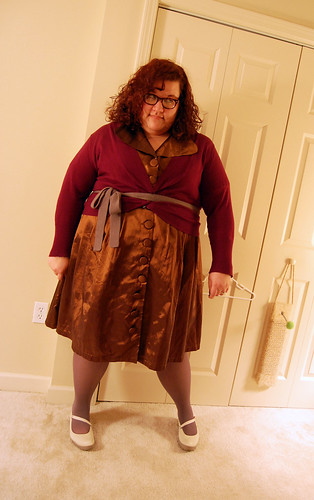
I’m smelling a sea change in the air, lately. I find that these shifts happen, from time to time, every couple of years. I’m talking about the coming Dress Plague.
Witness:
Lane Bryant’s current selection is astonishingly overpriced and even if it weren’t… well, I’ll stop short of calling it eye-stabbingly ugly, and instead state that it’s just not my style.
Even if Avenue hadn’t succumbed to the sad depths of print insanity, their dresses on the whole fit me so badly I am half convinced that I wronged their design team in a former life such that they’re single-mindedly dedicated to producing THOUSANDS of dresses I could not wear even if I wanted to.
Everything currently of interest at Igigi is heavily based on a straight-skirt line which just does not work for me.
The assemblage at One Stop Plus? A style void. Kiyonna and I have been broken up for quite some time, such that I’m not even down with linking to her punk ass. Alight has some cute offerings but I’m so over the idea of paying a premium for a Blue Plate/Mlle Gabrielle dress that’s going to literally disintegrate after a few rounds in the washing machine. And frankly, I oughtn’t to be spending money on clothes at the moment even if the shops were bursting with fabulous garments that fit me.
In other words, I’m out of resources at the moment. This isn’t necessarily a bad thing, given the economic climate and the resulting popularity of shopping in one’s own closet – which is frankly a great habit to get into, as it can force you to rethink established “outfits” and get more creative with what you’ve already got. It’s also a handy excuse to take fatshion risks you might otherwise avoid, such as mixing two colors you never thought could go together, or layering items with different textures or styles.
It can also be a great creative opportunity, to learn to sew – or at least to make alterations. (OR, to start sewing again, for those of us with the ability but a lack of motivation.)
Style isn’t just stumbled upon via a sheer variety of options; I’d argue that fully nine-tenths of great style is learning to be resourceful and inventive. It’s also being able to wear something catastrophic with grace and charm.
In our current risk-avoidant culture, I seriously want to take some fatshion chances.
Yesterday, Salon published an interview with Carol Lay, author of the so-called “diet-book graphic memoir” The Big Skinny: How I Changed My Fattitude. Self-consciously clever wordplay aside, it is evidently less an illustrated personal story and more like a weight loss book with drawings. But I’m less interested in talking about the book, which I haven’t read, than I am in talking about this snippet from Lay’s interview:
When did you decide you needed to change your eating habits?
I saw a photograph of myself, looking apparently happy. But I saw that, “Wow, I’m overweight, and I’m tired of doing this to myself.” I make the suggestion, “Get yourself photographed.” Cameras are much better tools than mirrors. I’ve got my mirror trained to show me exactly what I want. The camera is out of my control.
As is my way, I’m going to preface my response to this with a personal anecdote.
When I was about fourteen, I went on Jenny Craig for the first time, after Weight Watchers and nutritionist-mandated menus had failed me in my primary childhood dream of being not-fat. This was in 1991. These days, I imagine commercial diet centers are all digital, but at the time we only had old-fashioned film, specifically polaroids, for instantly-ready pictures. My Jenny Craig “counselor” took a photograph of me on my first paid visit to their center, with a new Polaroid camera and an eye-blasting flash. In this picture, I am standing slightly off center, my back to the institutional grey wall behind me, like a suspect in a line-up. On my upper half I am wearing a long-sleeved loose-fitting shirt screenprinted with random French words, and festooned with sequined flourishes, made by a clothing company I particularly fancied at the time called Ultra Pink. On my lower half I am clad in purple knit stirrup pants. My hair is shoulder-length and its rarely-seen natural blonde shade. My face is attempting a halfhearted smile but wasn’t quite there when the shutter snapped. I am wearing a size 14, and I weigh 167 pounds exactly, which is shortly to be recorded as the beginning point on my weight-loss line chart.
This polaroid was to be my “before” picture. The counselor took it with an impressive measure of enthusiasm, with an absolute wide-eyed assurance that someday soon I would look at this picture and shake my head and say “I cannot believe I ever looked like that!” because I would look so very, very different. This polaroid was paper-clipped to my file at Jenny Craig, and every time I went in, for my weekly weigh-in and “counseling” session, I would see it there. Clipped to my file. Like a piece of my soul.
Like Jenny Craig had stolen a piece of my soul.
It bothered me. It bothered me quite a lot but I could not, at that time and that age, articulate why. I hated that they had that picture of me. As time went by and the once readily-dropping line on my weight loss graph stopped dropping and extended itself out straight and flat like an endless plain, I realized that no, Jenny Craig would not save me from my fat any better than anything else I’d tried would. And that picture made me angrier and angrier. Every time I saw it I felt vulnerable, literally exposed. I wanted it back. I fantasized about breaking in to their strip-mall storefront late at night, just to pull my own file and take that fucking picture back.
Later, I would realize this was me fighting. Or trying to fight, rather, though the real fighting would not begin for another five years or so.
In the lives and minds of most people in the US, I would argue that there is an almost inextricable link between any photograph of a fat body – no matter the context – and that archetypal “before” picture. Lay’s story of having her mind changed by a photograph of herself is hardly unique; we’ve all heard it before, from friends and strangers alike, of people who were sailing merrily through life, totally unaware of how unhappy they’re supposed to be because of how they look. Then, suddenly, one day they see an unflattering photograph of their body and: gasp, THAT is how I really look! I have to DO something!
Despite Lay’s assertion to the contrary (”The camera is out of my control”), photographs still have to answer to the eye of the beholder. Pictures that I find unflattering others do not, and vice versa. This is how it goes. Because so many of the images we see on a daily basis are positively saturated by perfect-seeming faces and bodies (both photoshopped and otherwise), the expectation is that everyone can and should look that way in photographs. This is hardly an argument I’ve just invented but one that’s been polished to a brilliant shine over decades of media studies and feminism. We come to expect that the kind of photography we see in media is normal – when we fail to look similarly unblemished in photographs, we are somehow individually responsible.
But what really gets me about the above quote is the dismissal of happiness. I looked apparently happy in that photograph, but I was wrong. I looked apparently happy, but upon further reflection, my breasts are slightly uneven, my skin is too dark, my knees are ugly, my hair is windblown. I looked apparently happy but I was wrong to feel that way, because look at me. How could I be happy, looking like that? What kind of idiot am I? I, in my blind willful ignorance, having the unmitigated bravado to LOOK HAPPY when I also look so IMPERFECT? When I also look so FAT? How pathetic. I didn’t even know.
In my mind, I can draw a clear line between my inclination toward self-portraits and the Jenny Craig polaroid from all those years ago. Even the more remedial images that I take, ostensibly just to record the day’s outfit, are all actually stunningly persistent reenactments of that Jenny Craig polaroid – standing full length, back to the wall, remembering everything I was wearing, again and again and again. My Jenny Craig portrait was such a sad picture, such a painfully, pitifully sad moment captured and clipped to my file as a constant weekly reminder of why I was there. The picture said, “I don’t know what else to do.” The picture said, “I am taking the action I’m supposed to take, the action the whole damn world has directed me towards.” That choice was not in my heart. I always had other options; I could stop being afraid, hating myself, punishing my body. But I didn’t know these options existed. I didn’t even know.
Now I look at these literal hundreds of new “before” portraits, and realize that somewhere along the way I proved that I could see myself in photographs and like the way I look, and feel happy with my body, and possibly most important, recognize myself in pictures without judgment, with only pleasure and love.
Carol Lay recommends that fat people get themselves photographed, as a reality check. I recommend it too. However, the reality check I prescribe is not the lightning-strike revelation that you look terrible, how can you be happy, why are you doing this to yourself – it’s that you look like you and you always will, and that learning to love and accept yourself as an entire person, at any size, at any age, in any health, in any photograph, no matter how unflattering, is the much surer course to true happiness.
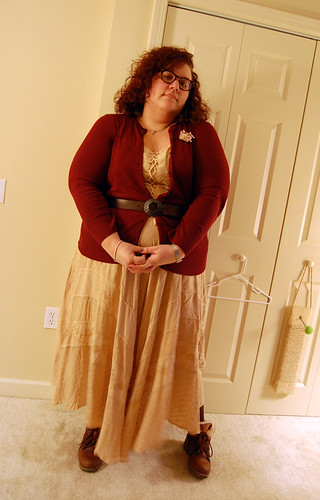
I’ve told and retold this story several times now, but here it goes again: The morning I wore this above, I shut my dress in the back of my dress in the car door. And drove that way for several miles, until a nice gentleman in another car alerted me to it. I wish I could say that it was a beautiful sunny day and my skirt merely flapped gaily in the breeze, but instead is was snowing/sleeting/icing and the exposed bit of skirt was dragged along the pavement and thus soaked and covered in black filth. Also it developed a sizeable hole.
When I hurt my clothes in some way, I tend to panic about it a little bit – particularly when it’s an item I can’t readily replace, like the above dress, which has been discontinued. My panic typically leads me to occasionally-elaborate improvisational remedies; for the dress above, this meant rinsing the dirt out in the bathroom at work (and dealing with a wet hem for hours) and then later, at home, very carefully hand-stitching the rip closed. If I had greater or more reliable access to clothes I like, I might have said, “Eh, I may be able to fix it, but if not, no big deal.” As it is, my mind went something like “OH MY FUCKING GOD, I HAVE TO FIX THIS NOW NOW NOW, I HAVE NO REASON TO BELIEVE I WILL EVER FIND A DRESS LIKE THIS AGAIN, EXCLAMATION POINT.”
This, my friends, is a side effect of living with style scarcity.
Because I really don’t have any reason to believe I’d find something like the dress in question ever again. Now, no longer being in possession of a particular dress is not exactly a hardship; certainly not on the level of not having a place to live or enough to eat. But the panic bubbles up anyway, because I can’t just run to Antropologie or H&M or whereever the ladies several sizes down from me do their shopping and pick up another. Fat style is a scarce resource. So I allow myself a little leeway in my admittedly-irrational terror when a garment I love goes wrong.
And either way, it’s an awesome dress that deserves better than to be dragged through frozen mud. Am I right?
 This is one of those things you don’t know you need until you find it: Ragtrader – an Etsy seller from whom I’ve purchased many lovely items, and who is also just fabulous about lengthening necklaces as needed for no additional charge – is currently offering necklaces made with vintage Miss Piggy cameos. Also, there are matching rings, if you want a coordinating set.
I’m not typically fond of kitschy jewelry – it’s just not my style – but even I have to admit these cameos are subtle enough to tickle my fancy. What better way to pay homage to one of the greatest fat icons in pop culture history?
Anyone who knows me well knows that Nina Simone ranks among my top three favorite musical artists ever in the history of human existence. Thus, in the spirit of both Martin Luther King Jr’s birthday, and the intersectional politics part of this blog, I submit for your consideration Simone’s beautiful tribute,: “Why? (The King of Love is Dead)”
1. It’s a shame you’re so underweight. You have such a pretty face!
2. Maybe if you just made a lifestyle change, you know, eating more fat and getting less exercise, you wouldn’t be so underweight.
3. I’m just concerned about your health. Being as underweight as you obviously are is dangerous.
4. There is a thinness epidemic going on! Everywhere you look, people are skinnier than they ever have been! Due to the current culture of obsessive dieting, our children are growing up undernourished!
5. You’re not thin! No, no. You’re just a little bit underweight.
6. I just prefer women/men who aren’t quite so underweight. It’s not my fault–evolution designed me to think this way.
7. It’s not just you who’se underweight–we could probably all stand to gain a few pounds. I know I could.
8. OMG, she was so underweight–she was like 120 pounds! Can you imagine? How awful!
9. You could be fatter; you’re just not trying hard enough, and that’s why you’re underweight.
10. You should see a doctor. Maybe there’s a medical reason you’re so underweight.
If a fat person approached an “average-sized” person and said these things–in other words, made comments that measured another person’s body by the standard applied to their own body–it would not be tolerated; and yet we fatties allow these kinds of comments to stand because we are so used to it that we don’t even think about it anymore.
How this came about: I was having a discussion the other night with my ex about using the word “overweight.” I’m not going to get into a lot of messy detail, but one of the reasons we split up was his lack of body positivity; immediately after we split, he started dieting and obsessing about being thinner. As a result of which, a fair number of our conversations now are about weight (him) and body positivity (me).
During the conversation, he said “overweight” a few times and finally I became exasperated and asked him not to use that term. He couldn’t understand my logic–isn’t “overweight” more polite, less offensive than calling someone “fat”?
In an effort to make him understand, I asked, “Would you refer to someone who is thinner than your particular standard of attractiveness as ‘underweight’?”
Well, of course not, was his reply.
I decided to write this post to show how ridiculous and offensive the statements people make so casually about our fat bodies can be. I originally had some funny ones in there, too–comments about shopping at the minus-sized store and reality shows called “The Biggest Gainer” or “90-Pound Weakling”–but in the end I decided not to use them, because I want this to be taken seriously.
Saying someone is “overweight” is like saying a short person is “undertall,” or a Caucasian person is “overpale.” The use of the prefix automatically implies that there is something missing, something in excess, something wrong.
Just so we’re clear: I am okay with being called fat, because I am, comparatively speaking, a fat person. I am a person on whose body there happens to be a substantial amount of fat. To acknowledge this is not an insult unless you say something insulting about it. Describing me to someone with whom you are setting me up on a blind date as “a cute fat blonde” is okay. It’s technically accurate and does not assign any value judgement to my weight.
It’s never okay to make dogmatic pronouncements about another person’s health, or even another person’s attractiveness, based on their appearance. Because you don’t know. You can’t.
Awhile back, SWAKdesigns popped up as a subject of conversation on the Fatshionista community over on LiveJournal, as a relatively new and heretofore unknown option for plus-size clothing. Lots of folks seemed happy with it, and honestly, I looked at the site once or twice and then stopped, because it seemed like the offerings in my size were sorely limited if not altogether nonexistent. So when the site contacted me recently, I sort of shrugged and almost didn’t go check them out again, since I remembered feeling frustrated the last time I was there.
Good news, though; in a climate where many plus-size shops are trimming back their extended sizes (I’m looking at you, Fashion Overdose and B & Lu), SWAKdesigns now has items that run from 1X all the way up to 6X! Considering the challenges in finding any kind of selection for extended sizes, particularly at affordable prices, this is fantastic news. Also, they’re kind enough to collect all their extended sizes on one page, here, instead of making fatter fats hunt around for the larger sizes, only to get their hopes up on an item and then to discover said garment only comes up to a small 2X. More than that, each item’s page has a size chart that gives item-specific measurements, from the standard bust-waist-hips to length and armhole circumference (a freaking godsend for those of us with arms and shoulders that make fitting sleeves a constant challenge).
The offerings at SWAKdesigns lean toward the most popular plus-size silhouettes – think lots of surplice-style tops – and the widely-beloved matte jersey. There’s a variety of stock basics (t-shirts, knit gauchos) and more overtly stylish offerings. If I have a criticism, it’s that their designs occasionally seem too varied and not particularly cohesive as a collected group. However, this sort of variety works for some folk just looking for comfortable garments that they also feel good in, so who am I to say.
For my part, I got to test out three of their dresses. I know, I know, it’s a tough job, but somebody’s got to do it.
 Dress the first was the Desi, in black, in a 4X. I was truly impressed by the quality of this garment – it’s cotton (plus!) and fully lined (with stretch poly jersey, but still) and the construction is impressive for the price. The bust runs a little small, and by this I mean the bust fits me and my smallish bosom with little room to spare. Or possibly it’s meant to be extra-cleavagey and I simply don’t have the cleavage to supply. Either way, I dig this vaguely boho, peasant-style dress a whole lot and it’ll definitely become an easy staple in my wardrobe, particularly in warmer weather, something on which I can rely on those mornings I just want to put on something comfortable that looks good without thinking about it too hard (as I am oft wont to do.) Frankly, this dress makes me stare bleakly out at the frozen heaps of old snow outside my windows and wish I had a beach vacation coming up. It’s that kind of dress. The kind you want to wear stretched out in the sun with an alcohol-laden frozen drink in your hand.
 Dress the second was the Leona. I chose this dress sort of on a whim, and to see what their jersey garments were like, even though it’s not really my personal style (though I do know someone whose style it totally fits, nudge nudge). I was mostly seduced by the colors of the stylized floral print. The Leona is a pretty standard print-jersey dress, on a par with what you’d find at your local Torrid. The fabric is lightweight and forgiving, as jersey is, and the fit is right where I’d expect a 4X to be – I had worried a little that SWAK’s stuff might be fakeout junior plus sizes, but this is totally not the case. In my experience with all of these garments, a 4X is a 4X, and that’s that, though if you’re shopping with them I’d still encourage you to check the size chart to be sure (if you don’t know your measurements, measure a favorite garment around the bust, waist, and hips to get an idea of how much room you need). All in all, the Leona is a cute dress that has one of those cuts that’s flattering across a wide variety of body shpes.
 Dress the third was the Alicia. First, I have to give a little backstory here: back in the days of The Old Torrid, in the pre-pinkening, they had a really ridiculously popular Dickies shirtdress. As I recall, I believe it was called the “Nurse Betty” dress, even though that would make no sense because it was only available in red and black, which are not generally colors nurses are known to wear. But whatever. I digress. Once Torrid sold out, they went for insane prices on eBay for a year after. I had one of these coveted dresses in black – I actually still have it. It is, frankly, a near-perfect stretch-cotton poplin shirtdress. Mine was getting a little faded, however, after years of wears and washes, but I couldn’t give a thought to retiring it. That is, until recently, when I was running into the stairwell at work (I take the stairs a million times a day not to Be Healthy, incidentally, but because I am way too impatient to wait for the elevator) and somehow my dress caught on the door handle and… rip. I mean RRRIP. EPIC RIP. I had to pin the thing closed from the waist down for the rest of the day (yes, ultra-professional, I know). I was crushed! Disproportionately so, because y’all, I’d had that dress forEVER and I’d never seen another quite like it – a simple, straightforward, a-line, above-the-knee-length, fat-girl-fitting shirtdress.
Enter the Alicia dress pictured to your left, there.
This is basically THE SAME DRESS. On SWAKdesigns’ version, the skirt flares a tich more (not a bad thing) and there’s also a tie belt (which I can take or leave), and the SWAK dress is a slightly thicker fabric (a VERY good thing), but it’s essentially the same dress. I was ridiculously gratified to find this dress. My only complaint is that A) it doesn’t go up to 6X so fatter fats can also enjoy it and B) it doesn’t come in a million colors, because I would totally buy this dress in a million colors and wear it all the damn time. I’ve written here before about my troubles finding simple cotton shirtdresses and so this is an excellent find for me.
Of course, these dresses will inevitably find their way into Outfitblogging posts, so you’ll see them in real-life action on me before long and you can judge for yourself.
When I first got the request from SWAKdesigns to check out their offerings with the idea of writing a post about it, I was sort of worried: What if I hate everything? But I can honestly say that overall I have been pleasantly surprised by my SWAKdesigns experience, particularly by their variety of sizes and plentiful real-measurement info on each garment. I’d love to see them venture out into more dramatic and edgy territory, style-wise, but having a good source for the basics can’t be understated, especially when so many of the items in question go up to a 6X. Did I mention that they have free shipping on all US orders?
If you’ve had an experience, good or bad, with SWAKdesigns, please do share it in comments.
I’m totally going to go hug my Alicia dress now.
Hey, you – do you have a plus-size retail business? Would you like your shop profiled in a feature review on this obnoxious, politicized, occasionally profanity-strewn blog? If you answered yes to both these questions, by all means contact me at lesley@fatshionista.com, or using the contact form on this site, and let’s chat about it.
 Two Whole Cakes is a blog written by